 Arabic
| Key Takeaways |
| Arabic basics cover five pillars: the alphabet, pronunciation, vocabulary, grammar, and writing — all taught in a structured sequence. |
| The Arabic alphabet has 28 letters, each with up to four written forms depending on its position within a word. |
| Modern Standard Arabic (MSA) is the recommended starting point for beginners, as it is understood across all Arabic-speaking countries. |
| Basic Arabic grammar begins with noun-adjective agreement, gender (masculine/feminine), and simple sentence structure before moving to verb conjugation. |
Every year, thousands of English speakers decide they want to learn Arabic — and within days, many feel lost, unsure where to begin or what “Arabic basics” even means in practice.
The basics of Arabic consist of five foundational pillars: the alphabet, pronunciation, core vocabulary, fundamental grammar, and reading and writing skills. Mastering these in sequence gives every beginner a stable, progressive path from zero to confident communication.
Table of Contents:
What Is the Basis of the Arabic Language?
The basis of the Arabic language is its root system — a pattern where most words derive from three-letter (trilateral) roots that carry a core meaning. From the root ك-ت-ب (k-t-b), meaning “writing,” Arabic produces كَتَبَ (kataba, “he wrote”), كِتَاب (kitāb, “book”), كَاتِب (kātib, “writer”), and مَكْتَبَة (maktaba, “library”). Understanding this principle early changes how quickly a beginner builds vocabulary.
Arabic belongs to the Semitic language family and is one of the most widely spoken languages in the world, with over 310 million native speakers across 22 countries. It is the liturgical language of the Quran and the official language of the Arab League.
At Buruj Academy, our Al-Azhar-certified Arabic instructors teach students this root-pattern logic from the very first lesson in our Arabic for Beginners course, because it removes the feeling that Arabic vocabulary is random and disconnected.
Modern Standard Arabic (MSA) — known in Arabic as الفصحى (Al-Fuṣḥā) — is the standardized, written, and formal form used in news, literature, and formal speech. It is universally understood and the recommended starting point for any learner.
Our beginner’s guide to Modern Standard Arabic explains in detail why MSA gives beginners the most transferable foundation.
Begin learning Arabic at Buruj with a FREE trial lesson

What Should I Learn First in Arabic?
The first thing to learn in Arabic is the alphabet — specifically, letter shapes and their sounds — before touching vocabulary or grammar.
Attempting to memorize words without knowing letters forces learners to rely on transliteration, which creates pronunciation habits that are difficult to correct later.
Here is the sequence we recommend at Buruj Academy for absolute beginners:
| Priority | Skill | Why First |
| 1 | Arabic alphabet (letters + sounds) | Everything else depends on it |
| 2 | Short vowel markers (Harakat) | Makes pronunciation readable |
| 3 | Core vocabulary (100–200 words) | Gives meaning to grammar rules |
| 4 | Basic grammar (gender, sentence structure) | Builds correct sentence patterns |
| 5 | Reading and writing practice | Reinforces all previous skills |
In our sessions at Buruj Academy, students who try to skip the alphabet and start with vocabulary almost always plateau within three weeks.
Those who master letters first — even spending a full week on them — progress significantly faster once grammar begins. Our article on how to learn Arabic for beginners walks through exactly why this sequence works.
1. Start with the Alphabet to Learn Arabic from Scratch
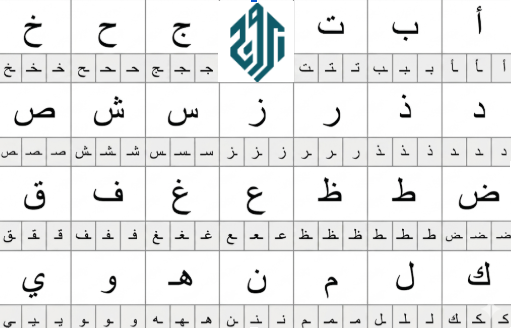
Learning Arabic from scratch begins with the 28-letter Arabic alphabet, reading from right to left. Each letter represents a consonant sound, and most letters change shape depending on whether they appear at the beginning, middle, or end of a word — or in isolation. This positional variation is the first technical challenge every new learner faces.
What Are the Four Positional Forms of Arabic Letters?
Each Arabic letter has up to four forms: isolated, initial (beginning of word), medial (middle of word), and final (end of word).
For example, the letter ب (bā’) appears as ب in isolation, بـ at the start, ـبـ in the middle, and ـب at the end. Most letters connect to the one following them, which is why Arabic appears as flowing, connected script.
What Are the Arabic Short Vowels (Harakat)?
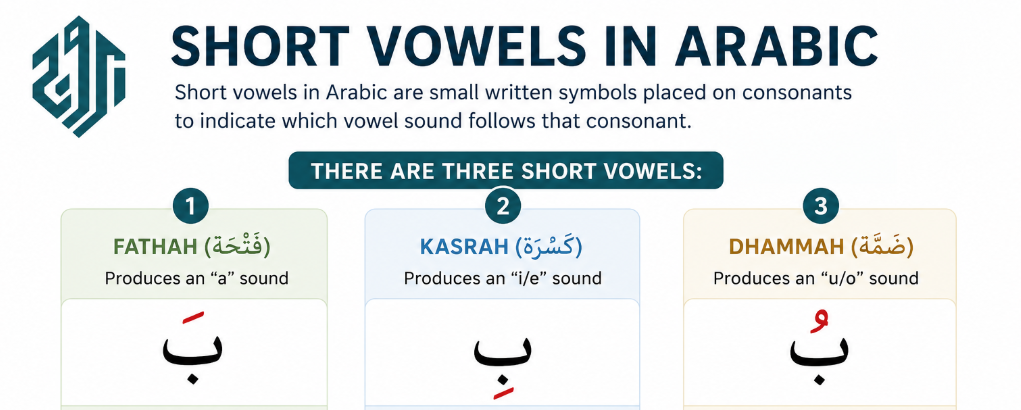
Arabic uses three short vowel markers written above or below letters:
| Vowel Marker | Name | Sound |
| َ (above) | Fatha | Short “a” — as in “bat” |
| ِ (below) | Kasra | Short “i” — as in “bit” |
| ُ (above) | Damma | Short “u” — as in “put” |
| ْ (above) | Sukoon | No vowel — consonant only |
Beginners must learn these markers before attempting to read any Arabic text independently. Our detailed guide on Arabic vowels covers all vowel types — short, long, and tanwin — with practical examples.
For younger learners starting from scratch, our Arabic Alphabet Learning Course uses visual and auditory methods specifically designed for non-native speakers building letter recognition from zero.
Get a free trial now in Buruj’s Alphabet course
2. Learn Basic Arabic Words and Phrases
Basic Arabic words and phrases fall into six high-frequency categories: greetings, numbers, family terms, everyday objects, time expressions, and question words.
Beginning with these categories gives learners functional communication ability fast, while also providing natural repetition of core grammar patterns.
A. What Are Some Basic Words in Arabic?
| Arabic | Transliteration | English | Category |
| بَيْت | Bayt | House | Place |
| مَاء | Māʾ | Water | Food/Drink |
| طَعَام | Ṭaʿām | Food | Food/Drink |
| كِتَاب | Kitāb | Book | Object |
| مُعَلِّم | Muʿallim | Teacher | Person |
| يَوْم | Yawm | Day | Time |
| نَعَمْ / لَا | Naʿam / Lā | Yes / No | Function |
| أَنَا | Anā | I / Me | Pronoun |
Read also: Learn Arabic at the Intermediate Level
B. What Are Some Basic Phrases in Arabic?
| Arabic | Transliteration | English |
| مَرْحَبًا | Marḥaban | Hello |
| كَيْفَ حَالُكَ؟ | Kayfa ḥāluk? | How are you? |
| بِخَيْرٍ، شُكْرًا | Bikhayrin, shukran | Fine, thank you |
| مِنْ فَضْلِكَ | Min faḍlik | Please |
| مَعَ السَّلَامَة | Ma’a as-salāma | Goodbye |
| لَا أَفْهَمُ | Lā afham | I don’t understand |
| هَلْ تَتَكَلَّمُ الْإِنْجِلِيزِيَّةَ؟ | Hal tatakallam al-injilīziyya? | Do you speak English? |
| أَيْنَ…؟ | Ayna…? | Where is…? |
Question words deserve specific attention early: أَيْنَ (ayna — where), مَتَى (matā — when), مَنْ (man — who), مَاذَا (mādhā — what), كَيْفَ (kayfa — how), and لِمَاذَا (limādhā — why). These seven words unlock the ability to form questions across any topic.
For vocabulary-building strategies beyond the basics, our article on mastering Arabic vocabulary provides tested techniques for retention and recall that our instructors recommend to every beginner.
3. Learn Basic Arabic Grammar
Basic Arabic grammar begins with three foundational concepts: grammatical gender, the structure of nominal sentences, and how nouns and adjectives agree. These three elements appear in almost every Arabic sentence, so understanding them early gives learners an enormous advantage.
A. Masculine and Feminine in Arabic
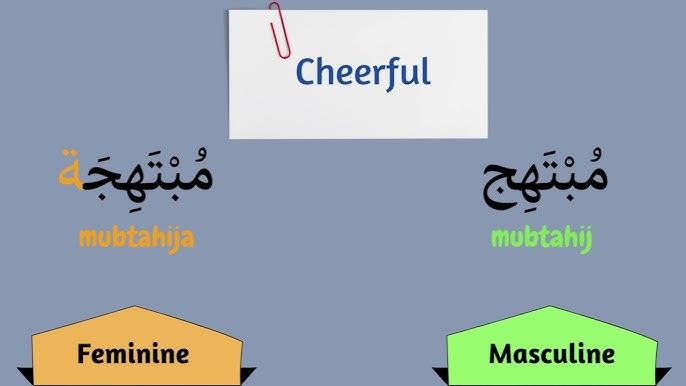
Every Arabic noun is either masculine or feminine — there is no neutral gender. Feminine nouns typically end in ة (tā’ marbūta), though exceptions exist. The adjective describing a noun must match its gender.
So “a new book” is كِتَابٌ جَدِيدٌ (kitābun jadīdun — masculine), while “a new car” is سَيَّارَةٌ جَدِيدَةٌ (sayyāratun jadīdatun — feminine).
Our article on masculine and feminine nouns in Arabic covers this in detail, including the common exception nouns every beginner needs to memorize.
Discover the Buruj Academy Difference
Step into our virtual classrooms and see how our expert instructors make learning Quran and Arabic intuitive and clear. We focus on overcoming the specific hurdles non-native speakers face, building your confidence and connection with the Quran.
Master the Arabic Language
Join our expert-led courses and build a strong foundation in Classical and Modern Arabic.
Get Your Free TrialB. Arabic Sentence Structure for Beginners
Arabic has two primary sentence types. A nominal sentence (الجملة الاسمية, al-jumla al-ismiyya) begins with a noun and does not require a verb in the present tense.
“The teacher is present” is المُعَلِّمُ حَاضِرٌ — literally “the teacher present” without any form of “is.” A verbal sentence (الجملة الفعلية, al-jumla al-fi’liyya) begins with a verb.
This is one of the points where our instructors see English speakers struggle most. Because English always requires a verb in every sentence, beginners instinctively search for one — and feel disoriented when it’s absent.
Understanding that Arabic nominal sentences are grammatically complete without a verb is a moment of genuine clarity for most of our students.
Our article on Arabic sentence structure breaks both sentence types down with clear, mapped examples. For students who want a full systematic treatment, our Arabic Grammar Course covers MSA grammar from foundational to advanced levels with Al-Azhar-trained instructors.
Understand the Arabic Grammar with Buruj’s free trial lesson
C. Arabic Verb Tenses at the Beginner Level
Arabic has three main tenses. At the beginner stage, the focus should be on the past tense (الماضي, al-māḍī) and present tense (المضارع, al-muḍāri’) before introducing the future.
Our articles on Arabic tenses, Arabic past tense, and the Arabic present tense each address one tense in depth, making them useful companions at the relevant stage of study.
4. Learn Basic Arabic Writing
Learning basic Arabic writing requires mastering letter connection rules, correct stroke direction, and the difference between print and handwritten script. Arabic is always written from right to left, and letters within a word flow into one another — a visual feature that takes deliberate practice to internalize.

The most effective method we use in Buruj Academy’s Learn Arabic Writing Course is letter-family grouping. Letters that share the same base shape — such as ب، ت، ث or ج، ح، خ — are taught together, reducing the cognitive load of learning 28 distinct forms.
A beginner who groups letters visually typically needs 40–50% less revision time than one who learns them in alphabetical order.
Dictation is another underused but highly effective writing tool. Our article on improving Arabic writing with dictation explains exactly how to use this technique, even at the beginner stage, to build both spelling accuracy and sound-letter connections simultaneously.
One technical point beginners consistently miss: the ة (tā’ marbūta) is written only at the end of words and is pronounced differently depending on whether the word is paused on or continues in speech. Getting this right early prevents a deeply ingrained error.
Book your free trial to start writing Arabic
How to Learn Basic Arabic Effectively as a Beginner?
Learning basic Arabic effectively as a beginner requires three commitments: consistent daily sessions (20–30 minutes beats two-hour weekly blocks), immediate use of new vocabulary in simple sentence patterns, and a qualified instructor who corrects errors before they solidify into habits.
The biggest mistake we observe in self-study learners is spending weeks on passive input — reading grammar explanations and watching videos — without producing any Arabic themselves.
Active recall, speaking, and writing are non-negotiable for retention. Our article on how to learn Arabic grammar easily outlines the active-learning approach our instructors use with beginners from the first session.
Pronunciation deserves special attention early. Arabic contains sounds that do not exist in English — particularly the emphatic consonants ص، ض، ط، ظ and the pharyngeal sounds ع and ح. Our Arabic pronunciation guide addresses these specifically for English speakers. Mispronunciation of these sounds changes word meanings entirely, so early correction from a trained instructor is worth more than months of self-study.
Buruj Academy’s Arabic Speaking Course is designed precisely for this stage — giving beginners structured conversation practice with real-time feedback from Al-Azhar-trained instructors, eliminating the hesitation that holds most learners back.
Book your free trial to start speaking Arabic fluently

Read also: Arabic Language Levels
Start Learning Arabic Basics with Buruj Academy’s Expert Instructors
Arabic basics are learnable at any age — with the right sequence and the right guidance. Buruj Academy offers personalized Online Arabic Classes taught by Al-Azhar University graduates with 12+ years of experience teaching non-native speakers across the globe.
Every student receives a customized learning plan built around their level, schedule, and goals — whether that’s conversational MSA, reading fluency, or grammar mastery.
Our 1-on-1 online sessions offer 24/7 flexible scheduling, real-time pronunciation correction, and the proven Buruj Method: Context-before-abstraction, meaning you build real understanding before abstract rules.
Book your free trial lesson today and take your first structured step toward Arabic fluency.
Begin your transformation today by choosing the path that fits your goals:
- Online Arabic Classes (General & Comprehensive)
- Arabic Course for Beginners
- Arabic Alphabet Learning Course
- Online Arabic Classes for Kids
- Arabic Classes for Adults
- Arabic Grammar Course (Nahw & Sarf)
- Intermediate Arabic Course (B1/B2)
- Arabic Speaking Course (Conversational Fluency)
- Arabic Reading Course (Literary Excellence)
- Learn Arabic Writing Course (Calligraphy & Composition)
Ready to speak with confidence? Join the global community at Buruj Academy and book your free placement interview today!
Master the Arabic Language
Join our expert-led courses and build a strong foundation in Classical and Modern Arabic.
Get Your Free TrialConclusion
Arabic basics are not an obstacle — they are a gateway. The five-pillar sequence of alphabet, pronunciation, vocabulary, grammar, and writing gives every beginner a clear and logical path forward.
What makes the difference is not talent but structure: learning skills in the right order, practicing actively every day, and getting real-time correction before errors become habits. Insha’Allah, with consistent effort and qualified guidance, fluency is genuinely within reach for any motivated learner.
Frequently Asked Questions About Arabic Basics
What Are the Basics of Arabic for a Complete Beginner?
The basics of Arabic for a complete beginner are: the 28-letter alphabet and its positional forms, short vowel markers (harakat), 100–200 high-frequency vocabulary words, foundational grammar (gender, nominal sentence structure), and right-to-left writing mechanics. Mastering these five areas in sequence gives every beginner a functional working foundation in Modern Standard Arabic.
How Long Does It Take to Learn Basic Arabic?
Most adult beginners with no prior exposure reach basic Arabic functionality — reading short texts, forming simple sentences, and holding brief conversations — within three to six months of consistent daily practice (20–30 minutes per day). In our instructors’ experience, students who combine daily independent practice with weekly 1-on-1 instruction progress roughly twice as fast as self-study learners alone.
What Is the Difference Between Modern Standard Arabic and Colloquial Arabic?
Modern Standard Arabic (MSA) is the formal, written, and universally understood form — used in books, news, formal speech, and the Quran. Colloquial Arabic refers to regional spoken dialects (Egyptian, Levantine, Gulf, etc.) that vary significantly across countries. Beginners are strongly advised to start with MSA, as it provides a transferable foundation that makes any dialect easier to learn afterward.
Should I Learn Arabic Alphabet Before Vocabulary?
Yes — always learn the Arabic alphabet before vocabulary. Attempting to memorize words using transliteration builds incorrect pronunciation patterns and prevents independent reading. Spending one to two weeks fully mastering letter shapes and their sounds before moving to vocabulary produces faster and more durable results at every subsequent stage of learning.
Related Articles
Arabic