 Arabic
| Key Takeaways |
| Arabic script is written right to left, using 28 letters that change shape depending on their position in a word. |
| Most Arabic letters connect to both neighboring letters, but six letters only connect to the letter before them, never after. |
| Every Arabic letter has four forms: isolated, initial, medial, and final — mastering these forms is the core writing challenge. |
| Short vowels in Arabic are written as diacritical marks above or below letters, not as separate letters in standard script. |
| Consistent daily practice of 15–20 minutes, focusing on one letter group at a time, produces measurable progress within weeks. |
Learning to write in Arabic feels like a genuine fresh start — a new direction on the page, a new alphabet, a new way of seeing language itself. For non-Arabic speakers, that novelty is both exciting and, honestly, a little daunting.
The good news is that Arabic writing is far more logical and systematic than it first appears. Once you understand how Arabic letters connect, how their shapes shift by position, and how the script flows from right to left, the pieces come together faster than most beginners expect.
Table of Contents:
Step 1: Understand How the Arabic Script Works Before Touching a Pen
Arabic writing follows three foundational rules that every beginner must internalize before practicing letters. First, Arabic is written and read from right to left — this reversal affects not just individual words but the entire layout of a page, a line, even a paragraph.
Second, the script is cursive by nature, meaning most letters connect directly to their neighbors within a word.
Third, Arabic has 28 letters, each of which can take up to four different shapes depending on where it appears in a word.
These three principles explain most of what feels strange to English speakers at first glance.
Why Does Arabic Script Look So Different From Letter to Letter?
Each Arabic letter has four positional forms: isolated (standing alone), initial (at the start of a word), medial (in the middle), and final (at the end). The core shape of each letter stays recognizable across all four forms — usually a distinctive curve or angle — but the connecting strokes change.
| Position | Arabic Example | When It Appears |
| Isolated | ب | Letter stands alone |
| Initial | بروج | Letter begins a word |
| Medial | صبر | Letter sits between two others |
| Final | قلب | Letter ends a word |
Another example is the letter ع (Ayn) looks like this across its four forms: ع / عـ / ـعـ / ـع. The “eye” shape is always present, but the connecting strokes shift.
Recognizing this core shape pattern is what we encourage every student in our Arabic Writing Course to focus on first, before worrying about speed or fluency.
Book your free trial to start writing Arabic
Step 2: Learn to Write the Six Non-Connecting Arabic Letters First
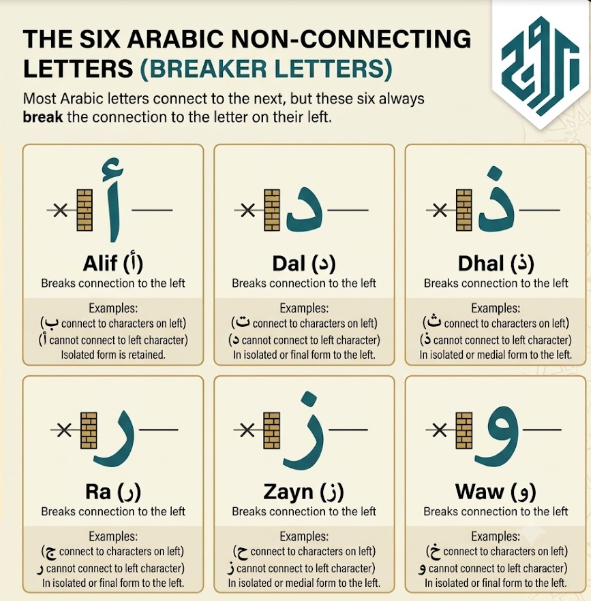
Six Arabic letters do not connect to the letter that follows them. These are: أ (Alif), د (Dal), ذ (Dhal), ر (Ra), ز (Zayn), و (Waw). Every other letter connects on both sides.
Understanding these six letters early prevents a confusion that trips up nearly every beginner we teach: seeing a “gap” inside a word and thinking it must be a space between two separate words. It is not. It is simply one of these six non-connecting letters, followed by the next letter.
Practical Exercise: Spot the Non-Connected Arabic Letters
Look at the word دَرَسَ (darasa — “he studied”). Notice the gap after the د. This is a single connected word, not two. Practice reading these words and identifying which non-connector creates the gap:
| Word | Meaning | Non-Connector Present |
| دَرَسَ | He studied | د (Dal) |
| زَارَ | He visited | ز (Zayn) |
| وَلَدٌ | A boy | و (Waw) |
| أَكَلَ | He ate | أ (Alif) |
Write each word three times, pausing deliberately at each non-connector to reinforce the habit.
Read also:Why Arabic Is Written from Right to Left
Step 3: Group the 28 Arabic Letters by Shape Family to Write Them Faster
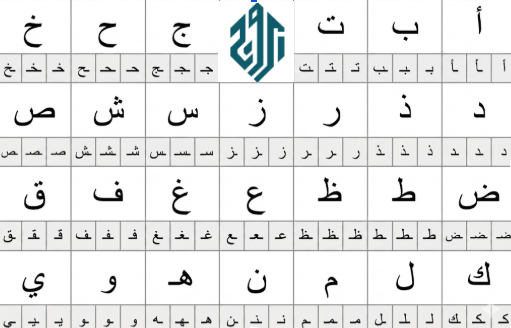
Arabic’s 28 letters are not 28 entirely different shapes. Many letters share the same base form and are distinguished only by the number and placement of dots.
Grouping letters by their shared skeleton — what Arabic teachers call the رَسْم (rasm) — cuts the learning curve significantly.
In our experience at Buruj Academy, students who learn letters in shape families typically master letter recognition in half the time compared to those who learn them in alphabetical order. This is one of the core insights behind how we structure our Arabic Alphabet Learning Course.
Get a free trial now in Buruj’s Alphabet course
The Major Arabic Letter Shape Families
| Base Shape | Letters in This Family | Distinguishing Feature |
| ب form | ب / ت / ث / ن | Dots: 1 below, 2 above, 3 above, 1 above |
| ج form | ج / ح / خ | Dots: 1 below, none, 1 above |
| د form | د / ذ | Dots: none, 1 above |
| ر form | ر / ز | Dots: none, 1 above |
| س form | س / ش | Dots: none, 3 above |
| ع form | ع / غ | Dots: none, 1 above |
| ف form | ف / ق | Dots: 1 above, 2 above |
Practice Exercise: Write Each Family Three Times
Take the ب family first. Write ب five times in isolation, then five times at the start of a word (e.g., بَيْت — bayt — “house”), then five times in the middle (e.g., كَبِير — kabeer — “big”), then five times at the end (e.g., قلب — Qalb — “heart”).
Repeat this for each letter in the family before moving to the next group.
Step 4: Master the Dots in the Arabic Letters
Dots in Arabic are not decorative. They are meaning-changing. Swapping or misplacing a dot turns one word into a completely different one. The letter ب (ba — “B” sound) and ت (ta — “T” sound) share an identical base. One dot below gives you ب. Two dots above give you ت. Three dots above give you ث (tha).
This level of precision matters enormously in writing. A student who writes carelessly and misplaces a dot is not just making a spelling error — they may be writing an entirely different word.
Read also: Arabic Calligraphy Styles
Minimal Pair Exercise: Dots Change Meaning
Practice writing these minimal pairs, focusing entirely on dot placement:
| Word 1 | Meaning | Word 2 | Meaning | What Changed |
| بَاب | Door | تَاب | He repented | ب → ت (dot position) |
| جَدَّ | He worked hard | حَدَّ | He limited | ج → ح (dot removed) |
| سَارَ | He walked | شَارَ | He consulted | س → ش (dots added) |
| فَارَ | It boiled | قَارَ | Tar | ف → ق (dots changed) |
Write each pair five times side by side. Say the word aloud as you write it to train both hand and ear simultaneously.
Discover the Buruj Academy Difference
Step into our virtual classrooms and see how our expert instructors make learning Quran and Arabic intuitive and clear. We focus on overcoming the specific hurdles non-native speakers face, building your confidence and connection with the Quran.
Master the Arabic Language
Join our expert-led courses and build a strong foundation in Classical and Modern Arabic.
Get Your Free TrialStep 5: Learn Arabic Vowel Marks to Write Arabic Words Fully
Standard Arabic writing — especially in educational texts, children’s books, and the Quran — uses tashkeel (تَشْكِيل): small diacritical marks written above or below letters to indicate short vowels.
In everyday adult Arabic writing, these marks are often omitted, and readers infer vowels from context.
As a beginner learning how to write in Arabic for beginners, understanding tashkeel gives you the ability to write any word with complete phonetic clarity.
This is essential at the early stages, because it trains your eye and hand to understand the vowel structure of every word you write.
For a deeper look at how vowels function in the Arabic writing system, our article on vowels in Arabic explains each mark in detail with examples.
The Three Core Short Vowel Marks in Arabic
| Mark | Name | Sound | Example | Transliteration |
| َ (above) | Fatha | “a” as in “cat” | كَتَبَ | kataba |
| ِ (below) | Kasra | “i” as in “bit” | كِتَاب | kitab |
| ُ (above) | Damma | “u” as in “put” | كُتُب | kutub |
There are also sukoon (ْ) — indicating no vowel on a letter — and shadda (ّ) — indicating a doubled consonant.
Practice writing each mark above and below the letter ك ten times before moving on to full words.
Arabic Writing Exercise with Tashkeel
Write the word كَتَبَ (he wrote) five times with full tashkeel. Then write كِتَابٌ (a book) five times. Then write كَاتِبٌ (a writer) five times.
Notice how the same root letters ك-ت-ب carry different meanings depending on the vowel pattern — a feature called the Arabic root system, which is one of the most elegant aspects of the language.
Read also:Different Styles of Arabic Calligraphy
Step 6: Practice Writing Arabic Words Using the Root System
Arabic vocabulary is built on three-letter roots (جُذُور ثُلَاثِيَّة). Once you learn a root, you can recognize and write dozens of related words by applying different vowel and consonant patterns around it.
This is one of the most efficient aspects of Arabic writing — and one that non-native learners often overlook entirely.
Take the root د-ر-س (d-r-s), which carries the concept of studying:
| Word | Meaning | Pattern Applied |
| دَرَسَ | He studied | Verb, past tense |
| يَدْرُسُ | He studies | Verb, present tense |
| دَرْسٌ | A lesson | Verbal noun (basic) |
| دِرَاسَةٌ | Study / studying | Verbal noun (extended) |
| مَدْرَسَةٌ | School | Place noun |
| دَارِسٌ | A student/scholar | Active participle |
Writing these families together is far more efficient than learning each word in isolation. If you are curious about how Arabic tense and verb structure work alongside this root system, our guide to Arabic tenses gives a clear breakdown for beginners.
Arabic Root Practice Exercise
Take the root ك-ت-ب (k-t-b — related to writing) and try writing: كَتَبَ (he wrote), يَكْتُبُ (he writes), كِتَابٌ (book), مَكْتَبٌ (desk/office), كَاتِبٌ (writer). Write each word five times, saying it aloud as you write.
Step 7: Write Complete Arabic Sentences Using Correct Word Order
Once you can write individual words, the next step is writing sentences. Arabic sentence structure differs from English in one fundamental way: the most common sentence structure in Modern Standard Arabic places the verb before the subject (Verb-Subject-Object), though Subject-Verb-Object order also exists and is especially common in spoken Arabic and modern writing.
Understanding this structure helps you write grammatically correct Arabic sentences from the start, rather than translating word-for-word from English and producing unnatural Arabic. Our detailed article on Arabic sentence structure for beginners walks through this with many examples.
Sentence Writing Exercise: Start Simple
Begin with short nominal sentences (جُمَل اسْمِيَّة — sentences with no verb, equating two nouns or a noun and adjective):
| Arabic Sentence | Transliteration | Meaning |
| الطَّالِبُ مُجْتَهِدٌ | Al-tālibu mujtahidun | The student is hardworking |
| الْبَيْتُ كَبِيرٌ | Al-baytu kabīrun | The house is big |
| الْكِتَابُ مُفِيدٌ | Al-kitābu mufīdun | The book is useful |
Write each sentence five times. Then practice adding a verb: ذَهَبَ الطَّالِبُ إِلَى الْمَدْرَسَةِ (The student went to school). Notice the verb ذَهَبَ comes first.
Buruj Academy’s Online Arabic Classes use this context-first approach from the very first session — students write real sentences in lesson one, not just isolated letters. The method works because meaningful context accelerates retention of both vocabulary and script.
Book your FREE Arabic trial online Arabic class at Buruj

Step 8: Build a Daily Arabic Writing Habit That Actually Produces Progress
Consistent short sessions outperform long irregular ones — every time. In our instructors’ experience at Buruj Academy, students who practice Arabic writing for 15–20 minutes daily for 30 days consistently outperform those who study for two hours on weekends.
The script requires muscle memory, and muscle memory is built through repetition spread across time.
A structured daily practice plan for beginners learning how to write in Arabic letters looks like this:
| Week | Focus Area | Daily Practice Activity |
| Week 1 | Letter families + isolated forms | Write each letter in a family 10 times |
| Week 2 | Four positional forms | Write 5 words per letter in all four positions |
| Week 3 | Dots + tashkeel | Write 10 words with full vowel marks |
| Week 4 | Words + basic sentences | Write 3 sentences daily from memory |
After Week 4, most students can write any given Arabic word if they know its sounds — which is the real milestone for beginner Arabic writing.
Read also: Arabic Connecting Letters
One Practical Technique: Arabic Dictation
Dictation (إِمْلَاء) is one of the most powerful tools for cementing Arabic writing. Listen to a simple Arabic sentence, pause the audio, and write it. Then check it.
This trains your ear-to-hand connection, which is exactly the skill you need for real-world Arabic writing. Our article on improving Arabic writing with dictation covers the technique in full practical detail.
How to Write Arabic in Arabic?
One of the most satisfying early milestones is being able to write Arabic in Arabic — that is, writing the word “Arabic” itself in its own script: عَرَبِيٌّ (arabiyyun — “Arabic” as an adjective) or الْعَرَبِيَّة (al-arabiyyah — “the Arabic language”).
Breaking this down shows how the system works in practice. The letters are ع-ر-ب-ي-ة. Written right to left: ع connects forward to ر, but ر is one of the six non-connectors, so it does not connect forward to ب. Then ب connects forward to ي, and ي connects forward to ة (Ta Marbuta — a special feminine ending).
This single word exercises non-connector rules, positional forms, and the Ta Marbuta ending — making it an excellent practice word for beginners. Write it ten times, identifying each letter by name as you write it.
For a structured approach to learning the full alphabet with visual aids, our guide to learning the Arabic alphabet is a practical next step alongside daily writing practice.
Master Arabic Writing with Buruj Academy’s Expert Instructors
Learning to write in Arabic is one of the most rewarding skills a Muslim can develop — and it becomes far more achievable with structured, expert-guided practice.
Buruj Academy’s Learn Arabic Writing Course is taught by Al-Azhar University graduates with 12+ years of experience teaching non-Arabic speakers worldwide.
Our instructors use the Buruj Method — context-before-abstraction, consistency-before-speed — to build genuine script fluency from day one.
Every student receives a personalized 1-on-1 learning plan, flexible scheduling, and real-time writing correction from qualified Arabic language specialists.
Progress is measurable, paced appropriately, and built on proven pedagogy.
Book your free trial lesson today and write your first Arabic sentence by the end of your first session.
Begin your transformation today by choosing the path that fits your goals:
- Online Arabic Classes (General & Comprehensive)
- Arabic Course for Beginners
- Arabic Alphabet Learning Course
- Online Arabic Classes for Kids
- Arabic Classes for Adults
- Arabic Grammar Course (Nahw & Sarf)
- Intermediate Arabic Course (B1/B2)
- Arabic Speaking Course (Conversational Fluency)
- Arabic Reading Course (Literary Excellence)
- Learn Arabic Writing Course (Calligraphy & Composition)
Ready to speak with confidence? Join the global community at Buruj Academy and book your free placement interview today!
Master the Arabic Language
Join our expert-led courses and build a strong foundation in Classical and Modern Arabic.
Get Your Free TrialConclusion
Arabic writing is a skill built in layers — direction, letter shapes, positional forms, dots, vowel marks, and finally full sentences. Each layer is learnable, and each one builds on the last. The students who make the fastest progress are not necessarily the most talented; they are the ones who practice consistently, learn letters in shape families, and write real words from the very first day.
With the right structure and daily commitment, reading your own Arabic handwriting — and understanding it — is not a distant goal. It is a few focused weeks away.
Frequently Asked Questions About How to Write in Arabic
How Long Does It Take a Complete Beginner to Learn How to Write in Arabic?
Most complete beginners can write all 28 Arabic letters in their isolated forms within two to three weeks of daily 15–20 minute practice. Writing words fluently — with correct positional forms and dots — typically takes six to eight weeks of consistent practice. Writing simple sentences from memory usually follows within two to three months of structured study.
Is It Possible to Learn How to Write Arabic Letters Without Learning to Read First?
Writing and reading Arabic reinforce each other so strongly that separating them is generally counterproductive. Most effective methods teach both simultaneously — you write a letter, you say its sound, you recognize it in a word. Attempting to write Arabic without learning to read it creates gaps in understanding that become harder to fix later in the learning process.
What Is the Correct Way to Hold a Pen for Writing Arabic?
Arabic calligraphy traditionally uses a reed pen held at a specific angle, but for modern Arabic writing, a standard pen or pencil held naturally is perfectly acceptable. The important habit is writing from right to left without lifting the pen unnecessarily within a connected word. Beginners should write slowly and deliberately, prioritizing shape accuracy over speed.
How to Write in Arabic for Beginners Without Making Common Mistakes?
The three most common beginner mistakes are: forgetting to write right to left, misplacing or omitting dots, and using the wrong positional form of a letter. The most effective fix for all three is writing words in complete context — never in isolation — from the very first practice session. Always write a letter within a real word, not just as a standalone shape.
Does Modern Standard Arabic Writing Differ From Everyday Written Arabic?
Modern Standard Arabic (MSA) uses the same script as all written Arabic forms. The difference lies in vocabulary, grammar complexity, and formality — not in the letters themselves. Everyday written Arabic in texts and social media sometimes uses colloquial spellings or omits vowel marks entirely, but the underlying script is identical. Beginners should start with MSA to build a solid, transferable writing foundation.