 Arabic
| Key Takeaways |
| Arabic has 22 connecting letters that join to both neighboring letters and 6 non-connecting letters that only join to the right. |
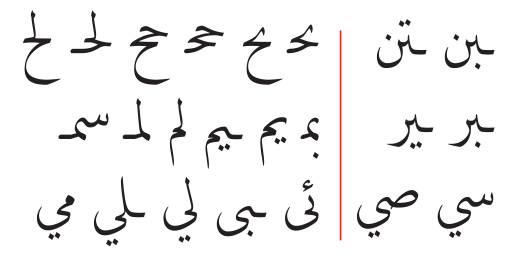
| Every Arabic letter has up to four forms — isolated, initial, medial, and final — determined entirely by its position within the word. |
| The six non-connecting letters (ا، د، ذ، ر، ز، و) always end a visual cluster, forcing the next letter to begin a new segment. |
| Recognizing letter forms by their shared skeleton (like the tooth shape of ب، ت، ث) accelerates reading and handwriting speed dramatically. |
| Consistent daily tracing of connected letter clusters — not isolated letters — is the fastest path to fluent Arabic handwriting. |
Learning to read Arabic can feel manageable until the letters start joining together. Suddenly, the clear alphabet you practiced disappears into flowing shapes that look nothing like what you studied. This is the most common point where beginners feel stuck.
Arabic connecting letters follow a precise, logical system — not an artistic free-for-all. Once you understand which letters connect, which do not, and how each letter’s shape shifts based on position, reading and writing connected Arabic becomes genuinely predictable.
This guide gives you that system, with worked examples and practice exercises built in throughout.
Table of Contents:
What Are Arabic Connecting Letters?
Arabic connecting letters are the 22 letters of the Arabic alphabet that join to the letter on both their right and left sides when written within a word. The Arabic script is a cursive system by default — unlike English, where print letters stand separately, Arabic letters in a word are almost always joined, creating a flowing written form that reflects the language’s deep aesthetic and calligraphic tradition.
This connecting behavior is the grammatical and visual standard for written Arabic, whether in newspapers, textbooks, signage, or handwritten notes.
Understanding this system is the foundation of Arabic literacy, and it directly affects both reading and writing fluency.
Arabic also has 6 non-connecting letters that connect only to the letter on their right, never to the left. These six letters effectively “break” a word into visual clusters, which is why a single Arabic word can appear to have gaps or segments inside it.
At Buruj Academy, we find that most beginners spend weeks confused about this before someone explains it clearly.
Enrolling in our Arabic for Beginners course gives you a structured framework where letter forms, connection rules, and reading flow are taught in a logical sequence — not piece by piece.
Begin learning Arabic at Buruj with a FREE trial lesson

The 6 Non-Connecting Letters You Must Memorize First
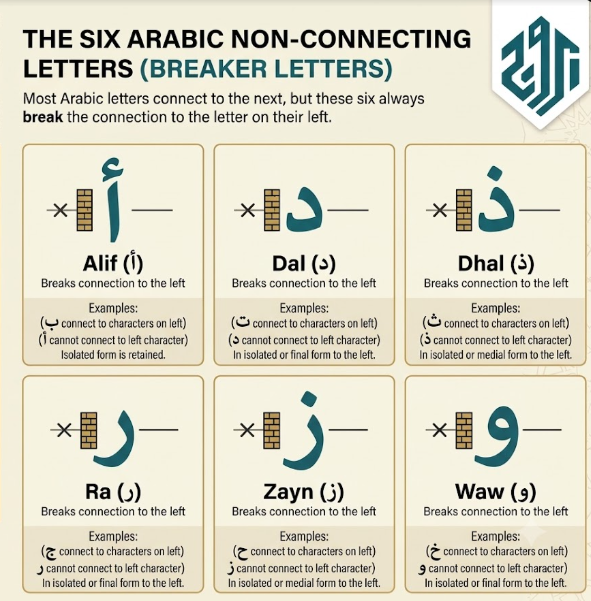
The six non-connecting Arabic letters are the most important group to identify early, because they determine where visual word-clusters begin and end.
These Arabic letters connect to the letter on their right only — they never connect to the letter on their left.
The six non-connecting letters are:
| Letter | Name | Connects Right | Connects Left |
| ا | Alif | ✅ Yes | ❌ No |
| د | Dal | ✅ Yes | ❌ No |
| ذ | Dhal | ✅ Yes | ❌ No |
| ر | Ra | ✅ Yes | ❌ No |
| ز | Zayn | ✅ Yes | ❌ No |
| و | Waw | ✅ Yes | ❌ No |
A useful memory aid: these six letters are sometimes grouped by their shapes — Alif stands alone as a vertical stroke; Dal and Dhal share a bowl shape; Ra and Zayn share a curved baseline; Waw has its distinct loop.
Recognizing the shape families helps you identify non-connectors instantly in running text.
When a non-connecting letter appears inside a word, the letter after it must begin a new segment. This is why the word كَتَبَ (kataba — he wrote) appears as a single continuous chain, while دَرَسَ (darasa — he studied) appears to have a break after the دَ, because Dal does not connect left.
Practice Exercise 1 — Spotting Non-Connectors
Look at these words and identify where the non-connecting letters cause a visual break:
- وَلَدٌ (waladun — a boy): The و does not connect left, so لَدٌ begins a new segment after it.
- دَرْسٌ (darsun — a lesson): The دَ does not connect left; then رْ does not connect left — two breaks in one short word.
- زَيْتٌ (zaytun — olive oil): The زَ does not connect left, creating a break before يْتٌ.
Read each word aloud and trace where your pen would lift. This physical awareness is what converts the rule from theory into reading instinct.
Read also:Understanding Syllable Letters in Arabic
The Four Forms of Every Arabic Letter
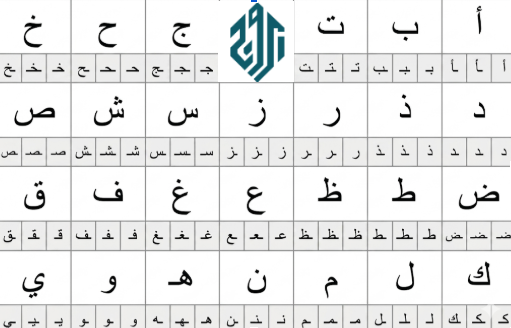
Every Arabic connecting letter changes its shape depending on where it appears in a word. There are exactly four positional forms for connecting letters, and understanding them is the key to recognizing letters in running text — which often look dramatically different from their isolated form.
| Position | Condition | Example with ب |
| Isolated | Letter stands alone | بَ |
| Initial | Beginning of a word, connects left only | بَيْت (house) — the بَ |
| Medial | Middle of a word, connects both sides | كِتَاب (book) — middle letters |
| Final | End of a word, connects right only | كَلْب (dog) — the بَ at end |
The non-connecting letters have only two forms: isolated and final. Because they never connect to the left, they can never appear in true initial or medial positions in the connecting sense.
How Arabic Letter Families Share Forms
Arabic letters are organized into shape families. Letters within the same family share the same skeleton — only their dots differ. This dramatically reduces the number of distinct forms you need to memorize.
| Family Skeleton | Letters | Shared Feature |
| One tooth | ب، ت، ث | Differ only in dot count/position |
| Curved bowl | ج، ح، خ | Differ only in dots |
| Two humps | س، ش | Differ only in dots |
| Closed loop | ع، غ | Differ only in dots |
| Round tail | ص، ض | Differ only in dots |
When you learn the medial form of ب, you have simultaneously learned the medial form of ت and ث. This is one of the most efficient aspects of the Arabic writing system.
How Arabic Connecting Letters Change Shape in Practice?
This is where the system becomes visible in real words. We will walk through several everyday Arabic words, showing exactly how each letter shifts across its positional forms.
Example Word 1: كَتَبَ (kataba — he wrote)
- كَ — Kaf in initial form: it opens and connects leftward to the next letter
- تَ — Ta in medial form: it reduces to its simplified tooth shape with two dots above, connecting on both sides
- بَ — Ba in final form: it takes its full final shape with one dot below
The same three letters in isolation look quite different from how they appear joined. In our experience teaching Arabic writing at Buruj Academy, students who first learn letters in isolation often struggle to recognize them in words — which is why we teach positional forms alongside alphabet recognition from the very beginning.
Example Word 2: مَدْرَسَة (madrasa — school)
- مَ — Mim in initial form: simplified circle opening rightward
- دْ — Dal in medial position but does not connect left — creates a break
- رَ — Ra, another non-connector — creates a second break
- سَ — Sin in initial form after the break (appears as three teeth)
- ة — Ta Marbuta in final form (closed with two dots)
This word has two internal breaks. Beginners often think they are reading two or three separate words. They are not — this is one word, segmented by non-connecting letters.
Example Word 3: شَجَرَة (shajara — tree)
- شَ — Shin initial form: three teeth with three dots above, connects left
- جَ — Jim medial form: reduces to a small curved hook, connects both sides
- رَ — Ra non-connector: breaks the chain here
- ة — Ta Marbuta final form: rounded with two dots
Practice Exercise 2 — Analyze the Letter Forms
For each word below, write out which form (initial / medial / final / isolated) each letter takes:
- بَيْتٌ (baytun — a house)
- نَهْرٌ (nahrun — a river)
- سَمَاءٌ (sama’un — sky)
- قَمَرٌ (qamarun — moon)
Work through each letter position and check whether any non-connectors create internal breaks. This exercise builds the analytical habit that makes reading unfamiliar words possible.
Read also: Arabic Calligraphy Styles
Discover the Buruj Academy Difference
Step into our virtual classrooms and see how our expert instructors make learning Quran and Arabic intuitive and clear. We focus on overcoming the specific hurdles non-native speakers face, building your confidence and connection with the Quran.
Master the Arabic Language
Join our expert-led courses and build a strong foundation in Classical and Modern Arabic.
Get Your Free TrialHow to Practice Joining Arabic Letters Effectively?
Joining Arabic letters is a physical skill as much as a cognitive one. Reading connected Arabic and writing connected Arabic require different kinds of practice, and both need to be trained deliberately.
For an excellent foundation in the script itself, our detailed guide on how to learn the Arabic alphabet covers the building blocks that make connection practice productive.
We offer personalized 1-on-1 sessions with flexible 24/7 scheduling, a dedicated Arabic Alphabet Learning course, and a free trial lesson so you can experience the method firsthand.
Get a free trial now in Buruj’s Alphabet course
For Reading Practice: Cluster Recognition Training
Rather than sounding out letter by letter, train yourself to recognize common letter clusters as single visual units. This is how fluent Arabic readers process text — in clusters, not individual letters.
Common high-frequency clusters to drill:
| Cluster | Transliteration | Appears In |
| كتـ | kta- | كَتَبَ، كِتَاب، كَتَّبَ |
| درس | drs | دَرَسَ، دُرُوس، مَدْرَسَة |
| بيت | byt | بَيْت، بُيُوت |
| علم | ‘lm | عَلِمَ، عَالِم، عِلْم |
Drill each cluster until you recognize it on sight without decoding.
For Writing Practice: The Baseline Connection Rule
In Arabic handwriting, all letters rest on an invisible baseline. When connecting letters, the pen moves rightward along this baseline, lifting only when a non-connecting letter forces a break.
Practice sequence for any new letter:
- Write the letter in isolation ten times
- Write it in initial position connected to ـبـ (as a neutral following letter) ten times
- Write it in medial position sandwiched between بـ and ـب ten times
- Write it in final position after بـ ten times
This four-stage drill, applied to each letter systematically, builds correct handwriting muscle memory faster than copying random words.
Our Arabic Writing course uses this exact sequence with instructor feedback — so errors in pen angle and connection points are corrected before they become habits.
Book your free trial to start writing Arabic
Practice Exercise 3 — Write These Connected Sequences
Using the four-stage method above, practice the following letter in all four positions:
Letter: عَ (Ain)
The Ain changes dramatically across positions:
- Isolated: ع — open bowl shape with a descending tail
- Initial: عَلِمَ — compressed and opens rightward
- Medial: مَعْلُوم — reduces to a tiny bump on the baseline
- Final: سَمَع — closes into a rounded shape with tail
Write each form fifteen times, paying attention to the connection points where the preceding or following letter attaches.
Common Mistakes Arabic Learners Make with Connecting Letters
In our sessions at Buruj Academy, we see the same connection errors appear repeatedly across students at every level. Knowing these mistakes in advance lets you avoid building bad habits.
Mistake 1 — Treating all Arabic letters as equal connectors
Students forget that the six non-connectors behave differently and write words as if every letter connects on both sides. This produces unreadable text and creates confusion when reading.
Mistake 2 — Using the isolated form in medial position
The isolated form of م (Mim) has a full tail. The medial form does not. Using the isolated form inside a word breaks the connection and produces incorrect script.
Mistake 3 — Incorrect dot placement on connected letters
When letters are joined, dots must still be placed precisely above or below the letter’s skeleton — not scattered loosely. Poor dot placement makes ب، ت، and ث indistinguishable.
Mistake 4 — Disconnecting letters that should connect
Some students, especially those who learned letters in isolation first, instinctively leave spaces between all letters. Written Arabic does not permit this for connecting letters — every connecting letter must physically touch its neighbor.
For a broader look at how beginners can approach Arabic systematically, our article on how to learn Arabic for beginners provides the strategic framework that makes each of these technical rules easier to absorb.
Connecting Letters in Everyday Arabic Words: Vocabulary Building Practice
The most effective way to internalize Arabic connecting letters is through meaningful vocabulary — words you will actually use, analyzed for their connection patterns. Pairing connection rules with vocabulary learning doubles your progress.
Below are twenty everyday Arabic words grouped by their connection complexity. Study each word’s internal structure before practicing it.
Level 1 — Simple Words (Few or No Non-Connectors)
| Arabic | Transliteration | Meaning | Connection Notes |
| سَلَام | salaam | peace / hello | All connecting with long Alif — note Alif non-connects |
| كِتَاب | kitaab | book | All connecting with long Alif — note Alif non-connects |
| نَبِيّ | nabiyy | prophet | All connecting letters |
| لَيْل | layl | night | All connecting |
| قَلَم | qalam | pen | All connecting |
Level 2 — Words with One Internal Break
| Arabic | Transliteration | Meaning | Breaking Letter |
| وَلَد | walad | boy | و (Waw) — breaks after first letter |
| زَهْرَة | zahra | flower | ز then ر — two breaks, one word |
| دَرَسَ | darasa | he studied | د then ر — two consecutive breaks |
| بَيْت | bayt | house | ي connects, then ت final — continuous |
| رَجُل | rajul | man | ر breaks immediately |
Practice Exercise 4 — Connect and Write
Take each of the Level 1 words above and write them three times in full, connected form. Then take each Level 2 word and draw a small mark above every letter that causes a break. Check your answers against the Connection Notes column.
This active analysis — reading with structural attention — is what separates students who sound out Arabic slowly from those who begin to read it with genuine fluency.
Read also: How to Write in Arabic?
How Do Arabic Connecting Letters Relate to Grammar and Word Structure?
Understanding Arabic connecting letters is not just about script — it also opens a window into how Arabic words are built. Arabic is a root-based language, meaning most words derive from a three-letter root (جَذْر). The connection pattern of a word often helps you see its root structure clearly.
For those building deeper grammatical knowledge, our guide on Arabic grammar for beginners shows how word patterns and roots work together.
Take the root كَتَبَ (k-t-b), meaning “to write”:
| Word | Meaning | Connection Pattern |
| كَتَبَ | he wrote | Continuous — all connectors |
| كِتَاب | book | Alif breaks after كِتَا |
| كَاتِب | writer | Alif breaks after كَا |
| مَكْتَبَة | library | All connectors — continuous |
| مَكْتُوب | written | Waw breaks near the end |
The root letters ك، ت، ب appear in every word. Seeing the connection breaks alongside the root letters helps you read more efficiently — you learn to spot roots even inside unfamiliar words.
Build Arabic Fluency with Buruj Academy’s Expert Instructors
Mastering Arabic connecting letters is one of the most important milestones in Arabic literacy, and it becomes dramatically faster with structured guidance and real-time correction.
At Buruj Academy, our Online Arabic Classes are led by Al-Azhar University graduates with 12+ years of experience teaching non-native speakers.
Our instructors use the Buruj Method — context-before-abstraction — so you learn letter forms through real words, not abstract rules.
Begin your transformation today by choosing the path that fits your goals:
- Online Arabic Classes (General & Comprehensive)
- Arabic Course for Beginners
- Arabic Alphabet Learning Course
- Online Arabic Classes for Kids
- Arabic Classes for Adults
- Arabic Grammar Course (Nahw & Sarf)
- Intermediate Arabic Course (B1/B2)
- Arabic Speaking Course (Conversational Fluency)
- Arabic Reading Course (Literary Excellence)
- Learn Arabic Writing Course (Calligraphy & Composition)
Ready to speak with confidence? Join the global community at Buruj Academy and book your free placement interview today!
Master the Arabic Language
Join our expert-led courses and build a strong foundation in Classical and Modern Arabic.
Get Your Free TrialConclusion
Arabic connecting letters follow a system that is logical, learnable, and ultimately rewarding. The key is approaching it in the right order: identify the six non-connectors, learn the four positional forms of connecting letters, recognize letter families by their shared skeletons, and then build vocabulary and reading speed through deliberate practice.
What looks like flowing, unpredictable script quickly reveals itself as a precise and elegant writing system. With consistent practice using the exercises in this guide — and qualified instruction to correct errors early — reading and writing connected Arabic becomes a genuine skill rather than a source of confusion.
Frequently Asked Questions About Arabic Connecting Letters
How Many Letters in Arabic Connect on Both Sides?
Twenty-two of the twenty-eight Arabic letters connect on both sides within a word. These letters take up to four positional forms — isolated, initial, medial, and final — depending on where they appear. The remaining six letters (ا، د، ذ، ر، ز، و) connect only to the right, never to the left, and appear in only two forms: isolated and final.
Why Does One Arabic Word Sometimes Look Like It Has Gaps in the Middle?
Those visual gaps are caused by the six non-connecting letters. When one of these letters appears inside a word, it cannot connect to the letter on its left, which creates a break in the otherwise continuous baseline. The word is still one grammatical unit — the gap is a feature of the script, not a space between words.
Is Connecting Arabic Letters Different from Print Arabic?
Standard Arabic has no true “print” equivalent the way English does. Connected cursive script is the default in all formal written Arabic — newspapers, books, signage, and handwriting all use the same connected system. Some children’s educational materials add extra spacing between letters to aid recognition, but this is a teaching aid, not standard Arabic script.
What Is the Fastest Way to Learn Arabic Letter Connections?
The fastest method is learning each letter in all four positional forms simultaneously, then drilling common letter clusters in real words rather than practicing isolated letters. Tracing connected words while speaking them aloud trains both visual recognition and muscle memory at once. Consistent 20-minute daily sessions consistently outperform longer infrequent study sessions in our instructors’ experience.
Do All Arabic Countries Write the Same Connected Script?
The standard connected Arabic script — Modern Standard Arabic (MSA) — is consistent across all Arabic-speaking countries for formal writing. Regional variations appear in handwriting styles and some dialectal written forms, but the connection rules and letter forms described in this guide apply universally to MSA, which is the written standard across all 22 Arab League countries. For a broader picture of the language, our article on Modern Standard Arabic for beginners covers this clearly