 Arabic
| Key Takeaways |
| Arabic calligraphy includes 6 major script styles: Naskh, Thuluth, Ruq’ah, Kufic, Diwani, and Nastaliq, each with distinct visual rules. |
| Naskh is the most widely used everyday script and the foundation of modern Arabic print, making it ideal for beginners to study first. |
| Ruq’ah is the fastest Arabic handwriting style used in daily writing across Arab countries, built on simplified, connected strokes. |
| Kufic is the oldest Arabic script style, originating in Kufa (Iraq) around the 7th century, and remains foundational to Islamic art. |
| Each calligraphy style carries specific proportional rules, letter spacing principles, and stroke techniques that define its visual identity. |
Arabic calligraphy is a precise visual language built on centuries of formal rules governing proportion, spacing, and stroke order.
For anyone learning Arabic, understanding these scripts changes how you read, write, and perceive the language itself.
Table of Contents:
What Are the 6 Major Types of Arabic Calligraphy?
The six major types of Arabic calligraphy are Naskh, Thuluth, Ruq’ah, Kufic, Diwani, and Nastaliq. Each style developed independently for a distinct communicative context — manuscript copying, monumental inscription, administrative correspondence, or everyday handwriting.
While dozens of regional sub-styles exist, these six form the canonical foundation recognized across the Arab world and in classical Arabic scholarship.
The table below gives you an at-a-glance orientation before we explore each style in depth.
| Script Style | Origin Period | Primary Use | Difficulty Level |
| Kufic | 7th century CE | Manuscripts, architecture | Advanced |
| Naskh | 10th century CE | Everyday print, Quran copies | Beginner-friendly |
| Thuluth | 11th century CE | Titles, headings, mosques | Intermediate–Advanced |
| Ruq’ah | 19th century CE | Daily handwriting | Beginner-friendly |
| Diwani | 16th century CE | Ottoman royal documents | Advanced |
| Nastaliq | 15th century CE | Persian-influenced Arabic | Intermediate |
1. Kufic is the Oldest Arabic Calligraphy Style and Its Geometric Foundations
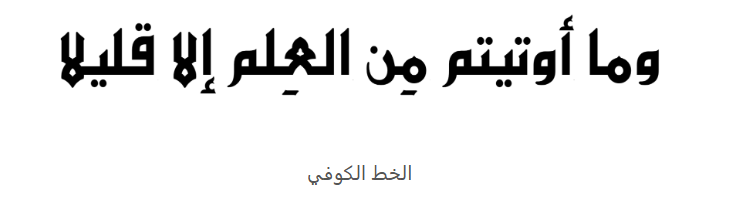
Kufic is the oldest documented Arabic script, emerging in the city of Kufa (present-day Iraq) around the 7th century CE. It is characterized by angular, geometric letterforms with strong horizontal baselines and minimal curves.
Early Quranic manuscripts — including the famous Blue Quran of North Africa — were written in Kufic before more legible scripts replaced it for manuscript use.

What Makes Kufic Letters Visually Distinct?
Kufic letters are built on a strict grid system: vertical strokes are tall and sharp, horizontal strokes extend deliberately, and curves are largely eliminated or reduced to minimal arcs.
The alif (ا) in Kufic stands as a perfect vertical pillar — there is no diagonal lean or curvature that you find in Naskh.
Letters like ع and غ appear as angular forms rather than the rounded shapes modern Arabic readers recognize.
Kufic in Architecture and Modern Design
Kufic did not disappear — it migrated from manuscripts to stone, tile, and architecture. Visit any classical mosque in Cairo, Istanbul, or Cordoba and you will find Kufic inscriptions carved into mihrab panels and dome interiors.
In contemporary graphic design, Square Kufic (Kufic Murabba’) is used to construct entire words from interlocking geometric blocks — a style common on logos, emblems, and Islamic geometric art prints.
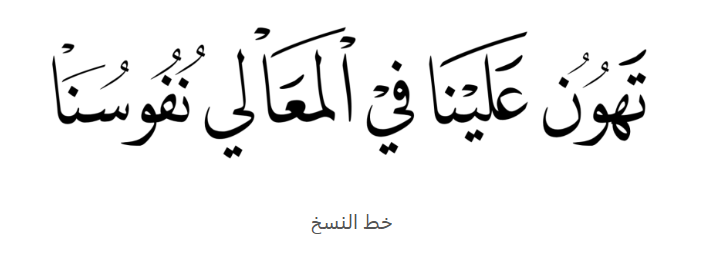
2. Naskh is the Arabic Handwriting Style That Became the Basis of Modern Print
Naskh (النسخ — literally “copying”) is the most widely used Arabic script in the world today. Developed and formalized by the Abbasid calligrapher Ibn Muqlah in the 10th century CE, Naskh was specifically designed for legibility and efficiency in manuscript copying.
Naskh is the script used in virtually all Arabic-language books, newspapers, websites, and printed Qurans.

At Buruj Academy, our online Arabic writing course begins with Naskh script precisely because it is the most transferable — mastering Naskh letterforms gives students a direct path from handwriting practice into reading authentic Arabic texts.
Students who learn Naskh correctly read printed Arabic more fluently, because their trained eye recognizes the proportional logic behind each letter.
Book your free trial to start writing Arabic
Why Is Naskh the Best Starting Point for Arabic Learners?
Naskh operates on a rhombic dot system — all letter proportions are calculated relative to the size of a single diamond-shaped dot made by a reed pen at a 45-degree angle. The alif is typically 5–7 dots tall.
The baseline is consistent and flat. This mathematical regularity makes Naskh far more systematic to learn than styles like Thuluth or Diwani, which layer visual complexity over the same proportional foundation.
| Naskh Letter | Distinctive Feature | Common Beginner Error |
| ب (Ba) | Sits just below the baseline | Drawing it flat on the line |
| ع (Ayn) | Open loop closing tightly | Closing the loop too early |
| م (Meem) | Small circular head | Making the head too large |
| ك (Kaf) | Internal diagonal stroke | Omitting the interior detail |
| ل (Lam) | Tall ascending stroke | Inconsistent height against alif |
If you are just beginning your Arabic writing path, our guide on how to learn Arabic for beginners is a strong companion resource to this calligraphy study.
3. Thuluth is the Arabic Writing Style of Mosque Inscriptions and Formal Titles
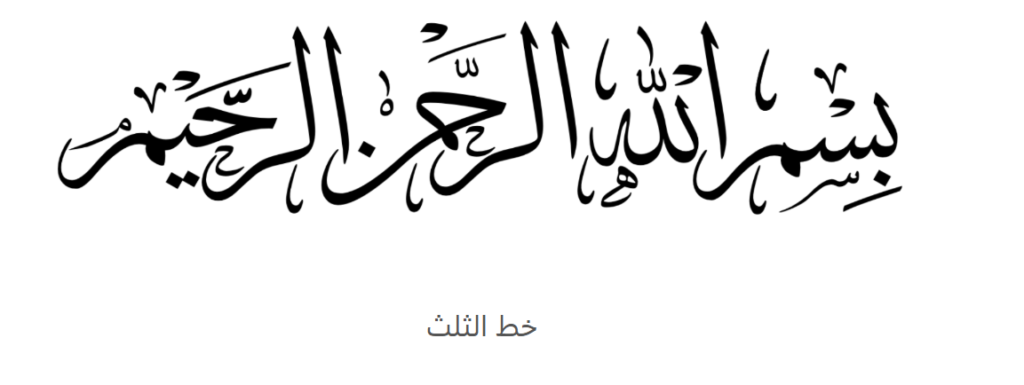
Thuluth (الثلث — “one-third”) is the most prestigious and visually commanding of all Arabic calligraphy styles. Its name refers to the proportion of the pen nib — one-third of the pen’s width defines the letter structure.
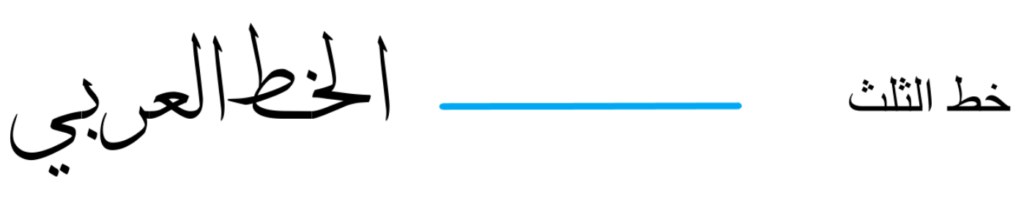
Thuluth features dramatic sweeping curves, elongated verticals, and elaborate letter compositions that allow multiple letters to overlap and interlock in layered arrangements called murakkab compositions.
4. Ruq’ah is the Fastest Arabic Handwriting Style for Daily Use
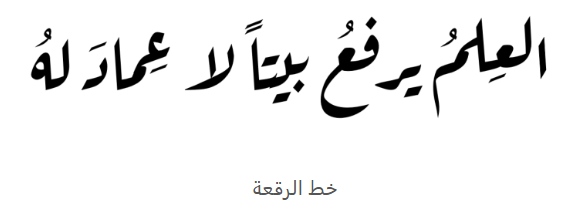
Ruq’ah (الرقعة) is the standard everyday handwriting script of the modern Arab world. Developed in the Ottoman Empire during the 19th century for administrative efficiency, Ruq’ah was designed to be written quickly without lifting the pen unnecessarily.
Most Arabic speakers use Ruq’ah instinctively when taking notes, writing letters, or filling out forms — even if they have never formally studied it.
In our experience teaching Arabic to non-native speakers at Buruj Academy, Ruq’ah is consistently the script that surprises students most. Adult learners often arrive expecting Arabic handwriting to look like calligraphy posters — ornate and elaborate.
When they see native speakers writing in Ruq’ah, the simplified, compressed strokes initially seem unrecognizable as the same letters they learned in Naskh. This perceptual gap is the first challenge we address directly.

Read also: Arabic Connecting Letters
Discover the Buruj Academy Difference
Step into our virtual classrooms and see how our expert instructors make learning Quran and Arabic intuitive and clear. We focus on overcoming the specific hurdles non-native speakers face, building your confidence and connection with the Quran.
Master the Arabic Language
Join our expert-led courses and build a strong foundation in Classical and Modern Arabic.
Get Your Free TrialHow Ruq’ah Simplifies Arabic Letter Forms
Ruq’ah achieves its speed through systematic simplification. Letters that carry multiple distinguishing dots in formal scripts are often written with a single horizontal dash. Curves are flattened.
Letters that descend below the baseline in Naskh are brought up closer to it in Ruq’ah. The word يكتب (he writes), which in Naskh has clearly distinguishable letter shapes, appears in Ruq’ah as a compressed, fast horizontal flow with minimal vertical variation.
| Feature | Naskh | Ruq’ah |
| Letter height variation | High | Low — letters stay close to baseline |
| Dot placement | Precisely placed | Often abbreviated or dashed |
| Curves | Full, rounded | Flattened, angular |
| Pen lifts between letters | Frequent | Minimized for speed |
| Use context | Print, formal writing | Everyday handwriting |
For students building their Arabic writing foundations, our Arabic Writing course covers Ruq’ah handwriting alongside Naskh in a structured progression designed for non-native learners.
Book your kid a free trial to start writing Arabic

5. Diwani is the Ornate Arabic Calligraphy of Ottoman Royal Correspondence
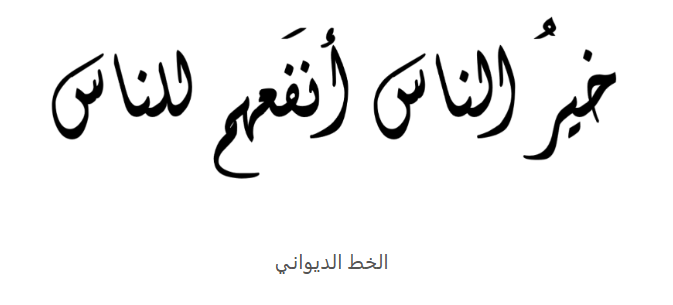
Diwani (الديواني) was developed in the Ottoman Imperial Court (Divan) during the 16th century and used exclusively for royal decrees, state documents, and official correspondence. Its defining characteristic is extreme curvature — almost every letter curves dramatically upward to the right, creating a visual upward sweep across the entire composition.

Vowel marks are often omitted, and letters can be stretched, compressed, or overlapped in ways that make Diwani the most difficult major script to read without specialized training.
Diwani Jali (الديواني الجلي) is the more decorative variant, where the spaces between and inside letters are filled with elaborate floral and geometric ornaments. A single word in Diwani Jali can take a master calligrapher days to complete.
6. Nastaliq is the Arabic Calligraphy Style Influenced by Persian Tradition
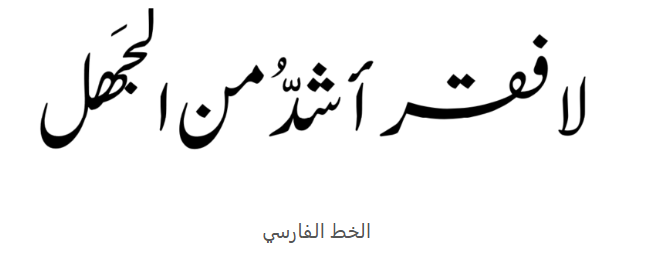
Nastaliq (النستعليق) is a hybrid script that merges the Arabic Naskh tradition with the Persian Ta’liq style, producing a distinctive diagonal flow where words appear to descend from right to left on a gentle downward slope. Developed in 15th-century Persia, Nastaliq became the dominant script for Persian, Urdu, and Pashto and is still used for Arabic poetry and literary manuscripts in certain traditions.
In standard Arabic calligraphy, Nastaliq occupies a specialized position — used primarily for poetic texts and artistic compositions rather than everyday communication.
The script’s dramatic diagonal baseline and the way horizontal letters hang below vertical anchors creates a visual rhythm that native readers describe as “musical” — each line of poetry appears to float across the page.
Nastaliq vs. Naskh: A Direct Comparison for Arabic Learners
| Feature | Naskh | Nastaliq |
| Baseline | Flat, horizontal | Diagonal, descending right-to-left |
| Letter size variation | Moderate | High — dramatic size contrast between letters |
| Vertical strokes | Upright | Often angled |
| Common use in Arabic | Print, Quran, books | Poetry, artistic manuscripts |
| Readability for beginners | High | Low — requires specialized exposure |
Read also: How to Write in Arabic?
What Is the History of Arabic Calligraphy?
Arabic calligraphy history spans fourteen centuries and follows a clear developmental arc from functional inscription to elaborate artistic tradition.
The earliest Arabic inscriptions — predating Islam — used proto-Nabataean forms that gradually evolved into recognizable Arabic letterforms.
With the advent of Islam in the 7th century CE, the urgent need to preserve and transmit the Quran became the primary driver of calligraphic development.
Ibn Muqlah (886–940 CE), the Abbasid vizier and calligrapher, is credited as the first to systematize Arabic script proportions through the rhombic dot measurement system — a contribution so foundational that classical Arabic scholarship considers him the father of Islamic calligraphy.
His student tradition produced Ibn al-Bawwab and later Yaqut al-Musta’simi, whose refinements of Naskh and Thuluth established the canonical standards still taught today.
The Ottoman period (16th–19th centuries) produced the greatest expansion of new styles, generating Diwani, Ruq’ah, and numerous regional substyles.
The Ottoman Imperial School of Calligraphy (Mekteb-i Tahrîriye) standardized Ruq’ah specifically as an administrative handwriting script, and its influence spread across the entire Arab world through Ottoman administrative networks.
For students curious about the structure of Arabic language that underlies all these scripts, our guide on Arabic sentence structure for beginners provides foundational grammatical context that complements calligraphy study.
How to Practice Arabic Calligraphy Styles as a Language Learner?
Arabic calligraphy practice is most effective when treated as a language skill, not just an art exercise. Every stroke you practice trains your eye to recognize letter forms in authentic Arabic text — and that visual training directly accelerates your reading speed. Here is a structured daily practice framework that our Buruj Academy Arabic instructors recommend for non-native speakers integrating calligraphy into their language study.
| Week | Focus Script | Daily Practice | Language Integration |
| 1–2 | Naskh letterforms | Copy individual letters 10× each | Connect letter forms to words you know |
| 3–4 | Naskh words | Write 5 vocabulary words in Naskh daily | Practice words from your Arabic lessons |
| 5–6 | Ruq’ah comparison | Write the same words in Ruq’ah | Notice which letters change most |
| 7–8 | Thuluth observation | Trace Thuluth letters from verified references | Identify these letters in mosque images |
| 9–10 | Kufic analysis | Reconstruct Arabic words in angular geometric forms | Study architectural calligraphy images |
What Tools Do You Need to Begin Practicing Arabic Calligraphy?
Begin with a flat-tipped calligraphy pen (nib width 2–3mm for practice), quality unlined paper, and a verified reference sheet for whichever script you choose. For Naskh and Ruq’ah, a 45-degree pen angle is standard.
For Thuluth, the pen angle shifts based on the stroke type. Digital calligraphy tools (tablets with pressure-sensitive styluses) are acceptable for initial practice but do not fully replicate the muscular memory that reed pen or flat-nib training builds.
Connecting your calligraphy practice to vocabulary building multiplies its language value. Our resource on mastering Arabic vocabulary pairs naturally with script practice — writing vocabulary words in calligraphic form reinforces both visual recognition and spelling simultaneously.
Master Arabic Writing with Buruj Academy’s Expert Instructors
Arabic calligraphy and writing mastery become significantly more accessible with structured expert guidance. At Buruj Academy, our Online Arabic Writing course and Online Arabic Classes are taught by Al-Azhar University graduates with 12+ years of experience teaching non-native speakers.
Our instructors bring:
- Ijazah-certified expertise in Arabic linguistics and script instruction
- The Buruj Method — Context-before-abstraction, building visual and written fluency together
- Personalized 1-on-1 sessions with real-time written correction
- Flexible 24/7 scheduling for students globally
- Clear progression from letter recognition through confident Arabic writing
Book your free trial lesson and discover the script style that fits your learning goals — whether you are a complete beginner or refining your Arabic handwriting skills.
Begin your transformation today by choosing the path that fits your goals:
- Online Arabic Classes (General & Comprehensive)
- Arabic Course for Beginners
- Arabic Alphabet Learning Course
- Online Arabic Classes for Kids
- Arabic Classes for Adults
- Arabic Grammar Course (Nahw & Sarf)
- Intermediate Arabic Course (B1/B2)
- Arabic Speaking Course (Conversational Fluency)
- Arabic Reading Course (Literary Excellence)
- Learn Arabic Writing Course (Calligraphy & Composition)
Ready to speak with confidence? Join the global community at Buruj Academy and book your free placement interview today!
Master the Arabic Language
Join our expert-led courses and build a strong foundation in Classical and Modern Arabic.
Get Your Free TrialConclusion
Arabic calligraphy styles are not decorative curiosities — they are structured visual systems with centuries of formal rules behind each stroke and proportion. From the angular geometry of Kufic to the flowing speed of Ruq’ah, each of the six major scripts developed in response to a specific communicative need, and understanding that history changes how you read and write Arabic today.
Whether you are learning how to improve Arabic writing with dictation or exploring the deeper structures of the language through our guide on Arabic grammar, integrating script awareness into your study will strengthen every dimension of your Arabic literacy.
Frequently Asked Questions About Arabic Calligraphy Styles
What Is the Most Common Arabic Calligraphy Style Used Today?
Naskh is the most common Arabic calligraphy style in use today, forming the basis of virtually all printed Arabic text, digital fonts, and published Qurans. Ruq’ah is the most common handwriting style used by Arab speakers in daily life. Together, these two scripts represent the vast majority of Arabic writing encountered in modern contexts.
What Is the Difference Between Arabic Calligraphy Styles and Arabic Handwriting Styles?
Arabic calligraphy styles refer to formally codified scripts with established proportional rules taught as an art form — Naskh, Thuluth, Kufic, Diwani, Nastaliq, and Ruq’ah. Arabic handwriting styles refer to how individuals adapt these scripts in everyday writing. Ruq’ah is the primary everyday handwriting style, while the others are primarily used in formal, artistic, or specialized contexts.
Which Arabic Calligraphy Style Should Beginners Learn First?
Beginners should learn Naskh first, as it is the most proportionally systematic, the most widely used in print, and the most directly transferable to reading modern Arabic text. After establishing Naskh competency, learning Ruq’ah as a handwriting style is the most practical second step for everyday communication.
How Long Does It Take to Learn Basic Arabic Calligraphy?
In our instructors’ experience at Buruj Academy, consistent daily practice of 20–30 minutes produces recognizable Naskh letterform accuracy within 6–8 weeks for motivated adult beginners. Achieving polished, publication-quality calligraphy in any style requires years of dedicated study. For language learners, functional script recognition and handwriting ability develop much faster than formal calligraphic mastery.