 Arabic
| Key Takeaways |
| Modern Standard Arabic (MSA) is the formal written and broadcast Arabic used across 22 Arab countries and 400+ million speakers. |
| MSA derives directly from Classical Arabic but simplifies archaic vocabulary and grammatical structures for contemporary use. |
| MSA is not a spoken dialect — no Arab community uses it as a native daily language, but all literate Arabs understand it. |
| Learning MSA gives access to newspapers, literature, formal speech, and forms the strongest bridge to understanding Quranic Arabic. |
| MSA and Quranic Arabic share the same foundational grammar system, though Quranic Arabic retains older vocabulary and stylistic features MSA has dropped. |
Modern Standard Arabic is the standardized, formal register of Arabic used in writing, journalism, education, and official communication across the Arab world.
MSA sits between the ancient Classical Arabic of the Quran and the regional spoken dialects, making it the single most accessible entry point for learners seeking both religious understanding and real-world Arabic literacy.
Table of Contents:
What Is Modern Standard Arabic and How Does It Work?
Modern Standard Arabic (MSA) — called الفصحى المعاصرة (Al-Fusha Al-Mu’asira) in Arabic — is the formal, codified form of Arabic standardized across Arab countries for written and official communication. MSA follows the same foundational grammar as Classical Arabic, uses diacritical vowel markers (harakat) in formal texts, and maintains consistent rules regardless of the speaker’s regional background.
Unlike spoken dialects, MSA has no single geographic “home.” An Egyptian journalist and a Moroccan academic write in the same MSA.
This cross-border intelligibility is MSA’s defining strength — and why we always recommend it as the foundation for serious Arabic learners at Buruj Academy.
How Did MSA Develop from Classical Arabic?
MSA emerged during the Nahda — the Arab cultural renaissance of the 19th and early 20th centuries. Arab scholars and reformers deliberately modernized Classical Arabic to address contemporary science, politics, and technology while preserving the language’s grammatical integrity.
The result kept Classical Arabic’s grammar framework intact but added thousands of modern terms and simplified some archaic constructions. Words like تِلِفِزْيُون (television) and حَاسُوب (computer) entered MSA through this process — they have no equivalent in pure Classical Arabic.
What Is the Modern Standard Arabic Alphabet?
The Modern Standard Arabic alphabet consists of 28 letters, all consonants, written from right to left. Short vowels are indicated by small diacritical marks placed above or below letters rather than by separate alphabet characters — a feature that distinguishes Arabic from European scripts fundamentally.
Every letter in the MSA alphabet connects to adjacent letters within a word, and most letters take different shapes depending on their position: initial, medial, final, or isolated. Mastering these four positional forms is the first real milestone every learner faces.
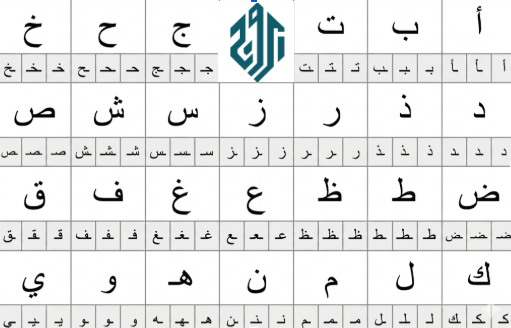
The Modern Standard Arabic Alphabet Chart
| Letter | Name | Approximate Sound |
| ا | Alif | “a” as in father |
| ب | Ba | “b” |
| ت | Ta | “t” |
| ث | Tha | “th” as in think |
| ج | Jim | “j” as in jar |
| ح | Ha | Heavy “h” (pharyngeal) |
| خ | Kha | “kh” as in Scottish “loch” |
| د | Dal | “d” |
| ذ | Dhal | “th” as in “this” |
| ر | Ra | Rolled “r” |
| ز | Zay | “z” |
| س | Sin | “s” |
| ش | Shin | “sh” |
| ص | Sad | Emphatic “s” |
| ض | Dad | Emphatic “d” |
| ط | Ta | Emphatic “t” |
| ظ | Dha | Emphatic “dh” |
| ع | ‘Ayn | Voiced pharyngeal (no English equivalent) |
| غ | Ghayn | Similar to French “r” |
| ف | Fa | “f” |
| ق | Qaf | Deep “k” from throat |
| ك | Kaf | “k” |
| ل | Lam | “l” |
| م | Mim | “m” |
| ن | Nun | “n” |
| ه | Ha | Light “h” |
| و | Waw | “w” or long “oo” |
| ي | Ya | “y” or long “ee” |
At Buruj Academy, our Arabic Alphabet Learning Course teaches each letter’s positional forms and sounds systematically, with Al-Azhar-trained instructors correcting pronunciation in real time from the very first session.
Get a free trial now in Buruj’s Alphabet course
Is Modern Standard Arabic Spoken or Only Written?
MSA is not a native spoken language — no Arab community grows up speaking it at home. However, educated Arabs across all 22 Arab-majority countries actively use MSA in formal speech: university lectures, news broadcasts, political speeches, religious sermons, international conferences, and inter-Arab communication between speakers of different dialects.
This distinction confuses many learners. The honest answer is: MSA is spoken regularly in formal contexts, but never informally.
An Arab switching to MSA in casual conversation would sound deliberately formal — the way someone speaking in Shakespearean English would in a modern coffee shop.
Where You Will Hear MSA Spoken
- Al Jazeera, BBC Arabic, and all major Arab news broadcasts
- Friday Khutbah (sermon) in many mosques
- University lectures and academic conferences
- Formal political addresses and diplomatic meetings
- Pan-Arab cultural programs and documentaries
In our Online Arabic Classes at Buruj Academy, we consistently find that students who develop strong MSA reading skills adapt quickly to formal Arabic listening contexts — because the grammar they’ve internalized matches exactly what broadcasters use.
Book your FREE Arabic trial online Arabic class at Buruj

Is Modern Standard Arabic Useful for Muslims Specifically?
MSA is genuinely useful for Muslim learners pursuing multiple interconnected goals. Quranic comprehension, Islamic scholarship, Arabic literacy, and engagement with classical Islamic texts all flow through the same grammatical river that MSA and Classical Arabic share. Learning MSA is not a detour from religious Arabic — it is a direct pathway toward it.
The Quranic Arabic classes at Buruj Academy deliberately build on MSA grammar foundations before introducing Classical-era vocabulary, because students who understand MSA sentence structure grasp Quranic grammar dramatically faster than those who attempt Quranic Arabic from scratch.
What MSA Gives Muslim Learners Access To
| Goal | MSA Benefit |
| Quran comprehension | Shared grammar system; 70%+ vocabulary overlap with Quranic Arabic |
| Tafsir reading | Classical commentaries accessible through MSA literacy |
| Islamic news and scholarship | Arab-world Islamic media, fatwas, and academic journals |
| Du’a and Adhkar understanding | Formal Arabic vocabulary clarifies supplication meanings |
| Hajj and Umrah communication | Formal Arabic understood by all Arabic-speaking Muslims worldwide |
Begin Understanding Quranic Arabic with a FREE Lesson
What Do You Need to Know Modern Standard Arabic Grammar?
Modern Standard Arabic grammar follows a root-based morphological system where most words derive from three-consonant (trilateral) roots. Understanding this root system is the single most efficient shortcut in Arabic learning — once you know the root ك-ت-ب (k-t-b, related to writing), you can identify كِتَاب (book), كَاتِب (writer), مَكْتُوب (written), and مَكْتَبَة (library) without memorizing each word individually.
MSA grammar distinguishes three grammatical cases (nominative, accusative, genitive) marked by short vowel endings on nouns — a system called الإعراب (i’rab). This case system is one of the more challenging aspects for English speakers, whose language abandoned cases centuries ago.
For a structured introduction to how Arabic sentences are built from the ground up, our beginners’ guide to Arabic sentence structure walks through the fundamentals clearly.
Read also: Learn Arabic in Egypt
The Three Core Grammar Areas That Unlock MSA Reading
1. Verb conjugation by root and pattern Arabic verbs conjugate for person, number, and gender. The past tense of a trilateral verb follows predictable patterns that, once mastered, apply across thousands of verbs.
2. Noun case endings (I’rab) Nouns change their final short vowel based on grammatical function. Mastering damma (nominative), fatha (accusative), and kasra (genitive) endings is essential for reading unvoweled texts correctly.
3. Definite article (ال — Al) The definite article Al- assimilates to sun letters and remains unchanged before moon letters — a rule that directly connects to Quranic pronunciation. Our guide on moon and sun letters in Arabic covers this in detail.
Our beginner-friendly guide to Arabic grammar breaks these systems down without overwhelming new students — we recommend it as companion reading alongside any structured course.
Master the Arabic Language
Join our expert-led courses and build a strong foundation in Classical and Modern Arabic.
Get Your Free TrialWritten and Spoken Forms of Modern Standard Arabic Numbers
Modern Standard Arabic numbers use two separate systems that confuse almost every beginner: the Eastern Arabic numerals (٠١٢٣٤٥٦٧٨٩) used throughout the Arab world in traditional and formal texts, and the Western Arabic numerals (0123456789) — which, ironically, Europe borrowed from Arabic mathematicians and uses today.
| Western Numeral | Eastern Arabic | MSA Word | Transliteration |
| 0 | ٠ | صِفْر | Sifr |
| 1 | ١ | وَاحِد | Wahid |
| 2 | ٢ | اثْنَان | Ithnan |
| 3 | ٣ | ثَلَاثَة | Thalatha |
| 4 | ٤ | أَرْبَعَة | Arba’a |
| 5 | ٥ | خَمْسَة | Khamsa |
| 6 | ٦ | سِتَّة | Sitta |
| 7 | ٧ | سَبْعَة | Sab’a |
| 8 | ٨ | ثَمَانِيَة | Thamaniya |
| 9 | ٩ | تِسْعَة | Tis’a |
| 10 | ١٠ | عَشَرَة | ‘Ashara |
One genuinely surprising rule: Arabic numbers above ten grammatically require the singular noun, not the plural — so “twenty books” in Arabic is literally “twenty book.” This counter-intuitive pattern trips up students consistently, and it’s one of the first grammar surprises we address in our Arabic Grammar Course.
Understand the Arabic Grammar with Buruj’s free trial lesson
Should You Learn Modern Standard Arabic?
Learning MSA first is the right decision for most Muslim learners — particularly those whose primary motivation is Quranic understanding, Islamic literacy, or access to formal Arabic media. MSA provides a transferable grammatical foundation that accelerates dialect acquisition later, while dialects provide no such foundation in reverse.
The practical objection — “but nobody speaks MSA on the street” — is real but overstated for Muslim learners. If your goal includes understanding the Quran, reading Islamic texts, or engaging with formal Islamic content, MSA is not a detour; it is the destination.
Classical Arabic vs Modern Standard Arabic: Key Differences
| Feature | Classical Arabic | Modern Standard Arabic |
| Primary use | Quran, Hadith, classical scholarship | Media, education, formal writing |
| Vocabulary | Archaic terms preserved | Modern vocabulary added |
| Grammar | Identical foundational system | Slight simplification of rare constructions |
| Accessibility | Requires classical text training | More accessible entry point |
| Mutual intelligibility | Fully intelligible to MSA speakers | Fully intelligible to Classical Arabic scholars |
Modern Standard Arabic vs Dialects
Dialects — Egyptian, Levantine, Gulf, Moroccan — are regional spoken varieties that evolved from Classical Arabic but diverged significantly in vocabulary, pronunciation, and sometimes grammar. Egyptian Arabic drops many case endings entirely. Moroccan Darija incorporates French and Berber vocabulary. Gulf Arabic preserves some Classical features MSA has simplified.
The core difference: MSA is written and understood pan-Arabically; dialects are spoken and understood regionally.
Quranic Arabic vs Modern Standard Arabic
Quranic Arabic and MSA share the same grammar framework — the same verb patterns, the same case endings, the same root system. The differences are stylistic and lexical rather than structural.
Quranic Arabic uses vocabulary, stylistic constructions, and grammatical forms that MSA has moved away from, but the grammar a student learns in MSA directly applies when reading the Quran.
In our instructors’ experience at Buruj Academy, students who complete a structured MSA grammar foundation understand approximately 60–70% of Quranic vocabulary by sight, having already internalized the grammatical patterns that govern how every word functions.
What Countries Speak Modern Standard Arabic and Who Uses It?
MSA is the official or co-official language across 22 countries in the Arab League, spanning North Africa, the Middle East, and the Arabian Peninsula. These countries include Egypt, Saudi Arabia, Jordan, Syria, Iraq, Morocco, Algeria, Tunisia, Libya, the UAE, Kuwait, Bahrain, Qatar, Oman, Yemen, Lebanon, Sudan, Mauritania, Somalia, Djibouti, Comoros, and Palestine.
Beyond the Arab world, MSA holds official status as one of the six official languages of the United Nations. It is used in Organisation of Islamic Cooperation (OIC) proceedings, Arab League documents, and international Islamic institutions including Al-Azhar University’s official communications.
Who Does Actually Speak Modern Standard Arabic?
Educated Arabs across all 22 countries — journalists, academics, lawyers, politicians, religious scholars, and authors. It is also the primary language of instruction in Arabic-medium universities across the Arab world, meaning every Arab university graduate has functional MSA literacy.
The Best Modern Standard Arabic Textbooks and Learning Resources
The most widely respected MSA textbooks for English-speaking learners are the Al-Kitaab Arabic Language Program (Georgetown University Press) and Arabic for Life by Bassam Frangieh. For self-study beginners, Mastering Arabic 1 by Jane Wightwick and Mahmoud Gaafar provides accessible introduction to the script and basic structures.
For Muslim learners specifically aiming toward Quranic comprehension, Madinah Arabic (the series used at the Islamic University of Madinah) integrates MSA grammar with Quranic vocabulary from the beginning, making it particularly relevant for those whose Arabic goals are faith-driven.
That said, textbooks alone cannot build the pronunciation accuracy or real-time grammar application that structured instruction with a qualified teacher provides. Our Arabic for Beginners course uses expert-curated materials alongside Al-Azhar-trained instructors who provide the pronunciation correction and grammar guidance no textbook can replicate.
For vocabulary building beyond grammar, our guide to mastering Arabic vocabulary provides practical strategies specifically for non-native speakers.
Begin learning Arabic at Buruj with a FREE trial lesson
Read also: Learn Arabic in the Middle East
Discover the Buruj Academy Difference
Step into our virtual classrooms and see how our expert instructors make learning Quran and Arabic intuitive and clear. We focus on overcoming the specific hurdles non-native speakers face, building your confidence and connection with the Quran.
Master Modern Standard Arabic with Buruj Academy’s Expert Instructors
Understanding what MSA is matters — but actually learning it requires structured guidance from qualified teachers who know precisely where English speakers struggle and how to move them past those challenges efficiently.
Buruj Academy’s Online Arabic Classes offer:
- Al-Azhar University graduates with 12+ years teaching non-Arabic speakers
- The Buruj Method: Context-before-abstraction from day one
- Personalized 1-on-1 sessions with flexible 24/7 scheduling
- Real-time pronunciation correction
- Clear progression from alphabet to grammar to reading fluency
- A dedicated free trial lesson — no commitment required
Book your free trial today and experience the difference structured instruction makes.
Begin your transformation today by choosing the path that fits your goals:
- Online Arabic Classes (General & Comprehensive)
- Arabic Course for Beginners
- Arabic Alphabet Learning Course
- Online Arabic Classes for Kids
- Arabic Classes for Adults
- Arabic Grammar Course (Nahw & Sarf)
- Intermediate Arabic Course (B1/B2)
- Arabic Speaking Course (Conversational Fluency)
- Arabic Reading Course (Literary Excellence)
- Learn Arabic Writing Course (Calligraphy & Composition)
Ready to speak with confidence? Join the global community at Buruj Academy and book your free placement interview today!
Master the Arabic Language
Join our expert-led courses and build a strong foundation in Classical and Modern Arabic.
Get Your Free TrialConclusion
Modern Standard Arabic is neither an obstacle nor a compromise — it is the most strategically sound foundation a Muslim learner can build. Its grammar system unlocks the Quran, its vocabulary opens Islamic scholarship, and its cross-border intelligibility connects learners to 400 million Arabic speakers and centuries of Islamic knowledge.
The path from complete beginner to confident Arabic reader is genuinely achievable with the right methodology, qualified teachers, and consistent practice. Insha’Allah, the effort you invest in MSA today returns dividends in Quranic understanding, Islamic literacy, and spiritual connection for the rest of your life.
Frequently Asked Questions About Modern Standard Arabic
What Is the Difference Between Modern Standard Arabic and Fusha?
Fusha (الفصحى) simply means “eloquent Arabic” and refers to the formal, correct register of Arabic — encompassing both Classical Arabic and MSA. When Arabs say Fusha, they typically mean the formal written language, which in contemporary usage is MSA. The two terms are used interchangeably in most modern contexts, though technically Classical Arabic is the older, stricter form of Fusha.
How Long Does It Take to Learn Modern Standard Arabic?
The US Foreign Service Institute classifies Arabic as a Category IV language — their most challenging tier — estimating approximately 2,200 classroom hours for professional working proficiency. For Muslim learners with realistic daily study goals, reaching functional Quranic reading comprehension with MSA grammar typically requires 12–18 months of consistent structured study, in our instructors’ experience at Buruj Academy.
Can I Learn Modern Standard Arabic Without Learning a Dialect First?
Yes — and for most Muslim learners, learning MSA first is the recommended sequence. MSA grammar transfers directly to Classical Arabic and Quranic comprehension. Dialects, while useful for conversational contexts, don’t provide the same grammatical foundation. Many students at Buruj Academy pursue MSA first, then add a dialect afterward with noticeably faster acquisition.
Is Modern Standard Arabic the Same in All Arab Countries?
Yes — MSA is standardized and identical across all Arab countries in its written form. Pronunciation may carry subtle regional accents when spoken formally, but the grammar, vocabulary, and written form are universally consistent. This standardization is precisely what makes MSA the most practical choice for learners who want Arabic knowledge with the widest possible reach.
What Is the Difference Between Gulf Arabic and Modern Standard Arabic?
Gulf Arabic is a regional spoken dialect used in Saudi Arabia, the UAE, Kuwait, Qatar, Bahrain, and Oman for daily conversation. It shares vocabulary and roots with MSA but drops case endings, alters pronunciations, and incorporates local vocabulary. MSA is what Gulf Arabs write, broadcast formally, and use in official contexts — Gulf Arabic is what they speak at home and socially.