 Quran
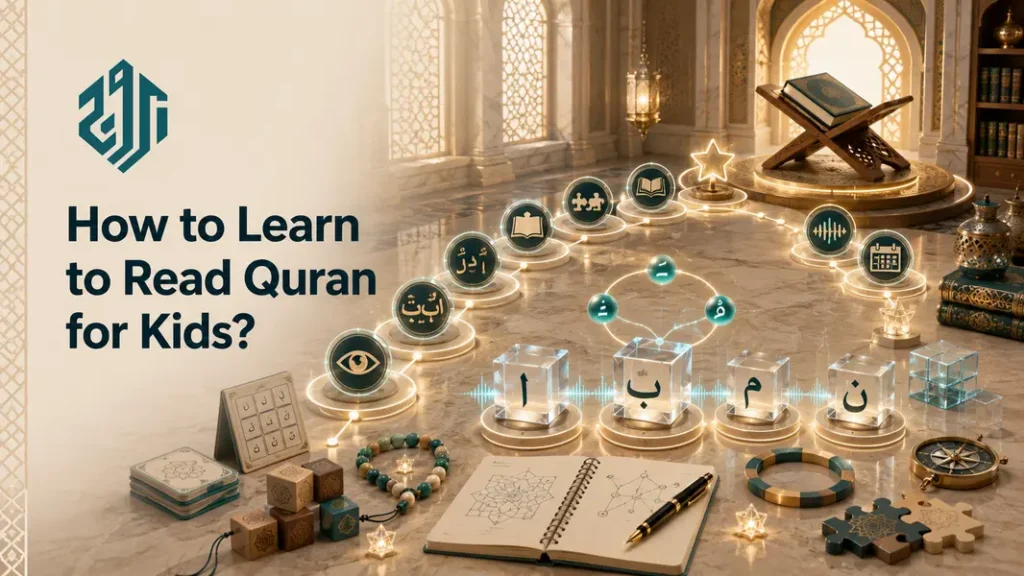
Many parents in the West sit down with their child and a Quran for kids book, unsure where to actually begin. The child stares at unfamiliar letters, the parent doesn’t know how to correct pronunciation, and both walk away frustrated within minutes.
Learning to read Quran as a child follows a specific sequence: alphabet recognition, letter joining, short vowel practice, then guided Quranic text. Skipping steps causes the frustration most families experience early on.
Table of Contents:
Step 1: Assess Your Child’s Readiness Before Starting Formal Quran Lessons
Most children show genuine readiness for Quran reading instruction between ages 4 and 6, once they can recognize basic shapes and sit through a 10-minute focused activity. Readiness isn’t about age alone — it’s about attention span and shape recognition.
In our sessions at Buruj Academy, we’ve noticed a consistent pattern among parents starting too early. They introduce Arabic letters before their child can distinguish visually similar English letters like “b” and “d,” and the child ends up confusing everything.
A simple readiness check works well here. Can your child sit through a short picture book without wandering off? Can they point out differences between two similar shapes, like a circle and an oval?
If your child struggles with either, spend two or three weeks on general pre-reading activities first. Puzzles, shape-sorting games, and short story time all build the visual discrimination skills Quran reading will require.
Parents raising very young children often benefit from starting general Islamic exposure before formal letter instruction.
Our guide on teaching Islam to a child covers age-appropriate first steps that pair naturally with early Quran readiness building.
Step 2: Introduce the Arabic Alphabet Through the Noorani Qaida for Kids
The Noorani Qaida is a structured beginner’s booklet that teaches the 28 Arabic letters, their shapes in different positions, and basic vowel sounds before a child touches actual Quranic text. It remains the standard entry point used by Quran teachers worldwide for non-Arabic speaking children.
Each Arabic letter changes shape depending on its position in a word — beginning, middle, end, or standalone. This is often the first real hurdle Western children face, since English letters don’t behave this way.
We recommend introducing no more than two or three letters per week for children under age 7. Moving faster than this creates the shallow memorization that later causes stumbling during actual recitation.
A certified Noorani Qaida instructor trained in child pedagogy makes a measurable difference here, since correcting shape confusion early prevents habits that are harder to unlearn later.
Buruj Academy’s Noorani Qaida for Kids course uses visual aids, repetition games, and gradual pacing designed specifically around how young learners retain new symbols, guided by instructors experienced in child-friendly teaching methods.
| Letter Position | Example (ب – Baa) | Key Teaching Focus |
| Standalone | ب | Full shape with dot below |
| Beginning of word | بـ | Connects forward, dot remains |
| Middle of word | ـبـ | Connects both sides |
| End of word | ـب | Connects backward only |
Sign up your kid for a free Noorani Qaida lesson
Step 3: Teach the Child Short Vowel Marks Before Introducing Full Quranic Arabic Words
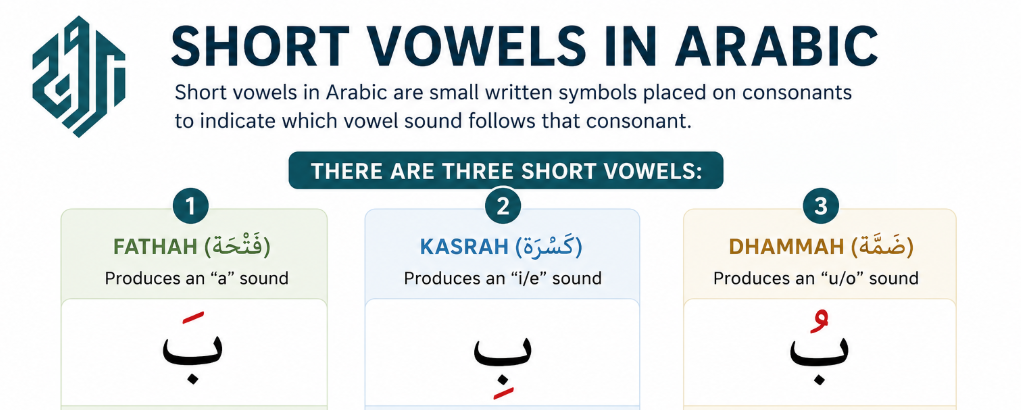
Short vowels in Arabic — Fatha, Kasra, and Dammah — are small marks placed above or below a letter that determine its sound, and they must be mastered before a child can sound out any word. Without solid vowel recognition, word-reading becomes guesswork rather than genuine literacy.
Fatha (a small diagonal stroke above the letter) produces an “a” sound, Kasra (the same stroke below) produces an “i” sound, and Dammah (a small loop above) produces a “u” sound. These three marks combine with every consonant a child has already learned.
We’ve found that children retain these marks fastest through consistent, exaggerated sound modeling rather than written explanation. Saying “ba, bi, bu” clearly while pointing to each mark works better for a 5-year-old than describing what a Fatha technically is.
Flashcards pairing a single letter with each of the three vowel marks give children rapid-fire practice without the added complexity of full words. Five minutes of flashcard drilling daily builds far more automatic recognition than occasional 30-minute sessions.
Once single-letter-plus-vowel combinations feel automatic, two-letter words become the natural next step, keeping early vocabulary limited to common, simple combinations.
Read More: Kids Islamic Poems in Arabic With Translation and Meaning
Step 4: Practice Letter Joining Rules With Simple Two and Three Letter Words
Letter joining is the process of connecting Arabic letters into words, and it introduces genuine reading — as opposed to isolated letter recognition — for the first time. This stage typically takes children the longest to internalize.
Some Arabic letters simply don’t connect to the letter following them, regardless of position. Six letters behave this way: ا, د, ذ, ر, ز, و. Children need to memorize this short list early, since it explains why certain words “break” mid-word visually.
In our teaching experience, students who struggle with joining almost always share one habit — they read each letter in isolation rather than blending the sounds smoothly together, producing a choppy, disconnected reading style.
Short, high-frequency words work best for this stage. Words like بَاب (door) or كَتَبَ (he wrote) give children manageable practice without overwhelming vocabulary.
We generally suggest 15–20 practice words before advancing further, revisited across multiple sessions rather than crammed into one sitting.
Our article on making Quran reading fun for kids includes specific game ideas that keep this repetitive stage engaging rather than tedious.
Read More: Best Personalized Islamic Gifts for Kids
Step 5: Build Reading Fluency With Short Surahs From Juz Amma
Once a child reliably joins letters into words, transitioning into short, familiar surahs from Juz Amma — the Quran’s final section — builds genuine reading confidence through recognizable, frequently-heard text. Familiarity accelerates fluency significantly at this stage.
Surahs like Al-Ikhlas, Al-Falaq, and An-Nas work particularly well as first reading texts, since most children have already heard them recited during daily prayers and already know how they should sound.
مِنْ شَرِّ ٱلْوَسْوَاسِ ٱلْخَنَّاسِ
Min sharril-waswasil-khannas
“From the evil of the retreating whisperer.” (An-Nas 114:4)
This verse demonstrates a Sukoon-marked letter — the “n” sound in “min” — which children encounter naturally once basic vowel reading is solid.
We typically see children move through this stage over 4–6 weeks of consistent daily practice, though pacing varies meaningfully by child. Reading recognizable text motivates children in a way that unfamiliar vocabulary simply doesn’t.
Parents wanting a broader roadmap of appropriate early surahs can review our guide to easy surahs of Quran to memorize, which pairs naturally with this reading-fluency stage even before formal memorization begins.
Book Your Kid’s First Session in Buruj’s Juz 30 Memorization Course
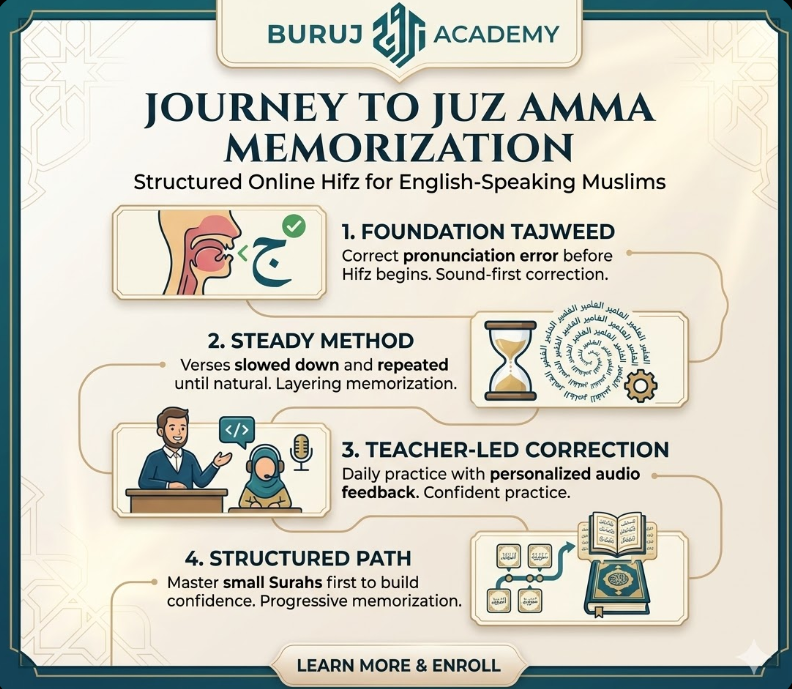
Discover the Buruj Academy Difference
Step into our virtual classrooms and see how our expert instructors make learning Quran and Arabic intuitive and clear. We focus on overcoming the specific hurdles non-native speakers face, building your confidence and connection with the Quran.
Excel in Your Quranic Studies
Join Buruj Academy and master the Quran with our structured, professional curriculum.
Book Your Free TrialStep 6: Introduce Basic Tajweed Rules for the Kid Only After Reading Fluency Is Established
Tajweed — the science of correct Quranic pronunciation — should be introduced gradually and only once a child reads confidently without sounding out each letter individually. Introducing Tajweed rules too early overwhelms children still mastering basic decoding.
The most foundational rule for beginners is Qalqalah, which applies to five letters (ق ط ب ج د) and produces a slight echoing bounce whenever one of them carries a Sukoon (vowel-less marker).
Students who struggle with Qalqalah almost always share one habit in our experience — they stop the letter abruptly rather than releasing it with the required slight echo, flattening a sound that should bounce.
We recommend introducing just one or two simple rules at this stage, layered gently over the reading skills your child has already built rather than taught as abstract theory.
Buruj Academy’s Tajweed for Kids course applies the Buruj Method’s sound-before-rules approach here, letting children hear and imitate correct pronunciation before memorizing rule names, taught by Ijazah-certified instructors experienced with young learners.
For families wanting a broader foundation once basics feel steady, our guide on Tajweed rules for kids expands on age-appropriate sequencing.
Read More: How to Learn Quranic Arabic Free?
Step 7: Establish a Consistent Daily Practice Routine Rather Than Occasional Long Sessions
Short, daily Quran reading sessions of 10–15 minutes produce dramatically better long-term retention in children than infrequent 45-minute sessions squeezed in once or twice a week. Consistency, not duration, drives lasting progress.
Young children’s attention spans simply cannot sustain focused letter-recognition work much beyond 15 minutes, and pushing past that limit often creates negative associations with the entire activity.
We’ve observed that families who anchor practice to a fixed daily time — right after Fajr, or immediately before bedtime — maintain the habit far longer than those practicing “whenever there’s time,” since the routine itself removes the daily decision-making friction.
| Age Group | Recommended Session Length | Ideal Frequency |
| Ages 4–6 | 10 minutes | Daily |
| Ages 7–9 | 15 minutes | Daily |
| Ages 10+ | 20–25 minutes | Daily |
This progression reflects natural attention span development rather than arbitrary scheduling.
Parents managing multiple children or busy schedules may find our piece on Quran learning tools for kids useful for structuring sustainable routines around real family life.
Read More: The Best Online Quran Classes with Tajweed for Kids
Step 8: Use Positive Reinforcement to Maintain Motivation Through Learning Plateaus
Nearly every child hits a plateau somewhere in the letter-joining or early-fluency stage, where progress feels invisible despite continued daily effort — and how parents respond during this phase often determines whether the child continues or gives up. Encouragement matters more here than correction.
Small, consistent rewards work better than large, infrequent ones for sustaining a young child’s motivation. A sticker chart marking each completed session gives visible, immediate proof of progress that a distant goal simply can’t provide.
Before Buruj Method’s structured milestone tracking, many families we’ve worked with measured progress only by “how much Quran was covered,” missing the smaller wins — smoother joining, faster recall — that actually indicate real growth underneath.
Celebrating small milestones out loud, like correctly reading an entire line without help for the first time, reinforces the specific behavior you want repeated rather than praising effort in vague, generic terms.
The Prophet Muhammad ﷺ said, “The best among you are those who learn the Qur’an and teach it.” (Sahih al-Bukhari 5027)
This principle applies directly to parents guiding their own children — the effort itself carries significant reward, regardless of pace.
Read also: Simple and Effective Ways to Teach the Quran to Kids
Step 9: Involve Your Child in Selecting Learning Materials to Increase Engagement
Letting children choose between a few parent-approved Quran learning resources — a particular workbook design, a specific colorful chart, or which app to use for practice — meaningfully increases their sense of ownership over the learning process. Choice, even limited choice, builds investment.
Children who feel some control over how they learn generally show greater willingness to sit down for daily sessions compared to children whose entire routine is dictated without their input.
This doesn’t mean abandoning structure. Parents still choose the overall curriculum and pacing; children simply select between equally appropriate options within that structure.
Our roundup of the best Quranic games for kids offers several engaging options families can review together, letting the child pick favorites while still tracking clear educational progress underneath the fun.
Read More: Should Muslims Read the Quran in Arabic?
Let Your Kid Learn Quran Reading With Buruj Academy’s Expert-Guided Kids Program
Teaching a child to read Quran well requires patient sequencing, correct pronunciation modeling, and consistent daily practice — challenging to sustain alone without training. Buruj Academy’s Online Quran Classes for Kids removes that guesswork entirely.
Our Al-Azhar University graduate and Ijazah-certified instructors bring 12+ years of experience teaching non-Arabic speaking children specifically, using the Buruj Method’s sound-before-rules approach.
Every child receives a Personalized Learning Plan matched to their age, attention span, and current reading level.
Sessions run 1-on-1 online with flexible 24/7 scheduling, giving busy Western families genuine control over when lessons happen. Instructors provide real-time pronunciation correction your child simply cannot get from an app alone.
Book a free trial lesson today and let our Online Quran Classes for Kids course show you exactly how structured, expert guidance transforms this learning journey.
Enroll your child in one of our specialized, kid-friendly tracks today:
- Online Quran Classes for Kids
- Tajweed Classes for Kids
- Hifz Classes for Kids
- Online Arabic Classes for Kids
- Quranic Arabic Course for Kids
- Noorani Qaida Course for Kids
- Islamic Studies Classes for Kids
Ready to watch your child grow in knowledge and character? Join the Buruj Academy family and book a free trial session for your child today!
Excel in Your Quranic Studies
Join Buruj Academy and master the Quran with our structured, professional curriculum.
Book Your Free TrialConclusion
Teaching a child to read Quran works best as a sequence, not a single leap — shapes before sounds, sounds before words, words before fluency, fluency before Tajweed. Rushing any stage tends to create the exact frustration parents hope to avoid.
What actually moves children forward is unglamorous: short daily sessions, patient correction, and small visible wins along the way. Consistency beats intensity every time with young learners.
Parents don’t need to master Tajweed themselves to start this journey well. Structured guidance, whether from a qualified instructor or a well-sequenced home routine, matters far more than parental expertise at the outset.
Frequently Asked Questions About Teaching Kids to Read Quran
What Age Should a Child Start Learning to Read Quran?
Most children show genuine readiness between ages 4 and 6, once they can recognize shapes and sit through short focused activities. Readiness depends more on attention span and visual discrimination skills than on age alone, so individual pacing matters.
How Long Does It Typically Take a Child to Learn to Read Quran?
Timelines vary significantly by child and consistency, but many children move from alphabet recognition through basic reading fluency within 6–12 months of regular daily practice. Consistent short sessions matter far more than occasional long ones for this timeline.
Should Tajweed Be Taught Alongside Basic Reading?
No, basic Tajweed rules should generally wait until a child reads confidently without sounding out individual letters. Introducing pronunciation rules too early alongside basic decoding tends to overwhelm young learners still mastering foundational skills.
Is the Noorani Qaida Necessary Before Reading the Quran Itself?
Yes, the Noorani Qaida remains the standard foundational step for non-Arabic speaking children, since it isolates alphabet recognition, positional letter shapes, and vowel marks before introducing full Quranic text. Skipping it often causes confusion later.
Can Parents Teach Quran Reading at Home Without a Qualified Instructor?
Parents can support early readiness activities at home, but correcting Arabic pronunciation and letter articulation accurately without training is genuinely difficult. A qualified instructor helps prevent habits that become harder to correct once established.