 Quran
Quran
| Key Takeaways |
| Correct makharij (articulation points) form the non-negotiable foundation of a beautiful Quran recitation voice. |
| Daily 15–20 minute focused voice training sessions produce measurable recitation improvement within 4–6 weeks. |
| Ghunnah resonance, proper breath control, and medd elongation are the three pillars of a melodious Quranic voice. |
| Listening to verified Qaris daily recalibrates the ear, which directly accelerates vocal improvement in recitation. |
| Tajweed rules and voice training must develop together — sound without precision, or precision without sound, both fall short. |
Many students ask us how to improve their Quran recitation voice after years of reading correctly but feeling their recitation still lacks beauty. The voice is an instrument — and like any instrument, it responds to structured, intentional training.
Improving your Quran recitation voice combines three disciplines: Tajweed precision, vocal technique, and consistent ear training. When these three elements develop together under qualified guidance, the result is recitation that is both technically accurate and genuinely moving to hear.
Table of Contents:
1. Build Correct Makharij Before Attempting Any Voice Work
Proper articulation points — makharij al-huruf — are the non-negotiable starting point for anyone serious about improving their Quran recitation voice.
Without correct makharij, voice training builds beauty on a faulty foundation, and bad habits become progressively harder to correct.
Each Arabic letter emerges from a precise point in the vocal tract. Our Al-Azhar-trained instructors identify 17 articulation points across five regions: the oral cavity (jawf), throat (halq), tongue (lisan), lips (shafatan), and nasal passage (khayshum).
In our sessions at Buruj Academy, the most common error we observe in adult beginners is confusing ع (Ayn) and أ (Hamza) — both seem similar but emerge from completely different throat positions. Correcting this single error alone dramatically changes a student’s recitation quality within weeks.
Before working on vocal beauty, spend two to three weeks isolating each letter’s makhraj. Our detailed resource on makharij al-huruf walks through each articulation point with clear guidance for non-Arabic speakers.
Through Buruj Academy’s Online Quran Recitation course, students receive systematic makharij correction from Ijazah-certified instructors before any advanced voice technique is introduced.
Book your first FREE recitation lesson

2. Master Breath Control as the Engine of Recitation
Beautiful Quran recitation depends on controlled, sustained breath — not lung capacity alone, but the ability to regulate airflow precisely throughout a verse. Breath is the physical engine behind every elongation, every ghunnah, and every waqf (pause).
How to Practice Diaphragmatic Breathing for Recitation?
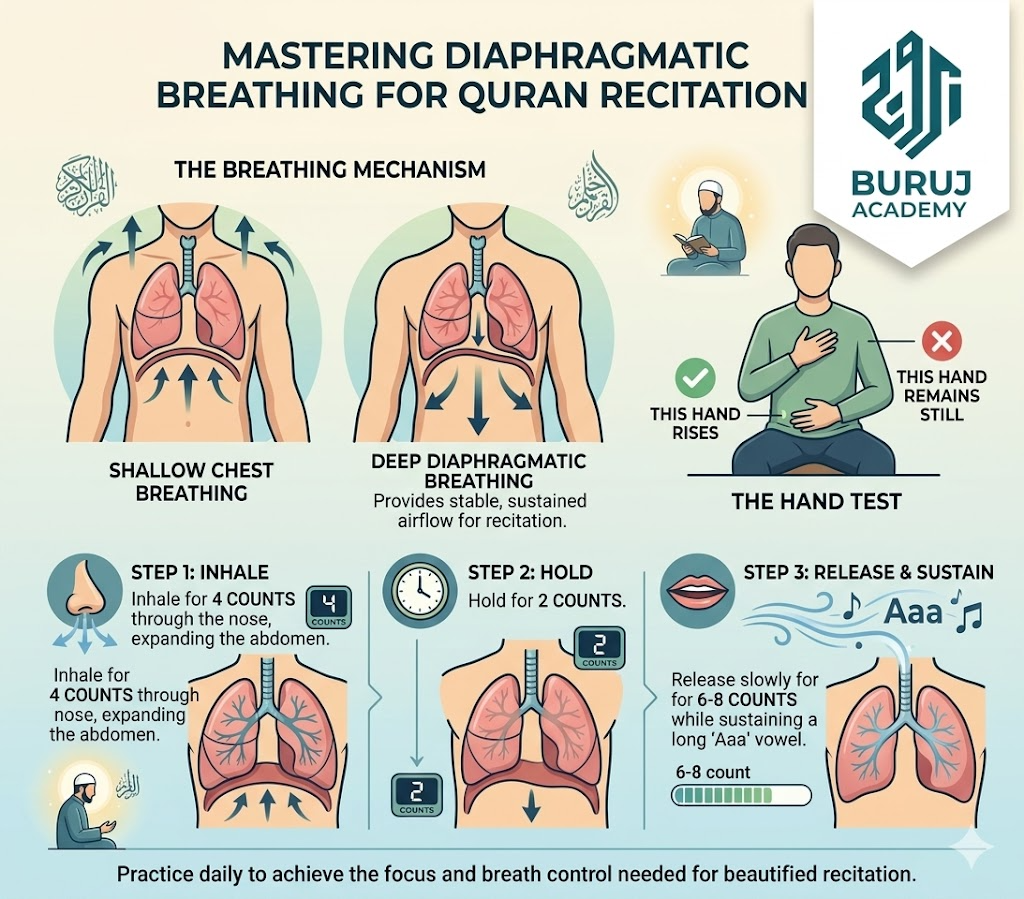
Diaphragmatic breathing — breathing from the lower abdomen rather than the chest — provides the stable, sustained airflow Quran recitation demands. Place one hand on your chest and one on your abdomen; during a correct breath, only the lower hand should rise.
Practice this daily:
- Inhale for 4 counts through the nose, expanding the abdomen
- Hold for 2 counts
- Release slowly for 6–8 counts while sustaining a vowel sound (such as a long “aaa”)
How Long Should You Practice Breath Control Daily?
Ten minutes of daily breath control exercises — practiced before recitation — produces noticeable stamina improvement within three to four weeks, in our instructors’ experience. Students who skip this step consistently struggle with running out of breath mid-verse, which forces unnatural waqf positions.
| Breath Exercise | Duration | Goal |
| Diaphragmatic inhale/hold/release | 5 minutes | Build controlled airflow |
| Sustained vowel on single breath | 3 minutes | Extend breath capacity |
| Recite one ayah per breath | 2 minutes | Apply control to real text |
This table represents a simple daily routine — adapt timing to your current capacity and increase gradually.
3. Train Your Ear Daily by Listening to Verified Qaris
The ear teaches the voice. Before a student can produce beautiful recitation, they must first internalize what beautiful recitation sounds like — at a granular, letter-by-letter level, not just as general melody.
Select one reciter whose style you want to develop, and listen to their recitation of specific surahs with full attention daily for 15–20 minutes.
Do not listen passively in the background. Listen actively, tracking each letter’s pronunciation, each elongation’s length, and each pause position.
Which Qaris Are Recommended for Voice Training?
The following reciters represent a range of styles recognized for both Tajweed precision and vocal beauty:
| Qari | Style | Ideal For |
| Sheikh Mahmoud Khalil Al-Husary | Slow, precise, pedagogical | Beginners learning rules |
| Sheikh Abdul Basit Abdus Samad | Mujawwad, full melodic | Intermediate voice development |
| Sheikh Mishary Rashid Al-Afasy | Clear, modern, accessible | Everyday training model |
| Sheikh Saad Al-Ghamdi | Murattal, steady pace | Consistent daily listening |
Choose one reciter, not several. Mixing styles early in training creates inconsistency. After six months of focused listening, you will naturally begin to hear and self-correct errors in your own recitation.

4. Apply Ghunnah Resonance Correctly to Add Depth to Your Voice
Ghunnah — the nasal resonance produced through the nasal passage — is one of the most powerful tools for adding depth and beauty to Quran recitation. It applies to Noon mushaddad (نّ) and Meem mushaddad (مّ), and to Noon sakinah and Tanween under specific Tajweed rules.
The duration of ghunnah is fixed at two counts (harakatayn) in standard recitation. Extending or shortening it is a Tajweed error — not a stylistic choice.
In our experience at Buruj Academy, students who struggle with ghunnah almost always make the same mistake: they produce the nasal sound from the throat rather than directing airflow exclusively through the nasal passage.
A simple self-check is to pinch the nose while producing the ghunnah — if the sound stops completely, the nasal passage is engaged correctly.
Our detailed guide on ghunnah and its rules covers every application context with clear examples from Quranic text.
Read also: How to Recite the Quran?
5. Use Madd (Elongation) Rules to Create Natural Vocal Flow
Madd — Quranic elongation — is not merely a Tajweed rule. It is the rhythmic structure that gives recitation its flowing, melodic quality. Applying madd lengths correctly and consistently is what separates flat recitation from recitation that moves the listener.
The foundation is Madd Asli (natural elongation), which extends alif, waw, and ya letters by exactly two counts wherever they appear. This baseline must be automatic before tackling extended madd types.
| Madd Type | Duration (Counts) | Trigger |
| Madd Asli (Natural) | 2 | Long vowel with no hamzah or sukoon following |
| Madd Muttasil | 4–5 | Long vowel followed by hamzah in same word |
| Madd Munfasil | 2–4-5 | Long vowel followed by hamzah in next word |
| Madd Lazim | 6 | Long vowel followed by sukoon or shaddah |
Our full guide on Madd Asli explains the natural elongation foundation that every other madd type builds upon.
Practicing madd lengths with a metronome — setting one beat per count — removes guesswork and builds the internal rhythm that experienced reciters carry automatically.
6. Recite Aloud Daily Using Targeted Short Portions
The single most overlooked element in voice training for Quran recitation is consistent, audible daily practice.
Reading silently in your head does not train the voice. The vocal mechanism — larynx, tongue, lips, breath — improves only through repeated, intentional physical use.
We recommend 15–20 minutes of focused daily recitation aloud, using short portions of text rather than racing through long sections.
Three ayaat recited carefully, with full attention to makharij, ghunnah, and madd — repeated five to six times — achieves more than twenty ayaat recited hastily.
Should You Record Your Own Recitation?
Recording yourself is one of the most effective self-correction tools available. Hearing your own voice played back allows you to identify errors your mind automatically overlooks in real time — muffled makharij, rushed elongations, inconsistent ghunnah length.
Record one short surah weekly. Compare it to your chosen reciter’s version of the same surah. Note three specific differences and focus your next week’s practice on those points.
Excel in Your Quranic Studies
Join Buruj Academy and master the Quran with our structured, professional curriculum.
Book Your Free Trial7. Learn Waqf and Ibtida Rules to Recite with Correct Phrasing
How to recite the Quran beautifully is inseparable from knowing where to pause and where to continue. Waqf (stopping) and ibtida (resuming) rules govern the phrasing of recitation — and incorrect pausing can alter meaning entirely while also breaking the natural vocal flow.
The Quran’s text contains waqf markers that guide readers on permissible, preferable, impermissible, and required stops. The most important markers are:
| Symbol | Name | Recitation Instruction |
| مـ | Waqf Lazim | Mandatory stop |
| لا | Waqf Mamnu’ | Prohibited stop |
| ج | Waqf Ja’iz | Permissible stop |
| صلي | Al-Wasl Awla | Continuation preferred |
| قلي | Al-Waqf Awla | Stop preferred |
| ∴ ∴ | Waqf Mu’anaqah | Stop at one of two points only |
Understanding these markers transforms recitation from a word-by-word exercise into a coherent, flowing act of worship.
For students beginning to explore Tajweed systematically, our Tajweed for Beginners guide provides the rule foundation that makes waqf positions meaningful rather than arbitrary.
Discover the Buruj Academy Difference
Step into our virtual classrooms and see how our expert instructors make learning Quran and Arabic intuitive and clear. We focus on overcoming the specific hurdles non-native speakers face, building your confidence and connection with the Quran.
8. Correct Tafkhim and Tarqiq Errors to Refine Your Vocal Tone
Tafkhim (heaviness) and Tarqiq (lightness) — the tonal weight of Arabic letters — significantly shape the sound quality of recitation. Letters of tafkhim produce a full, resonant sound; letters of tarqiq are light and forward in the mouth. Mixing these up creates a recitation that sounds tonally inconsistent to trained ears.
The seven letters of tafkhim are: خ، ص، ض، ط، ظ، غ، ق — along with the letter ر under specific conditions, and the majestic name of Allah (لفظ الجلالة) after a fatha or damma.
In our experience, non-Arabic speaking students consistently pronounce ق (Qaf) too far forward, losing its deep, heavy quality — and pronounce ر (Ra) too heavily in all positions, not recognizing when tarqiq applies.
Our resource on heavy and light letters in Tajweed covers the complete tafkhim and tarqiq framework with practical guidance.
Through Buruj Academy’s Online Tajweed Classes, Ijazah-certified instructors provide real-time tonal correction — something no recorded resource can replicate.
Book Your FREE Trial Lesson to Begin Your Tajweed Journey

9. Work with a Qualified Tajweed Teacher for Real-Time Correction
All the self-study strategies above accelerate significantly — and avoid compounding errors — when paired with qualified instruction. The Prophet ﷺ received the Quran through a chain of direct oral transmission, and the tradition of learning recitation with a teacher is foundational to authentic Quran education.
According to the hadith recorded in Sahih al-Bukhari, the Prophet ﷺ said: “The best of you are those who learn the Quran and teach it.” This hadith (Bukhari: 5027) is understood by scholars to refer to learning through proper oral transmission with a teacher — not self-study alone.
A qualified teacher provides three things no self-study resource can:
- Immediate error detection — catching mistakes before they solidify into habits
- Personalized progression — identifying which specific errors most impact your recitation
- Motivational accountability — maintaining the consistency that self-study rarely sustains
Buruj Academy’s Tajweed Beginners course is specifically designed for non-Arabic speakers who want to build correct recitation from the ground up, with Al-Azhar-trained instructors who have 12+ years of experience teaching students across the English-speaking world.
Book Your FREE Trial Lesson to Begin Your Tajweed Journey
10. Understand the Difference Between Mujawwad and Murattal Recitation Styles
How to recite Quran beautifully also depends on understanding which recitation style suits your goal. There are two recognized stylistic modes in classical Tajweed science:
Mujawwad recitation applies full melodic embellishment — extended madd, rich tonal variation, and deliberate pacing. This style is used in formal recitation contexts and requires advanced vocal and Tajweed mastery.
Murattal recitation is steady, clear, and moderately paced — the style most commonly used for daily prayer and personal recitation. It applies all Tajweed rules without additional melodic elaboration.
Most students should focus on Murattal first. Attempting Mujawwad-style melodic recitation before mastering Murattal precision produces recitation that sounds stylized but is Tajweed-deficient — which is a more serious problem than plain but correct recitation.
Once Murattal recitation is solid — correct makharij, consistent madd, proper ghunnah — students may explore melodic embellishment under the guidance of a qualified instructor.
Read also: Islamic Quran Memorization and Recitation Challenges
Strengthen Your Recitation with Buruj Academy’s Expert Teachers
Beautiful, accurate Quran recitation is achievable for every Muslim — at any age, with any background — when the right steps are followed in the right order.
Buruj Academy offers:
- Ijazah-certified instructors and Al-Azhar University graduates
- 12+ years of teaching non-Arabic speaking students worldwide
- The Buruj Method: Sound-before-rules — training the ear before teaching written rules
- Personalized 1-on-1 online sessions with real-time pronunciation correction
- Flexible scheduling across all time zones, 24/7
- Clear progression from foundational makharij to advanced recitation mastery
Book your free trial lesson with Buruj Academy today and receive personalized feedback on your recitation from a qualified instructor.
Take the next step in your learning journey today by enrolling in one of our specialized programs:
- Online Quran Classes
- Online Quran Classes for Beginners
- Online Quran Classes for Adults
- Online Quran Classes for Ladies
- Online Quran Classes for Kids
- Quran Reading Course
- Quran Recitation Course
- Online Ijazah Course
- Online Qirat Course
Don’t wait to transform your relationship with the Holy Quran. Join our global community of students and book your free evaluation session now!
Visit Buruj Academy’s free trial page to get started — no commitment required.
Excel in Your Quranic Studies
Join Buruj Academy and master the Quran with our structured, professional curriculum.
Book Your Free TrialConclusion
Improving your Quran recitation voice is not about talent — it is about applying the right techniques in the right sequence, with consistency and qualified guidance.
Correct makharij, controlled breath, proper ghunnah, accurate madd, and daily audible practice form the complete framework. Each step reinforces the others, and the compounding effect over weeks and months is remarkable.
The Quran deserves to be recited with both precision and beauty. With structured training and a committed teacher, that standard is within reach — Insha’Allah.
Frequently Asked Questions About How to Improve Quran Recitation Voice
How Long Does It Take to Improve Quran Recitation Voice with Daily Practice?
Most students see meaningful improvement in recitation clarity within four to six weeks of daily 15–20 minute focused practice. Achieving consistent tonal beauty — correct tafkhim, smooth madd, natural ghunnah — typically requires three to six months of structured training with a qualified teacher providing regular feedback and correction.
Is It Possible to Learn How to Recite the Quran Beautifully Without a Natural Musical Voice?
Yes. Beautiful Quran recitation is built on Tajweed precision and correct articulation — not on natural musical ability. Many students with ordinary speaking voices develop genuinely moving recitation through systematic makharij correction, breath training, and consistent practice. A pleasant voice is a gift, but correct recitation is an acquired skill.
How Do I Recite the Quran Beautifully in Salah When I Am Nervous?
Nervousness in Salah recitation is almost always caused by uncertainty — not knowing whether a recitation is correct. The solution is accuracy before beauty. When makharij and Tajweed rules are internalized through consistent practice, recitation becomes automatic and anxiety significantly decreases. Daily recitation aloud — even outside Salah — builds the confidence that transfers into prayer.
Which Surah Should Beginners Use for Quran Recitation Voice Practice?
Surah Al-Fatiha and the short surahs of Juz Amma are ideal for voice training because they are short, frequently recited, and cover a wide range of Tajweed applications. For students who want a structured approach to learning these surahs with correct recitation from the start, our guide on reading the Quran for the first time provides a clear starting framework.