 Arabic

Staring at a verse you’ve recited a thousand times without knowing what it means is a specific kind of frustration many of our students describe.
Quranic Arabic, the classical register found in the Quran, can be learned for free through structured self-study using root-word analysis, grammar resources, and verse-by-verse tools like the Quranic Arabic Corpus.
This guide breaks that process into a sequence any beginner can follow, starting today, with Buruj Academy examples drawn directly from the Quran.
Table of Contents:
1. Understand Why Quranic Arabic Differs From Everyday Arabic Matters First
Quranic Arabic is the classical, 7th-century register of Arabic used throughout the Quran, distinct from Modern Standard Arabic (MSA) in vocabulary, syntax, and rhetorical density. It relies heavily on root-word patterns, elliptical phrasing, and grammatical structures rarely used in daily conversation. Recognizing this distinction early prevents a common beginner mistake.
Many students assume MSA fluency automatically unlocks Quranic comprehension. In our sessions at Buruj Academy, we consistently see the opposite pattern with heritage speakers who grew up hearing conversational Arabic at home.
They read the Quran’s script fluently but stumble on words like إِيَّاكَ (iyyaka, “You alone”) because classical constructions rarely appear in everyday speech.
Quranic Arabic also uses a smaller, more concentrated vocabulary than modern Arabic overall. Linguists studying the Quran’s text have long noted that a relatively limited set of root words, repeated across derived forms, accounts for the majority of the text.
This repetition is precisely why root-word study, covered in Step 3 below, becomes the single highest-leverage skill for free learners.
Before diving into resources, it helps to understand what a structured program teaches versus what self-study covers gradually.
Buruj Academy’s Quranic Arabic classes guide students through grammar and vocabulary systematically with Al-Azhar University graduates specializing in Quranic linguistics, using the context-before-abstraction method rather than isolated grammar drills.
Begin Understanding Quranic Arabic with a FREE Lesson
Free learners can replicate much of this structure with the tools below, though pacing and error correction typically move faster with an instructor present.
Table: Quranic Arabic vs Modern Standard Arabic at a Glance
| Feature | Quranic Arabic | Modern Standard Arabic |
| Vocabulary source | Classical roots, 7th-century usage | News media, academic, contemporary |
| Sentence structure | Often elliptical, rhetorical | Generally direct, linear |
| Primary use today | Recitation, Tafsir, Islamic study | Media, education, formal writing |
| Grammar emphasis | I’rab (case endings) heavily active | Case endings often relaxed in speech |
This table clarifies why a learner fluent in one register may still need dedicated Quranic Arabic study.
2. Build an Arabic Alphabet and Pronunciation Foundation With Free Resources
Solid alphabet mastery and correct pronunciation must precede grammar study, since misreading letters compounds every later mistake in vocabulary and meaning.
This foundation typically takes non-Arabic speakers two to four weeks of consistent daily practice before letters, short vowels, and basic reading feel automatic. Skipping this step is the single most common reason free self-study stalls.
Free resources for this stage include Noorani Qaida PDFs, YouTube channels demonstrating makharij (articulation points), and mobile apps offering letter-tracing practice.
Students should focus first on distinguishing similar-sounding letters like ص and س, or ح and ه, since English lacks equivalent sounds for several Arabic consonants.
In our experience, students who rush past this stage to reach “real” grammar often develop pronunciation habits that take far longer to correct later.
Our related guide on reading the Quran for the first time covers this foundational stage in more depth for complete beginners.
How Do Beginners Practice Makharij Without a Teacher for Free?
Beginners can practice makharij using free video demonstrations that show tongue and lip positioning, paired with audio comparison against a certified reciter’s recitation. Recording your own voice and comparing it against a Qari’s recitation of the same verse reveals gaps that silent reading alone won’t expose.
This self-correction method works, but has a real limitation: learners often cannot hear their own errors accurately, especially early on.
Our article on makharij al-huruf details each articulation point precisely, and our Noorani Qaida online course pairs this reading with live correction from instructors trained specifically in beginner phonetics.
Book your FREE trial lesson in the Noorani Qaida course
3. Learn the Roughly Twenty Core Grammar Rules That Unlock Most Quranic Text
A defined set of foundational grammar rules, covering noun-verb distinction, gender agreement, definite articles, and basic sentence types, accounts for the grammatical backbone behind most Quranic sentences.
Free learners who master this core set before attempting broader Arabic grammar textbooks report faster comprehension gains, since Quranic sentences repeat these same structural patterns constantly.
Key concepts to prioritize include the difference between الاسم (noun) and الفعل (verb), how إعراب (I’rab, case endings) signals grammatical role, and how المضاف والمضاف إليه (possessive constructions) function.
These patterns appear in nearly every surah, so learning them once pays dividends across the entire Quran rather than in isolated verses.
Consider the opening of Surah Al-Fatiha:
الْحَمْدُ لِلَّهِ رَبِّ الْعَالَمِينَ
Alhamdu lillahi rabbil-‘alameen
“All praise is due to Allah, Lord of the worlds.” (Al-Fatiha 1:2)
Grammar note: الْحَمْدُ is a definite noun marked by the definite article “ال,” while لِلَّهِ combines the preposition “لِ” with Allah’s name, illustrating basic prepositional attachment students should recognize immediately.
Read also:How to Conjugate the Arabic Past Tense
Free Resources for This Stage
Free resources for this stage include Bayyinah TV’s Arabic With Husna series, Madinah Arabic’s free grammar books, and the Quranic Arabic Corpus’s morphological breakdowns, which tag every word in the Quran by grammatical function.
What Grammar Concepts Should Beginners Prioritize First?
Beginners should prioritize noun-verb distinction, definite articles, gender agreement, and the three basic case endings before moving to more complex conditional or subjunctive structures.
These four areas alone explain the majority of sentence-level confusion new learners report during their first months of study.
Our guide on tajweed for beginners complements grammar study, since correct recitation reinforces correct word boundaries and case-ending pronunciation simultaneously.
Get Your Free Trial Quranic Arabic Grammar Lesson

Discover the Buruj Academy Difference
Step into our virtual classrooms and see how our expert instructors make learning Quran and Arabic intuitive and clear. We focus on overcoming the specific hurdles non-native speakers face, building your confidence and connection with the Quran.
Master the Arabic Language
Join our expert-led courses and build a strong foundation in Classical and Modern Arabic.
Get Your Free Trial4. Study Root Words as the Fastest Free Path to Quranic Vocabulary
Arabic vocabulary organizes around three-letter root words, and each root generates multiple derived forms sharing a core meaning, making root study the single most efficient vocabulary-building method available to free learners.
Recognizing one root can unlock recognition of dozens of related words scattered throughout the Quran.
Take the root ع-ل-م (‘ayn-lam-mim), meaning “knowledge.” From this single root come عَالِم (scholar), عِلْم (knowledge), مَعْلُوم (known), and يَعْلَمُ (he knows), among many others.
Once a student internalizes this root, encountering any of its derivatives across different surahs becomes immediately recognizable rather than requiring fresh memorization each time.
This pattern appears clearly in a well-known verse:
وَقُل رَّبِّ زِدْنِي عِلْمًا
Wa qul rabbi zidni ‘ilma
“And say, ‘My Lord, increase me in knowledge.'” (Ta-Ha 20:114)
Grammar note: عِلْمًا carries the accusative case ending, signaling it functions as the object being asked for, a pattern that repeats across countless supplication verses.
In our experience, students who spend even fifteen minutes daily studying root families for two months typically recognize a noticeably larger share of common Quranic vocabulary than students who memorize word lists without root context.
The free Quranic Arabic Corpus (corpus.quran.com) tags every word’s root, making this study method directly accessible without cost.

How Many Root Words Cover Most of the Quran’s Vocabulary
A relatively small, concentrated set of root words, repeated across their many derived forms, accounts for a large share of total word occurrences throughout the Quran’s text.
This concentration is exactly why root-based study outperforms linear vocabulary memorization for free learners working without a structured curriculum.
Focusing on the most frequently occurring roots first, rather than studying surahs in sequential order, produces faster practical comprehension for learners with limited daily study time.
Read More: Quranic Verses About the Quran
5. Use Free Digital Tools to Read the Quran Word by Word With Grammar Tags
Word-by-word Quran applications overlay each Arabic word with its root, grammatical function, and literal translation, allowing learners to study any verse as a self-contained grammar lesson without needing a textbook open simultaneously.
This method transforms daily Quran reading into active grammar reinforcement rather than passive recitation.
The Quranic Arabic Corpus, hosted by the University of Leeds, remains the most comprehensive free tool for this purpose, tagging every word in the Quran with full morphological analysis.
Quran.com’s word-by-word feature and the Ayat app offer similar functionality with simpler interfaces suited to complete beginners.
Students should read the same short passage repeatedly across several days, checking the word-by-word breakdown each time until the grammar becomes recognizable without assistance. This repetition builds pattern recognition faster than moving through new verses daily without reinforcement.
Our related guide on how to get better at reading Quran offers additional practice strategies that pair naturally with this word-by-word method.
Free Word-by-Word Quran Tools Compared
| Tool | Best For | Key Feature |
| Quranic Arabic Corpus | Deep morphological study | Full grammar tagging per word |
| Quran.com word-by-word | Daily reading practice | Simple root and translation overlay |
| Ayat app | Mobile, on-the-go review | Audio paired with word breakdowns |
| Lane’s Lexicon (archive.org) | Classical meaning depth | Extensive root definitions |
Read also:Easy Tips to Memorize Surah Al-Mulk
6. Follow Free Structured Courses Instead of Scattered Resources
Free structured courses, offered by platforms like Bayyinah TV, provide sequenced lessons building from basic grammar to full comprehension, which prevents the disorganized, gap-filled learning that often results from randomly combining YouTube videos and apps. Sequence matters as much as content quality for retention.
Nouman Ali Khan’s Bayyinah TV offers free introductory Arabic grammar content structured specifically around Quranic examples rather than generic Arabic textbooks, making every lesson immediately applicable to actual verses.
This surah-anchored approach helps students see grammar rules functioning in real revelation rather than in abstract sentences.
We’ve observed that students following a sequenced free course for at least three months, rather than jumping between unrelated resources weekly, retain grammar concepts more consistently.
Scattered study creates gaps students often don’t notice until they try reading an unfamiliar surah and realize foundational pieces are missing.
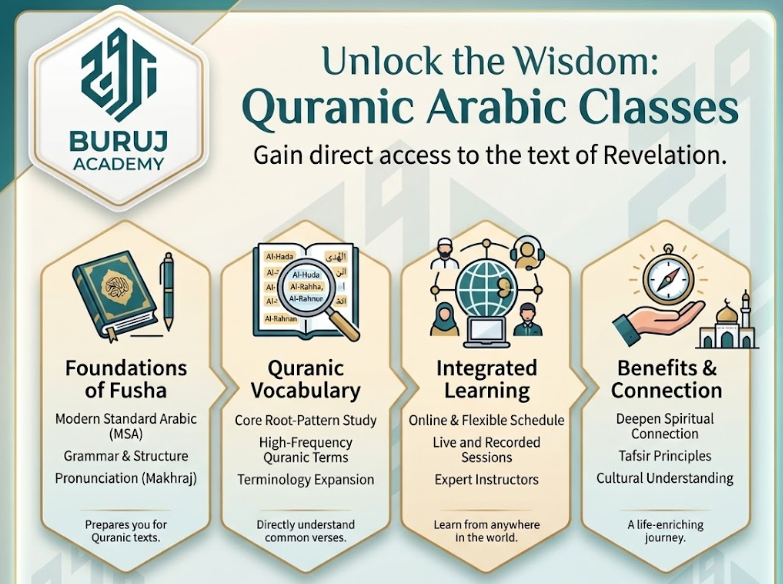
For learners who reach the limits of free structured content and want continued sequencing with feedback, Buruj Academy’s Quranic Arabic for beginners course extends this same sequenced approach with live instructor correction, building on whatever free-resource foundation a student has already established.
Begin Understanding Quranic Arabic with a FREE Lesson
7. Practice Daily Recitation While Actively Translating What You Read
Reading Quranic verses aloud while consciously translating them, rather than reciting on autopilot, converts routine daily recitation into continuous grammar and vocabulary reinforcement without requiring separate dedicated study time. This dual-purpose practice suits learners balancing work, family, or school alongside language study.
Choose a short surah already memorized or familiar from daily prayer, then pause after each verse to identify the subject, verb, and object before checking a translation.
Over weeks, this active pause-and-translate habit builds automatic recognition that passive listening alone doesn’t develop.
Consider this verse, frequently recited and grammatically instructive:
فَاذْكُرُونِي أَذْكُرْكُمْ وَاشْكُرُوا لِي وَلَا تَكْفُرُونِ
Fadhkuruni adhkurkum washkuru li wa la takfuroon
“So remember Me; I will remember you. And be grateful to Me and do not deny Me.” (Al-Baqarah 2:152)
Grammar note: فَاذْكُرُونِي demonstrates an imperative verb form with an attached object pronoun, “ونِي” meaning “Me,” a pattern repeated throughout the Quran’s commands.
Our guide on how to start reading Quran daily offers a practical framework for building this consistency without it feeling like an additional burden on an already full schedule.
Read More: Basic Arabic Words With Pronunciation
8. Join Free Community Study Groups for Accountability and Correction
Study groups, whether local mosque circles or free online forums like Quran study Discord servers and Reddit’s r/LearnQuranicArabic community, provide peer accountability and basic error-spotting that solo study cannot replicate. Learning alongside others also sustains motivation through inevitable plateaus.
Community members can flag obvious mistakes, share free resource recommendations, and discuss verse meanings collaboratively, which surfaces interpretations and grammar nuances a solo learner might overlook entirely.
Regular group meetings also create the external commitment many self-taught learners need to maintain consistency.
That said, peer correction has clear limits. Community members are typically fellow learners rather than certified instructors, so errors in pronunciation or grammar can go uncorrected or, occasionally, get reinforced incorrectly.
This is where the gap between free peer study and certified instruction becomes most apparent for students pursuing genuine accuracy.
Read More: Should Muslims Read the Quran in Arabic?
Master Quranic Arabic With Buruj Academy’s Expert Instructors
Free resources build a genuine foundation, but structured guidance closes the gaps self-study leaves behind.
Buruj Academy’s Quranic Arabic Classes, taught by Al-Azhar University graduates and Ijazah-certified instructors with over 12 years teaching non-Arabic speakers, apply the Buruj Method’s context-before-abstraction approach.
Students receive personalized 1-on-1 sessions, flexible 24/7 scheduling, and real-time correction that self-study alone cannot provide, whether they’re absolute beginners or advancing toward Tafsir-level comprehension. Learning plans adapt to age, pace, and prior exposure to Arabic.
Ready to move beyond scattered free resources toward structured, corrected progress? Begin your transformation today by choosing the path that fits your goals:
- Online Arabic Classes (General & Comprehensive)
- Arabic Course for Beginners
- Arabic Alphabet Learning Course
- Online Arabic Classes for Kids
- Arabic Classes for Adults
- Arabic Grammar Course (Nahw & Sarf)
- Intermediate Arabic Course (B1/B2)
- Arabic Speaking Course (Conversational Fluency)
- Arabic Reading Course (Literary Excellence)
- Learn Arabic Writing Course (Calligraphy & Composition)
Ready to speak with confidence? Join the global community at Buruj Academy and book your free placement interview today!
Master the Arabic Language
Join our expert-led courses and build a strong foundation in Classical and Modern Arabic.
Get Your Free TrialConclusion
Free Quranic Arabic study works best as a layered process: pronunciation first, core grammar second, root-word vocabulary third, then daily reinforced practice tying it all together. Skipping stages, or relying on scattered resources without sequence, is what typically stalls progress rather than any lack of available tools.
The resources covered here, from the Quranic Arabic Corpus to Bayyinah TV to community study circles, genuinely deliver results when used consistently over months rather than days. What free study cannot replicate is real-time error correction, which is precisely where structured, certified instruction closes the remaining gap for serious learners.
Frequently Asked Questions About Learning Quranic Arabic Free
How Long Does It Take to Understand Quranic Arabic as a Beginner?
Timelines vary significantly by study consistency, but many non-Arabic speaking adults notice meaningful comprehension gains after roughly six months of daily focused study covering grammar and root words. Full comprehension of complex verses typically takes considerably longer and benefits from guided instruction.
Is Quranic Arabic Harder to Learn Than Modern Standard Arabic?
Quranic Arabic isn’t inherently harder, but its classical vocabulary and rhetorical structures differ enough from Modern Standard Arabic that MSA fluency doesn’t automatically transfer. Learners focused specifically on Quranic texts often progress faster by studying Quranic Arabic directly rather than general MSA first.
What Is the Best Free Website for Learning Quranic Arabic Vocabulary?
The Quranic Arabic Corpus (corpus.quran.com) is widely considered the most comprehensive free resource, since it tags every word in the Quran with root, grammatical function, and translation simultaneously. Quran.com’s word-by-word feature offers a simpler alternative for complete beginners.
Do I Need to Know Tajweed Before Learning Quranic Arabic Grammar?
Tajweed and Quranic Arabic grammar can be studied in parallel, though basic alphabet and pronunciation mastery should come first since misreading letters undermines both recitation accuracy and grammar recognition. Our guide on tajweed rules explains how these two skills reinforce each other.
Related Articles
Arabic