 Quran
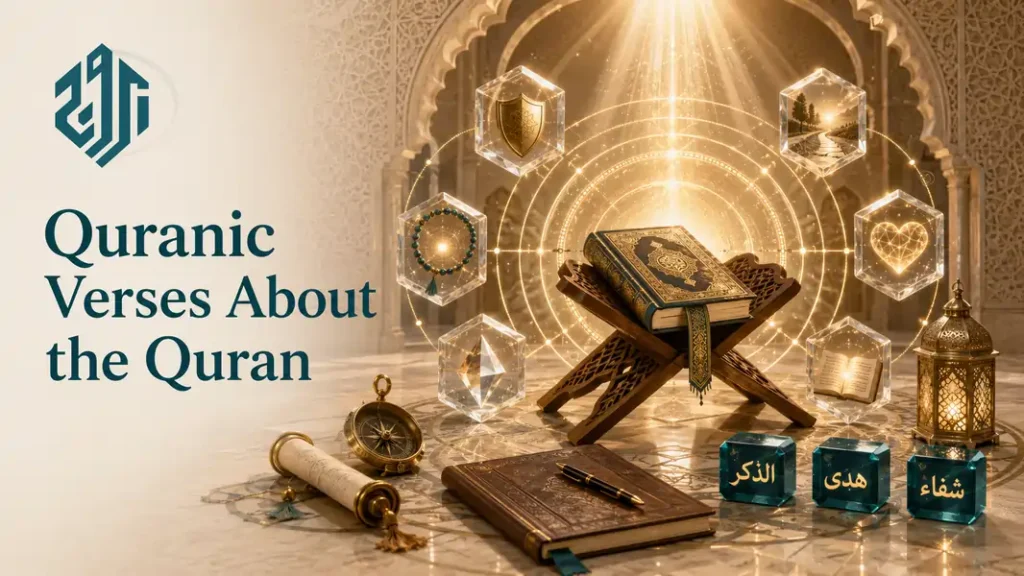
The Quran is unusual among sacred texts because it speaks about itself. Its own verses describe its purpose, protection, and effect on the heart.
Reading these self-referential ayat first builds a foundation before deeper Tafsir study; understanding why the Quran describes its own nature shapes how a student approaches recitation, memorization, and daily reading practice.
Table of Contents:
1. The Quranic Verse Stating That Allah is the Protector of the Quran
Allah states directly that He alone guarantees the Quran’s preservation, a promise unlike protection given to any scripture revealed before it. This single verse explains why the Quran’s text has remained unchanged for over fourteen centuries across every continent and language community.
إِنَّا نَحْنُ نَزَّلْنَا الذِّكْرَ وَإِنَّا لَهُ لَحَافِظُونَ
Inna nahnu nazzalna adh-dhikra wa inna lahu lahafizoon
“Indeed, it is We who sent down the Qur’an and indeed, We will be its guardian..” (Al-Hijr 15:9)
This is the only revealed scripture in which Allah explicitly names Himself, rather than a human intermediary, as the guarantor of preservation.
We often open our first sessions with new students by referencing this ayah, because it answers a question almost every beginner eventually asks: how do we know today’s Quran matches what was revealed to the Prophet Muhammad (peace be upon him)?
In our sessions at Buruj Academy, students find comfort in learning that this promise is why the science of Tajweed developed with such precision — every makhraj and sifah exists to protect the exact sound Allah promised to preserve.
This precision is also why Buruj Academy’s Online Tajweed Classes exist: not to add rules for their own sake, but to transmit the sound as it was protected.
Students pursuing a deeper connection to this preservation often move toward memorization, where the promise becomes personal — they carry the Hifz within their own hearts.
Book Your FREE Trial Lesson to Begin Your Tajweed Journey
2. The Quran States It Was Made Easy for Remembrance
Allah repeats a specific declaration four times within a single surah: that He made the Quran easy to memorize, recite, and reflect upon. This fourfold repetition is unique in the Quran and signals deliberate emphasis on accessibility for every believer, not only scholars.
وَلَقَدْ يَسَّرْنَا الْقُرْآنَ لِلذِّكْرِ فَهَلْ مِن مُّدَّكِرٍ
Wa laqad yassarna al-qur’ana lidh-dhikri fahal min muddakir
“And We have certainly made the Qur’an easy for remembrance, so is there any who will remember?” (Al-Qamar 54:17)
This exact ayah repeats at verses 22, 32, and 40 of the same surah — a structural feature scholars note as unparalleled emphasis.
Many adult beginners arrive at our door believing memorization is reserved for those raised speaking Arabic. This verse directly refutes that belief, and we remind students of it whenever a memorization plateau feels discouraging.
In our instructors’ experience, non-Arabic speaking adults typically need consistent daily repetition before a surah feels secure, and this ayah becomes a personal anchor during those weeks.
Our Online Hifz Program is built entirely around this promise of ease, pairing Al-Azhar-trained Hifz specialists with retention systems designed for exactly this kind of plateau.
For those specifically working through the final Juz, our Juz 30 course applies the same ease-focused method to shorter, high-frequency surahs.
Read More: Dua for Children Memorizing Quran
Start Hifz today with a FREE trial session
3. The Quran Describes Itself as Healing and Mercy for Believers
Allah calls the Quran a direct source of healing for what lies within the chest — doubt, spiritual sickness, and heart hardness — alongside guidance and mercy specifically for those who believe. This verse frames Quran engagement as therapeutic, not merely informational.
يَا أَيُّهَا النَّاسُ قَدْ جَاءَتْكُم مَّوْعِظَةٌ مِّن رَّبِّكُمْ وَشِفَاءٌ لِّمَا فِي الصُّدُورِ وَهُدًى وَرَحْمَةٌ لِّلْمُؤْمِنِينَ
Ya ayyuha an-nasu qad ja’atkum maw’izatun min rabbikum wa shifa’un lima fi as-sudoori wa hudan wa rahmatun lilmu’mineen
“O mankind, there has come to you instruction from your Lord and healing for what is in the breasts and guidance and mercy for the believers.” (Yunus 10:57)
Notice the address begins with “O mankind,” a universal call, before narrowing “healing” toward all people and “mercy” specifically toward believers.
Students often tell us they feel calmer simply from correct, unhurried recitation, and this ayah explains why that calm is not incidental. The Quran positions itself as medicine for the heart, and proper Tajweed — pacing, articulation, breath control — supports that healing effect rather than rushing past it.
We frequently reference 10 manners of reading the Quran alongside this verse, since manners and healing are deeply connected.
Discover the Buruj Academy Difference
Step into our virtual classrooms and see how our expert instructors make learning Quran and Arabic intuitive and clear. We focus on overcoming the specific hurdles non-native speakers face, building your confidence and connection with the Quran.
Excel in Your Quranic Studies
Join Buruj Academy and master the Quran with our structured, professional curriculum.
Book Your Free TrialRead also:Powerful Ayat About Death in the Quran
4. The Quran Identifies Itself as Guidance Toward the Most Upright Way
Allah describes the Quran as leading specifically to “that which is most straight” or most upright, a phrase indicating the Quran offers not merely one valid path but the optimal path in matters of belief, worship, and conduct.
إِنَّ هَٰذَا الْقُرْآنَ يَهْدِي لِلَّتِي هِيَ أَقْوَمُ وَيُبَشِّرُ الْمُؤْمِنِينَ الَّذِينَ يَعْمَلُونَ الصَّالِحَاتِ أَنَّ لَهُمْ أَجْرًا كَبِيرًا
Inna hadha al-qur’ana yahdee lillatee hiya aqwamu wa yubashshiru al-mu’mineena alladheena ya’maloona as-salihati anna lahum ajran kabeera
“Indeed, this Qur’an guides to that which is most suitable and gives good tidings to the believers who do righteous deeds that they will have a great reward.” (Al-Isra 17:9)
The word “aqwam” is a superlative form, meaning not simply “straight” but “most straight” — implying the Quran surpasses every other guiding system in precision.
We find this verse especially meaningful for reverts and new Muslims navigating unfamiliar terrain — building daily prayer habits, understanding halal and haram, structuring a new worldview.
Rather than presenting Islam as one option among many, this ayah reassures the learner they have found the most direct route available.
Read More: Learn Arabic in Qatar
5. The Quran Confirms No Falsehood Can Ever Corrupt It
Allah states unequivocally that no falsehood approaches the Quran from any direction — not from the past through contradiction with earlier revelation, and not from the future through later corruption or replacement.
This verse works alongside Al-Hijr 15:9 as a second, independent guarantee of textual integrity.
لَّا يَأْتِيهِ الْبَاطِلُ مِن بَيْنِ يَدَيْهِ وَلَا مِنْ خَلْفِهِ ۖ تَنزِيلٌ مِّنْ حَكِيمٍ حَمِيدٍ
La ya’teehi al-batilu min bayni yadayhi wa la min khalfihi tanzeelun min hakeemin hameed
“Falsehood cannot approach it from before it or from behind it; [it is] a revelation from a [Lord who is] Wise and Praiseworthy.” (Fussilat 41:42)
Classical commentators note “min bayni yadayhi” and “min khalfihi” cover both directions of time — meaning no prior revelation can invalidate the Quran, and no future claim can override it.
Advanced students preparing for Ijazah certification often study this verse alongside the science of Quranic preservation (Uloom Al-Quran), tracing how oral transmission through unbroken chains protected the text exactly as this ayah promised.
We walk Ijazah candidates through this historical chain during our Online Ijazah Course, connecting the theological promise to the documented sanad system that fulfilled it across fourteen centuries.
Book your FREE trial lesson in your path to Ijazah
6. The Prophet Described Learning and Teaching the Quran as the Best Deed
While not a Quranic verse itself, an authentic hadith from the Prophet Muhammad (peace be upon him) directly reflects the Quran’s self-description as something meant for transmission — learned, internalized, and passed forward to others as an act of the highest merit.
The Prophet (peace be upon him) said, as narrated by Uthman, that the best among believers are those who learn the Quran and then teach it to others (Sahih al-Bukhari 5027). This teaching reframes Quran study as inherently communal rather than solitary.
We see this hadith in action every time a student who started as a complete beginner eventually helps a younger sibling or their own child with a surah. That moment — watching someone move from receiving to giving — is one of the most rewarding patterns we witness in our teaching.
It is also why our Noorani Qaida Online Course emphasizes solid foundational habits early: a student who learns letter recognition correctly the first time is far better equipped to teach it accurately later.
Read also: Healing Quran Verses for Difficult Times
What Do These Self-Referential Verses Mean for Daily Recitation?
These six sources together establish the Quran as protected, accessible, healing, guiding, incorruptible, and meant for transmission — a complete internal description of its own nature and purpose.
Recognizing this framework transforms daily recitation from routine into recognition of what the text itself claims to be.
Reading with this awareness changes the emotional posture a student brings to each session.
A verse is no longer just words to decode correctly; it is part of a text that has described its own healing effect, its own accessibility, and its own promise of protection.
We encourage students exploring reading the Quran for the first time to return to these six references periodically, since they reframe technical practice — makharij, tajweed rules, memorization repetition — as service to something the Quran already told us about itself.
Consistent engagement with this framework also supports long-term habits. Students working through a quran memorization schedule or building how to start reading Quran daily routines often find renewed motivation simply by revisiting why the Quran describes itself as easy, healing, and protected.
Strengthen Your Connection to the Quran with Buruj Academy’s Expert Instructors
These six sources reveal a text that describes its own protection, ease, healing, and guidance — knowledge best absorbed through structured, correct recitation.
Buruj Academy brings this to life through Ijazah-certified instructors and Al-Azhar University graduates with 12+ years teaching non-Arabic speakers worldwide.
Our Buruj Method applies sound-before-rules for Tajweed, context-before-abstraction for Arabic, and consistency-before-speed for Hifz — ensuring every student builds authentic skills rather than memorized theory.
Personalized 1-on-1 sessions, flexible 24/7 scheduling, and real-time correction mean progress fits your life, not the reverse.
Whether you’re beginning with the Quran Reading Course, refining recitation, or pursuing memorization, our instructors meet you exactly where you are.
Book your free trial lesson today and experience the difference structured, expert guidance makes.
Take the next step in your learning journey today by enrolling in one of our specialized programs:
- Online Quran Classes
- Online Quran Classes for Beginners
- Online Quran Classes for Adults
- Online Quran Classes for Ladies
- Online Quran Classes for Kids
- Quran Reading Course
- Quran Recitation Course
- Online Ijazah Course
- Online Qirat Course
Don’t wait to transform your relationship with the Holy Quran. Join our global community of students and book your free evaluation session now!
Excel in Your Quranic Studies
Join Buruj Academy and master the Quran with our structured, professional curriculum.
Book Your Free TrialConclusion
These six sources form a self-portrait the Quran paints of itself — protected by Allah directly, made deliberately easy to remember, offered as healing and mercy, and guaranteed against corruption from any direction. Together they answer a question every sincere student eventually asks: why does this text feel different to engage with than any other book?
Understanding this framework does more than satisfy curiosity. It reshapes the daily habit of opening the mus’haf into something recognized, rather than routine, and gives struggling memorizers a reason to keep returning to the same lines. The Quran told us what it is; our practice is simply catching up to that truth.
Frequently Asked Questions About Quranic Verses on the Quran Itself
What Is the Most Famous Verse About the Quran’s Preservation?
Al-Hijr 15:9 is the most cited preservation verse, where Allah states He Himself guarantees the Quran’s protection. This promise is unique among revealed scriptures and explains the historical precision of oral and written transmission across fourteen centuries.
Does the Quran Describe Itself as Medicine for the Heart?
Yes. Yunus 10:57 explicitly calls the Quran “healing for what is in the breasts,” describing its effect on doubt, spiritual sickness, and heart hardness alongside guidance and mercy specifically extended to believers.
How Many Times Does the Quran Mention Its Own Protection?
Al-Hijr 15:9 and Fussilat 41:42 both address preservation directly, approaching the theme from different angles — one as a direct divine promise, the other confirming no falsehood can corrupt the text from past or future.
Is Learning to Teach the Quran Mentioned as a Special Virtue?
Yes. Sahih al-Bukhari 5027 records the Prophet Muhammad (peace be upon him) stating that the best among believers are those who learn the Quran and then teach it, framing Quran study as inherently meant for onward transmission.