 Quran
Quran

| Key Takeaways |
| Surah Al-Mulk contains exactly 30 verses, making it realistic to memorize in structured daily sessions within one to two weeks. |
| A verified Hasan hadith recorded in Sunan at-Tirmidhi 2891 links this surah’s thirty verses to intercession for its reciter. |
| Word-by-word repetition combined with listening to a single reciter builds accurate memorization faster than reading silently alone. |
| Daily revision of previously memorized verses prevents forgetting and must run alongside new memorization from day one. |
| Breaking the surah into small clusters of three to five verses matches its natural thematic and rhythmic divisions. |
Many students open Surah Al-Mulk with real enthusiasm, then stall around verse twelve when the rhyme pattern shifts and new vocabulary appears. This happens to nearly every beginner, and it is not a sign of weak ability.
Surah Al-Mulk memorizes best in five clusters of five to seven verses, paired daily with audio repetition, verse-by-verse translation review, and cumulative revision. This method respects the surah’s natural thematic breaks and produces reliable retention within one to two weeks.
Table of Contents:
Step 1: Memorize the Opening Cluster of Surah Mulk
The opening cluster, verses one through five, should be memorized through repeated listening to a single reciter before any silent reading begins. This locks the correct pronunciation and melodic pattern into memory before visual reading habits can introduce errors.
Begin by listening to verse one on repeat for ten to fifteen minutes while following the Arabic text with your finger.
تَبَـٰرَكَ ٱلَّذِى بِيَدِهِ ٱلْمُلْكُ وَهُوَ عَلَىٰ كُلِّ شَىْءٍۢ قَدِيرٌ
(Tabāraka alladhī biyadihi al-mulku wa huwa ʿalā kulli shayʾin qadīr)
“Blessed is He in whose hand is dominion, and He is over all things competent” (Al-Mulk 67:1).
This opening word, tabāraka, appears at the start of several Quranic surahs and signals a declaration of Allah’s greatness. Students often mispronounce the elongated baa sound here, so slow down deliberately on this letter.
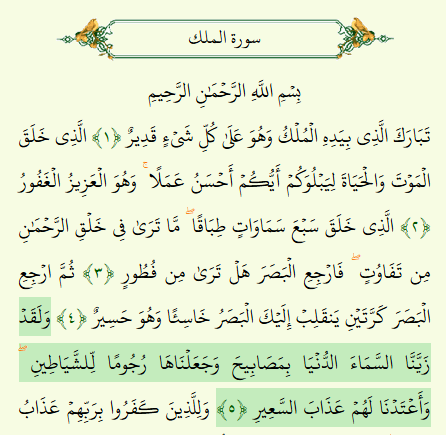
After verse one feels secure, add verse two, then verse three, reciting the growing cluster from the beginning each time rather than practicing new verses in isolation.
This cumulative approach is central to what we call Consistency-before-speed at Buruj Academy — a pillar of the Buruj Method that prioritizes accuracy over rushing forward.
Students working with our online Hifz program typically spend their entire first session on just this five-verse cluster, and that pacing is intentional rather than slow.
Start Hifz today with a FREE trial session

Common Pronunciation Errors in Verses One Through Five
Before the Buruj Method’s sound-before-rules approach, most self-taught students memorize these verses with the qaf in qadeer softened toward a kaf sound, a common English-speaker habit. Correcting this early prevents the error from calcifying across the rest of the surah.
Step 2: Approach the Hellfire Description in Verses 6 Through 14 in Surah Mulk
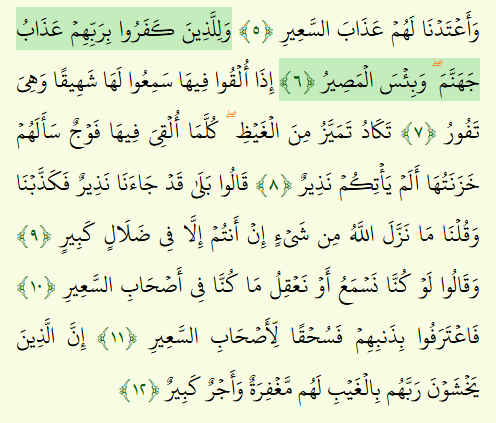
Verses six through fourteen describe the punishment awaiting disbelievers and should be memorized with attention to the emotional shift in tone, since the vocabulary here turns noticeably more severe than the opening cluster. Recognizing this shift helps students internalize meaning alongside sound.
This section introduces words like saʿīr (blazing fire) and fawr (boiling), which do not appear in the opening verses. Because these words are visually and phonetically distinct, students often find this cluster easier to memorize than expected, despite its heavier subject matter.
Practice this cluster in groups of three verses rather than all nine at once. Recite verses six through eight until fluent, then layer in nine through eleven, and finally twelve through fourteen — always reviewing from verse one forward before adding anything new.
A specific instructional observation from our classrooms: students who struggle here almost always share one habit — they memorize the Arabic sound without pairing it to the translation, which weakens long-term retention.
Reading the meaning of reading the Quran for the first time reinforces exactly this kind of meaning-first approach for beginners.
Building Retention Through Translation Pairing
Read the English meaning of each verse immediately after reciting the Arabic, every single time, for at least the first week. This habit is not optional for lasting memorization — it is the difference between memorizing sounds and memorizing meaning.
Read also: Dua for Memorizing Quran
Step 3: Know Why Verses 15 Through 19 Feel Like a Turning Point for Most Students
Verses fifteen through nineteen shift focus to observable signs in creation — the earth made subservient, birds held aloft by Allah’s power — and many students describe this cluster as the point where memorization suddenly feels smoother. This happens because the imagery here is concrete and visualizable, unlike the abstract theological statements earlier.
“Do they not see the birds above them with wings outspread and [sometimes] folded in? None holds them [aloft] except the Most Merciful.” This verse (Al-Mulk 67:19) uses a vivid, everyday image that most students find easier to retain than abstract vocabulary.
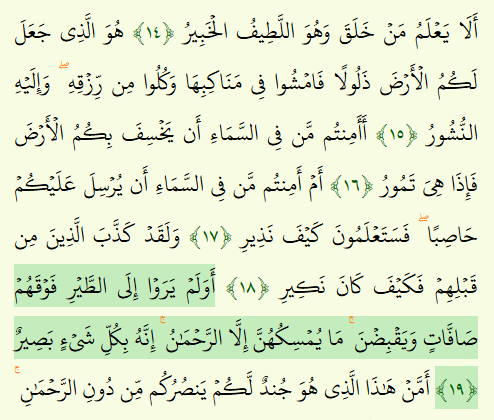
In our experience, non-Arabic speaking adults typically need three to four days of twenty-minute daily sessions before this cluster feels fully secure, compared to five or six days for the opening cluster. The visual nature of the content genuinely accelerates the process.
Use this momentum deliberately. Once verses fifteen through nineteen feel comfortable, immediately test yourself by reciting verses one through nineteen consecutively without pausing, which confirms the earlier clusters have not faded.
Our best way to memorize Quran guide covers this exact cumulative-testing technique in greater depth for students working through longer surahs.
A Practical Daily Schedule for This Middle Stretch
| Day | New Verses | Cumulative Review |
| 1 | 15–16 | 1–14 |
| 2 | 17–18 | 1–16 |
| 3 | 19 | 1–18 |
| 4 | Consolidation only | 1–19 |
This schedule prevents the common trap of racing ahead while earlier verses quietly deteriorate in memory.
Read also:How to Memorize Surah Rahman from Beginning to End?
Discover the Buruj Academy Difference
Step into our virtual classrooms and see how our expert instructors make learning Quran and Arabic intuitive and clear. We focus on overcoming the specific hurdles non-native speakers face, building your confidence and connection with the Quran.
Excel in Your Quranic Studies
Join Buruj Academy and master the Quran with our structured, professional curriculum.
Book Your Free TrialRead also: How Many Hafiz of the Quran Are There?
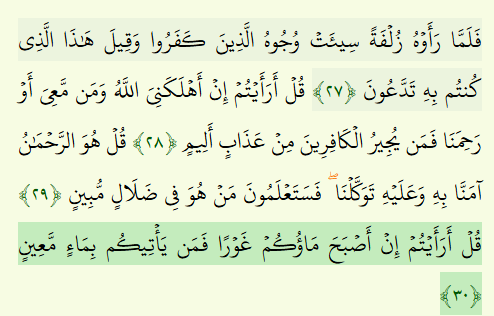
Step 4: Memorize the Rhetorical Questions in Verses 20 Through 30
Verses twenty through thirty return to a denser rhetorical style, repeatedly asking “who is it” that could provide for or protect humanity besides Allah, and this repetition actually works in the memorizer’s favor once the pattern is recognized. Identifying the recurring sentence structure early makes this final cluster far less intimidating.
Six separate verses in this section open with variations of the phrase أَمَّنْ هَـٰذَا (am-man hādhā), meaning “or who is it.”
Once a student notices this repeated opening, the cluster stops feeling like thirty new words and starts feeling like one pattern repeated with small variations.
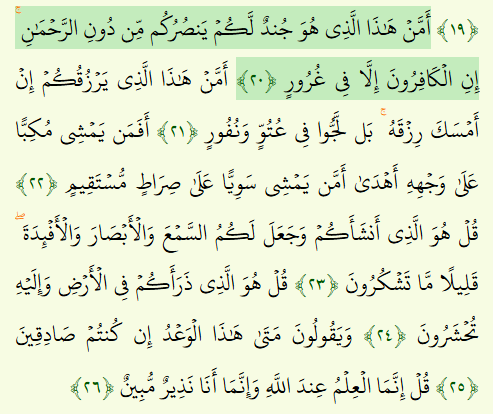
Before students recognize this repetition, most struggle significantly with verses twenty-two through twenty-eight, treating each verse as entirely unfamiliar. After the pattern is pointed out explicitly, retention speed for this section improves noticeably in our sessions.
Break this final cluster into two halves: verses twenty through twenty-five, then twenty-six through thirty. The second half concludes with a direct challenge about drinking water sinking into the earth, tying back thematically to the earth-and-sky imagery from earlier in the surah.
Enrolling in our Juz 30 Memorization course gives students structured guidance through exactly these rhetorical patterns across other short surahs as well, building a transferable skill rather than a one-time memorization.
Why Root-Word Recognition Speeds Up This Final Section
Recognizing the shared root in am-man hādhā across six verses is a skill that pays dividends beyond this single surah — learning Surah Mulk word by word through our Quranic Arabic classes builds exactly this kind of pattern recognition systematically.
Begin Understanding Quranic Arabic with a FREE Lesson

How Long Does It Realistically Take to Memorize Surah Mulk in Full?
A realistic timeline for memorizing all thirty verses of Surah Mulk is seven to fourteen days for most adult beginners, based on twenty to thirty minutes of focused daily practice. Students asking how to memorize Surah Mulk in one day should understand this is achievable only with several hours of concentrated repetition and prior familiarity with basic Quranic Arabic sounds.
The thirty verses divide cleanly into five clusters of roughly six verses each, and a strong planner to memorize Surah Mulk allocates one to three days per cluster depending on vocabulary density.
| Timeline | Daily Commitment | Suitable For |
| 1 day | 3–5 hours intensive | Students already fluent in Quranic Arabic sounds |
| 7 days | 30–40 minutes | Motivated beginners with some prior Quran exposure |
| 14 days | 15–20 minutes | Complete beginners or busy working adults |
A Quran memorization schedule that spreads this surah across two weeks, rather than compressing it into one intensive day, produces memorization that survives long past the initial session.
Students pursuing the one-day intensive route should still expect to spend the following month lightly reviewing the surah daily, since same-day memorization without follow-up revision fades within days for most learners.
Balancing Speed With Long-Term Retention
Speed-focused memorization without daily revision typically results in forgetting forty to sixty percent of newly memorized content within two weeks, based on general memory-retention patterns observed across our student base.
This is why our online Hifz program structures revision as a non-negotiable daily component, never an optional add-on.
Start Hifz today with a FREE trial session

How Should Daily Revision Be Structured While Memorizing Surah Mulk?
Daily revision should happen before any new memorization begins, covering everything memorized so far from verse one forward, every single day, without exception. Skipping this step even once creates gaps that compound quickly across a thirty-verse surah.
A practical revision session takes five to ten minutes once you have covered the first two clusters, growing slightly as more verses accumulate.
A learning milestone we track closely at Buruj Academy: students who revise daily typically retain the full surah accurately six months later, while those who stop revising after “finishing” often lose fifteen to twenty percent of accuracy within a month.
Pair silent revision with occasional recitation aloud to a teacher, family member, or recording device. Hearing your own mistakes is far more effective than assuming silent recitation is correct.
Our Quran memorization faster guide outlines additional revision structures that apply well beyond this single surah, useful once students move to longer chapters.
Why the Best Time to Practice Affects Retention
Choosing a consistent daily slot, whether after Fajr or before sleep, measurably improves retention according to our instructors’ classroom observations.
Our best time to memorize Quran guide explores this connection between timing and retention in greater detail.
Master Surah Mulk With Buruj Academy’s Online Hifz Program
Memorizing Surah Mulk becomes far more reliable with structured guidance rather than self-study alone. Buruj Academy’s Online Hifz Program pairs each student with Al-Azhar-trained Hifz specialists who tailor revision schedules to individual pace and retention needs.
Our Ijazah-certified instructors bring 12+ years of experience guiding non-Arabic speakers through exactly this kind of short-surah memorization.
The Buruj Method’s Consistency-before-speed framework ensures verses stick permanently, not just for a week.
Sessions run 1-on-1 with flexible 24/7 scheduling, adapting to working professionals, parents, and complete beginners alike.
Book a free trial lesson today and begin memorizing Surah Mulk with expert guidance from your very first session.
Take the first step toward this lifelong blessing by enrolling in a program tailored to your pace:
- Online Hifz Program (Comprehensive Quran Memorization)
- Juz 30 Memorization Course (Perfect for focused starts)
- Hifz Classes for Kids (Engaging and interactive)
- Hifz Classes for Adults (Flexible scheduling for busy lives)
- Hifz Classes for Sisters (Private, supportive learning)
- Short Surah Memorization Course (Ideal for daily prayers)
- Hifz Ijazah Course (For advanced students seeking certification)
Don’t let another day pass without moving closer to your goal. Join Buruj Academy today and schedule your free trial session to begin your Hifz journey!
Excel in Your Quranic Studies
Join Buruj Academy and master the Quran with our structured, professional curriculum.
Book Your Free TrialDiscover the Buruj Academy Difference
Step into our virtual classrooms and see how our expert instructors make learning Quran and Arabic intuitive and clear. We focus on overcoming the specific hurdles non-native speakers face, building your confidence and connection with the Quran.
Read also:The 7 Best Quran Reciters to Memorize the Quran
Conclusion
Surah Al-Mulk rewards students who respect its natural rhythm rather than rushing toward a finish line. Breaking its thirty verses into five thematic clusters, pairing each with meaning and daily revision, turns an intimidating goal into a manageable two-week routine.
The plateau most students hit around verse fifteen or twenty resolves quickly once the surah’s repeating patterns become visible. What separates lasting memorization from a fading one is simple: consistent daily review from day one, never skipped, never postponed.
Frequently Asked Questions About Memorizing Surah Mulk
Can Surah Mulk Really Be Memorized in One Day?
Memorizing all thirty verses in a single day is possible only for students already comfortable with Quranic Arabic sounds, requiring three to five hours of concentrated repetition. Most beginners achieve stronger, longer-lasting results across seven to fourteen days instead.
What Are the Main Benefits of Memorizing Surah Mulk?
A verified Hasan hadith links this surah’s recitation to intercession for its reciter, based on its thirty verses (Sunan at-Tirmidhi 2891). Beyond this spiritual virtue, memorization strengthens Quranic Arabic vocabulary and recitation fluency simultaneously.
Which Part of Surah Mulk Do Students Usually Find Hardest?
Verses twenty through twenty-eight often feel hardest before students notice the repeated am-man hādhā rhetorical pattern running through six consecutive verses. Recognizing this structure explicitly tends to resolve the difficulty quickly.
Do I Need to Know Tajweed Before Memorizing Surah Mulk?
Basic familiarity with Tajweed pronunciation rules significantly improves memorization accuracy from the start, though perfect mastery is not required beforehand. Our tajweed for beginners guide and Tajweed for Beginners course support parallel learning alongside memorization.
How Often Should I Review Surah Mulk After Finishing Memorization?
Daily revision for the first month, followed by revision two to three times weekly afterward, maintains long-term accuracy based on our instructors’ classroom observations. Stopping revision entirely typically causes fifteen to twenty percent accuracy loss within a month.