 Quran
Quran

| Key Takeaways |
| Sheikh Al-Husary’s Mu’allam recitation is the most widely used reciter for structured Hifz memorization. |
| Reciters with slow, clear Murattal pacing and minimal melodic variation aid retention far more than fast or highly ornamented styles. |
| Consistency with a single reciter throughout memorization prevents pattern confusion between differing pause points and pronunciation habits. |
| Sheikh al-Minshawi’s Murattal style is favored for its clarity and measured Tajweed application. |
| The right reciter choice should match a student’s current Tajweed level, not simply personal listening preference. |
Many new memorizers spend weeks jumping between reciters, unaware that this habit alone can slow their Hifz progress by months. Choosing the right voice to memorize with is not a matter of preference — it directly shapes how quickly and accurately the Quran settles into memory.
The best reciters for memorization are those with slow, clear Murattal recitation and consistent pause points — primarily Sheikh Mahmoud Khaleel Al-Husary (Mu’allam style) and Sheikh Muhammad Siddiq al-Minshawi.
Table of Contents:
1. Sheikh Mahmoud Khaleel Al-Husary (Mu’allam Style) is the Best Reciter to Memorize the Quran
Sheikh Al-Husary’s Mu’allam (“teaching”) recitation is widely regarded as the gold standard for memorization audio because each verse is repeated multiple times at a deliberately slow pace.
This repetition mirrors exactly how a memorization teacher drills a student, making it ideal for independent practice between sessions.
His articulation of every Makhraj is textbook-precise, and his Waqf points are highly predictable, which builds a stable internal rhythm for new memorizers. Listen to his full Mahmoud Khaleel Al-Husary’s recitation.
In our experience, beginner Hifz students who start with Al-Husary’s Mu’allam style retain first-time accuracy noticeably better than those who begin with faster reciters.
The repeated-verse structure essentially builds spaced repetition directly into the listening experience.

2. Sheikh Muhammad Siddiq al-Minshawi (Murattal)
Sheikh al-Minshawi’s Murattal recitation is prized for its emotional clarity paired with strict Tajweed discipline, striking a balance many students find easier to stay engaged with over long memorization sessions. His voice carries measured pacing without dragging, and his Ghunnah application is consistently precise across all 114 surahs.
His full recitation is available on Sheikh Muhammad Siddiq al-Minshawi’s recitation, alongside a separate Mujawwad recitation for students who later want to study melodic recitation once memorization is complete.
We often recommend al-Minshawi to students who have completed initial memorization with Al-Husary and are now working on Understanding proper Tajweed rules at a deeper level, since his style rewards close listening.

3. Sheikh Abdur-Rahman as-Sudais
As-Sudais, Imam of the Grand Mosque in Makkah, offers a Murattal style with steady pacing and powerful, clear articulation that many students find motivating during long memorization stretches.
His recitation carries natural gravity without excessive melodic embellishment, keeping focus on the words themselves.
His full recitation catalog is available on QuranicAudio.

Students preparing for short surah memorization course often respond well to his clarity, particularly during Juz Amma, where his pacing remains consistent from short verses through longer ones.
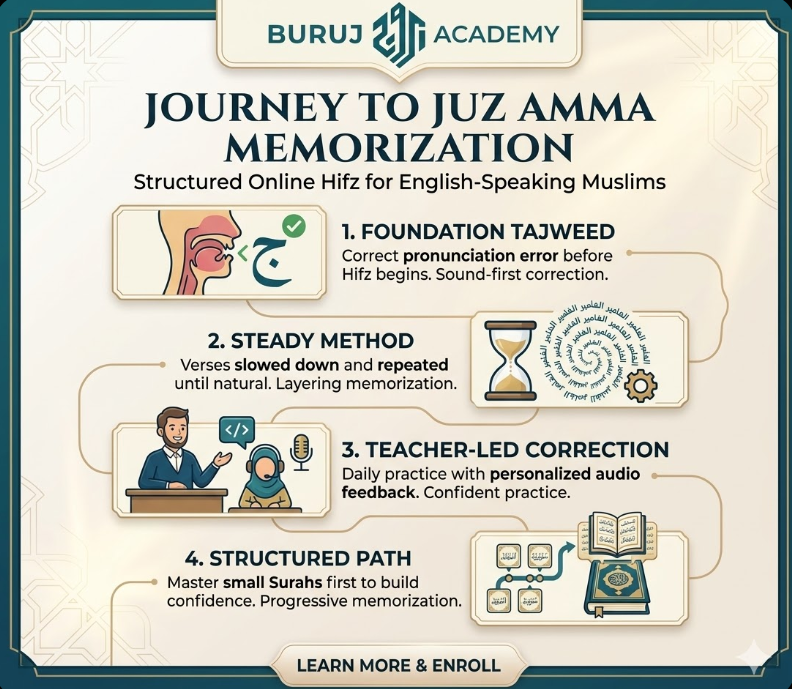
Book Your First Session in Buruj’s Juz 30 Memorization Course
4. Sheikh Sa’ud ash-Shuraym
Sheikh ash-Shuraym’s recitation is known for balanced pacing and clean transitions between verses, making it a strong secondary option once a student has built initial familiarity with a slower reciter.
His pronunciation of heavy letters (Huroof al-Isti’la) is particularly precise, offering excellent modeling for Tafkhim practice.
Sheikh Sa’ud ash-Shuraym recitations are available on QuranicAudio, including a combined Sudais and Shuraym recording frequently used in Haramain-style Taraweeh study.
We recommend ash-Shuraym to intermediate students who have already established solid pronunciation habits and are refining their recitation rather than building it from scratch.

| Reciter | Best For | Pacing Style | QuranicAudio Link |
| Al-Husary (Mu’allam) | Absolute beginners | Slow, repeated verses | Listen |
| Al-Minshawi (Murattal) | Post-beginner refinement | Measured, clear | Listen |
| As-Sudais | Juz Amma / short surahs | Steady, motivating | Listen |
| Ash-Shuraym | Intermediate refinement | Balanced, clean | Listen |
5. Sheikh Ali Abdur-Rahman al-Huthaify
Al-Huthaify’s recitation is often praised for exceptionally clear consonant articulation, making it a strong choice for students still building comfort with Arabic phonetics. His pacing sits between Al-Husary’s deliberate slowness and the more moderate speed of Haramain-style reciters.
Sheikh Ali Abdur-Rahman al-Huthaify recitations are available on QuranicAudio.
In our sessions, non-Arabic speaking adults have specifically mentioned finding his consonant clarity helpful when working through makharij al-huruf alongside their memorization.

6. Sheikh Maher al-Muaiqly
Al-Muaiqly’s Murattal recitation offers gentle, unhurried pacing with warm tonal quality, which many students describe as easier to sustain focus with during extended daily memorization sessions. His Qalqalah application is notably crisp and audible, useful for students still training their ear to catch this specific rule.
Sheikh Maher al-Muaiqly’s full recitation is available on QuranicAudio.
Students working through our Ghunnah and its rules guide often benefit from pairing that study with al-Muaiqly’s clear nasal resonance during recitation.

Discover the Buruj Academy Difference
Step into our virtual classrooms and see how our expert instructors make learning Quran and Arabic intuitive and clear. We focus on overcoming the specific hurdles non-native speakers face, building your confidence and connection with the Quran.
Excel in Your Quranic Studies
Join Buruj Academy and master the Quran with our structured, professional curriculum.
Book Your Free Trial7. Sheikh Yasser ad-Dussary
Ad-Dussary’s recitation combines emotional depth with disciplined pacing, appealing to students who want a reciter that keeps them engaged without sacrificing accuracy for melody. His transitions between verses remain crisp even during longer surahs, supporting steady memorization rhythm.
Sheikh Yasser ad-Dussary’s full recitation catalog is available on QuranicAudio.
We generally recommend ad-Dussary as a later-stage option, once foundational memorization habits are already established with a slower, more repetitive reciter like Al-Husary.

Why Does the Right Reciter Matter for Quran Memorization?
The reciter you memorize with becomes the internal voice your memory replays during every future recitation. Selecting a reciter with clear, deliberate pacing and precise Tajweed application builds accurate muscle memory from day one, while inconsistent or overly fast recitation styles introduce errors that become difficult to correct later.
In our sessions at Buruj Academy, we’ve observed that students who memorize with fast or heavily melodic reciters frequently mispronounce elongations (Madd) once they attempt to recite from memory alone. This happens because the ear absorbs rhythm and pacing just as readily as it absorbs the words themselves.
A slower reciter gives the brain time to process each Makhraj (articulation point) individually rather than blending sounds together. This single factor separates strong, accurate Hifz from memorization riddled with subtle pronunciation slips.
Our Online Hifz Program trains students to pair reciter selection with structured revision from the very first session, ensuring the foundation is solid before volume increases.
Start Hifz today with a FREE trial session

What Happens When Students Switch Reciters Mid-Memorization?
Switching reciters mid-Hifz journey creates competing audio patterns in memory, particularly around pause points (Waqf) and breath stops that differ between qaris.
Students often report confusion when their recitation “sounds wrong” simply because they trained their ear on inconsistent audio sources.
We’ve noticed this pattern especially among self-taught adult learners juggling multiple YouTube videos. One week they memorize with a fast Haramain Taraweeh recording, the next with a slower Egyptian broadcast reciter — and the two styles clash in recall.
The safest approach is committing to a single primary reciter for each new portion until it is fully memorized and revised at least twice.
Read also:Benefits of Reading Surah Al-Fath
How Should Students Choose the Right Reciter for Their Level?
Choosing a reciter should be based on current Tajweed proficiency rather than personal listening enjoyment alone, since a mismatch between skill level and reciter pacing often causes avoidable errors. Complete beginners benefit most from repeated, slow-paced audio, while intermediate students can handle moderate-speed Murattal styles.
Students who have not yet completed foundational Tajweed training should prioritize Al-Husary’s Mu’allam style regardless of personal preference, since its built-in repetition compensates for gaps in independent rule application. This matches guidance covered in our practical tips for faster memorization.
Once foundational Tajweed rules feel automatic, students can transition to reciters like al-Minshawi or as-Sudais for continued refinement.
Our Amli Tajweed Course specifically bridges this gap between rule knowledge and live application during recitation.
Book Your FREE Trial Lesson in Buruj’s Amli Tajweed Course

Does the Reciter’s Riwayah Matter for Memorization?
Yes — nearly all reciters commonly used for memorization recite according to Hafs ‘an ‘Asim, the riwayah (transmission) used in the vast majority of printed Mushafs worldwide.
Every reciter listed above follows this transmission, ensuring consistency between what students hear and what they read on the page.
Students memorizing from a standard Mushaf should avoid non-Hafs recitations during active memorization, since differing letter counts and word variants between riwayaat can create confusion. QuranicAudio’s Non-Hafs section exists separately for this exact reason.
What Role Does Consistency Play Beyond Reciter Choice?
Consistency extends beyond reciter selection into daily practice timing, revision frequency, and session length, all of which compound with reciter choice to determine memorization success. Even the ideal reciter cannot compensate for irregular practice or skipped revision cycles.
We’ve found that students who pair a single reciter with a fixed daily schedule progress with fewer corrections needed later. This principle is explored further in our guide on the best time to memorize Quran.
Our Online Hifz Program builds this consistency directly into personalized learning plans, pairing reciter recommendations with structured revision timetables tailored to each student’s pace and life schedule.
Accelerate Your Hifz Journey with Buruj Academy’s Online Hifz Program
Choosing the right reciter is only the beginning — lasting Hifz requires structured guidance, consistent correction, and a proven revision system tailored to you.
Buruj Academy’s Online Hifz Program pairs students with Al-Azhar-trained Hifz specialists and Ijazah-certified instructors who bring 12+ years of experience teaching non-Arabic speakers.
Every student follows the Buruj Method’s Consistency-before-speed approach, paired with a Personalized Learning Plan matched to age and pace.
Sessions run 1-on-1 with flexible 24/7 scheduling and real-time correction, ensuring memorization errors are caught immediately rather than compounding over weeks. Book a free trial lesson and experience structured, guided Hifz for yourself.
Take the first step toward this lifelong blessing by enrolling in a program tailored to your pace:
- Online Hifz Program (Comprehensive Quran Memorization)
- Juz 30 Memorization Course (Perfect for focused starts)
- Hifz Classes for Kids (Engaging and interactive)
- Hifz Classes for Adults (Flexible scheduling for busy lives)
- Hifz Classes for Sisters (Private, supportive learning)
- Short Surah Memorization Course (Ideal for daily prayers)
- Hifz Ijazah Course (For advanced students seeking certification)
Don’t let another day pass without moving closer to your goal. Join Buruj Academy today and schedule your free trial session to begin your Hifz journey!
Excel in Your Quranic Studies
Join Buruj Academy and master the Quran with our structured, professional curriculum.
Book Your Free TrialDiscover the Buruj Academy Difference
Step into our virtual classrooms and see how our expert instructors make learning Quran and Arabic intuitive and clear. We focus on overcoming the specific hurdles non-native speakers face, building your confidence and connection with the Quran.
Conclusion
Memorization accuracy begins long before the first verse is repeated — it starts with the voice a student chooses to learn from. Reciters like Al-Husary and al-Minshawi remain trusted anchors precisely because their pacing and clarity were built with learners in mind, not performance.
Ultimately, the “best” reciter is the one matched to a student’s current level and used with unwavering consistency until each portion is fully secured. Pairing that choice with structured revision and expert correction transforms scattered listening into lasting Hifz.
Read also: A Guide to the Best Quranic Arabic Books for Non-Arabic Speakers
Frequently Asked Questions About the Best Reciters for Quran Memorization
Is It Better to Memorize with a Slow or Fast Reciter?
Slow reciters are strongly preferred for memorization, particularly for beginners, since they allow the brain to process each word and articulation point individually. Fast reciters are better suited for later stages, once accuracy is already established through structured Hifz practice.
Can I Memorize Quran Using Different Reciters for Different Surahs?
While possible, sticking to one primary reciter throughout memorization significantly reduces pause-point confusion and pacing mismatches. If switching is necessary, choose reciters with similarly slow, clear Murattal styles rather than combining very different pacing types.
Does Listening to a Reciter Count as Memorization Practice?
Listening alone builds passive familiarity but does not replace active repetition, recitation aloud, and structured revision. Our Hifz for Adults program combines guided listening with active practice for lasting retention.
Why Is Sheikh Al-Husary’s Mu’allam Recitation Specifically Recommended?
The Mu’allam style repeats each verse multiple times at a deliberately slow pace, functioning like a built-in teaching drill rather than a standard recitation. This repetition structure directly supports the spaced repetition patterns proven effective for memorization.