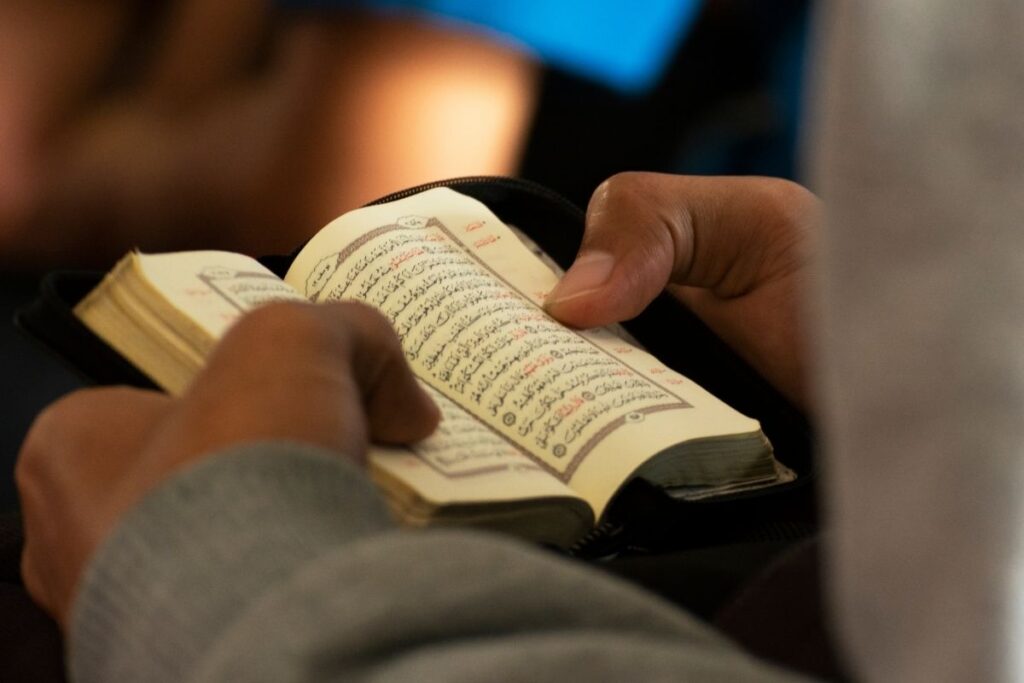
 Quran
Quran

| Key Takeaways |
| Listening to the Quran while sleeping is not haram; no authentic evidence in the Quran or Sunnah prohibits it. |
| Passive listening during sleep builds familiarity with verses but does not replace active, conscious repetition needed for true Hifz. |
| Feeling sleepy during recitation often reflects both the Quran’s calming effect and normal nighttime fatigue, not disrespect. |
Many students ask us at Buruj Academy whether falling asleep to Quran recitation is disrespectful toward the Book of Allah. It’s a sincere question, and one worth answering clearly rather than with vague reassurance.
Listening to the Quran while sleeping is not haram. Scholars agree there is no evidence in the Quran or Sunnah prohibiting it, and many consider it a recommended practice with real spiritual benefit for the household.
Table of Contents:
Is It Haram to Listen to the Quran While Sleeping?
No, it is not haram to listen to the Quran while sleeping, and no authentic text forbids it. This question comes up often because of Surah Al-A’raf, where Allah says, “When the Quran is recited, listen to it attentively and be silent, so you may be shown mercy” (Al-A’raf 7:204). Scholars clarify this verse refers primarily to prayer and formal recitation settings, not casual background listening at bedtime.
Islamic scholars have addressed this directly. As explained on Islam Question & Answer, there is nothing wrong with a Muslim listening to Quran before sleeping, since doing so instills tranquility in the heart.
This aligns with what we teach students in our own Online Quran Classes for Beginners: the Quran was revealed for reflection and connection, and passive listening at night is one gentle form of that connection, even if it isn’t the deepest one.
Begin Learning Quran With a FREE Trial Lesson
What Does the Hadith Say About Reciting Quran at Night in the Home?
The Prophet ﷺ specifically encouraged reciting Surat Al-Baqarah in homes at night, explaining that it drives away Shaytan’s influence for the following nights.
Abu Hurairah reported that the Messenger of Allah ﷺ said: “Do not turn your houses into graveyards. Satan runs away from the house in which Surat Al-Baqarah is recited” (Sahih Muslim 780).
A related narration adds more detail. It states that Satan will not enter a house for three nights if Surah Al-Baqarah is recited there at night, and for three days if recited during the day (Sahih Ibn Hibban 782).
This is precisely why we sometimes recommend students play or recite Al-Baqarah before bed — not superstitiously, but because it’s grounded in authentic prophetic teaching. If you’re working toward reciting longer surahs confidently, our Tajweed for Beginners course builds that skill step by step.
| Hadith | Reported Benefit | Source |
| “Do not turn your houses into graveyards…” | Satan flees the home where Al-Baqarah is recited | Sahih Muslim 780 |
| “Whoever recites it in his house at night…” | Satan kept out for three nights (day: three days) | Sahih Ibn Hibban 782 |
Will Listening to the Quran While Sleeping Help You Memorize It?
Listening to the Quran while sleeping can build passive familiarity with verses but does not replace active memorization. Hifz requires focused repetition, understanding, and conscious recall — none of which happen while the brain is asleep, even if the sound is technically still playing.
In our experience teaching Hifz students at Buruj Academy, the ones who progress fastest treat sleep-listening as a supplement, never a substitute. A student might play a surah overnight to reinforce familiarity, but real retention still comes from focused daytime sessions with correct Tajweed and deliberate recall.
That said, familiarity isn’t nothing. Repeated exposure to the same recitation can make verses feel less foreign when you sit down to actually memorize them the next day.
It’s the same reason we structure lessons in our Online Hifz Program around consistent daily repetition rather than one long overnight session.
If memorization is your real goal, pairing passive listening with an active plan matters more than the listening itself.
Our guide on how to memorize Quran faster walks through techniques that actually build retention, and our piece on the best time to memorize Quran explains why waking hours outperform sleep for this specific goal.
Start Hifz today with a FREE trial session

Why Passive Listening Falls Short of Active Memorization
Passive listening engages the ears; memorization engages the mind, tongue, and memory together in a loop. Without actively repeating a verse aloud and testing your own recall, the brain has no strong reason to encode it into long-term memory.
This is a pattern we see constantly with adult students who assume overnight listening alone will get them through Juz Amma — it rarely does on its own.
Read also:What Causes Goosebumps When Listening to the Quran?
Discover the Buruj Academy Difference
Step into our virtual classrooms and see how our expert instructors make learning Quran and Arabic intuitive and clear. We focus on overcoming the specific hurdles non-native speakers face, building your confidence and connection with the Quran.
Excel in Your Quranic Studies
Join Buruj Academy and master the Quran with our structured, professional curriculum.
Book Your Free TrialWhy Do I Get Sleepy When Listening to Quran?
Feeling sleepy while listening to the Quran is a normal, common response tied to both its calming acoustic qualities and simple nighttime tiredness. It is not a sign of disrespect or spiritual deficiency, and it happens to lifelong huffaz just as often as it happens to new listeners.
Several peer-reviewed studies have examined this pattern. Research summarized in a review published on PMC found that listening to Quranic recitation is associated with increased alpha brainwave activity, a pattern linked to relaxation states.
Alpha and theta waves are the same general patterns associated with drifting toward sleep, which may explain why so many listeners doze off during recitation rather than staying alert.
There’s also a simpler explanation: most people listen to Quran specifically at bedtime, when the body is already winding down.
The rhythmic, melodic pacing of Tajweed-correct recitation — the very thing that makes it beautiful — also happens to be soothing in a way that pairs naturally with an already-tired mind.
Read also:Is It Haram to Smoke Cigarettes While Listening to Quran?
How Should You Properly Play the Quran While Sleeping?
Playing the Quran while sleeping is best done with a recording that stops after the recitation ends, rather than one that continues into music or unrelated audio. This detail matters more than most people realize, since a continuously playing radio station may shift to something inappropriate while you’re unaware and asleep.
We recommend choosing a dedicated Quran recitation app or a fixed-length audio file over live radio, precisely for this reason. It’s a small technical choice, but it protects the intention behind the practice: honoring the Quran, not leaving a device running unattended.
Beyond the technical setup, intention matters. If you set the recitation on purposefully — hoping for barakah, protection, or a calmer heart — that intention carries weight even after you’ve fallen asleep.
Students in our Online Islamic Studies Classes often ask how intention (niyyah) functions in everyday acts like this one, and this is a clear example: the ongoing act itself continues to carry reward tied to the original intention.
Begin Your Islamic Knowledge Journey With a FREE Trial Lesson

Strengthen Your Relationship With the Quran Beyond Bedtime Listening
Falling asleep to Quran recitation is permissible and can bring real comfort, but it’s only one small part of a full relationship with the Book of Allah. Real growth comes from reciting it consciously, understanding its meaning, and reading it with correct Tajweed while fully awake.
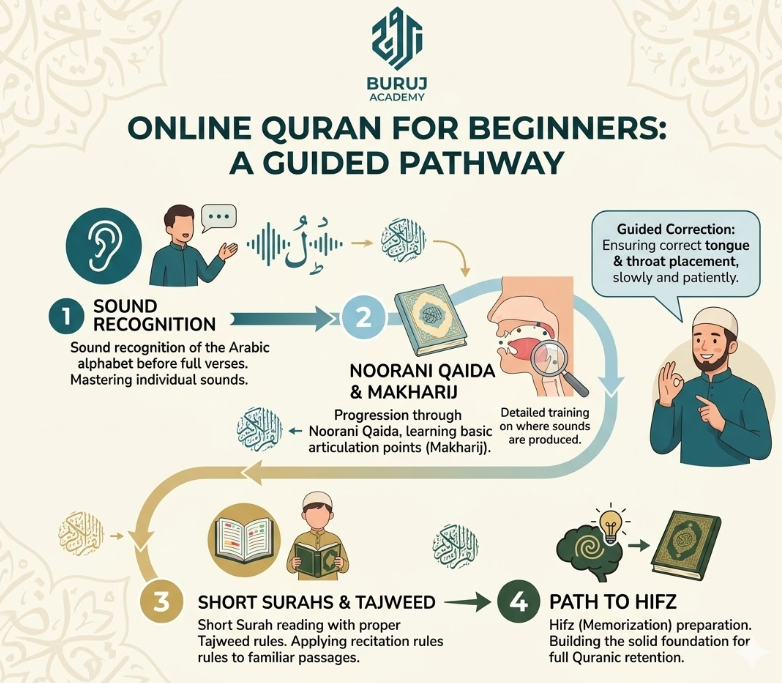
At Buruj Academy, our Ijazah-certified instructors and Al-Azhar University graduates help students move from passive listening to confident, accurate recitation using the Buruj Method: sound-before-rules, consistency-before-speed.
With flexible 1-on-1 online sessions and personalized learning plans, our team meets you exactly where you are — beginner, parent, or advanced student.
Ready to build a daily Quran habit that goes beyond bedtime? Book a free trial lesson with Buruj Academy today.
Take the next step in your learning journey today by enrolling in one of our specialized programs:
- Online Quran Classes
- Online Quran Classes for Beginners
- Online Quran Classes for Adults
- Online Quran Classes for Ladies
- Online Quran Classes for Kids
- Quran Reading Course
- Quran Recitation Course
- Online Ijazah Course
- Online Qirat Course
Don’t wait to transform your relationship with the Holy Quran. Join our global community of students and book your free evaluation session now!
Excel in Your Quranic Studies
Join Buruj Academy and master the Quran with our structured, professional curriculum.
Book Your Free TrialRead also:Do You Need Wudu to Listen to the Quran?
Conclusion
Listening to the Quran while falling asleep carries no prohibition and, according to authentic hadith, may even offer real spiritual protection for your home. What it can’t do on its own is replace the focused, waking effort that true memorization and Tajweed mastery require.
Think of sleep-listening as a companion practice rather than a complete one. Let it soften your nights, but pair it with intentional study during the day if your goal is deeper connection, retention, or fluent recitation with proper rules applied.
Frequently Asked Questions About Listening to the Quran While Sleeping
Is It Sinful to Fall Asleep During Quran Recitation?
No, falling asleep during Quran recitation is not sinful. It’s an involuntary response, often linked to the recitation’s calming effect combined with natural tiredness. Scholars distinguish this from intentionally ignoring the Quran out of disinterest.
Should I Use Headphones or a Speaker When Sleeping With Quran Playing?
Either is fine, though a speaker at a low, comfortable volume is often gentler for uninterrupted sleep than headphones. Choose whichever keeps the recitation audible without disturbing your rest or anyone else sharing the room.
Is It Better to Recite Quran Myself Before Sleeping Instead of Playing a Recording?
Active recitation generally holds greater virtue than passive listening, since it engages memory, tongue, and heart together. However, playing a recording remains beneficial, especially for those still building their own recitation confidence and Tajweed accuracy.