 Quran
Quran
| Key Takeaways |
|---|
| Goosebumps from Quran recitation are called piloerection, a real nervous-system response. |
| Az-Zumar 39:23 describes believers’ skin shivering at the Quran, framing this reaction as a sign of taqwa (God-consciousness). |
| Crying during recitation follows an authentic pattern shown by the Prophet ﷺ himself while listening to Ibn Mas’ud recite. |
| Fear during recitation often reflects verses about accountability, while comfort follows verses about mercy, matching the Quran’s own description. |
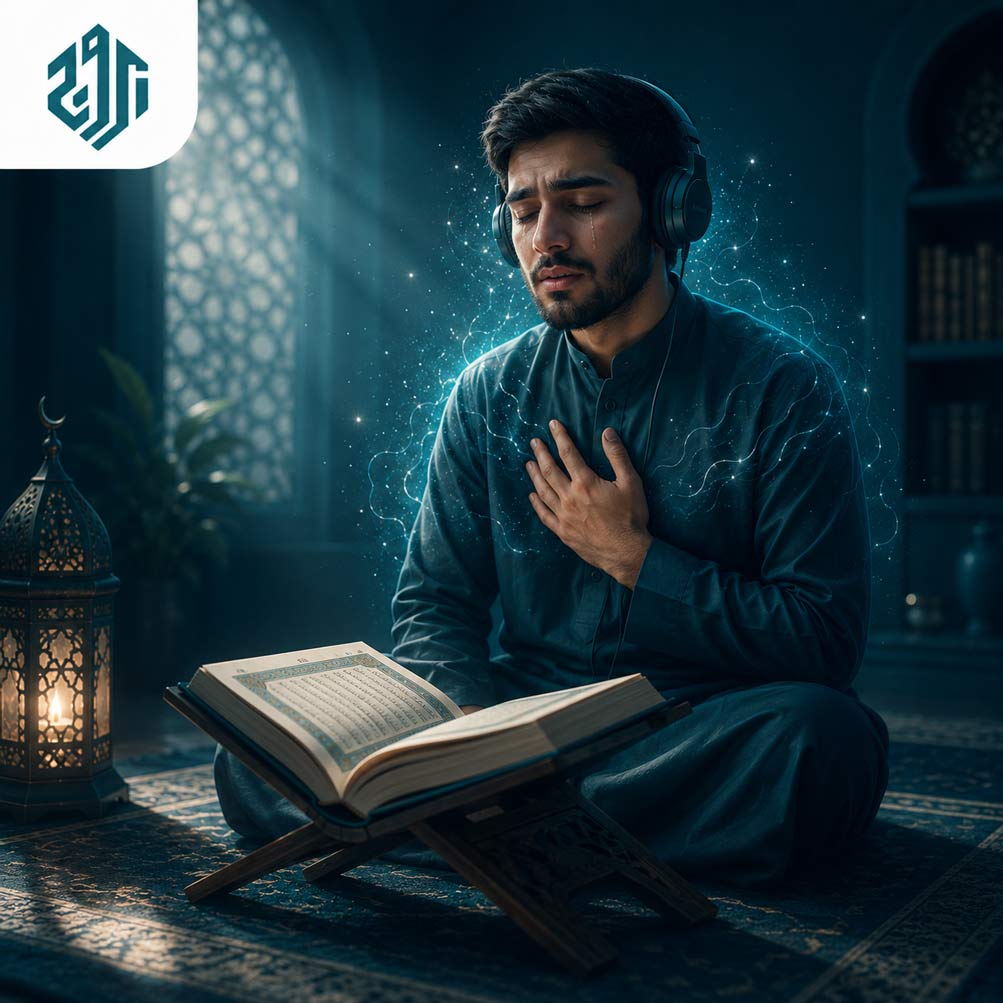
Your skin prickles. Your chest tightens. Somewhere between the third and fourth ayah, without warning, your eyes are wet. You didn’t plan this reaction, and you’re not entirely sure what to make of it.
Goosebumps, tears, or a flicker of fear during Quran recitation are a recognized physiological and spiritual response, not a malfunction. Both neuroscience and the Quran itself describe this reaction as real and meaningful.
Table of Contents:
What Does Cause Goosebumps When Listening to the Quran?
Goosebumps during recitation happen because tiny muscles at the base of each hair follicle contract in response to intense emotional or auditory stimulation, a reflex called piloerection. The reaction sits at the intersection of how your nervous system processes sound and how your heart responds to meaning.
Understanding this response has helped us guide countless students through their reading the Quran for the first time.
In our sessions at Buruj Academy, new reciters are often surprised that their bodies react before their minds fully process the words — proof that recitation reaches something deeper than intellectual comprehension.
1. The Nervous System Response Behind Piloerection
Piloerection is a documented autonomic reflex, not a subjective impression, triggered when tiny muscles at hair follicles contract in response to strong sensory or emotional stimuli. Cold triggers it.
So do fear, sadness, and moments of aesthetic intensity. This reflex activates most reliably during unexpected shifts in sound: a voice entering after silence, a sudden dynamic change, or a melodic pattern that builds tension before resolving it.
Skilled Quran reciters — particularly those trained in Tajweed — naturally produce these acoustic patterns through elongated Madd, rhythmic pausing (Waqf), and tonal variation across verses.
A reciter’s controlled pause before a decisive word, or the elongation of a vowel at a moment of emphasis, mirrors the exact structural features research has linked to chills.
Read also: Top 10 Quran Reciters to Learn Tajweed From
2. Why Quranic Recitation Specifically Triggers This Reflex
Quranic recitation activates piloerection because it combines rhythmic, tone-varied vocal delivery with content the listener holds as sacred, layering emotional weight onto an already chill-triggering acoustic structure.
This dual layering — sound plus meaning — helps explain why the same verse recited by different reciters can produce very different intensities of response.
Dopamine release occurs both in anticipation of an emotional peak and during the resolution, activating the orbitofrontal cortex for emotional processing, the supplementary motor area, and the right temporal lobe for auditory processing.
3. The Role of Belief and Emotional Meaning in the Response
Belief intensifies piloerection because the listener isn’t just processing sound patterns — they’re processing content understood as direct divine speech, adding a layer of reverence that a purely aesthetic listening experience cannot replicate.
We’ve observed this distinction repeatedly in our online Quran classes. In our experience, students who understand even basic translation alongside the Arabic report stronger physical reactions than those reciting purely by sound — meaning appears to amplify the reflex rather than compete with it.
Start Learning Quran With a FREE Trial Lesson
Does Islam Explain Why the Skin Reacts to the Quran?
Yes, the Quran describes believers’ skin shivering at recitation as a direct sign of fearing Allah, followed by the heart softening at His remembrance. This is stated plainly in a verse revealed specifically about how the Quran moves the body of a sincere listener.
اللَّهُ نَزَّلَ أَحْسَنَ الْحَدِيثِ كِتَابًا مُّتَشَابِهًا مَّثَانِيَ تَقْشَعِرُّ مِنْهُ جُلُودُ الَّذِينَ يَخْشَوْنَ رَبَّهُمْ ثُمَّ تَلِينُ جُلُودُهُمْ وَقُلُوبُهُمْ إِلَىٰ ذِكْرِ اللَّهِ
Allahu nazzala ahsanal hadeethi kitaban mutashabihan mathaniya taqsha’irru minhu juloodul-lathina yakhshawna rabbahum thumma taleenu julooduhum wa quloobuhum ila thikrillah
“Allah has sent down the best statement: a consistent Book wherein is reiteration. The skins shiver therefrom of those who fear their Lord; then their skins and their hearts relax at the remembrance of Allah.” (Az-Zumar 39:23)
This ayah describes a two-stage response: shivering skin from fear/awe, followed by the heart settling into comfort at the mention of Allah — the exact pattern many reciters and listeners describe experiencing.
What Az-Zumar 39:23 Reveals About This Reaction
This verse frames goosebumps not as an isolated physical quirk but as one half of a complete spiritual sequence — awe followed by comfort. The skin’s shiver at fearing Allah is meant to resolve into the heart’s calm at His remembrance, not remain stuck in agitation.
Classical commentary on this ayah draws a careful distinction. According to Tafsir Ibn Kathir, this reaction — the skin shivering, the eyes weeping, the heart finding rest — describes the characteristic of the righteous believers, while losing control of one’s mind or fainting reflects something else entirely.
The response the Quran describes is composed, not chaotic. Understanding this framework has shaped how we teach the manners of reading the Quran at Buruj Academy — reverence is expressed through presence, not performance.
How This Reaction Connects to Taqwa and Sincerity
Scholars have consistently linked physical responsiveness to Quranic recitation with taqwa (God-consciousness), viewing it as evidence of a heart genuinely engaged with the words rather than merely hearing them.
The verse specifies this shivering happens to “those who fear their Lord” — meaning the reaction correlates with sincerity of heart, not simply exposure to sound.
This doesn’t mean the absence of goosebumps indicates weak faith. Many sincere believers process recitation more through calm reflection than visible physical reaction, and both are valid.
What matters is the state described in the second half of the verse: a heart that softens at Allah’s remembrance, whatever form that takes for you.
Read also:Do You Need Wudu to Listen to the Quran?
Why Does Listening to the Quran Make Me Cry?
Crying during Quran recitation typically happens when a verse connects directly to personal accountability, mercy, or mortality — themes the Quran addresses with unusual directness.
This response has clear precedent in the life of the Prophet ﷺ himself, who wept while listening to a companion recite.
The Prophetic Precedent for Weeping During Quran Recitation
The clearest example comes from a hadith where the Prophet ﷺ asked Abdullah ibn Mas’ud to recite Surah An-Nisa aloud.
When Ibn Mas’ud reached the verse describing every nation bringing forth a witness on Judgment Day, the Prophet ﷺ said, “Enough for the present,” and his eyes were overflowing with tears (Sahih al-Bukhari 5050).
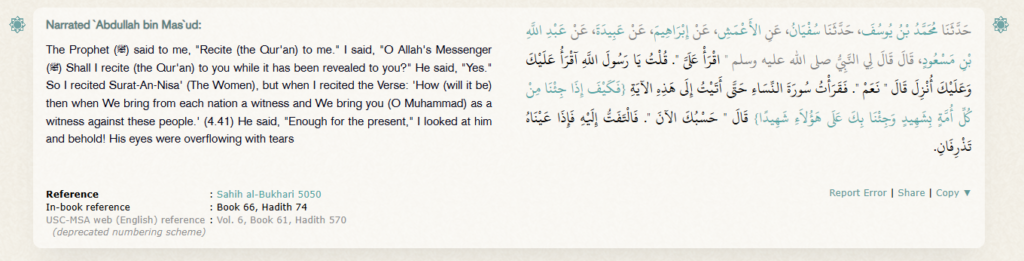
This narration establishes that emotional response to recitation — even to the point of tears — was demonstrated by the Prophet ﷺ himself, not merely tolerated as an unusual reaction in others.
Which Verses Most Commonly Trigger Tears
Verses describing the Day of Judgment, personal accountability before Allah, or the vastness of His mercy after acknowledging sin tend to produce the strongest emotional responses, since they confront the listener with their own reality in direct, unavoidable language.
Ibn Mas’ud’s recitation stopped specifically at a verse about universal accountability — a theme that continues to affect listeners the same way today.
Surahs invoking Allah’s names related to mercy and forgiveness often produce a different kind of tears — relief rather than fear. This mirrors the two-stage pattern in Az-Zumar 39:23: distress giving way to comfort.
Recognizing which verses affect you and why is part of what we help students develop through our Online Quran Recitation Course, where understanding meaning alongside pronunciation deepens this connection naturally.
Book your first FREE recitation lesson

Is Crying During Recitation Something to Encourage?
Yes, within measure — the Quran and Sunnah both frame emotional responsiveness to recitation positively, provided it doesn’t disrupt the composure needed to continue reciting accurately or reflecting on subsequent verses.
Weeping that flows from genuine reflection is different from performative emotion, and the difference usually shows in what happens next: does the tears lead to renewed focus, or does it become the point of the exercise itself?
In our instructors’ experience, students memorizing through our Online Hifz Program often report their most emotional moments occur not during first exposure to a verse, but during later revision — once the meaning has settled and repetition has deepened familiarity rather than dulled it.
Read also:Is It Haram to Listen to the Quran While Sleeping?
Discover the Buruj Academy Difference
Step into our virtual classrooms and see how our expert instructors make learning Quran and Arabic intuitive and clear. We focus on overcoming the specific hurdles non-native speakers face, building your confidence and connection with the Quran.
Excel in Your Quranic Studies
Join Buruj Academy and master the Quran with our structured, professional curriculum.
Book Your Free TrialWhy Do I Get Scared When I Hear the Quran?
Fear while listening to the Quran usually stems from verses describing accountability, divine justice, or the consequences of wrongdoing — content the Quran presents with intentional gravity rather than abstraction.
This fear is distinct from anxiety; it’s a response the text itself is designed to produce in a reflective listener.
Understanding Khashyah Versus Ordinary Fear
Islamic scholarship distinguishes khashyah — reverential fear rooted in knowledge and awareness of Allah’s magnitude — from ordinary anxiety or dread.
Khashyah is described as a fear that draws the heart closer rather than pushing it away, motivating changed behavior rather than paralysis.
The Quranic vocabulary itself makes this distinction: the word used in Az-Zumar 39:23 for those whose skin shivers is derived from this same root.
| Fear Type | Source | Typical Effect |
| Khashyah (reverential fear) | Awareness of Allah’s magnitude and justice | Draws heart closer, motivates reflection |
| Ordinary anxiety | Uncertainty, stress, unrelated triggers | Creates avoidance or distress |
| Momentary startle | Sudden tonal or volume shift in recitation | Passes quickly, no lasting effect |
This table distinguishes the spiritually productive fear the Quran describes from anxiety that has no connection to the verse’s content.
Read also:Is It Haram to Smoke Cigarettes While Listening to Quran?
Verses Commonly Associated With This Response
Passages describing the Hereafter, the weighing of deeds, or direct address to disbelievers and wrongdoers frequently produce this reaction, even in listeners who don’t yet understand the Arabic, because tone and delivery carry meaning independent of translation.
Skilled reciters often intensify pace or lower pitch specifically at these junctures, a technique rooted in proper Tajweed delivery rather than theatrical embellishment.
We address this directly in our Tajweed for Beginners guidance, since understanding why a reciter pauses or elongates a word at a specific point transforms an unsettling moment into a meaningful one. Fear rooted in comprehension settles faster than fear rooted in confusion.
Understanding the Full Body Response to Quran Recitation
Beyond goosebumps, tears, and fear, listeners commonly report slowed breathing, a lowered heart rate, and a general physical settling — responses increasingly documented in clinical research on Quranic recitation. These effects extend beyond subjective spiritual impression into measurable physiological territory.
What Clinical Research Has Found
A systematic review of studies on Quran listening, recitation, and memorization found favorable effects on depression, anxiety, physiologic parameters, quality of life, quality of sleep, and intelligence quotient (PMC systematic review).
Separate clinical research on post-operative patients found that Quran recitation stimulates alpha brain waves associated with endorphin release, enhanced stress threshold, and reduced negative emotion.
These findings apply specifically to structured recitation listening in controlled clinical settings, and should be understood as documented physiological correlation rather than a substitute for medical or spiritual guidance in individual cases.
Why Do Headaches Sometimes Occur During Recitation?
Occasional headaches during Quran listening typically trace to identifiable, ordinary causes: physical tension from unfamiliar posture, the cognitive effort of processing unfamiliar Arabic phonetics, or built-up emotional intensity that manifests physically before it resolves. This is different from goosebumps or tears, and doesn’t carry the same spiritual significance described in Az-Zumar 39:23.
If headaches persist regardless of context or session length, that’s a matter for a medical professional rather than a spiritual explanation.
How to Deepen Your Connection When You Feel This Response?
When goosebumps, tears, or fear arise during recitation, the most beneficial response is to lean into reflection rather than distraction — pausing briefly, considering the verse’s meaning, and allowing the second stage described in Az-Zumar 39:23 to unfold naturally. Learning what the words mean is what transforms a physical reaction into lasting spiritual benefit.
Building Comprehension Alongside Recitation
Understanding meaning is what separates a fleeting emotional reaction from genuine reflection. Structured learning through our Online Quranic Arabic Classes helps students connect the words producing these reactions to their actual meaning, so the response deepens rather than remaining a mystery each time it occurs.
Begin Understanding Quranic Arabic with a FREE Lesson

Establishing Consistent, Reflective Recitation Habits
Consistency matters more than intensity. Following a best time to read Quran and building a daily Quran reading habit allows these responses to become part of a sustained relationship with the text rather than isolated emotional spikes.
Regular, unhurried recitation — particularly during the quiet stillness described in guidance around Qiyam al-Layl — tends to produce the calmest, most reflective versions of this response.
Strengthen Your Connection to the Quran with Buruj Academy
Understanding why your body responds to the Quran is only the beginning — real depth comes from understanding what you’re hearing.
Buruj Academy’s Online Quran Classes connect you with Ijazah-certified instructors and Al-Azhar University graduates who guide you from recitation to genuine comprehension.
Through the Buruj Method — sound-before-rules, context-before-abstraction – our instructors help students at every level move from powerful but fleeting emotional moments toward sustained, reflective connection with the Quran.
With personalized 1-on-1 sessions and flexible 24/7 scheduling, you can build this relationship at your own pace, wherever you are.
Book a free trial lesson and experience the difference expert guidance makes in your recitation journey.
Take the next step in your learning journey today by enrolling in one of our specialized programs:
- Online Quran Classes
- Online Quran Classes for Beginners
- Online Quran Classes for Adults
- Online Quran Classes for Ladies
- Online Quran Classes for Kids
- Quran Reading Course
- Quran Recitation Course
- Online Ijazah Course
- Online Qirat Course
Don’t wait to transform your relationship with the Holy Quran. Join our global community of students and book your free evaluation session now!
Excel in Your Quranic Studies
Join Buruj Academy and master the Quran with our structured, professional curriculum.
Book Your Free TrialDiscover the Buruj Academy Difference
Step into our virtual classrooms and see how our expert instructors make learning Quran and Arabic intuitive and clear. We focus on overcoming the specific hurdles non-native speakers face, building your confidence and connection with the Quran.
Conclusion
Goosebumps, tears, and fear during Quran recitation aren’t strange or isolated reactions — they follow a documented physiological pathway, layered with the added weight of sacred meaning for a believing heart. The Quran itself names this response directly in Az-Zumar 39:23, framing shivering skin and a softening heart as signs of sincere faith rather than anomalies.
What matters most isn’t whether you feel goosebumps every time you listen, but whether the words are reaching you at all. For some, that shows up physically. For others, it shows up as quiet reflection. Both are forms of a heart responding to the Quran exactly as it was meant to.
Frequently Asked Questions About Goosebumps and Quran Recitation
Is It Normal to Not Feel Goosebumps When Listening to the Quran?
Yes. Physical responsiveness to sound varies naturally between individuals, and roughly half the population doesn’t regularly experience chills. Absence of goosebumps says nothing about the sincerity of your faith or the quality of your reflection.
What Does It Mean When You Cry Every Time You Hear the Quran?
Consistent crying often indicates deep emotional and spiritual engagement with the text’s meaning, particularly around themes of accountability or mercy. This mirrors the pattern shown by the Prophet ﷺ himself while listening to recitation, and is generally considered a positive sign when it doesn’t prevent continued listening or reflection.
Can Goosebumps From Quran Recitation Happen Without Understanding Arabic?
Yes. Tone, rhythm, and vocal delivery in skilled Tajweed-based recitation can trigger piloerection independent of language comprehension, since the acoustic structure itself carries emotional weight. Understanding the meaning typically intensifies rather than causes this response.
Does the Buruj Method Address Emotional Responses to Recitation?
Yes. Our instructors are trained to guide students through emotional moments during recitation with patience, helping connect physical or emotional reactions to verse meaning rather than treating them as distractions from proper Tajweed practice.