 Quran
Quran
| Key Takeaways |
| Surah Ar-Rahman contains 78 verses divided into three thematic sections: creation (1–30), judgment (31–45), and paradise (46–78). |
| The refrain “Fabi ayyi aala’i Rabbikuma tukazziban” repeats 31 times, offering natural built-in memory anchors between verses. |
| Memorizing verses 1–13 first establishes the surah’s rhythm before tackling the 26 couplets that follow the same pattern. |
| Pairing each verse with its matching refrain repetition, rather than memorizing them separately, cuts confusion between similar-sounding ayahs. |
| Daily review of the previous day’s verses before adding new ones prevents the most common memorization plateau students face. |
Surah Rahman’s poetic rhythm makes it one of the most rewarding surahs to memorize, but its repeated refrain is also where most students lose their place. Verses start to blend together, and the mind confuses which blessing belongs to which repetition of “then which of your Lord’s favors would you deny.”
To memorize Surah Rahman successfully, students should progress through its natural three-part structure: the 13-verse introduction, the 26 verse-pairs of creation and judgment, and the paradise section, always anchoring each new verse to its refrain before adding another.
Table of Contents:
Step 1: Understand the Surah Rahman’s Structure Before Memorizing a Single Verse
Surah Rahman is built from 78 verses split into three thematic movements: verses 1–30 describe Allah’s creation and blessings, verses 31–45 describe the Day of Judgment, and verses 46–78 describe the delights of Paradise. Recognizing this shape before memorizing anything prevents the disorientation most students feel halfway through.
In our sessions at Buruj Academy, we’ve noticed that students who skip this step and simply start reciting from verse 1 tend to lose track of where they are by the mid-30s. They know the surah “sounds right,” but they cannot locate a specific verse without reciting from the beginning.
The refrain “فَبِأَيِّ آلَاءِ رَبِّكُمَا تُكَذِّبَانِ” (Fabi ayyi aala’i Rabbikuma tukazziban) — “Then which of the favors of your Lord would you deny?”(Ar-Rahman 55:13) — appears 31 times and marks the end of nearly every unit after verse 13.
This is not decoration. It is a built-in checkpoint system, and a student who memorizes with this checkpoint in mind will always know exactly which blessing they just recited before hitting the refrain.
We recommend starting with Buruj Academy’s Online Hifz Program, where instructors map out this exact structure with students before assigning a single line, so the mental model is in place from day one.
Start Hifz today with a FREE trial session

The 13-Verse Opening Behaves Differently Than the Rest of the Surah
Verses 1 through 13 form an introductory stanza that does not follow the couplet-and-refrain pattern seen later in the surah. Verse 1 is a single word — الرَّحْمَٰنُ (Ar-Rahman) — and verses 2 through 12 build a chain of blessings before the first refrain appears at verse 13.
Students often assume every verse pairs with a refrain, then get confused when the opening doesn’t behave that way. Treating verses 1–13 as their own standalone unit, separate from the pattern that follows, removes this confusion entirely.
Step 2: Begin Memorization of Surah Rahman with Verses One Through Thirteen as a Single Unit
The opening thirteen verses should be memorized together as one connected passage before any refrain-based memorization begins, since this section establishes the surah’s cadence and contains no repeated pattern to lean on. This is the hardest section of the entire surah for most students, precisely because there is no repetition to help.
We tell our Hifz students at Buruj Academy that verses 1–13 are the “foundation stanza” — get this section solid, and the rest of the surah becomes noticeably easier because the ear is now trained to Ar-Rahman’s rhythm.
Recite verses 1–4 together first, since they form a natural logical sequence: Allah taught the Quran, created man, and taught him articulate speech.
“الرَّحْمَٰنُ عَلَّمَ الْقُرْآنَ خَلَقَ الْإِنسَانَ عَلَّمَهُ الْبَيَانَ”
Ar-Rahman, ‘Allamal-Qur’an, Khalaqal-insan, ‘Allamahul-bayan
“The Most Merciful taught the Qur’an, created man, [and] taught him eloquence.” (Ar-Rahman 55:1–4)
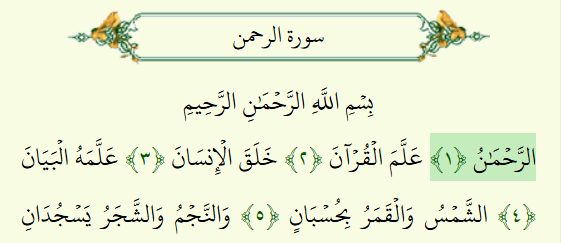
Note the internal rhyme pattern — each verse ends in the same long “-aan” sound, which is one of the features that makes this surah easier to recall once the ear adjusts to it.
Move to verses 5–9 as the second block, which describe the sun, moon, stars, and the balance Allah established in creation. Then verses 10–13 close the opening with the earth’s blessings for creatures and the first refrain.
Students following Buruj Academy’s Amli Tajweed Course alongside their Hifz sessions often find this section easier still, since correct Tajweed application reduces hesitation and false starts during recitation.
Book Your FREE Trial Lesson in Buruj’s Amli Tajweed Course
How to Handle the Rhyme Scheme in Surah Rahman Without Letting It Mask Meaning
Every verse in the opening thirteen ends in the same “-aan” sound, which helps recitation flow but can cause students to memorize the sound pattern without truly connecting each verse to its meaning.
We advise pausing after every four verses to translate the block silently in your own words before continuing.
This single habit — translating in your head before moving on — is what separates students who can recite Surah Rahman fluently from students who can also explain what they just recited to someone else.
Read also:Dua for Memorizing Quran
Step 3: Memorize the Twenty-Six Couplets in Blocks of Four Blessings at a Time
Once verses 1–13 are secure, the next 17 verses (14–30) present Allah’s blessings in couplet form, where the first verse names a blessing and the second immediately follows with the refrain. These should be memorized in blocks of four verses — two blessings and two refrains — rather than verse by verse.
In our experience teaching Hifz to non-Arabic speaking adults, breaking this section into two-blessing blocks rather than isolated single verses cuts memorization time roughly in half, because the refrain itself requires no new memorization after the first few repetitions.
Verses 14–16 describe man’s creation from clay and jinn’s creation from smokeless fire, followed by the second refrain. Practice this block until the transition from “created” to “which of the favors” feels automatic, not memorized as two separate thoughts.
“خَلَقَ الْإِنسَانَ مِن صَلْصَالٍ كَالْفَخَّارِ”
Khalaqal-insana min salsalin kal-fakhkhar
“He created man from clay like [that of] pottery.” (Ar-Rahman 55:14)
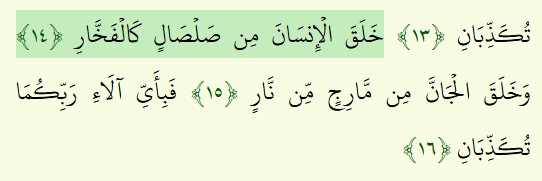
The comparison to pottery — clay that has been fired and hardened — is a specific detail students often forget when reciting quickly; slow down at this verse specifically.
Continue this four-verse block pattern through verse 30, covering the two seas, pearls and coral, ships, and the eventual perishing of all creation except Allah’s Face.
By verse 30, students have memorized 30 verses total, roughly 38 percent of the surah, using only two distinct memorization techniques.
This is also the point in the surah where Buruj Academy’s Hifz for Adults course structures its first formal review milestone, since verse 30 marks the close of the surah’s first thematic section.
Book Your Free Trial Lesson with Burruj’s Hifz Course for Adults

What to Do When Two Blessings Start to Sound the Same in Your Memory?
Students consistently confuse verse 19’s mention of the two seas with verse 24’s mention of ships upon the sea, since both involve water imagery in close proximity.
The fix is to attach a single distinguishing word to each verse in your own mind — “meeting” for verse 19, “ships” for verse 24 — before attempting to recite the block from memory.
Discover the Buruj Academy Difference
Step into our virtual classrooms and see how our expert instructors make learning Quran and Arabic intuitive and clear. We focus on overcoming the specific hurdles non-native speakers face, building your confidence and connection with the Quran.
Excel in Your Quranic Studies
Join Buruj Academy and master the Quran with our structured, professional curriculum.
Book Your Free TrialStep 4: Approach the Judgment Section in Surah Rahman as a Shift in Tone
Verses 31 through 45 shift from describing creation to describing the Day of Judgment and its punishments, and this tonal shift itself functions as a memory aid if a student recognizes it while memorizing. Rather than treating verse 31 as “verse number 31,” treat it as “the verse where the tone changes.”
We’ve found that students who consciously notice this shift — a change from wonder at creation to warning about judgment — retain this section faster than students who memorize it with the same mental approach as the previous section.
“سَنَفْرُغُ لَكُمْ أَيُّهَ الثَّقَلَانِ”
Sanafrughu lakum ayyuhath-thaqalan
“We will attend to you, O prominent [beings] (jinn and mankind).” (Ar-Rahman 55:31)
This verse is a direct address to both jinn and humankind — recognizing this shift from third-person description to second-person address helps mark it clearly in memory.
Memorize verses 31–36 as one block, covering the warning to jinn and mankind and the description of flames and smoke sent against those who deny. Then verses 37–40 as a second block, describing the sky splitting and becoming rose-colored.
Verses 41–45 close the section with the recognition of criminals by their marks and the punishment of boiling water and Hellfire, ending the judgment unit at verse 45.
Students working through Buruj Academy’s Islamic studies course often find this section reinforces classroom learning on the Day of Judgment, giving the memorization added context beyond pure recitation.
Begin Your Islamic Knowledge Journey With a FREE Trial Lesson

Common Mistake Students Make When Reciting Verses Thirty-One Through Forty-Five
The most frequent error we correct in this section is students rushing through the refrain after verse 36’s description of flames, treating it as filler rather than a deliberate pause. The refrain here carries weight precisely because of what precedes it — slow the pace of recitation through this specific stretch rather than maintaining the same speed used in the creation section.
Read also:How to Memorize Surah Mulk?
Step 5: Memorize the Verses of the Two Paradise Gardens in Surah Rahman
Verses 46 through 61 describe two gardens prepared for those who feared standing before Allah, and this passage is structured so that many verses describing the first garden are mirrored by nearly identical verses describing the second. Recognizing this mirroring cuts the effective memorization load significantly.
For example, verse 48’s description of the first garden’s two flowing springs closely parallels verse 66’s later description of the second set of gardens, which also contain two springs.
Students who notice these parallels across the surah, rather than memorizing each garden description in total isolation, build stronger recall because one memory reinforces the other.
فِيهِمَا عَيْنَانِ تَجْرِيَانِ
Fihima ‘aynani tajriyan
“In both of them are two springs, flowing.” (Ar-Rahman 55:50)
This exact phrase structure — “in both of them are two [feature]” — repeats with variations throughout the paradise sections; once memorized once, subsequent instances become recognition rather than new memorization.
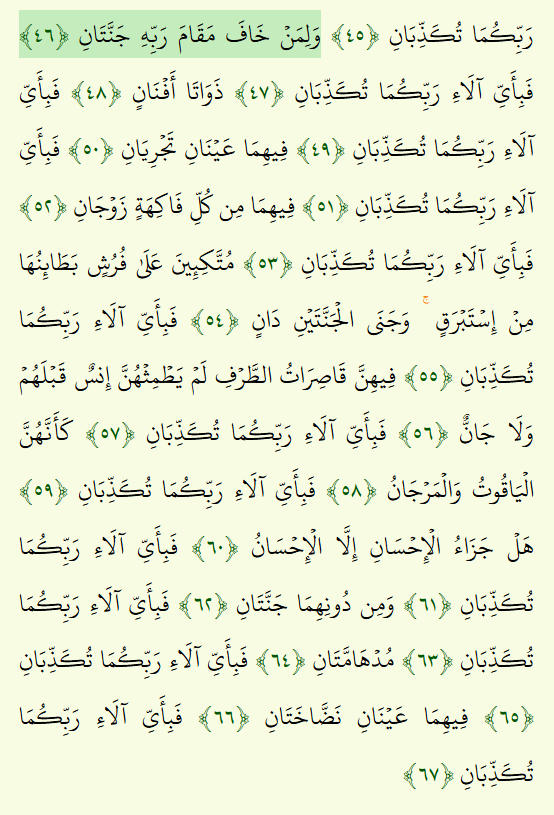
We recommend memorizing verses 46–61 (the first garden pair) completely before beginning verses 62–78 (the second garden pair), rather than alternating between them, since mixing the two before either is solid tends to blend their descriptions together.
Students enrolled in Buruj Academy’s Juz 30 memorization course, many of whom later progress to longer surahs like Ar-Rahman, are already familiar with this block-memorization approach from shorter surah work.
Book Your First Session in Buruj’s Juz 30 Memorization Course
Read also: How Common Is Memorizing the Quran?
Step 6: Complete the Final Twelve Verses of Surah Rahman and the Closing Blessing
Verses 62 through 78 complete the second garden description and close the surah with a final standalone verse of blessing that does not carry the refrain.
This closing structure — description, final refrain at verse 77, then one unpaired verse — should be memorized as its own distinct final block.
تَبَارَكَ اسْمُ رَبِّكَ ذِي الْجَلَالِ وَالْإِكْرَامِ
Tabarakasmu Rabbika dhil-Jalali wal-Ikram
“Blessed is the name of your Lord, Owner of Majesty and Honor.” (Ar-Rahman 55:78)
This final verse breaks the couplet-refrain pattern entirely, which is precisely why students should memorize it as a deliberate closing statement rather than expecting another refrain to follow.
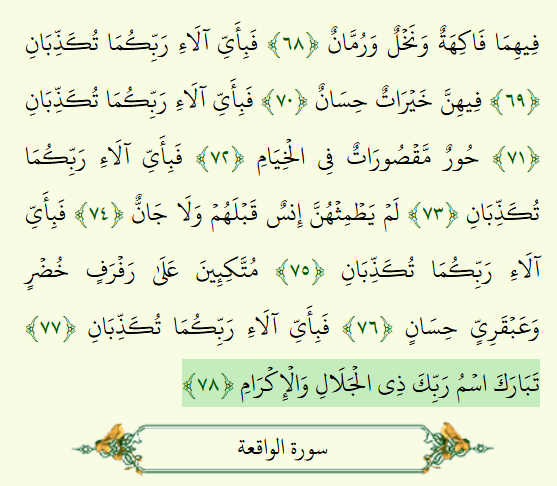
In our teaching experience, students often forget this final verse exists separately, assuming the surah ends on the last refrain at verse 77.
Marking verse 78 clearly as “the closing blessing, no refrain follows” prevents this from becoming a permanent gap in recitation.
At this stage, we recommend connecting with Buruj Academy’s Online Hifz Program for a formal check of the complete surah, since self-review at this length often misses small transposition errors between similarly structured verses that only a trained instructor catches in live recitation.
Read also: How to Memorize Surah Naba?
Step 7: Consolidate the Entire Surah Rahman Through Structured Daily Revision
Once all 78 verses are individually memorized, they must be linked into one continuous recitation through daily revision that connects each section to the next, since sectional memorization alone does not guarantee smooth full-surah recall. This consolidation phase typically takes as long as the initial memorization itself.
| Revision Week | Focus | Daily Target |
| Week 1 | Link verses 1–30 | Recite full section without pausing |
| Week 2 | Link verses 31–61 | Recite full section, then connect to Week 1 |
| Week 3 | Link verses 62–78 | Recite full surah start to finish |
| Week 4+ | Full surah maintenance | Recite complete surah 2–3 times weekly |
This table assumes verses were already individually memorized during the earlier phases described above; it is not a first-memorization schedule.
Reviewing Buruj Academy’s guide on how to memorize Quran faster alongside this consolidation phase can help students apply general retention techniques specifically to Ar-Rahman’s section transitions.
Why the Transition Points Between Sections Cause the Most Forgetting
The verses immediately before and after a thematic shift — verse 30 into 31, and verse 45 into 46 — are statistically where students lose their place most often during full-surah recitation, since the brain has memorized each section as a separate unit rather than a continuous whole.
Deliberately practicing these two transition points in isolation, five to ten times each, closes this gap faster than repeating the entire surah from the beginning every time.
Read also: How Many People Have Memorized the Quran Worldwide?
Master Surah Rahman with Buruj Academy’s Expert Hifz Guidance
Memorizing Surah Rahman rewards students who follow its natural three-part structure rather than treating all 78 verses as one undifferentiated block. Refrain-based checkpoints, mirrored garden descriptions, and deliberate transition practice turn a long surah into a manageable sequence.
Buruj Academy’s Online Hifz Program pairs students with Ijazah-certified instructors and Al-Azhar University graduates who apply the Buruj Method’s consistency-before-speed approach to exactly this kind of structured, multi-phase memorization.
Our instructors, with 12+ years of experience teaching non-Arabic speakers, catch the small transposition errors between similar verses that self-study alone often misses.
Sessions are personalized, scheduled flexibly around your week, and include real-time correction so errors are fixed before they become habits.
Book a free trial lesson with Buruj Academy today and begin memorizing Surah Rahman with expert guidance from day one.
Take the first step toward this lifelong blessing by enrolling in a program tailored to your pace:
- Online Hifz Program (Comprehensive Quran Memorization)
- Juz 30 Memorization Course (Perfect for focused starts)
- Hifz Classes for Kids (Engaging and interactive)
- Hifz Classes for Adults (Flexible scheduling for busy lives)
- Hifz Classes for Sisters (Private, supportive learning)
- Short Surah Memorization Course (Ideal for daily prayers)
- Hifz Ijazah Course (For advanced students seeking certification)
Don’t let another day pass without moving closer to your goal. Join Buruj Academy today and schedule your free trial session to begin your Hifz journey!
Excel in Your Quranic Studies
Join Buruj Academy and master the Quran with our structured, professional curriculum.
Book Your Free TrialDiscover the Buruj Academy Difference
Step into our virtual classrooms and see how our expert instructors make learning Quran and Arabic intuitive and clear. We focus on overcoming the specific hurdles non-native speakers face, building your confidence and connection with the Quran.
Conclusion
Surah Rahman’s length can feel daunting, but its architecture is actually a gift to the memorizer: a foundation stanza, twenty-six paired blessings, a judgment passage, and two mirrored gardens closing on a single blessing. Working phase by phase through this real structure, rather than reciting from verse one until something sticks, turns 78 verses into six manageable stages.
Consistency across daily revision matters more than the pace of new memorization, particularly at the section transitions where most forgetting happens. With patience and the right structure, this surah — described as the Quran’s adornment — becomes one students carry for life.
Frequently Asked Questions About Memorizing Surah Rahman
How Long Does It Take to Memorize Surah Rahman?
Timelines vary by pace and prior memorization experience, but students dedicating 15–20 minutes daily typically memorize Surah Rahman’s 78 verses within 6–10 weeks, followed by 2–4 weeks of consolidation to link all sections into smooth, continuous recitation.
Why Does the Refrain Repeat Thirty-One Times in This Surah?
The refrain “Then which of the favors of your Lord would you deny?” repeats after nearly every blessing described from verse 13 onward, functioning as a rhetorical challenge that pairs each mentioned blessing with a direct question to the listener, reinforcing gratitude throughout the surah’s structure.
Should Beginners Memorize Surah Rahman Before Completing Juz Amma?
Surah Rahman’s Makki couplet structure differs significantly from the shorter surahs of Juz Amma, so most instructors recommend building foundational memorization habits on shorter surahs first before attempting Ar-Rahman’s length and refrain-based pattern.
What Is the Best Way to Avoid Confusing Similar Verses in Surah Rahman?
Attaching one distinguishing word or image to each verse — a specific blessing, color, or object — rather than relying on the refrain alone to separate verses, is the most effective way to prevent similar-sounding blessings from blending together during recall.