 Arabic
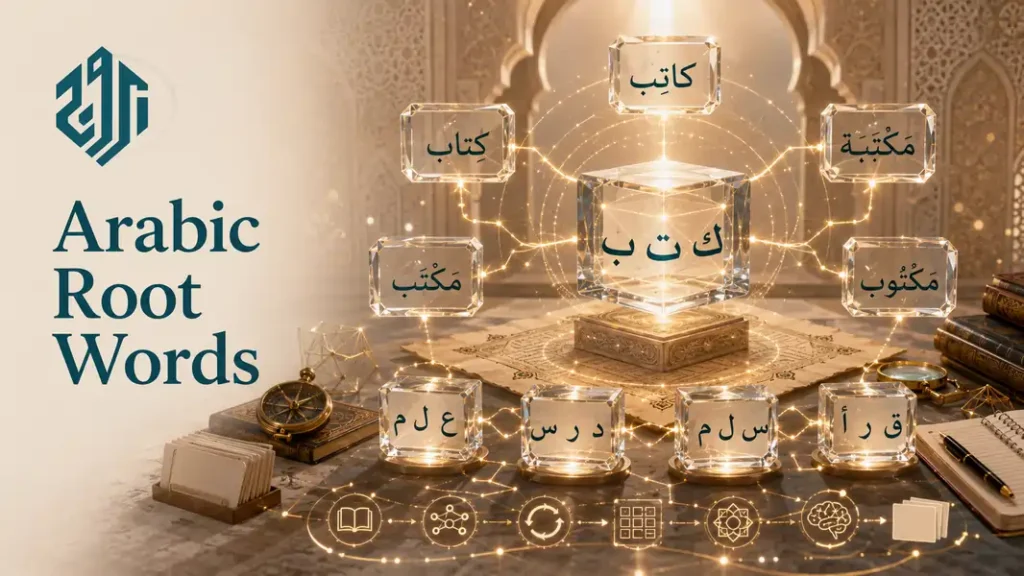
Every Arabic word you have ever struggled to memorize is secretly connected to dozens of others through a shared three-letter skeleton. Once we see that connection, vocabulary stops feeling like an endless list.
Arabic root words (جذر — jidhr) are typically three-consonant sequences carrying a core meaning, from which entire families of verbs, nouns, and adjectives are built. Learning roots turns scattered memorization into a system.
Table of Contents:
What Is an Arabic Root Word?
An Arabic root word is a sequence of consonants — usually three — that carries a general, abstract concept before any grammatical form is applied. The root ك-ت-ب, for instance, holds the idea of “writing” itself, with no tense, gender, or role attached yet. Everything specific comes later.
In our Arabic grammar classes at Buruj Academy, we have noticed that students who learn roots first, rather than memorizing whole words in isolation, retain vocabulary roughly three times faster over a semester. The root is the seed; the grammar is the tree that grows from it.
This is why Arabic dictionaries are not organized like English ones. You cannot look up a word alphabetically by its first letter, because that first letter might just be a prefix.
You search by root instead. Understanding this system connects directly to broader Arabic grammar fundamentals that every serious learner eventually needs.
Understand the Arabic Grammar with Buruj’s free trial lesson
How Do Root Letters Differ From the Words They Build?
A root is not itself a usable word — it is a raw concept waiting for structure. The root د-ر-س means “the concept of studying,” but you cannot say that phrase aloud as a sentence.
To become usable, the root passes through a pattern (وزن — wazn), a template that adds vowels, prefixes, or suffixes.
The pattern decides whether the result is a verb, a doer-noun, a place-noun, or a tool-noun. Root plus pattern equals word — always in that order.
Read More: Learn Arabic in Morocco
How Many Root Letters Does a Typical Arabic Word Have?
Most Arabic roots consist of exactly three consonants, called trilateral roots, though four-consonant (quadrilateral) roots and rare five-letter roots also exist in the language.
Trilateral roots make up the overwhelming majority — commonly cited at around 85 to 90 percent of the total root inventory.
The remaining roots are quadrilateral, meaning they use four consonants instead of three, such as ز-ل-ز-ل (z-l-z-l), which produces زَلْزَال (zalzāl — earthquake).
Trilateral Roots are the Backbone of the Arabic Language
Trilateral roots (جذر ثلاثي — jidhr thulāthī) are three-consonant sequences and form the vast majority of words in everyday Arabic and formal writing alike. The order of the three letters is fixed and meaningful.
Swap the order and the meaning collapses entirely. ك-ت-ب (writing) is completely unrelated to ب-ك-ت, which is not a real root at all in standard Arabic. Sequence carries as much information as the letters themselves.
Quadrilateral and Rare Longer Arabic Roots
Quadrilateral roots use four consonants and are noticeably less frequent, but they still appear in common vocabulary — تَرْجَمَ (tarjama — to translate) comes from the root ت-ر-ج-م. These roots follow a slightly different pattern template, often written as فَعْلَلَ.
A pattern our instructors flag early: students sometimes force a four-letter word into a three-letter root by guessing, which produces the wrong meaning entirely. Verifying the root in a dictionary is always the safer habit, even for advanced learners.
What Are Some Common Arabic Root Words With Their Meanings?
Common Arabic roots include ك-ت-ب (writing), ع-ل-م (knowledge), د-ر-س (studying), س-ل-م (peace/safety), and ق-ر-أ (reading), each generating ten or more everyday derived words. These five roots alone appear in hundreds of frequently used Arabic terms.
The table below shows how five foundational roots branch into distinct word families, useful for building a working vocabulary quickly.
| Root | Core Meaning | Example Derived Word | Translation |
| ك-ت-ب | Writing | كَاتِب (kātib) | Writer |
| ع-ل-م | Knowledge | عَالِم (ʿālim) | Scholar |
| د-ر-س | Studying | مَدْرَسَة (madrasah) | School |
| س-ل-م | Peace/Safety | سَلَام (salām) | Peace |
| ق-ر-أ | Reading | قَارِئ (qāriʾ) | Reader |
Notice that the middle column shows the abstract concept, while the derived word narrows that concept into a specific role — a person, a place, or an object.
1. The Root ك-ت-ب (Writing) in Full
The root ك-ت-ب carries the core idea of writing, and it produces some of the most frequently used words in daily Arabic, from the verb “to write” to nouns for books, offices, and libraries. Every derived form keeps the same three consonants in the same order.
كَتَبَ (kataba — he wrote), كِتَاب (kitāb — book), كَاتِب (kātib — writer), مَكْتَب (maktab — office or desk), مَكْتَبَة (maktaba — library or bookshop), and مَكْتُوب (maktūb — written, or a letter) all trace back to this single root.
Learn the three letters once, and six words become recognizable instantly.
Read also:Understanding Arabic Consonants
2. The Root ع-ل-م (Knowledge) in Full
The root ع-ل-م centers on knowledge and produces some of the most theologically significant vocabulary in Arabic, including words describing scholarship and divine attributes. عِلْم (ʿilm — knowledge) is the base concept from which many derivations flow.
عَالِم (ʿālim — scholar, one who knows), عَلِيم (ʿalīm — all-knowing), يَعْلَمُ (yaʿlamu — he knows), and تَعْلِيم (taʿlīm — education or teaching) all share these three consonants. This root appears repeatedly throughout the Quran in contexts describing divine knowledge.
عَلَّمَ الْإِنسَانَ مَا لَمْ يَعْلَمْ
ʿAllama al-insāna mā lam yaʿlam
“Taught man that which he knew not.” (Al-‘Alaq 96:5)
This verse uses the root ع-ل-م twice — once as the verb “taught” and once as “knew” — showing how one root shifts meaning through pattern change alone.
Read also:Understanding Arabic Past Tense Conjugation
3. The Root س-ل-م (Peace and Safety) in Full
The root س-ل-م centers on peace, safety, and wholeness, and it produces some of the most recognizable words in the Islamic vocabulary, including the very name of the religion itself. سَلَام (salām — peace) is the noun most learners meet first.
مُسْلِم (muslim — one who submits to peace, a Muslim), إِسْلَام (islām — submission, the religion), سَلِيم (salīm — sound, unharmed), سَلَّمَ (sallama — he greeted with peace), and يُسَلِّمُ (yusallimu — he greets or hands over) all share this root.
In our Arabic Classes for Beginners at Buruj Academy, we often point out to students that سَلَام, مُسْلِم, and إِسْلَام are not three separate vocabulary words to memorize — they are one root wearing three different patterns.
Begin learning Arabic at Buruj with a FREE trial lesson

Discover the Buruj Academy Difference
Step into our virtual classrooms and see how our expert instructors make learning Quran and Arabic intuitive and clear. We focus on overcoming the specific hurdles non-native speakers face, building your confidence and connection with the Quran.
Master the Arabic Language
Join our expert-led courses and build a strong foundation in Classical and Modern Arabic.
Get Your Free Trial4. The Root ح-م-د (Praise) in Full
The root ح-م-د centers on praise and gratitude, generating both everyday vocabulary and one of the most recited words in daily Muslim life. حَمْد (ḥamd — praise) is the base noun, appearing at the opening of Surah Al-Fatihah.
حَامِد (ḥāmid — one who praises), مَحْمُود (maḥmūd — praised, praiseworthy), حَمِيد (ḥamīd — praiseworthy, a divine attribute), and أَحْمَد (aḥmad — most praiseworthy, a name) all derive from these same three consonants.
This is also the root behind the Prophet’s ﷺ given name, Muhammad, and the phrase Muslims repeat in prayer more than any other.
الْحَمْدُ لِلَّهِ رَبِّ الْعَالَمِينَ
Al-ḥamdu lillāhi rabbi al-ʿālamīn
“[All] praise is [due] to Allah, Lord of the worlds.” (Al-Fatihah 1:2)
This is the second verse of every Surah Al-Fatihah recitation, and the root ح-م-د here appears in its most basic noun form before any pattern narrows it further.
Read More: Learn Arabic in Amman, Jordan
Table of 12 High-Frequency Arabic Roots
Twelve roots — including ك-ت-ب, ع-ل-م, د-ر-س، ق-ر-أ، س-ل-م، ن-ظ-ر، ج-م-ع، ح-م-د، ر-ح-م، ع-م-ل، ذ-ك-ر، and ق-ب-ل — generate hundreds of daily-use Arabic words between them. Mastering these twelve first builds a functional reading vocabulary quickly.
| Root | Core Meaning | Common Derived Word |
| ن-ظ-ر | Looking, viewing | نَظَر (view, opinion) |
| ج-م-ع | Gathering, counting | جَامِعَة (university) |
| ح-م-د | Praising | مَحْمُود (praised) |
| ر-ح-م | Mercy | رَحِيم (merciful) |
| ع-م-ل | Working, acting | عَامِل (worker) |
| ذ-ك-ر | Remembering | ذِكْر (remembrance) |
The root ر-ح-م appears with striking frequency throughout Quranic vocabulary, connecting words that describe divine attributes across many verses.
Practicing recognition with this list pairs well with our Arabic vocabulary tips for building retention systems that stick.
What Is the Difference Between a Root and a Pattern in Arabic?
A root (جذر) is the fixed set of consonants carrying core meaning, while a pattern (وزن — wazn) is the template of vowels and affixes that shapes that root into a specific grammatical word. The root never changes; the pattern always does.
Think of the root as unchanging DNA and the pattern as the specific trait that DNA expresses. The same root produces a verb, a doer, a place, and an object — depending entirely on which pattern is applied around it.
1. Recognizing the فَاعِل Pattern (The Doer)
The فَاعِل (fāʿil) pattern typically indicates “the one who does” an action, producing an active-participle noun from any trilateral root. Applied to ك-ت-ب, it yields كَاتِب (kātib — writer, one who writes).
Applied to the root ق-ر-أ (reading), the same pattern produces قَارِئ (qāriʾ — reader, one who reads). The consonants change; the grammatical role announced by the pattern stays identical across every root.
2. Recognizing the مَفْعَل Pattern (The Place)
The مَفْعَل (mafʿal) pattern commonly signifies “the place where” an action happens, turning an abstract root into a concrete noun of location. Applied to د-ر-س (studying), it produces مَدْرَسَة (madrasah — school).
Our Arabic reading course covers pattern recognition directly, since spotting مَفْعَل on sight lets students guess unfamiliar word meanings before ever opening a dictionary. Applied to ك-ت-ب, this same pattern gives مَكْتَب (maktab — office, desk).
Read Arabic fluently with a free Buruj trial

How Do You Identify the Root of an Arabic Word?
To identify a root, strip away known prefixes (like مُ, تَ, or اِسْتَ), infixes, and suffixes, leaving only the core consonants that carry meaning. This process works in reverse — from the full derived word back to its three-letter or four-letter origin.
The word تَعْلِيم (taʿlīm — education) illustrates this clearly. Remove the ت prefix and the ي infix, and the root ع-ل-م remains, confirming the word’s connection to knowledge.
A Step-by-Step Root Extraction Method
Step 1: Identify obvious added letters — commonly م، ت، ن، س، ا، و، ي، ة، and ء frequently mark patterns rather than roots.
Step 2: Remove them systematically, one at a time, checking whether three solid consonants remain.
Step 3: Verify your extracted root in a trusted dictionary such as Hans Wehr, Lane’s Lexicon, or a digital word-analysis tool.
In our experience, even fluent adult students misidentify roots occasionally — checking is normal practice, not a beginner’s crutch.
Common Root-Identification Mistakes to Avoid
Learners often delete letters at random rather than recognizing which specific affixes belong to known patterns, producing an incorrect root entirely. The word مُشَارِك (mushārik — participant) is a clear case worth studying closely.
Removing the مُ prefix and the ا infix correctly leaves ش-ر-ك (sharing), not some randomly shortened guess. Always match the removed letters against a known pattern rather than simply cutting the word shorter.
Read More: Quranic Verses About the Quran
What Are Weak Roots and Why Are They Different?
A weak root contains one of the three “weak letters” — ا، و، or ي — as one of its consonants, causing irregular changes during conjugation that regular roots do not show. These roots are common enough that ignoring them leaves major vocabulary gaps.
Weak roots fall into three types based on where the weak letter sits: first-weak (و-ج-د), hollow (with the weak letter in the middle), and defective (with the weak letter at the end).
| Weak Root Type | Weak Letter Position | Example Root | Example Word |
| First-weak | First letter | و-ج-د | وَجَدَ (found) |
| Hollow | Middle letter | ق-و-ل | قَالَ (said) |
| Defective | Final letter | د-ع-و | دَعَا (called) |
Notice how the weak letter frequently disappears or transforms across different derived forms — a pattern our instructors specifically flag for beginner Arabic students, since these words otherwise look irregular.
Practice Exercise: Identify These Five Root Words
Try extracting the root from each word below before checking the answer column — this single exercise, repeated daily, is what separates students who plateau from those who progress steadily.
| Word | Meaning | Root (Answer) |
| مُدَرِّس | Teacher | د-ر-س |
| مَعْلُومَات | Information | ع-ل-م |
| مُسْلِم | Muslim | س-ل-م |
| قِرَاءَة | Reading | ق-ر-أ |
| مُجْتَمَع | Society | ج-م-ع |
Cover the answer column with your hand, extract each root independently, then check your work. This mirrors exactly how we train root-recognition drills inside our Arabic classes with new students.
Learn Arabic Root Words With Buruj Academy’s Expert Instructors
Understanding root words is the single fastest way to multiply your Arabic vocabulary without endless flashcard memorization. But applying this system correctly, especially with weak roots, benefits enormously from live correction.
Buruj Academy’s Online Arabic Classes use a context-before-abstraction method, introducing roots through real words and phrases rather than dry grammatical theory.
Our Al-Azhar University graduate instructors bring 12+ years of experience teaching non-Arabic speakers specifically.
Every student receives a Personalized Learning Plan, flexible 1-on-1 scheduling, and real-time pronunciation and pattern-recognition feedback. Whether you are a complete beginner or refining advanced grammar, structured root instruction accelerates everything that follows.
Book your free trial lesson today and experience how root-based learning transforms your Arabic vocabulary from day one.
Begin your transformation today by choosing the path that fits your goals:
- Online Arabic Classes (General & Comprehensive)
- Arabic Course for Beginners
- Arabic Alphabet Learning Course
- Online Arabic Classes for Kids
- Arabic Classes for Adults
- Arabic Grammar Course (Nahw & Sarf)
- Intermediate Arabic Course (B1/B2)
- Arabic Speaking Course (Conversational Fluency)
- Arabic Reading Course (Literary Excellence)
- Learn Arabic Writing Course (Calligraphy & Composition)
Ready to speak with confidence? Join the global community at Buruj Academy and book your free placement interview today!
Master the Arabic Language
Join our expert-led courses and build a strong foundation in Classical and Modern Arabic.
Get Your Free TrialConclusion
Root words are not an optional grammar detail — they are the organizing logic beneath nearly every Arabic word you will ever encounter. Once ك-ت-ب, ع-ل-م، and their fellow roots become familiar, vocabulary growth stops feeling random and starts feeling predictable.
The pattern system rewards consistency far more than raw memorization speed. A learner who drills twelve roots deeply will out-read a learner who memorized two hundred isolated words.
Start small, verify often, and let the root system do the heavy lifting your memory otherwise would.
Frequently Asked Questions About Arabic Root Words
Are Quranic Arabic Root Words Different From Modern Standard Arabic Roots?
No — Quranic Arabic and Modern Standard Arabic draw from the same root system, since MSA developed directly from Classical Arabic grammar. A root like ع-ل-م functions identically whether encountered in the Quran or in a contemporary newspaper article.
Can One Arabic Root Have More Than One Meaning?
Yes, some roots carry multiple related senses depending on context and the specific pattern applied around them. This is why our Arabic sentence structure lessons always pair root study with contextual reading practice.
Is It Necessary to Memorize All Root Words to Read Arabic Fluently?
No — mastering roughly 100 to 150 high-frequency roots typically covers the majority of words encountered in everyday reading and conversation. Building from there through active reading is more efficient than attempting exhaustive memorization upfront.