 Arabic
| Key Takeaways |
| Arabic has 28 consonants, each representing a distinct sound not always found in English phonology. |
| Most Arabic consonants have four written forms depending on their position at the beginning, middle, end, or standalone in a word. |
| Several Arabic consonants — like ح, ع, and غ — have no direct English equivalent and require dedicated phonetic training to produce accurately. |
| Arabic consonants are classified by articulation point (makhraj) and manner of articulation, making phonetic study systematic and learnable. |
| Short vowels in Arabic (fatha, kasra, damma) are separate diacritical markers added to consonants — they are not consonant letters themselves. |
Arabic learners from English-speaking backgrounds consistently hit the same wall: the sounds. Not the script, not the grammar — the raw, unfamiliar sounds that English simply does not prepare you for. That wall is built almost entirely from consonants.
Arabic has 28 consonants, and they form the structural backbone of every word. Once you understand how these consonants are organized — where they come from in the mouth and throat, how they’re written, and how they behave in words — the language opens up in a way that no vocabulary list alone can achieve.
Table of Contents:
What Are the Arabic Consonants?
Arabic consonants are the 28 letters of the Arabic alphabet, all of which represent consonant sounds. Unlike English, Arabic is a consonant-heavy language — its root system is built almost entirely on three-consonant roots (trilateral roots), and vowels are added as short diacritical marks rather than as independent letters within the root.
This means every Arabic word you encounter is, at its core, a combination of consonants.
How Many Consonants Are in Arabic?
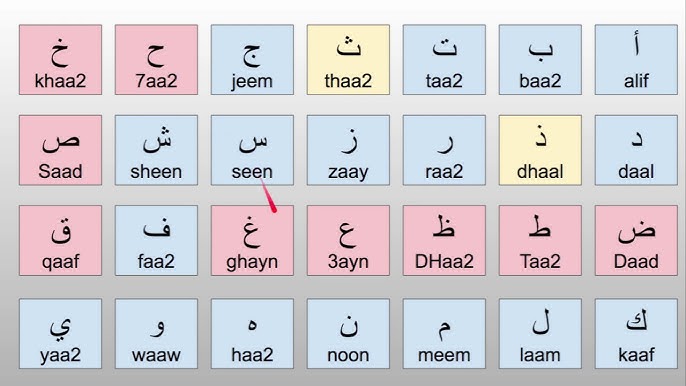
Arabic has exactly 28 consonants, corresponding to its 28 letters. Each of the 28 letters represents one consonant phoneme.
The Complete Arabic Consonants List with Pronunciation
Below is the full list of Arabic consonants, organized with their name, transliteration, and English pronunciation approximation.
| # | Arabic Letter | Name | Transliteration | Pronunciation Guide |
| 1 | ا | Alif | ā / ʾ | Glottal stop or long “a” vowel carrier |
| 2 | ب | Ba | b | As in “ball” |
| 3 | ت | Ta | t | As in “top” (dental, not retroflex) |
| 4 | ث | Tha | th | As in “think” |
| 5 | ج | Jim | j | As in “jam” |
| 6 | ح | Ha | ḥ | Breathy “h” from deep in the throat — no English equivalent |
| 7 | خ | Kha | kh | Like the “ch” in Scottish “loch” |
| 8 | د | Dal | d | As in “door” (dental) |
| 9 | ذ | Dhal | dh | As in “the” or “this” |
| 10 | ر | Ra | r | Rolled “r,” similar to Spanish |
| 11 | ز | Zay | z | As in “zebra” |
| 12 | س | Sin | s | As in “sun” |
| 13 | ش | Shin | sh | As in “shoe” |
| 14 | ص | Sad | ṣ | Emphatic “s” — heavier, from back of mouth |
| 15 | ض | Dad | ḍ | Emphatic “d” — unique to Arabic |
| 16 | ط | Ta | ṭ | Emphatic “t” — heavy and back-heavy |
| 17 | ظ | Dha | ẓ | Emphatic “dh” — like “the” but heavier |
| 18 | ع | Ayn | ʿ | Constricted throat sound — no English equivalent |
| 19 | غ | Ghayn | gh | Like a French “r” or a soft gargling sound |
| 20 | ف | Fa | f | As in “fan” |
| 21 | ق | Qaf | q | Deep “k” from the back of the throat |
| 22 | ك | Kaf | k | As in “king” |
| 23 | ل | Lam | l | As in “lamp” |
| 24 | م | Mim | m | As in “moon” |
| 25 | ن | Nun | n | As in “noon” |
| 26 | ه | Ha | h | As in “hat” |
| 27 | و | Waw | w | As in “water” (also vowel carrier for “oo”) |
| 28 | ي | Ya | y | As in “yes” (also vowel carrier for “ee”) |
This table gives you the foundation. The real learning, though, begins when you drill each sound from its correct articulation point — which is where our Arabic Alphabet Learning Course at Buruj Academy begins.
Get a free trial now in Buruj’s Alphabet course
Arabic Consonants in English: Which Sounds Transfer and Which Don’t
One of the most practical questions learners ask is: which Arabic consonants can I already pronounce? The honest answer is — about half of them.
ِArabic Consonants With a Direct English Equivalent
These Arabic consonants map cleanly onto English sounds you already produce:
| Arabic | Sound | English Example |
| ب (Ba) | /b/ | “ball” |
| ت (Ta) | /t/ | “top” |
| ث (Tha) | /th/ | “think” |
| د (Dal) | /d/ | “door” |
| ذ (Dhal) | /dh/ | “the” |
| ر (Ra) | /r/ | rolled, like Spanish |
| ز (Zay) | /z/ | “zebra” |
| س (Sin) | /s/ | “sun” |
| ش (Shin) | /sh/ | “shoe” |
| ف (Fa) | /f/ | “fan” |
| ك (Kaf) | /k/ | “king” |
| ل (Lam) | /l/ | “lamp” |
| م (Mim) | /m/ | “moon” |
| ن (Nun) | /n/ | “noon” |
| ه (Ha) | /h/ | “hat” |
| و (Waw) | /w/ | “water” |
| ي (Ya) | /y/ | “yes” |
ِ
Discover the Buruj Academy Difference
Step into our virtual classrooms and see how our expert instructors make learning Quran and Arabic intuitive and clear. We focus on overcoming the specific hurdles non-native speakers face, building your confidence and connection with the Quran.
Master the Arabic Language
Join our expert-led courses and build a strong foundation in Classical and Modern Arabic.
Get Your Free TrialArabic Consonants That Require New Muscle Memory for English Speakers
These are the sounds that genuinely challenge English speakers. In our sessions at Buruj Academy, students consistently spend the most time on this group — and rightly so:
ح (Ḥa) — This is not the English “h.” It’s produced by narrowing the throat while exhaling, creating a warm, breathy friction. Think of the sound of fogging up a mirror, but deeper.
ع (Ayn) — This is the most distinctive Arabic consonant for English speakers. It’s a voiced pharyngeal sound — produced by constricting the upper throat. The word عَيْن (ʿayn) means “eye” and starts with this very letter.
غ (Ghayn) — A voiced velar fricative. The closest approximation is the French “r” in “Paris” — a soft gargling from the back of the throat.
خ (Kha) — Voiceless velar fricative. The “ch” in the Scottish word “loch” or German “Bach.”
ق (Qaf) — A /k/ sound, but produced at the very back of the throat, almost touching the uvula. English “k” is much further forward.
The Emphatic Four (ص ض ط ظ) — These are “pharyngealized” consonants — produced with the tongue body raised toward the back of the mouth simultaneously.
They make surrounding vowels sound heavier and darker. Mispronouncing these changes word meaning entirely.
For a deeper dive into mastering Arabic sounds from scratch, our guide on Arabic pronunciation and our Arabic speaking course walks through the phonetic system step by step.
Book your free trial to start speaking Arabic fluently

Read also: Learn Arabic Advanced Level
What Is Arabic Phonology?
Arabic phonology is the study of how sounds function within the Arabic language system — which sounds exist, how they contrast with each other, and how they affect meaning. Understanding Arabic phonology is not an academic luxury; it’s a practical tool for every learner.
Arabic phonology organizes its consonants into three main categories based on place of articulation:
1. Labial and Dental Sounds — produced at the lips or front teeth: ب، م، ف، و، ت، ث، د، ذ، ن، ل، ر، ز، س، ش
2. Palatal and Velar Sounds — produced in the mid-to-back palate: ج، ك، غ، خ، ق
3. Pharyngeal and Glottal Sounds — produced deep in the throat: ح، ع، ه، ء (hamza/Alif)
When you understand where a sound comes from physically, you stop guessing and start adjusting.
If you are just beginning to study Modern Standard Arabic and want to understand how phonology connects to the broader language system, our beginner’s guide to Modern Standard Arabic is an excellent companion resource.
Arabic Vowels and Consonants
Arabic vowels and consonants differ fundamentally in function. All 28 letters are consonants. The short vowels — fatha (َ), kasra (ِ), and damma (ُ) — are not letters at all. They are diacritical marks (حَرَكَات, ḥarakāt) written above or below consonant letters to indicate the short vowel sound that follows that consonant.
| Feature | Consonants | Short Vowels (Vowel Marks) |
| Appear in the alphabet? | Yes — all 28 letters | No — they are symbols |
| Written in everyday text? | Always | Usually omitted in adult Arabic text |
| Change word meaning independently? | Yes | Yes — critically |
| Examples | ك، ب، ت، ع | fatha (a), kasra (i), damma (u) |
The long vowels — Alif (ا) for /aː/, Waw (و) for /uː/, and Ya (ي) for /iː/ — are represented by letters and do appear in written text. This is why Alif, Waw, and Ya serve a dual role: as consonants (/ʾ/, /w/, /y/) and as long vowel carriers.
Example in practice:
- كَتَبَ (kataba) = “he wrote” — the short vowels (fatha marks) appear only in vowelled texts
- كِتَاب (kitāb) = “book” — the long /aː/ vowel is written as Alif (ا) and always visible
- كُتُب (kutub) = “books” — the short vowels again guide pronunciation
This distinction matters enormously because Arabic newspapers, novels, and everyday written text almost never include short vowel marks. Learners must learn to infer vowels from context and morphological patterns — and that skill begins with solid consonant mastery.
For more on how vowels function within the Arabic writing system, our detailed article on vowels in Arabic covers this with full examples.
At Buruj Academy, our Arabic for Beginners course builds this consonant-vowel distinction from day one, ensuring students never confuse the two systems as they advance.
Begin learning Arabic at Buruj with a FREE trial lesson

How Arabic Consonant Position Changes the Written Form
Arabic consonants change shape depending on their position in a word. This is one of the most visually distinctive features of the Arabic script, and it trips up nearly every beginner. Each consonant has up to four forms: initial, medial, final, and standalone.
Example: The Letter ع (Ayn)
| Position | Form | Example Word |
| Standalone | ع | — |
| Initial (beginning) | عَ | عَيْن (eye) |
| Medial (middle) | ـعـ | مُعَلِّم (teacher) |
| Final (end) | ـع | شَارِع (street) |
Most consonants follow this four-form pattern. However, six letters (ا، د، ذ، ر، ز، و) only connect to the letter before them, not after — which means they only have two forms each (standalone/final and initial/medial merged).
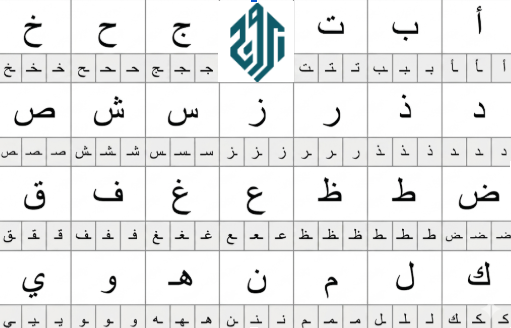
For a visual breakdown of how each letter changes shape with pictures and examples, our article on the Arabic alphabet with pictures for kids works equally well for adult beginners who benefit from visual learning.
Read also: 10 Best Universities to Learn Arabic
Learn Arabic Effectively with Buruj Academy’s Expert Native Arab Instructors
Mastering Arabic consonants is the single most valuable investment you can make in your Arabic learning — and it requires more than a chart. It requires ears trained by a skilled teacher and a structured system that progresses from sounds to words to sentences.
At Buruj Academy, our Online Arabic Classes are taught by Al-Azhar University graduates with 12+ years of experience teaching non-native speakers.
We use the Buruj Method — Context-before-abstraction, sound production before grammar rules — to build phonetic accuracy from the very first session.
Our instructors offer personalized 1-on-1 sessions with flexible scheduling.
Book your free trial lesson today and start building the consonant foundation Arabic demands.
Begin your transformation today by choosing the path that fits your goals:
- Online Arabic Classes (General & Comprehensive)
- Arabic Course for Beginners
- Arabic Alphabet Learning Course
- Online Arabic Classes for Kids
- Arabic Classes for Adults
- Arabic Grammar Course (Nahw & Sarf)
- Intermediate Arabic Course (B1/B2)
- Arabic Speaking Course (Conversational Fluency)
- Arabic Reading Course (Literary Excellence)
- Learn Arabic Writing Course (Calligraphy & Composition)
Ready to speak with confidence? Join the global community at Buruj Academy and book your free placement interview today!
Master the Arabic Language
Join our expert-led courses and build a strong foundation in Classical and Modern Arabic.
Get Your Free TrialConclusion
Arabic consonants are not an obstacle — they are the architecture of the language. All 28 letters are consonants, each one occupying a precise point of articulation, and each one carrying meaning-differentiating weight in every word you will ever read or speak.
What separates learners who plateau from those who progress is almost always phonetic accuracy. When you know not just what a letter looks like but where it comes from in the mouth and throat, Arabic stops being a foreign script and becomes a readable, speakable system.
Frequently Asked Questions About Arabic Consonants
How Many Consonants Are in the Arabic Language?
Arabic has exactly 28 consonants, corresponding to its 28 letters. All 28 letters represent consonant sounds. Short vowels are not letters — they are diacritical marks added to consonants. Some Arabic linguists note that Alif, Waw, and Ya also function as long vowel carriers, but their primary classification remains consonantal.
What Are the Hardest Arabic Consonants for English Speakers?
The most consistently difficult Arabic consonants for English speakers are ع (Ayn), ح (Ḥa), غ (Ghayn), خ (Kha), and ق (Qaf), along with the four emphatic consonants ص، ض، ط، ظ. These sounds have no English equivalents and require deliberate phonetic training targeting pharyngeal and velar articulation points not used in English speech.
What Is the Difference Between Arabic Vowels and Consonants?
All 28 Arabic letters are consonants. Vowels in Arabic are short diacritical marks — fatha, kasra, and damma — written above or below consonant letters. Long vowels use the consonant letters Alif, Waw, and Ya as carriers. In everyday written Arabic, short vowel marks are usually omitted, making consonant recognition the primary reading skill.