 Arabic
Choosing where to study Arabic is one of the most consequential decisions a language learner makes. The quality of your instruction, the depth of your immersion, and the academic framework your program uses will determine whether you reach conversational confidence or remain stuck at the textbook level for years.
The best universities to learn Arabic combine rigorous Modern Standard Arabic instruction, meaningful cultural immersion, and pathways into Classical or Quranic Arabic — depending on your goals.
Table of Contents:
1. Georgetown University — Washington, D.C., USA
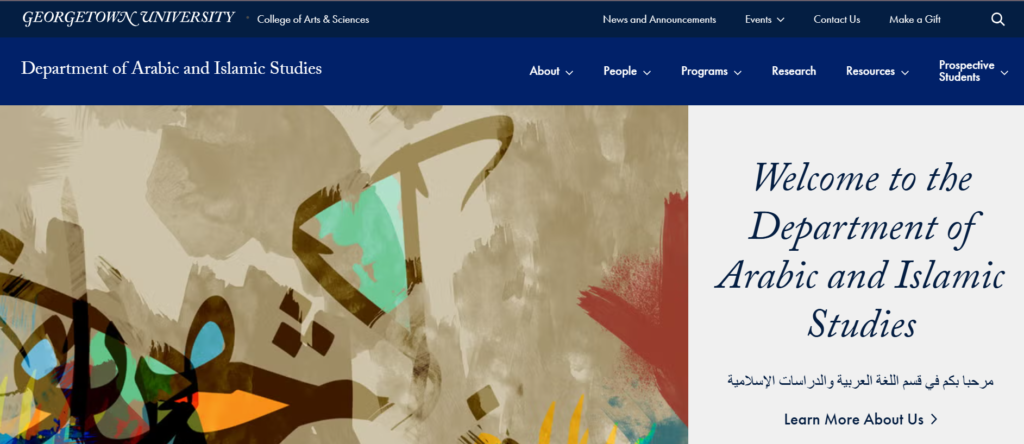
Georgetown’s Department of Arabic and Islamic Studies stands alone in American higher education as the home of the oldest undergraduate Arabic major in the United States. For learners who want institutional depth alongside linguistic rigor, this is the starting point for comparison.
The department offers a B.A. degree in Arabic, a minor in Arabic, and a minor in Islamic Studies.
The undergraduate major focuses on building both linguistic and intercultural skills to an advanced level of communicative competence, with the first five semesters designed to be intensive in order to accelerate proficiency.
What distinguishes Georgetown is the mandatory study-abroad requirement. Arabic majors are required to spend a year, a semester, or a summer studying at an approved educational institution in an Arabic-speaking country.
Georgetown has institutional ties with the Qasid Institute in Amman, Jordan, and the Diplomacy and Policy Studies program in Amman, run by the Council for International Educational Exchange (CIEE).
At graduate level, the department offers M.A. and Ph.D. degrees in Arabic and Islamic Studies, with concentrations available in Arabic Literature, Arabic Linguistics, or Islamic Studies.
| Degree Level | Program | Focus |
| Undergraduate | B.A. in Arabic | MSA, intercultural competency, study abroad |
| Graduate | M.A. in Arabic & Islamic Studies | Literature, Linguistics, or Islamic Studies |
| Graduate | Ph.D. in Arabic & Islamic Studies | Research specialization |
At Buruj Academy, we recommend Georgetown as a benchmark institution for serious academic study. For those building toward that level of Arabic, our Arabic Grammar Course provides the MSA grammatical foundation that university programs assume from day one.
Understand the Arabic Grammar with Buruj’s free trial lesson
2. SOAS University of London — United Kingdom
SOAS University of London is the UK’s most specialized institution for Arabic and Middle Eastern studies, and its Arabic department consistently ranks among the strongest in Europe.
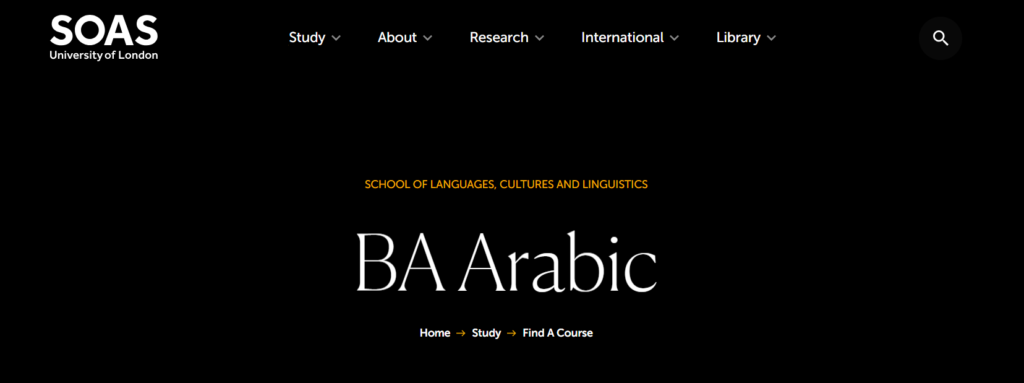
The BA Arabic programme provides students with a solid foundation in Arabic, training them in both the written and the spoken forms of the language and exposing them to related cultural, social and historical contexts and literary and artistic practices, thereby equipping them with the skills needed to achieve linguistic and cultural fluency.
The BA Arabic and combined honours degree gives students a solid grounding in Modern Standard and Classical Arabic, as well as conversational ability in Colloquial Arabic.
Students are required to spend the third year of study at a university or language institute in the Middle East.
SOAS is ranked 7th in the UK for African and Middle Eastern Studies according to the Complete University Guide Subject League Table 2026, and 2nd in the UK for graduate prospects.
| Program | Duration | Key Feature |
| BA Arabic | 4 years | Year 3 mandatory in Arab world |
| BA Arabic and combined degree | 4 years | Arabic + second discipline |
| MA + Intensive Language (Arabic) | 2 years | Unique European pathway |
| Certificate in Arabic | 1 year | Equivalent to first BA year |
For learners not yet ready for university-level Arabic, our Arabic for Beginners course builds the foundational reading and grammar skills that SOAS’s first-year curriculum demands.
Begin learning Arabic at Buruj with a FREE trial lesson
3. Al-Azhar University — Cairo, Egypt
For Arabic learners whose goal includes Quranic comprehension and classical Islamic text literacy, no institution carries the authority of Al-Azhar University. Al-Azhar Al-Sharif has for more than a thousand years been a center of science and a center of attention for students from everywhere to learn legislative, Arabic, natural and human sciences.
Al-Azhar operates a dedicated Institute for Teaching Arabic to Non-Native Speakers, inaugurated to serve the growing global demand for classical and Modern Standard Arabic instruction grounded in authentic Islamic scholarly tradition.
What Al-Azhar offers that no Western university can replicate is the living connection to the Arabic language as it functions within classical Islamic scholarship.
Al-Azhar University was founded in 970 as a centre of Islamic learning. Today it is the chief centre of Arabic literature and Islamic learning.
| Program Type | Audience | Language Focus |
| Institute for Non-Native Speakers | International students | MSA + Classical Arabic |
| Undergraduate Faculties | Degree-seeking students | Full Arabic academic immersion |
| International Student Programs | Heritage + new learners | Structured by proficiency level |
Our Buruj Academy teaching team holds Al-Azhar University degrees. The methodology our instructors bring to every Online Arabic Classes session is shaped directly by Al-Azhar’s approach to classical Arabic pedagogy — the same framework you would encounter studying in Cairo.
Begin Understanding Quranic Arabic with a FREE Lesson
4. University of Jordan — Amman, Jordan
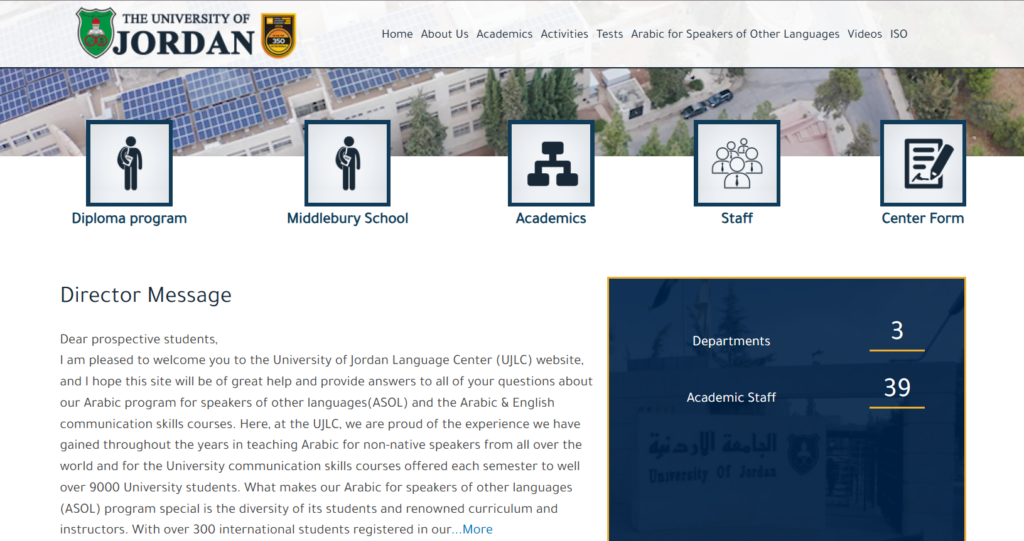
The University of Jordan Language Center (UJLC) in Amman is one of the most practically structured Arabic programs available for non-native speakers outside Egypt, combining intensive language study with the Levantine dialect environment of a modern Arabic capital.
Since 1979, the University of Jordan Language Center has been a leader in teaching Arabic to non-native speakers. Over the years, thousands of students from around the world have benefited from the center’s high-quality education and safe learning environment.
The General Program has nine levels. Students attend classes five days a week, totalling 20 hours per week for 16 weeks in the fall and spring semesters, and for 8 weeks in the summer semester.
Jordan offers a significant practical advantage: Amman is one of the most accessible, safe, and English-adjacent Arabic-speaking capitals for international students.
The dialect taught alongside MSA is Levantine Arabic, one of the most widely understood dialects across the Arab world.
For learners interested in how to learn Arabic effectively as a beginner, studying in Amman places them at the intersection of formal MSA instruction and genuine daily Arabic communication.
| Level | Weekly Hours | Semester Duration |
| Level 1–9 (placement-based) | 20 hours/week | 16 weeks (fall/spring) |
| Summer intensive | 20 hours/week | 8 weeks |
| Specialized programs | Customized | Varies by focus |
Read also: Learn Arabic Advanced Level
5. University of Edinburgh — Scotland, UK
The University of Edinburgh offers one of the most academically distinguished Arabic programs in the UK, combining formal language study with Islamic and Middle Eastern Studies across a four-year degree that includes a mandatory year abroad.
Edinburgh has taught Arabic since the 18th century. Students build up to fluency over four years, with study abroad as part of every programme — requiring no additional time beyond the standard degree duration.
The University of Edinburgh is ranked 3rd in the UK for Modern Languages and Arts and Humanities. It typically offers both taught and research-led masters programmes in Islamic and Middle Eastern Studies.
Edinburgh’s combination of cultural and linguistic instruction is particularly valuable for learners whose Arabic interest connects to Islamic studies and Middle Eastern history. Students will spend Year 3 abroad — a minimum of 30 weeks — in a country where Arabic is spoken.
| Program | Degree | Duration |
| Arabic with Islamic & Middle Eastern Studies | MA (Hons) | 4 years |
| Arabic and Business | MA (Hons) | 4 years |
| Arabic and Persian | MA (Hons) | 4 years |
| Arabic and Spanish | MA (Hons) | 4 years |
Understanding the Arabic tenses system — past, present, and future — is typically the first major grammar milestone students hit in Edinburgh’s first-year curriculum. Our blog resources offer targeted support for exactly these foundational structures.
Master the Arabic Language
Join our expert-led courses and build a strong foundation in Classical and Modern Arabic.
Get Your Free Trial6. Princeton University — New Jersey, USA
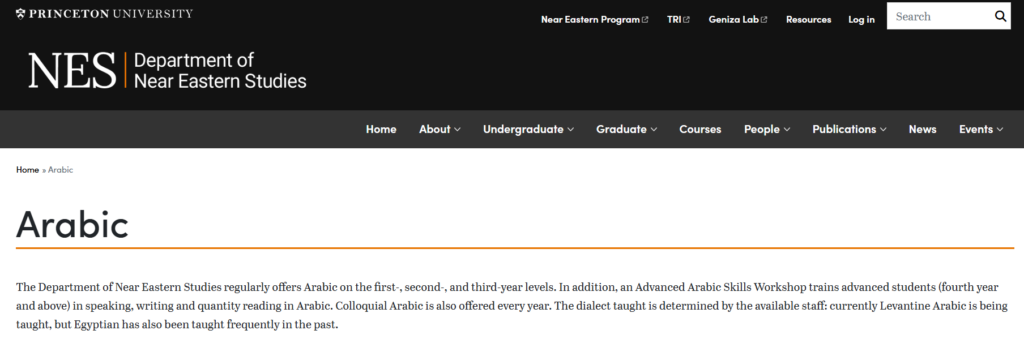
Princeton’s Department of Near Eastern Studies offers a rigorous Arabic program as part of one of America’s most research-intensive university environments, with a curriculum spanning beginner through advanced Modern Standard Arabic, Classical Arabic, and colloquial dialect study.
Arabic language learning at Princeton is enhanced by a weekly Arabic lecture offered by invited scholars in diverse fields, as well as an Arab writers series in which Arab authors are invited for lectures or seminars.
A number of study abroad programs are available to students of Arabic, with the majority studying at the American University in Cairo because of its fine reputation in Arabic teaching.
Princeton’s Arabic program benefits from the resources of a major research university while maintaining a focused language curriculum.
| Language Track | Scope | Special Feature |
| Modern Standard Arabic | Beginner to advanced (multi-year) | Intensive grammar and skills |
| Classical Arabic | Intermediate to advanced | Islamic text literacy |
| Dialect Studies | Levantine Arabic (ARA 111–112) | Conversational focus |
7. Middlebury Language Schools — Vermont, USA
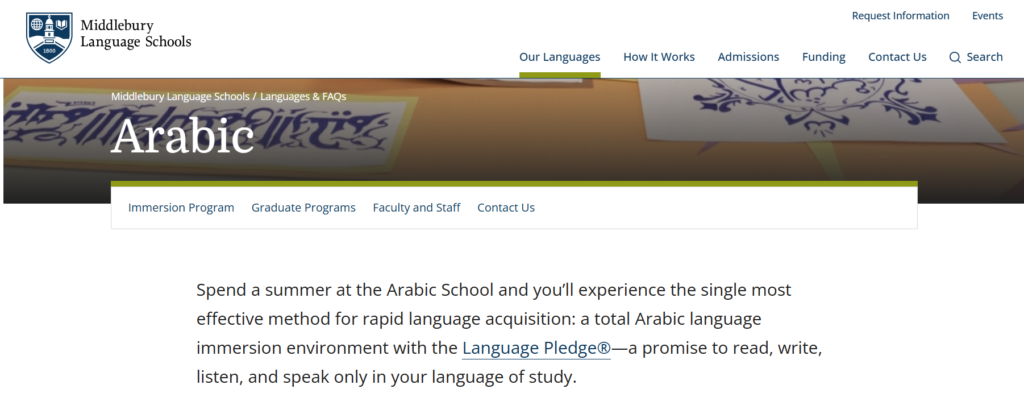
Middlebury’s Arabic School is in a category of its own among immersion-based Arabic programs. The Language Pledge model — in which every participant commits to speaking only Arabic for the entire program — produces measurable, rapid proficiency gains that classroom-based programs rarely achieve in comparable timeframes.
Middlebury’s 8-week Arabic immersion program enrolls a highly diverse student body, including undergraduates, graduate students, recent graduates, and professionals.
Students immerse themselves in the language through academic work, commitment to the Language Pledge, and participation in cocurricular activities. Courses are offered at levels 1 through 4, including half-levels, with placement determined by examination at the beginning of the session.
In the first two years, students focus on Modern Standard Arabic. The program also introduces students to basics of vernacular Arabic dialects — typically Egyptian, Levantine, and Moroccan — before junior-year immersive experiences at Middlebury’s study abroad sites in Amman and Rabat.
For those who cannot travel to the Arab world immediately, Middlebury’s Vermont campus offers the closest possible approximation to full immersion available in the United States.
| Program Type | Duration | Level | Graduate Option |
| Arabic Immersion | 8 weeks | Beginners to advanced | No |
| Graduate Arabic (M.A.) | 4 summers or 2 summers + online | Advanced | Yes — M.A. degree |
8. University of Michigan — Ann Arbor, USA
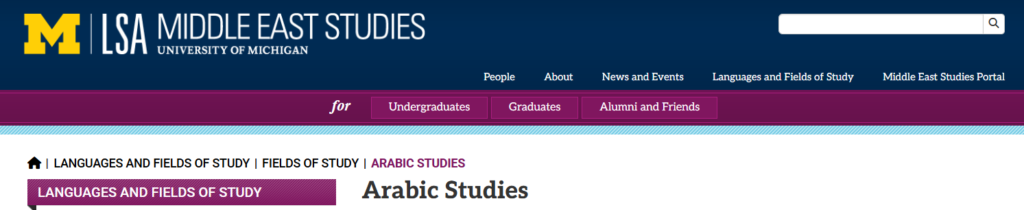
The University of Michigan’s Department of Middle East Studies has one of the longest Arabic teaching traditions in American higher education, with the language first taught at the university in 1892.
The Arabic program at U-M combines the study of Arabic culture, literature, and linguistics with methodological training in the language.
At graduate level, Michigan holds a particularly notable distinction: the Teaching Arabic as a Foreign Language (TAFL) graduate program was the first of its kind in the United States, established by Professor Raji Rammuny in the University of Michigan’s Department of Middle East Studies.
The MA in TAFL program provides training in Arabic language and linguistics and Arabic foreign language teaching methodology, with special emphasis on learning and teaching Arabic as a foreign language.
| Program | Level | Focus |
| B.A. Arabic Language + Culture | Undergraduate | MSA, four skills development |
| M.A. in Arabic Studies (APP) | Graduate | Language, literature, culture |
| M.A. in TAFL | Graduate | Arabic language pedagogy |
Understanding how Arabic grammar works systematically for beginners is the essential foundation before entering any of these university tracks — and it’s where our Arabic Grammar Course delivers the most direct preparation.
Understand the Arabic Grammar with Buruj’s free trial lesson
9. Harvard University — Cambridge, USA
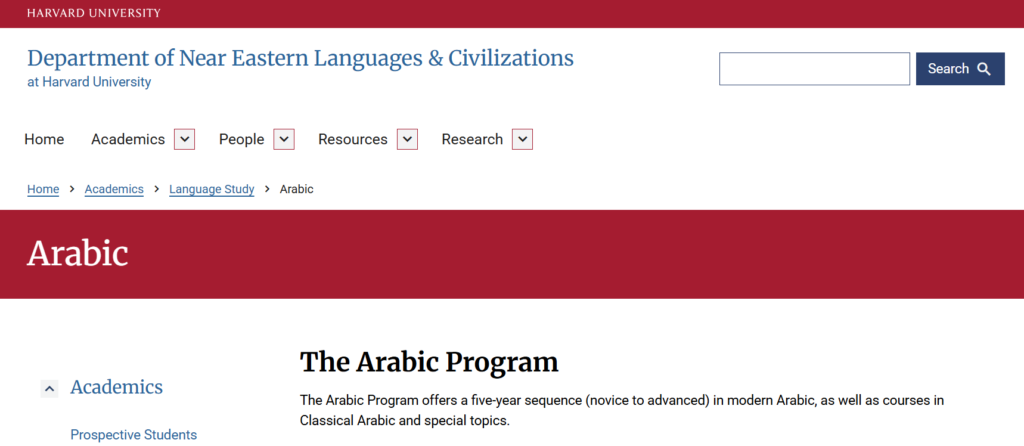
Harvard’s Arabic Language Program, housed in the Department of Near Eastern Languages and Civilizations, is among the most academically rigorous in the Ivy League, offering an intensive multi-year sequence in both Modern and Classical Arabic.
Harvard’s Arabic language program is comprised of two main tracks — modern and classical — each consisting of five years of formal, intensive language instruction.
The modern track aims at developing global proficiency in modern standard Arabic as it is currently used throughout the Arab world, with emphasis equally placed on all four basic language skills: reading, listening comprehension, speaking, and writing.
The classical track serves students whose interests include Quranic Arabic, Islamic jurisprudence, classical literature, and Tafsir — making Harvard’s offering particularly relevant for serious students of the Islamic intellectual tradition.
| Track | Duration | Primary Audience |
| Modern Standard Arabic | 5-year sequence | All learners; diplomatic, academic, literary |
| Classical Arabic | 5-year sequence | Islamic scholarship, Tafsir, historical texts |
Read also: Arabic Consonants
10. University of St Andrews — Scotland, UK
The University of St Andrews rounds out this list as one of the strongest Arabic programs in Scotland and a consistent high ranker for language instruction quality across the UK.
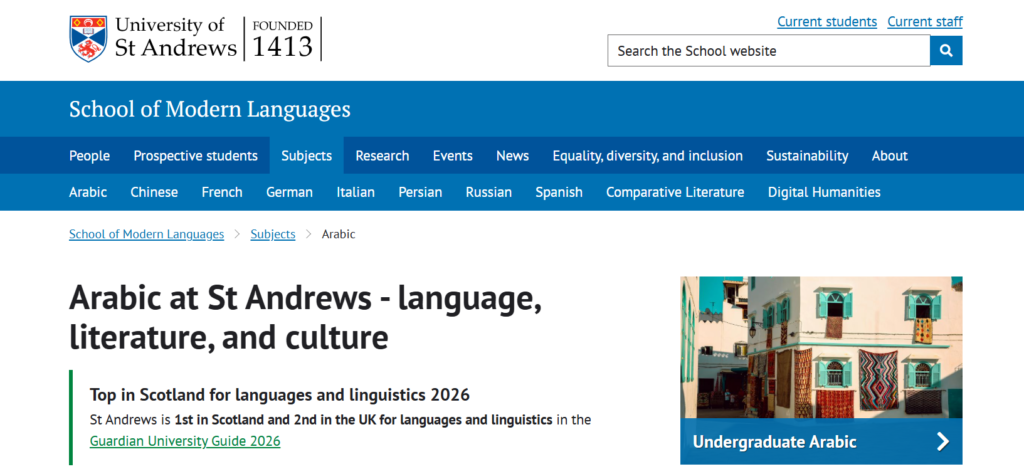
St Andrews is ranked 1st in Scotland and 2nd in the UK for languages and linguistics in the Guardian University Guide 2026. Undergraduate study in Arabic is open to beginners — students are not expected to have any prior background in Arabic.
Core language modules build on each other to expand and develop language proficiency. The Department uses Modern Standard Arabic, the standardised written form of Arabic used across the Arab world.
St Andrews offers integrated study abroad placements in Egypt, Jordan, Morocco, Qatar, Italy, Canada, and the USA. Arabic studies graduates leave St Andrews with a strong mix of linguistic, transferable, and social skills.
The range of study abroad destinations — including Egypt and Jordan — gives St Andrews students genuine flexibility in where they encounter Arabic in its living cultural context. For those considering how long learning Arabic actually takes, St Andrews’ structured four-year progression with a year abroad provides a realistic roadmap.
Read also:Advanced Arabic Learning
Full Comparison: 10 Best Universities to Learn Arabic
| University | Country | Undergraduate Degree | Graduate Degree | Year Abroad | Best For |
| Georgetown | USA | B.A. Arabic | M.A. / Ph.D. | Mandatory | Academic depth, Islamic Studies |
| SOAS London | UK | BA Arabic | MA + Intensive Arabic | Mandatory (Year 3) | Linguistic + cultural breadth |
| Al-Azhar | Egypt | Full degree programs | Yes | N/A — full immersion | Classical, Quranic Arabic |
| University of Jordan | Jordan | N/A (ASOL program) | Diploma (TAFL) | N/A — based in Arab world | Intensive non-degree immersion |
| University of Edinburgh | UK | MA (Hons) Arabic | M.A. / Ph.D. | Mandatory (Year 3) | Islamic & Middle Eastern Studies |
| Princeton | USA | Near Eastern Studies | Yes | Study abroad options | Research-level MSA + Classical |
| Middlebury | USA | N/A (immersion) | M.A. in Arabic | N/A — Language Pledge immersion | Rapid proficiency gain |
| University of Michigan | USA | B.A. Arabic | M.A. TAFL / APP | Yes (options) | Arabic pedagogy, TAFL careers |
| Harvard | USA | Arabic courses (NELC) | Ph.D. track | Yes | Classical Arabic + research |
| St Andrews | UK | MA (Hons) Arabic | Yes | Integrated (Egypt, Jordan, Morocco) | Beginners; strong UK ranking |
Read also:Summer Arabic Programs
Discover the Buruj Academy Difference
Step into our virtual classrooms and see how our expert instructors make learning Quran and Arabic intuitive and clear. We focus on overcoming the specific hurdles non-native speakers face, building your confidence and connection with the Quran.
Learn Arabic with Buruj Academy’s Expert Instructors
Formal university study is one path to Arabic mastery. Personalized, expert-led instruction is another — and for most adult learners, it is significantly faster.
At Buruj Academy, our Al-Azhar University graduates and Ijazah-certified instructors bring the same scholarly depth found in the world’s top Arabic programs directly into your 1-on-1 online sessions.
Our Online Arabic Classes use the Buruj Method — context before abstraction, meaning before memorization — to build genuine reading, speaking, and grammar competency at your pace.
We offer:
- Personalized 1-on-1 sessions with 24/7 scheduling flexibility
- Structured progression from complete beginner to advanced MSA and Quranic Arabic
- Specialized tracks including Arabic Grammar, Arabic Speaking, and Quranic Arabic
- A dedicated Arabic for Kids course for young learners
Book your free trial lesson today and begin the same quality of Arabic instruction that Al-Azhar graduates bring to every session.
Begin your transformation today by choosing the path that fits your goals:
- Online Arabic Classes (General & Comprehensive)
- Arabic Course for Beginners
- Arabic Alphabet Learning Course
- Online Arabic Classes for Kids
- Arabic Classes for Adults
- Arabic Grammar Course (Nahw & Sarf)
- Intermediate Arabic Course (B1/B2)
- Arabic Speaking Course (Conversational Fluency)
- Arabic Reading Course (Literary Excellence)
- Learn Arabic Writing Course (Calligraphy & Composition)
Ready to speak with confidence? Join the global community at Buruj Academy and book your free placement interview today!
Master the Arabic Language
Join our expert-led courses and build a strong foundation in Classical and Modern Arabic.
Get Your Free TrialConclusion
The ten universities listed here represent genuinely distinct approaches to Arabic language learning — from the classical immersion of Al-Azhar in Cairo to the Language Pledge intensity of Middlebury in Vermont, to the research-driven rigor of Georgetown and Princeton. The right choice depends on your goals, timeline, budget, and whether you want a formal degree, a short-term intensive, or a gateway into Quranic Arabic in particular.
What every strong program shares is this: Arabic rewards consistent, structured, expert-guided practice above all else. Whether you pursue a formal degree or build your foundation with Buruj Academy’s personalized instruction, the path forward is clear — start where you are, work with teachers who know the language deeply, and commit to the long game. Insha’Allah, the Arabic language is well worth it.
Frequently Asked Questions About the Best Universities to Learn Arabic
Which country is best for learning Arabic at university?
Egypt and Jordan are the most accessible Arabic-speaking countries for international university study. Al-Azhar University in Cairo is unmatched for classical and Quranic Arabic, while the University of Jordan Language Center in Amman offers structured MSA instruction alongside the Levantine dialect environment. For Western university programs, Georgetown (USA) and SOAS (UK) are widely considered the strongest Arabic departments in their respective countries.
What is the difference between a colleges that offer an Arabic language degree versus an Arabic language certificate?
A degree — whether a B.A., M.A., or Ph.D. — requires multi-year formal enrollment and awards an academic qualification. A certificate program, such as SOAS’s one-year Certificate in Arabic, provides focused language instruction without the full degree structure. Certificate programs are often used by working professionals, researchers, or students who want intensive Arabic without committing to a four-year degree pathway.
Can I study Classical Arabic or Quranic Arabic at these universities?
Yes — several programs offer Classical Arabic as a distinct track alongside Modern Standard Arabic. Harvard’s Arabic program explicitly includes a five-year Classical Arabic sequence. Georgetown’s curriculum addresses classical Arabic texts within Islamic Studies concentrations. Al-Azhar University in Cairo is the gold standard for Classical and Quranic Arabic, with instruction grounded directly in the Arabic linguistic tradition that produced classical Islamic scholarship.
Related Articles
Arabic