 Arabic
| Key Takeaways |
| The U.S. Foreign Service Institute classifies Arabic as a Category IV language, requiring approximately 2,200 class hours for professional proficiency. |
| Most adult beginners reach conversational Arabic in 1–2 years with consistent daily study of 30–60 minutes per session. |
| Quranic Arabic comprehension is achievable in 6–12 months of focused study, significantly faster than full Modern Standard Arabic mastery. |
| Your native language, prior language learning experience, and daily consistency are the three biggest factors affecting how long Arabic takes. |
| Structured 1-on-1 instruction cuts learning time significantly compared to self-study, especially for pronunciation and grammar accuracy. |
Most learners asking how long it takes to learn Arabic are really asking a more personal question: Can someone like me actually do this? The honest answer is yes — but the timeline depends on what “learning Arabic” means for your specific goals.
For practical purposes: reaching basic conversational ability takes most non-Arabic speaking adults 6–12 months of consistent study.
Achieving professional fluency requires 3–5 years. Quranic Arabic comprehension — a distinct and more focused goal — is often reachable within 6–12 months with the right approach.
Table of Contents:
How Many Hours Does It Take to Learn Arabic to a Professional Level?
Learning Arabic to professional proficiency requires approximately 2,200 classroom hours, according to the U.S. Foreign Service Institute’s language difficulty rankings. Arabic sits in the Category IV classification — the most demanding tier for English speakers — alongside Mandarin, Japanese, and Korean.
That figure applies to full professional proficiency. Most learners have more modest, achievable goals — and those take considerably less time. The table below maps realistic hour estimates to practical milestones.
| Proficiency Goal | Estimated Hours | Realistic Timeline (1hr/day) |
| Arabic alphabet reading | 20–40 hours | 3–6 weeks |
| Basic Quranic Arabic comprehension | 150–300 hours | 5–10 months |
| Survival conversational Arabic | 300–400 hours | 10–14 months |
| Intermediate Modern Standard Arabic | 600–900 hours | 2–3 years |
| Professional/advanced fluency | 1,800–2,200 hours | 5–6 years |
These are estimates based on our instructors’ experience working with non-Arabic speaking adults at Buruj Academy. Individual results vary based on consistency, instruction quality, and native language background.
At Buruj Academy, our Online Arabic Classes are structured around these realistic milestones — so students always know where they are and what comes next.
Book your FREE Arabic trial online Arabic class at Buruj

What Factors Determine How Long It Takes to Learn Arabic?
How long Arabic takes is not a fixed number — it is a function of several variables that either accelerate or slow your progress. Understanding these factors lets you build a realistic, honest plan.
1. Does Your Native Language Affect Arabic Learning Speed?
Your native language is one of the strongest predictors of Arabic learning speed. English speakers face a steeper curve because Arabic shares almost no vocabulary, grammatical structure, or script with English. Speakers of Farsi, Urdu, or Turkish already know thousands of Arabic loanwords, giving them a meaningful head start in vocabulary acquisition.
This does not mean English speakers cannot learn Arabic — it means their early months require more deliberate phonetic work.
In our sessions, English-speaking adult beginners typically need 4–6 weeks before Arabic sounds feel even partially natural to their ear.
2. How Does Daily Study Time Affect Your Arabic Timeline?
Daily consistency matters more than session length. Thirty minutes of daily Arabic practice produces faster results than a three-hour session once per week.
The brain consolidates language patterns during sleep — so daily exposure gives memory systems more opportunities to encode new information.
The table below shows how daily study time affects the realistic timeline to conversational ability.
| Daily Study Time | Months to Basic Conversation |
| 15 minutes/day | 18–24 months |
| 30 minutes/day | 12–18 months |
| 60 minutes/day | 8–12 months |
| 90+ minutes/day | 6–9 months |
These projections assume structured, guided study — not passive listening or app-only practice.
3. Does Prior Language Learning Experience Speed Up Arabic Acquisition?
Students who have successfully learned any second language previously almost always progress faster in Arabic.
They already know how language systems work, how to tolerate ambiguity during early stages, and how to use deliberate practice strategies.
In our experience at Buruj Academy, students with even one prior foreign language typically reach conversational Arabic 20–30% faster than absolute language-learning beginners.
How Long Does It Take to Learn Quranic Arabic Specifically?
Quranic Arabic is a distinct goal from Modern Standard Arabic fluency, and it is significantly more achievable in a shorter timeframe. Most dedicated adult learners reach functional Quranic comprehension — understanding 70–80% of Quranic vocabulary in context — within 6–12 months of focused study.
This is possible because the Quran uses a relatively contained vocabulary. Approximately 80% of the Quran’s content can be understood through mastery of roughly 300 high-frequency words.
That is a manageable, structured target — very different from the open-ended vocabulary demands of conversational Arabic.
Our Quranic Arabic for Beginners course at Buruj Academy introduces Quranic vocabulary through meaningful Quranic context from the first lesson — exactly the kind of context-before-abstraction approach that accelerates this goal.
Students who complement this with our resources on Arabic grammar find their Quranic comprehension develops far more quickly.
Begin Understanding Quranic Arabic with a FREE Lesson

How Long Does It Take to Learn the Arabic Alphabet?
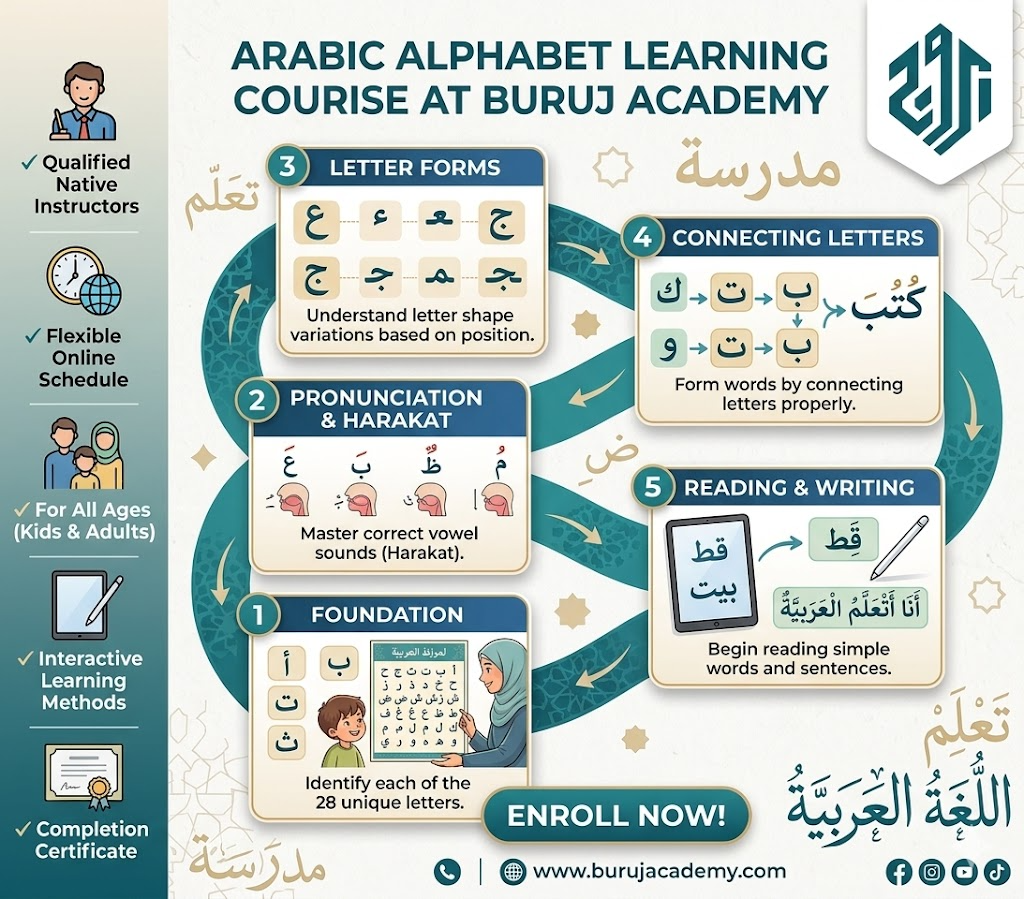
The Arabic alphabet is the first concrete milestone — and the most encouraging one. Most adult beginners learn to recognize and read all 28 Arabic letters within 2–5 weeks of consistent daily practice. Writing all letters legibly typically follows within 6–10 weeks.
The challenge is not the number of letters — 28 is comparable to English’s 26. The challenge is that Arabic letters change shape depending on their position in a word (initial, medial, final, and isolated forms), and that Arabic is written right to left with a connected cursive script.
Our Al-Azhar-trained instructors at Buruj Academy consistently observe that students who practice letter writing by hand — not just digital tracing — internalize letter forms roughly twice as fast.
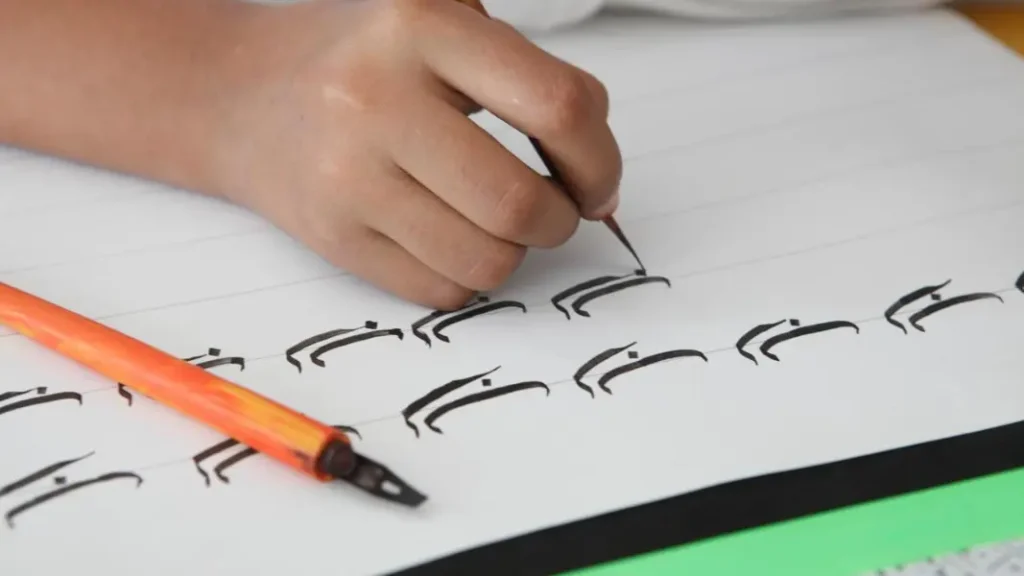
The physical act of writing activates different memory pathways. You can explore our detailed guide on the Arabic alphabet to understand exactly what the early weeks involve.
For children, the learning curve looks quite different — and our Arabic Alphabet Learning course uses age-appropriate visual methods that make this milestone achievable within the same timeframe for young learners.
Get a free trial now in Buruj’s Alphabet course
Read also: Why Learn Arabic?
What Is a Realistic Arabic Learning Timeline for Adults?
For working adults with real responsibilities, the question is not just how many hours — it is what progress looks like across real months of life. The timeline below maps honest, stage-by-stage progress for an adult studying 30–45 minutes daily with structured instruction.
| Stage | Timeframe | What You Can Do |
| Foundation | Weeks 1–6 | Read the Arabic alphabet; distinguish letter sounds |
| Basic Literacy | Months 2–4 | Read short words and simple sentences slowly |
| Elementary | Months 4–8 | Understand basic Quranic phrases; form simple sentences |
| Pre-Intermediate | Months 8–14 | Hold basic conversations; read short texts with minimal support |
| Intermediate | Year 2–3 | Discuss familiar topics; understand audio with context |
| Advanced | Year 3–5+ | Professional use; full Quranic comprehension; media consumption |
These stages are not rigid. Students who invest in speaking practice from early on — as our Arabic Speaking course trains them to do — typically progress through the first three stages faster than those focused exclusively on reading.
Book your free trial to start speaking Arabic fluently
Master the Arabic Language
Join our expert-led courses and build a strong foundation in Classical and Modern Arabic.
Get Your Free TrialWhat Are the Most Common Mistakes That Slow Arabic Learning?
Most students who feel stuck in Arabic are not struggling with the language itself — they are struggling with avoidable mistakes in how they are studying it. These patterns appear consistently in our sessions at Buruj Academy.
1. Studying Grammar Rules Before Building a Sound Foundation
The most common mistake we see among adult self-studiers is opening a grammar textbook before their ears and tongues are comfortable with Arabic sounds.
Arabic phonetics — particularly letters like ع (Ayn), غ (Ghayn), ح (Haa), and خ (Khaa) — have no equivalents in English. Students who try to memorize grammar rules before these sounds feel natural end up building knowledge on an unstable foundation.
Our approach at Buruj Academy follows the Buruj Method’s context-before-abstraction principle: meaningful language exposure first, grammar systematization second.
This is exactly why our Arabic Grammar course begins with sentence-level exposure before formal rule teaching. You can also explore our guide to Arabic sentence structure to understand how grammar fits into the bigger picture.
Understand the Arabic Grammar with Buruj’s free trial lesson
2. Relying Exclusively on Apps Without Live Correction
Apps can support Arabic learning but cannot replace real-time feedback. Pronunciation errors in Arabic have significant consequences — mispronouncing a single letter can change a word’s meaning entirely.
Students who spend 6–12 months on apps alone often arrive at their first live session with deeply embedded pronunciation habits that require patient correction.
3. Inconsistent Practice with Long Gaps Between Sessions
Arabic requires what linguists call “distributed practice” — frequent short sessions spread across time. Students who study intensively for two weeks then stop for three experience significant regression.
In our experience, a student who misses two weeks of Arabic practice typically needs one additional week of review before they are truly back to their previous level.
Discover the Buruj Academy Difference
Step into our virtual classrooms and see how our expert instructors make learning Quran and Arabic intuitive and clear. We focus on overcoming the specific hurdles non-native speakers face, building your confidence and connection with the Quran.
How Does Structured Instruction Compare to Self-Study for Arabic?
Structured instruction with a qualified teacher dramatically reduces how long it takes to learn Arabic — especially in the early stages. Self-study through apps, YouTube, or books is valuable as supplementary input, but it cannot replicate three things that only a live instructor provides.
First, real-time pronunciation correction — catching errors the moment they occur, before they become habits.
Second, personalized pacing — moving faster where you are strong and slowing precisely where you need reinforcement.
Third, accountability and structured progression — a clear path that prevents the most common self-study trap: spending months on comfortable material without advancing.
Our Arabic Reading course and Arabic Writing course at Buruj Academy are built around 1-on-1 instruction for exactly this reason. Improving pronunciation specifically is something we address in depth in our guide on Arabic pronunciation.
Read also: Best Resources to Learn Arabic
Start Learning Arabic with Buruj Academy’s Expert Instructors
Arabic is one of the most rewarding languages a Muslim can invest in — and the right instruction makes the difference between years of frustration and steady, measurable progress.
Buruj Academy’s Online Arabic Classes are led by Al-Azhar University graduates with 12+ years of experience teaching non-Arabic speakers worldwide.
Our Ijazah-certified instructors use the Buruj Method — context-before-abstraction, consistency-before-speed — to take students from the Arabic alphabet to confident reading, writing, and Quranic comprehension.
Every student receives a personalized 1-on-1 learning plan, flexible scheduling, and real-time correction.
Book your free trial lesson today and find out exactly how quickly you can progress.
Begin your transformation today by choosing the path that fits your goals:
- Online Arabic Classes (General & Comprehensive)
- Arabic Course for Beginners
- Arabic Alphabet Learning Course
- Online Arabic Classes for Kids
- Arabic Classes for Adults
- Arabic Grammar Course (Nahw & Sarf)
- Intermediate Arabic Course (B1/B2)
- Arabic Speaking Course (Conversational Fluency)
- Arabic Reading Course (Literary Excellence)
- Learn Arabic Writing Course (Calligraphy & Composition)
Ready to speak with confidence? Join the global community at Buruj Academy and book your free placement interview today!
Master the Arabic Language
Join our expert-led courses and build a strong foundation in Classical and Modern Arabic.
Get Your Free TrialConclusion
Arabic takes time — but far less time than most people fear, especially when your goal is Quranic understanding rather than full native-level fluency. The alphabet becomes readable within weeks. Basic Quranic comprehension is achievable within a year.
What separates students who reach these milestones from those who plateau is not talent — it is daily consistency, sound-first instruction, and a clear progression path.
Every hour invested in Arabic brings you closer to the Quran on your own terms. That is a goal worth building toward steadily, one session at a time.
Frequently Asked Questions About How Long It Takes to Learn Arabic
How Many Hours Does It Take to Learn Arabic Fluently?
Reaching professional Arabic fluency requires approximately 2,200 hours of study, according to the U.S. Foreign Service Institute. For most adult learners studying one hour daily, that represents a 5–6 year timeline. However, functional conversational ability is achievable much sooner — typically within 300–400 study hours, or 10–14 months of daily practice.
Can I Learn Quranic Arabic Faster Than Modern Standard Arabic?
Yes — significantly faster. Quranic Arabic has a more contained vocabulary than Modern Standard Arabic. Mastering approximately 300 high-frequency Quranic words gives access to roughly 80% of the Quran’s content. Most focused adult learners reach functional Quranic comprehension within 6–12 months of daily structured study.
Is Arabic Harder to Learn Than Other Languages?
Arabic is classified by the U.S. Foreign Service Institute as a Category IV language — the most challenging category for English speakers. The unfamiliar script, right-to-left writing direction, unique phonemes, and grammatical system all contribute. That said, difficulty is relative to your goals. Quranic reading and basic comprehension are far more accessible targets than full professional fluency.
How Long Does It Take to Learn the Arabic Alphabet?
Most adult learners recognize and read all 28 Arabic letters within 3–6 weeks of daily practice. Writing them confidently typically takes 6–10 weeks. The key challenge is that Arabic letters take different forms depending on their position within a word, which requires deliberate practice beyond simple memorization.
Does Learning Arabic Get Easier After the First Year?
Yes — meaningfully so. The first 3–6 months involve the steepest learning curve: unfamiliar sounds, an unfamiliar script, and a grammatical system unlike English. After this foundation is stable, vocabulary acquisition accelerates, reading fluency improves faster, and the language begins to feel increasingly natural. Consistency through that early phase is what determines long-term success.