 Arabic
| Key Takeaways |
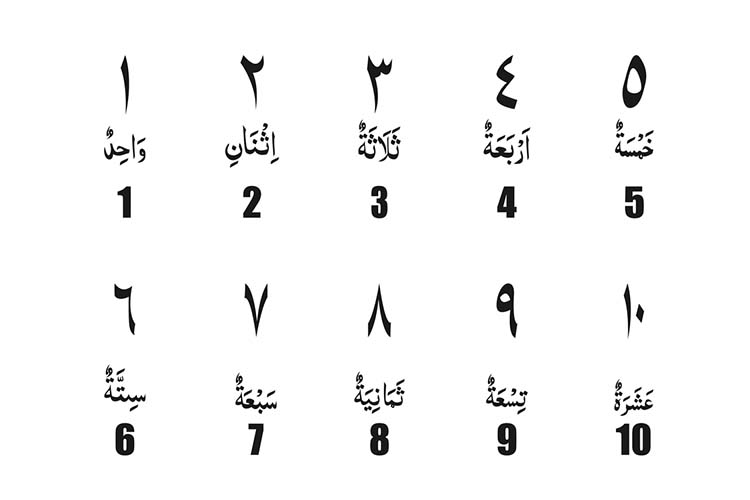
| Arabic uses the Eastern Arabic numerals (١٢٣) primarily. |
| Arabic numbers 1–10 have masculine and feminine forms that must agree grammatically with the noun being counted. |
| Two-digit Arabic numbers are pronounced units-first, then tens — so 23 is said “three and twenty,” not “twenty-three.” |
| Three-digit numbers follow the pattern: hundreds first, then units, then tens — 123 is “hundred, three, and twenty.” |
| The Hindu-Arabic numeral system, developed by Arab mathematicians, replaced Roman numerals in Europe and enabled modern mathematics. |
Arabic numbers confuse most learners at first — not because they are complex, but because they follow rules no one explains clearly.
The numeral shapes look unfamiliar, the grammar involves gender agreement, and the pronunciation order reverses what English speakers expect.
Arabic numbers are systematic and learnable once you understand three things: the numeral forms themselves, the gender agreement rules for 1–10, and the reversed pronunciation order for multi-digit numbers.
Table of Contents:
What Are Arabic Numbers and Which System Do Arabs Actually Use?
Arabic speakers today use the Eastern Arabic numerals (٠ ١ ٢ ٣ ٤ ٥ ٦ ٧ ٨ ٩) primarily, it appears widely in the Arab world, Quran printing, and formal Arabic texts.
Actually, the Western Arabic numerals (0 1 2 3 4 5 6 7 8 9) — which the entire world now uses — also can be used in modern Arabic media, digital content, and education across the region.
The confusion arises because Westerners call 1, 2, 3 “Arabic numerals” while Arabs themselves often call the Eastern forms “Indian numerals” (أرقام هندية), acknowledging their origin in the Indian subcontinent.
Arab mathematicians transmitted and refined this system into what became the Hindu-Arabic number system — the foundation of all modern mathematics.
How to Write Numbers in Arabic?
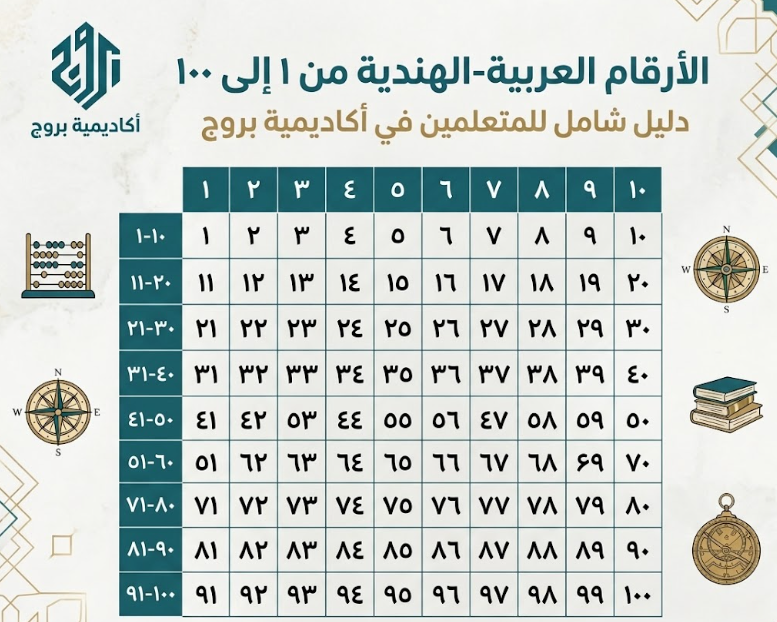
Learning to write Eastern Arabic numerals requires recognizing shapes that only partly resemble Western numerals. Several digits — particularly ٤, ٥, and ٦ — look nothing like their Western counterparts and require deliberate memorization. Here are Arabic numbers 1-100:
What Was the Advantage of the Arabic Number System?
The Arabic number system introduced positional notation and the concept of zero as a placeholder — two innovations absent from Roman numerals. This made large calculations, fractions, and algebra possible in ways Roman numerals simply could not support.
When Europe adopted the Hindu-Arabic system during the 10th–13th centuries, it directly enabled advances in trade, science, and engineering. Arithmetic that previously required an abacus could now be done on paper.
What Was the Effect of the Adoption of the Hindu-Arabic Number System in Europe?
The adoption transformed European mathematics fundamentally. Merchants could calculate profits and interest using written notation.
Astronomers could record and compute vast numbers. Universities began teaching arithmetic systematically.
What we recognize today as modern science, engineering, and commerce traces directly to this adoption. The shift from Roman to Hindu-Arabic numerals was one of the most consequential intellectual transfers in human history.
Arabic Numbers 1–10: Forms, Pronunciation, and Gender Rules
Arabic numbers 1–10 are the most important to master because every larger number builds on them. At Buruj Academy, we see the same pattern consistently: students who rush past 1–10 without internalizing gender agreement struggle with every two- and three-digit number afterward.
| Number | Eastern Numeral | Masculine Form | Feminine Form | Pronunciation (Masc.) |
| 1 | ١ | وَاحِدٌ | وَاحِدَةٌ | Wāḥid |
| 2 | ٢ | اثْنَانِ | اثْنَتَانِ | Ithnān |
| 3 | ٣ | ثَلَاثَةٌ | ثَلَاثٌ | Thalātha |
| 4 | ٤ | أَرْبَعَةٌ | أَرْبَعٌ | Arba’a |
| 5 | ٥ | خَمْسَةٌ | خَمْسٌ | Khamsa |
| 6 | ٦ | سِتَّةٌ | سِتٌّ | Sitta |
| 7 | ٧ | سَبْعَةٌ | سَبْعٌ | Sab’a |
| 8 | ٨ | ثَمَانِيَةٌ | ثَمَانٍ | Thamāniya |
| 9 | ٩ | تِسْعَةٌ | تِسْعٌ | Tis’a |
| 10 | ١٠ | عَشَرَةٌ | عَشْرٌ | ‘Ashara |
Numbers 3–10 follow polarity (المخالفة): the masculine form is used with feminine nouns, and the feminine form is used with masculine nouns. This reversal surprises English speakers but follows a consistent grammatical rule well documented in classical Arabic grammar texts.
Our Arabic grammar course addresses this rule systematically in the context of sentence construction.
For a deeper foundation in Arabic sentence patterns including number-noun agreement, our article on Arabic sentence structure provides accessible groundwork.
Understand the Arabic Grammar with Buruj’s free trial lesson

Arabic Numbers 1–20: How to Count in Arabic Beyond Ten
Arabic numbers 11–19 are compound forms that combine units with the word for ten. Their pronunciation is more phonetically demanding than English equivalents — and several have distinct masculine and feminine forms that must be learned as pairs.
| Number | Eastern | Arabic | Pronunciation |
| 11 | ١١ | أَحَدَ عَشَرَ | Aḥada ‘ashara |
| 12 | ١٢ | اثْنَا عَشَرَ | Ithnā ‘ashara |
| 13 | ١٣ | ثَلَاثَةَ عَشَرَ | Thalāthata ‘ashara |
| 14 | ١٤ | أَرْبَعَةَ عَشَرَ | Arba’ata ‘ashara |
| 15 | ١٥ | خَمْسَةَ عَشَرَ | Khamsata ‘ashara |
| 16 | ١٦ | سِتَّةَ عَشَرَ | Sittata ‘ashara |
| 17 | ١٧ | سَبْعَةَ عَشَرَ | Sab’ata ‘ashara |
| 18 | ١٨ | ثَمَانِيَةَ عَشَرَ | Thamāniyata ‘ashara |
| 19 | ١٩ | تِسْعَةَ عَشَرَ | Tis’ata ‘ashara |
| 20 | ٢٠ | عِشْرُونَ | ‘Ishrūn |
Notice that 11 and 12 have their own unique constructions. From 13–19, the pattern is consistent: unit + عَشَرَ. Twenty (عِشْرُونَ) begins a new category — the tens — and pronunciation shifts accordingly.
At Buruj Academy, our Online Arabic Classes cover number pronunciation with audio correction from native-speaker instructors, ensuring students develop accurate phonetic habits from the outset rather than reinforcing mispronunciations through self-study.
Book your FREE Arabic trial online Arabic class at Buruj

The Reversed Order Rule for Two-Digit Numbers in Arabic Numbers Pronunciation
This is where most learners make consistent errors — and where we want to be precise, because the mistake is predictable and fixable.
In Arabic, two-digit numbers above 20 are pronounced units first, then tens, connected by the word وَ (wa, meaning “and”). The number 35 is not said as “thirty-five” — it is said as خَمْسَةٌ وَثَلَاثُونَ — “five and thirty.”
| Tens | Arabic | Pronunciation |
| 20 | عِشْرُونَ | ‘Ishrūn |
| 30 | ثَلَاثُونَ | Thalāthūn |
| 40 | أَرْبَعُونَ | Arba’ūn |
| 50 | خَمْسُونَ | Khamsūn |
| 60 | سِتُّونَ | Sittūn |
| 70 | سَبْعُونَ | Sab’ūn |
| 80 | ثَمَانُونَ | Thamānūn |
| 90 | تِسْعُونَ | Tis’ūn |
Practical examples with correct pronunciation:
- 23 → ثَلَاثَةٌ وَعِشْرُونَ — “Three and twenty” (NOT “twenty and three”)
- 47 → سَبْعَةٌ وَأَرْبَعُونَ — “Seven and forty”
- 99 → تِسْعَةٌ وَتِسْعُونَ — “Nine and ninety”
In our sessions with adult learners, the unit-before-tens order initially feels reversed — but it becomes intuitive quickly once students practice ten or fifteen examples aloud with a teacher providing real-time correction.
Our Arabic pronunciation guide offers additional phonetic guidance for building this accuracy independently.
Master the Arabic Language
Join our expert-led courses and build a strong foundation in Classical and Modern Arabic.
Get Your Free TrialHow to Read Arabic Three-Digit Numbers Correctly?
Three-digit number pronunciation follows a specific order that differs from both English and the two-digit rule. This is the area where we see the most errors — even among intermediate learners — and precise instruction here makes a significant difference.
The correct order for three-digit Arabic numbers is: hundreds → units → tens.
The number 123 is pronounced: مِائَةٌ وَثَلَاثَةٌ وَعِشْرُونَ — “one hundred, three, and twenty” — NOT “one hundred and twenty and three.”
Read also: What Countries Speak Arabic?
How to Say Hundreds in Arabic
| Number | Arabic | Pronunciation |
| 100 | مِائَةٌ | Mi’a |
| 200 | مِئَتَانِ | Mi’atān |
| 300 | ثَلَاثُمِائَةٍ | Thalāthu mi’a |
| 400 | أَرْبَعُمِائَةٍ | Arba’u mi’a |
| 500 | خَمْسُمِائَةٍ | Khamsu mi’a |
| 600 | سِتُّمِائَةٍ | Sittu mi’a |
| 700 | سَبْعُمِائَةٍ | Sab’u mi’a |
| 800 | ثَمَانُمِائَةٍ | Thamānu mi’a |
| 900 | تِسْعُمِائَةٍ | Tis’u mi’a |
Applied three-digit examples:
- 135 → مِائَةٌ وَخَمْسَةٌ وَثَلَاثُونَ — “hundred, five, and thirty”
- 472 → أَرْبَعُمِائَةٍ وَاثْنَانِ وَسَبْعُونَ — “four hundred, two, and seventy”
- 999 → تِسْعُمِائَةٍ وَتِسْعَةٌ وَتِسْعُونَ — “nine hundred, nine, and ninety”
This structure is consistent across all three-digit numbers without exception. Once the pattern is internalized, four-digit numbers (thousands) follow a similarly logical system.
Discover the Buruj Academy Difference
Step into our virtual classrooms and see how our expert instructors make learning Quran and Arabic intuitive and clear. We focus on overcoming the specific hurdles non-native speakers face, building your confidence and connection with the Quran.
Are Arabic Numbers Written Left to Right or Right to Left?
Arabic numbers are written left to right, even though Arabic text reads right to left. This is one of the most commonly misunderstood aspects of the Arabic writing system.
When a number appears within an Arabic sentence, the sentence flows right to left, but the number itself is written in its normal left-to-right digit order. Eastern Arabic numerals (١٢٣) follow the same directional convention as Western Arabic numerals (123) — left to right, with the largest digit first.
This directional switch within right-to-left text is handled automatically by Arabic typesetting software and is standard across all Arabic publications.
For learners building reading skills, our beginners’ guide to Modern Standard Arabic addresses script directionality in practical reading contexts.
Why Are There Numbers in Arabic Words?
Some Arabic words — particularly proper nouns, transliterations, and internet-era writing — contain numerals used as phonetic substitutes for Arabic sounds not representable in the Latin alphabet. This system, called Arabizi or Franco-Arabic, uses numbers because certain Arabic letters have no Latin equivalent.
| Number Used | Arabic Letter | Sound Represented |
| 2 | ء (Hamza) | Glottal stop |
| 3 | ع (Ayn) | Deep pharyngeal voiced sound |
| 7 | ح (Haa) | Breathy voiceless pharyngeal |
| 5 | خ (Kha) | Velar fricative (like Scottish “loch”) |
| 8 | غ (Ghain) | Voiced velar fricative |
| 9 | ص (Saad) | Emphatic S |
This convention is informal and primarily used in digital messaging, social media, and transliteration contexts. It is not standard in formal Arabic writing, academic texts, or Quranic contexts. Understanding it helps learners read informal Arabic online content without confusion.
For building proper writing skills, our Arabic writing course teaches standard script without relying on these informal substitutions.
Master Arabic writing with a free Buruj trial

Original Arabic Numbers: The Historical Context of the Numeral System
The numerals the world uses today — 0 through 9 — are called “Arabic numerals” because Arab mathematicians transmitted them from India to the Western world between the 8th and 13th centuries. Scholars such as Al-Khwarizmi (خوارزمي), whose name gave us the word “algorithm,” formalized the system in Arabic mathematical texts that were later translated into Latin.
The original Arabic numbers in their Eastern form (١ ٢ ٣…) remain visually closer to the Indian Devanagari numerals from which they derive. The Western forms we use globally were adapted through North African Arabic manuscripts reaching Spain and Italy during the medieval period.
This historical transmission represents one of the most significant contributions of classical Islamic civilization to world knowledge — directly connecting Quranic-era scholarship to the foundations of modern science.
Read also: Vowels in Arabic: Short, Long, and Double Vowels
Start Learning Arabic Numbers with Buruj Academy’s Expert Instructors
Mastering Arabic numbers — from basic counting to correct three-digit pronunciation — requires structured guidance, not just memorization. Buruj Academy’s Online Arabic Classes provide exactly that through personalized 1-on-1 sessions with Al-Azhar University graduates who have 12+ years of experience teaching non-Arabic speakers globally.
Our Arabic for Beginners course covers number systems, gender agreement, pronunciation, and real reading skills from day one.
With flexible 24/7 scheduling, real-time correction, and the Buruj Method’s context-before-abstraction approach, students build confident, accurate Arabic from the foundation up.
Book your free trial lesson today and begin learning Arabic numbers — and the entire language — with a qualified instructor who will personalize every session to your level and goals.
Begin your transformation today by choosing the path that fits your goals:
- Online Arabic Classes (General & Comprehensive)
- Arabic Course for Beginners
- Arabic Alphabet Learning Course
- Online Arabic Classes for Kids
- Arabic Classes for Adults
- Arabic Grammar Course (Nahw & Sarf)
- Intermediate Arabic Course (B1/B2)
- Arabic Speaking Course (Conversational Fluency)
- Arabic Reading Course (Literary Excellence)
- Learn Arabic Writing Course (Calligraphy & Composition)
Ready to speak with confidence? Join the global community at Buruj Academy and book your free placement interview today!
Master the Arabic Language
Join our expert-led courses and build a strong foundation in Classical and Modern Arabic.
Get Your Free TrialConclusion
Arabic numbers follow logical, learnable patterns once the underlying rules are clear. The gender agreement in 1–10, the unit-before-tens order in two-digit numbers, and the hundred-unit-tens sequence in three-digit numbers are not arbitrary — they reflect a grammatically consistent system with deep roots in classical Arabic.
Beyond counting, understanding the Arabic number system connects learners to one of history’s most significant intellectual contributions.
The Hindu-Arabic numerals used worldwide today traveled through Arabic scholarship — a legacy worth knowing as you build your language skills.
Frequently Asked Questions About Numbers in Arabic
What Is the Correct Way to Pronounce Two-Digit Arabic Numbers?
Two-digit Arabic numbers above 20 are pronounced units first, then tens, connected by وَ (wa, “and”). The number 44 is said أَرْبَعَةٌ وَأَرْبَعُونَ — “four and forty” — not “forty-four.” This reversed order applies consistently to all numbers from 21 through 99 without exception.
How Do Arabic Numbers 1–10 Change Based on Gender?
Arabic numbers 3–10 use polarity: the form with taa marbuta (ة) is used with masculine nouns, and the form without it is used with feminine nouns. Numbers 1 and 2 agree normally with their nouns. Numbers 11 and above follow different agreement rules that gradually simplify.
Are Eastern Arabic Numerals Used in the Mushaf?
Yes. Standard printed Quran copies, particularly those following the Uthmani script from Madinah, use Eastern Arabic numerals (١ ٢ ٣…) for verse numbers. Recognizing these numerals helps learners navigate Quranic text, reference specific verses, and follow along during recitation more confidently.
What Is the Difference Between Hindu-Arabic and Arabic Numbers?
The term “Hindu-Arabic numbers” refers to the complete numeral system (0–9) developed in India and transmitted by Arab scholars — this includes both Eastern (١٢٣) and Western (123) forms. “Arabic numbers” informally refers to the Western form globally, though Arab speakers use both systems. The Eastern form is technically more accurate to call “original Arabic numerals.”
How Long Does It Take to Learn Arabic Numbers 1–100?
With daily structured practice of 15–20 minutes, most non-Arabic speaking adult learners recognize and correctly pronounce Arabic numbers 1–100 within two to three weeks. Writing Eastern numerals accurately typically takes one additional week of focused practice. Grammar-integrated usage — including gender agreement — develops naturally over the following month of conversation practice.
Related Articles
Arabic