 Tajweed

Every parent searching for online Quran classes with Tajweed for kids eventually hits the same wall: dozens of academies, all claiming to be the best, with almost no way to compare them fairly. Choosing the wrong one wastes months a child cannot get back.
Buruj Academy ranks first for structured, 1-on-1 Tajweed instruction delivered by Ijazah-certified, Al-Azhar-trained teachers. Below, we break down Buruj Academy in full, followed by five other known platforms, so parents can compare honestly.
Table of Contents:
1. Buruj Academy Is the Best Overall for Live, Personalized Tajweed Instruction
Buruj Academy is the strongest choice for parents who want a child’s Tajweed corrected in real time by a qualified human teacher, not an app. Every instructor holds an Ijazah in Quran recitation and completes mandatory child-pedagogy training before teaching. Lessons run 1-on-1, never in unmonitored groups.
We built our children’s curriculum around a problem we see constantly in our own sessions.
Most parents enroll expecting steady progress, then watch motivation collapse within three weeks because the lesson pace doesn’t match how a child’s attention actually works.
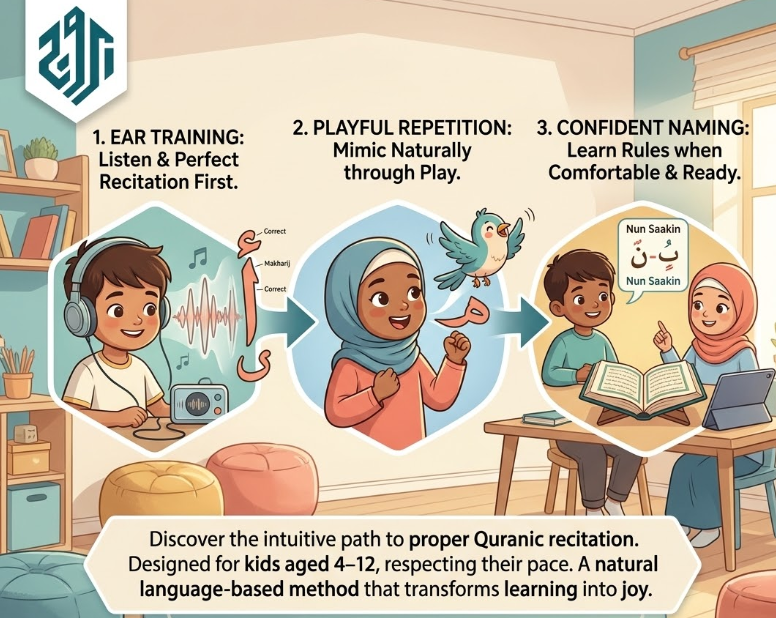
Our instructors don’t push memorization before sound recognition; a child learns to distinguish ح from ه through repetition and play first.
For families wanting the reading foundation before Tajweed begins, our Noorani Qaida course for kids builds letter recognition first.
Sign up your kid for a free Noorani Qaida lesson

How Does Buruj Academy Structure Tajweed Learning by Age?
Buruj Academy splits instruction into two developmental stages, so a four-year-old and a ten-year-old never receive the same lesson plan.
Younger children (ages 4–7) begin with sound recognition and short Surahs using color-coded Mushafs.
Older children (8–12) move into Tajweed rule application once abstract reasoning develops.
Children under eight receive lessons capped at 20–30 minutes, with attention resets built in every eight to ten minutes through games or movement breaks.
In our sessions, we’ve found that children taught Qalqalah through mimicry — feeling the bounce in ق and ب before ever hearing the rule’s name — retain the correct sound far longer than children who memorize the term first.
The Tajweed rules for kids guide walks through this sound-before-terminology approach in more depth.
| Age Group | Primary Focus | Session Length | Technical Terms Introduced |
| 4–7 years | Sound recognition, short Surahs | 20–30 minutes | Delayed until sound is natural |
| 8–9 years | Tajweed rule names, application | 30–40 minutes | Introduced gradually |
| 10–12 years | Rule interaction, longer recitation | 40–45 minutes | Full terminology used |
This progression matters because a child who memorizes rule names before internalizing the sound tends to apply Tajweed inconsistently for years afterward.
What Does Make Buruj Academy’s Teaching Team Different
Every teacher completing our hiring process must demonstrate how they would explain Qalqalah to a six-year-old versus a twelve-year-old — a distinction most academies never test for.
This is where the Buruj Method (sound-before-rules, context-before-abstraction, consistency-before-speed) shapes every lesson plan we write.
Parents considering Buruj Academy’s Online Tajweed Classes for Kids often ask how we handle a child who falls behind.
Our instructors adjust pacing immediately rather than following a fixed calendar — some children need three weeks on Noorani Qaida foundations, others need three months, and both outcomes are treated as normal.
Read More: The Best Online Quran Classes for Kids
Book your child’s free Tajweed trial lesson today
2. Alhuda Academy
Alhuda Academy offers live, 1-on-1 online Quran and Tajweed classes for children, with teachers who are graduates of Al-Azhar University and other recognized Islamic institutions. Parents can request male or female teachers, and the platform includes a homework-and-progress tracking feature that some families find useful for monitoring a child’s week-to-week improvement.
Alhuda has operated since before the current wave of Quran-tutoring platforms and has a visible base of parent testimonials describing patient teaching with children who previously resisted Arabic study. It is a reasonable option for families who specifically want Al-Azhar-credentialed teachers but haven’t yet compared pricing or trial-lesson structure across platforms.
Discover the Buruj Academy Difference
Step into our virtual classrooms and see how our expert instructors make learning Quran and Arabic intuitive and clear. We focus on overcoming the specific hurdles non-native speakers face, building your confidence and connection with the Quran.
Excel in Your Quranic Studies
Join Buruj Academy and master the Quran with our structured, professional curriculum.
Book Your Free Trial3. Qutor
Qutor takes a different approach than most academies: instead of being matched with an assigned teacher, parents browse individual tutor profiles, use a free 30-minute trial to interview several candidates, and then purchase credits to continue with whichever teacher fits their child best.
This structure suits parents who want direct control over teacher selection rather than trusting an academy’s matching process.
The tradeoff is that quality-vetting responsibility shifts more heavily onto the parent, since Qutor functions closer to a tutor marketplace than a curated academy with a fixed pedagogical framework.
Read More: How to Learn to Read Quran for Kids?
4. Bayyinah Institute
Bayyinah Institute, founded by Nouman Ali Khan, is one of the most widely recognized names in Quranic education. It’s worth naming honestly here: Bayyinah is built around self-paced Arabic and Tafsir courses rather than live, 1-on-1 Tajweed correction for young children, so it fits older kids and teenagers building deep Quranic Arabic comprehension better than a five-year-old learning makharij for the first time.
Families sometimes pair Bayyinah’s Arabic-comprehension courses with a separate live Tajweed tutor for younger children, since the two serve genuinely different learning stages.
5. Muslim Kids TV is Useful Supplement, Not a Substitute for Tajweed Correction
Muslim Kids TV is a well-known, ad-free streaming app offering Islamic cartoons, songs, Quran-learning videos, and games for children aged roughly 2–12. It’s a legitimate, safe platform many Muslim families already use for screen time.
It is not, however, a Tajweed-correction tool. As we note in our best Quranic games for kids guide, games and videos reinforce what a qualified teacher has already taught — they cannot identify a child’s pronunciation error the way a live instructor can. Parents searching specifically for Tajweed correction should treat apps like this as a between-lesson supplement.
Read More: Arabic Words in Spanish
6. Quran Explorer / QuranInteractive — Long-Running Nonprofit Option
Quran Explorer, run by the nonprofit Noble Education Institute, has offered a free Quran-reading app alongside live online classes through its QuranInteractive.com arm for well over a decade. Because it operates as a registered nonprofit rather than a commercial academy, some families find its pricing structure and mission framing appealing.
Its live-class offering is smaller and less specialized for children specifically compared to academies built around a dedicated kids’ curriculum, so it tends to suit families already using the free app who want to add occasional live sessions.
What Should Parents Look for in a Kids’ Tajweed Platform?
Parents should prioritize four factors: verified teacher credentials (Ijazah, not just “certified”), 1-on-1 rather than large group format, age-appropriate session length, and a free trial lesson before any payment commitment.
A platform that cannot answer specifically how it teaches an eight-year-old differently from a four-year-old likely lacks real child-pedagogy training.
Read also: Top Institutes to Study Tajweed
Why Live Correction Matters More Than App Features for Tajweed
Tajweed is a spoken skill, and spoken skills require a listener who can catch an error the moment it happens. An app can show a child what Ikhfa looks like on a page; it cannot hear that the child is holding the nasal sound for one count instead of two and correct it mid-recitation.
This is why the strongest kids’ programs — including our own — pair digital tools with a live teacher rather than replacing one with the other.
Our how to make reading Quran fun for kids guide covers how to blend structured lessons with playful practice at home without losing Tajweed accuracy.
How Should Parents Structure the First Few Weeks?
The first two to three weeks should focus on assessment, not memorization targets. A trial lesson should reveal whether a child can sit for 15–20 minutes, follow basic instructions, and engage with a teacher’s teaching style before any academy commits to a fixed curriculum path.
Parents new to this process often find our how to learn Quran for kids overview helpful for understanding the full sequence — from Noorani Qaida through Tajweed to early Hifz — before selecting a platform.
Read More: Should Muslims Read the Quran in Arabic?
Give Your Child Expert, Personalized Tajweed Instruction with Buruj Academy
Choosing the right platform shapes whether a child builds lifelong Quran confidence or loses motivation within weeks.
Buruj Academy’s Online Tajweed Classes for Kids deliver exactly what this comparison shows matters most: Ijazah-certified, Al-Azhar-trained instructors, true 1-on-1 sessions, and the Buruj Method’s sound-before-rules approach.
Every teacher completes dedicated child-pedagogy training and adjusts pacing to your child’s actual progress, not a fixed calendar.
Sessions are scheduled flexibly across time zones, with real-time correction no app can replicate.
Book your child’s free trial lesson and see how personalized Tajweed instruction works from the very first session.
Enroll your child in one of our specialized, kid-friendly tracks today:
- Online Quran Classes for Kids
- Tajweed Classes for Kids
- Hifz Classes for Kids
- Online Arabic Classes for Kids
- Quranic Arabic Course for Kids
- Noorani Qaida Course for Kids
- Islamic Studies Classes for Kids
Ready to watch your child grow in knowledge and character? Join the Buruj Academy family and book a free trial session for your child today!
Excel in Your Quranic Studies
Join Buruj Academy and master the Quran with our structured, professional curriculum.
Book Your Free TrialConclusion
Comparing kids’ Quran platforms honestly means separating true live-tutoring academies from supplementary apps, since each serves a different role in a child’s learning. The strongest results come from pairing a qualified 1-on-1 teacher with age-appropriate pacing, not from any single app or feature list.
Buruj Academy’s structured, credential-backed approach addresses the gap most families hit within their child’s first month — mismatched pacing and unverified teacher training — while the other platforms above each fill a narrower, honestly-described role in a family’s broader learning toolkit.
Frequently Asked Questions About Online Quran Classes with Tajweed for Kids
What age should a child start online Tajweed classes?
Most academies, including Buruj Academy, accept children from age four, provided they can sit for 15–20 minutes and follow basic instructions. Readiness is typically assessed during a free trial lesson rather than assumed from age alone.
Can apps replace a live Tajweed teacher for kids?
No. Apps and games reinforce sound recognition and vocabulary, but only a live teacher can hear a specific pronunciation error in real time and correct it before it becomes a habit. Apps work best as between-lesson supplements.
How long should a Tajweed lesson be for young children?
Children under eight generally do best with 20–30 minute sessions, since attention spans at that age can’t sustain longer structured instruction without built-in breaks every eight to ten minutes.
Is group or 1-on-1 tutoring better for kids learning Tajweed?
1-on-1 sessions allow a teacher to catch and correct an individual child’s specific pronunciation habits immediately. Group classes can work for review and confidence-building, but individual correction is harder to deliver consistently.
How much daily practice is needed outside class?
Around 5–10 minutes daily for children under eight, expanding to 15 minutes for older students, tends to produce better retention than longer, infrequent weekend sessions.
Related Articles
Tajweed