 Arabic
| Key Takeaways |
| Spanish contains approximately 4,000 words of Arabic origin. |
| Around 1,000 of these are direct Arabic roots, while roughly 3,000 are words derived from those roots. |
| Most Arabic loanwords entered Spanish between 711 and 1492 CE, during nearly 800 years of Arabic-speaking rule in Iberia. |
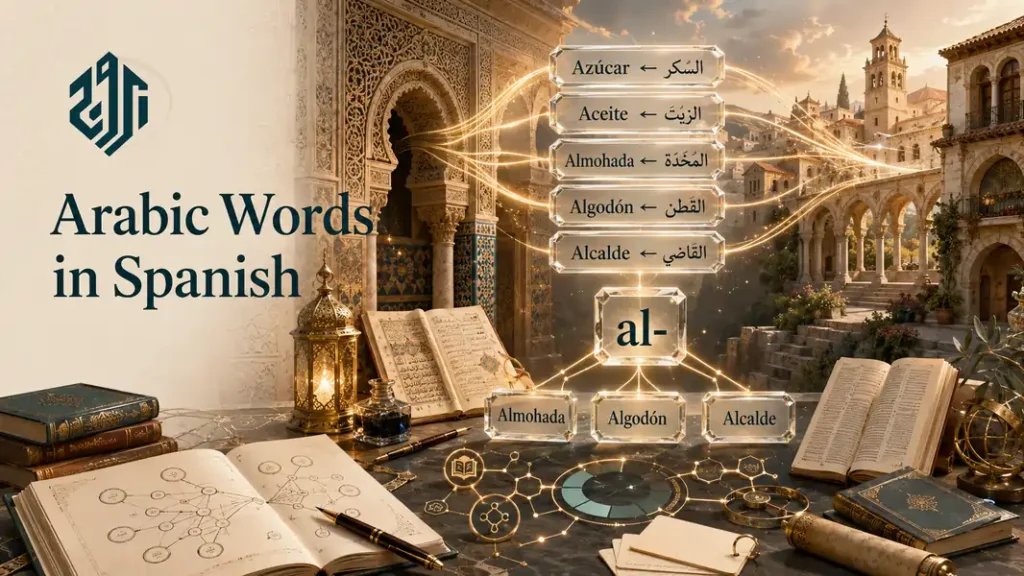
| Words beginning with “al-” (like almohada and azúcar) usually trace back to the Arabic definite article “al.” |
| Everyday Spanish categories most shaped by Arabic include agriculture, architecture, food, mathematics, and household vocabulary. |
Spanish speakers use Arabic-derived words dozens of times a day without realizing it — azúcar, almohada, ojalá, and aceite all trace back to Andalusian Arabic, a fact that surprises most learners the first time we mention it.
Table of Contents:
How Many Spanish Words Have an Arabic Root?
Approximately 4,000 Spanish words have Arabic origins, representing about 8% of the entire Spanish dictionary. Linguists divide this number into roughly 1,000 direct Arabic roots and around 3,000 additional words derived from those roots through Spanish morphology.
This estimate comes from repeated analysis of the Diccionario de la Real Academia Española (DRAE), cross-referenced against documented Andalusian Arabic vocabulary. The exact figure varies slightly by source, since etymologists sometimes disagree on whether a word arrived directly or through an intermediate language.
What stays consistent is the scale: after Latin, Arabic represents the largest single lexical influence on the Spanish language, with about one thousand Arabic roots and approximately three thousand derived words, making a total of around four thousand words or 8% of the Spanish dictionary.
Root Words Versus Derived Words
A root word is a term borrowed directly from Arabic with minimal change, such as azúcar from as-sukkar (السكر). A derived word builds on that root using Spanish grammar — adding suffixes or forming adjectives that didn’t exist in the original Arabic.
For example, the root aceite (oil) produced Spanish derivatives like aceitoso (oily) and aceitera (oil container), neither of which exists as a standalone word in Arabic.
This pattern repeats across hundreds of Arabic-origin roots, multiplying the original 1,000 borrowed terms into thousands of related vocabulary items.
| Category | Approximate Count | Example |
| Direct Arabic roots | ~1,000 | azúcar (sugar) |
| Words derived from roots | ~3,000 | azucarado (sugary) |
| Total Arabic-influenced vocabulary | ~4,000 | — |
This root-and-derivative structure mirrors how Arabic itself works, since Arabic vocabulary is built from three-letter root patterns generating dozens of related words.
Students who grasp this early often find our Arabic Grammar Course easier, since Arabic’s root system rewards pattern recognition over memorization.
Understand the Arabic Grammar with Buruj’s free trial lesson
What Are Common Spanish Words That Come From Arabic?
Common Spanish words from Arabic span food, household items, professions, and science — including azúcar (sugar), almohada (pillow), aceite (oil), and alcalde (mayor). Most entered Spanish through Andalusian Arabic between the 9th and 15th centuries.
Below is a working list organized by everyday category, with the Arabic source word and its meaning.
Food and Agriculture Arabic Vocabulary in Spanish
Arabic reshaped Spanish food vocabulary more thoroughly than almost any other category, since Andalusian farmers introduced crops and irrigation techniques Latin vocabulary couldn’t describe.
| Spanish Word | Arabic Source | Meaning |
| Azúcar (sugar) | as-sukkar (السكر) | Sugar |
| Aceite (oil) | az-zait (الزيت) | Oil |
| Aceituna (olive) | az-zaytūn (الزَّيْتُون) | Olive |
| Naranja (orange) | nāranj (نارنج) | Bitter orange |
Household and Domestic Life Arabic Terms in Spanish
Many of Spanish’s most common household nouns entered directly from Arabic, keeping the definite article “al” fused onto the front of the word.
Almohada (pillow) comes from the Arabic al-mikhaddah (المخدة), meaning cushion or pillow, while alquiler (to rent) derives from al-kirraʾ (الكِرَاء), meaning to rent, hire, or lease.
Algodón (cotton) traces to al-quton (القطن), and alfombra (carpet) comes from al-khumra (الخُمْرَة).
We often point beginning students toward these household words first, since they already know the vocabulary — they just don’t yet know it’s Arabic, a confidence boost we lean on in our Online Arabic Classes for Beginners.
Begin learning Arabic at Buruj with a FREE trial lesson

Arabic Vocabulary in Spanish for Professions, Governance, and Science
Arabic also shaped Spanish’s civic and scientific vocabulary, reflecting the administrative sophistication of Al-Andalus.
Alcalde (mayor) derives from al-qādi (القاضي), the Arabic word for “the judge,” showing how a judicial title evolved into a municipal leadership role.
Álgebra comes from al-jabr (الجبر), from a foundational 9th-century mathematics text, and alcohol traces to al-kuhul (الكحل), originally a fine cosmetic powder before shifting meaning in European languages.
Discover the Buruj Academy Difference
Step into our virtual classrooms and see how our expert instructors make learning Quran and Arabic intuitive and clear. We focus on overcoming the specific hurdles non-native speakers face, building your confidence and connection with the Quran.
Master the Arabic Language
Join our expert-led courses and build a strong foundation in Classical and Modern Arabic.
Get Your Free TrialWhy Does Spanish Have So Many Arabic Loanwords?
Spanish absorbed thousands of Arabic words because Arabic-speaking rulers governed most of the Iberian Peninsula for nearly 800 years, from 711 to 1492 CE. During this era, known as Al-Andalus (الأَنْدَلُس), Arabic functioned as the dominant language of administration, science, agriculture, and commerce across the region.
This wasn’t a brief contact between two languages — it was one of the longest sustained periods of bilingualism in European history, and the vocabulary transfer reflects that depth.
How Did Al-Andalus Shape the Spanish Lexicon?
Al-Andalus refers to the Iberian territories under Arabic-speaking Muslim rule, from the Umayyad conquest in 711 CE to the fall of Granada in 1492. Andalusian Arabic differed somewhat from Classical Arabic, and many Spanish Arabisms reflect this regional dialect rather than the fus’ha (formal) Arabic used in scholarship today.
In our sessions with Spanish-speaking adults exploring Arabic for the first time, we’ve noticed this history often becomes the hook that keeps them motivated.
Recognizing a familiar word makes the language feel less foreign, which is why so many students want to understand this connection before starting formal study through Buruj Academy’s Online Arabic Classes.
Read More: Dua for Children Memorizing Quran
Book your FREE Arabic trial online Arabic class at Buruj

How Do You Recognize Arabic-Origin Words in Spanish?
Most Arabic-origin Spanish words are recognizable by an initial “al-” prefix, which comes from the Arabic definite article meaning “the.” Words like almohada, algodón, and alcalde all carry this fossilized article, though not every “al-” word in Spanish is Arabic.
This pattern exists because Arabic nouns typically appear with their article attached in speech, and early Spanish speakers absorbed the noun and article as a single unit rather than separating them.
The “Al-” Prefix Test
A reliable rule of thumb: if a Spanish word starts with “al-” and has no obvious Latin root, there’s a strong chance it originated in Arabic. However, not every Spanish word starting with “al-” is Arabic — alto (tall) comes from Latin altus, and alma (soul) comes from Latin anima.
This inconsistency reflects real Arabic grammar. Arabic divides its alphabet into “sun letters” and “moon letters,” which determines whether the “l” in “al” is pronounced or assimilated into the next consonant.
Spanish absorbed both patterns — some words kept “al-” clearly (algodón), while others show only a single vowel (azúcar, where “al” merged into “az” before the sun letter “s”).
Arabic Words Without the “Al-” Pattern
Not every Arabic loanword kept the article at all. Ojalá, one of the most commonly cited Arabic-origin Spanish words, shows no “al-” prefix whatsoever, and its actual etymology is more contested than most casual sources suggest.
The popular explanation claims ojalá comes from the Arabic phrase in sha’a Allah (إن شاء الله), “if God wills.” However, serious etymological analysis argues ojalá does not come from in sha’a Allah “if God wills,” but rather from law sha’a Allah, “if God had willed” or “if God so willed.”
The distinction matters grammatically: Arabic uses the particle “in” for a real, likely condition, while “law” expresses an unreal or hypothetical condition — and ojalá functions in Spanish the way a hypothetical wish would, not a realistic expectation.
We mention this nuance often in our Arabic classes, since it’s a useful example of how etymology requires real linguistic evidence, not just surface resemblance.
Read More: Basic Arabic Words With Pronunciation
Which Spanish Words Are Nearly Identical to Their Arabic Source?
No Spanish word is spelled identically to its Arabic source, since Spanish uses Latin script and different phonetic rules — but several words remain phonetically very close to the original Arabic pronunciation. Words like azúcar, ajedrez, and guitarra preserve most of the original Arabic sound pattern.
This is worth clarifying because many learners search for Arabic words that are “the same” in Spanish, expecting identical spelling — that’s not how loanwords function between languages with different writing systems.
Near-Identical Pronunciation Examples
| Spanish Word | Arabic Source | Phonetic Closeness |
| Azúcar | as-sukkar (السكر) | Very close |
| Guitarra | qīthāra (قيثارة) | Close, via Greek-Arabic path |
| Ajedrez | ash-shatranj (الشطرنج) | Moderate |
| Alcohol | al-kuhul (الكحل) | Close |
Ajedrez (chess) evolved from al-shatranj (الشطرنج), which came from Middle Persian chatrang, ultimately derived from Sanskrit chaturanga, referring to the four divisions of an ancient army.
Some “Arabic” loanwords in Spanish actually transmit Persian and Sanskrit vocabulary — Arabic acted as the carrier, not always the origin.
Common Misconceptions About Word Similarity
A frequent misunderstanding is assuming shared loanwords mean the two languages are related. Spanish belongs to the Romance language family descending from Latin, while Arabic belongs to the Semitic language family entirely — the vocabulary overlap comes from historical contact, not shared ancestry.
This matters for learners: recognizing a familiar loanword doesn’t mean Arabic grammar will feel familiar too, since Arabic’s root-and-pattern verb system and script work nothing like Spanish.
That’s why our Beginner’s Guide to Modern Standard Arabic builds genuine grammar foundations rather than leaning on cognates as a shortcut.
What Is a List of Spanish Words With Arabic Roots by Category?
Spanish words with Arabic roots cluster heavily around agriculture, architecture, mathematics, textiles, and daily household vocabulary. Below is a reference list covering the categories most relevant to everyday conversation.
Architecture and Construction Arabic Terms in Spanish
Alcázar (fortress/palace) comes from al-qasr (القصر). Azotea (flat rooftop) derives from as-sutayha (السطيحة), and alcantarilla (sewer/drain) traces to al-qantara (القنطرة), meaning “the bridge.”
Textile and Household Arabic Vocabulary in Spanish
Algodón (cotton) comes from al-quton (القطن), and alfombra (carpet) derives from al-khumra (الخُمْرَة). Both entered Spanish alongside the textile trade routes that connected Al-Andalus to the wider Mediterranean.
Common Spanish Verbs of Arabic Origin
Alquiler, meaning “to rent,” derives from the Arabic al-kirraʾ (الكِرَاء), meaning to rent, hire, or lease — one of the few Arabic-origin Spanish terms built primarily around a verb-like action rather than a physical object.
Practicing vocabulary by category like this is exactly the structured approach we use with students working toward conversational fluency, an area covered in our guide to mastering Arabic vocabulary.
Read More: The Best Online Quran Classes with Tajweed for Kids
Master Arabic Vocabulary With Buruj Academy’s Structured Classes
Recognizing Arabic loanwords in Spanish is a fascinating start, but real fluency requires structured instruction. At Buruj Academy, our Online Arabic Classes use the context-before-abstraction method, connecting familiar vocabulary to genuine Arabic grammar and pronunciation from day one.
Our Al-Azhar-trained instructors bring 12+ years of experience teaching non-Arabic speakers, with personalized 1-on-1 sessions tailored to your pace.
Whether you’re a complete beginner or already recognize Arabic-origin words in your own language, we build a genuine foundation in reading, writing, and speaking.
Begin your transformation today by choosing the path that fits your goals:
- Online Arabic Classes (General & Comprehensive)
- Arabic Course for Beginners
- Arabic Alphabet Learning Course
- Online Arabic Classes for Kids
- Arabic Classes for Adults
- Arabic Grammar Course (Nahw & Sarf)
- Intermediate Arabic Course (B1/B2)
- Arabic Speaking Course (Conversational Fluency)
- Arabic Reading Course (Literary Excellence)
- Learn Arabic Writing Course (Calligraphy & Composition)
Ready to speak with confidence? Join the global community at Buruj Academy and book your free placement interview today!
Master the Arabic Language
Join our expert-led courses and build a strong foundation in Classical and Modern Arabic.
Get Your Free TrialConclusion
Spanish carries nearly 800 years of Arabic linguistic history inside words used every single day, from azúcar to almohada. That legacy runs deeper than casual vocabulary lists suggest, touching agriculture, science, governance, and household life across the Iberian Peninsula.
Understanding which words are genuinely Arabic — and which merely look similar — takes real etymological grounding, not surface pattern-matching.
For Spanish speakers curious about Arabic, this shared history offers a genuine head start, provided the next step is structured learning rather than assumption.
Frequently Asked Questions About Arabic Words in Spanish
How Many Arabic Words Are in Spanish?
Approximately 4,000 Spanish words have Arabic origins, representing about 8% of the entire Spanish dictionary. Roughly 1,000 are direct Arabic roots, while the remaining 3,000 are Spanish-derived words built from those original borrowed terms.
Are Arabic and Spanish Related Languages?
No. Spanish is a Romance language descended from Latin, while Arabic is a Semitic language entirely unrelated in grammar and structure. The vocabulary overlap comes from nearly 800 years of historical contact during Al-Andalus, not shared linguistic ancestry.
Why Do So Many Spanish Words Start With “Al-“?
Many Spanish words starting with “al-” come from Arabic nouns that carried their definite article “al” (meaning “the”) into Spanish as a single fused unit. However, not every “al-” word is Arabic — alto and alma both come from Latin.
Does Ojalá Really Mean “Allah Willing”?
Ojalá expresses a wish similar to “if only” or “hopefully,” and most sources link it to the Arabic phrase for “if God wills.” Serious etymological analysis, however, argues it more precisely traces to law sha’a Allah, expressing a hypothetical rather than expected wish.
Which Spanish Words Sound Closest to Their Original Arabic?
Words like azúcar (from as-sukkar), alcohol (from al-kuhul), and guitarra (from qīthāra) retain phonetic patterns close to their Arabic source, even though none are spelled identically due to differing writing systems.