 Arabic
| Key Takeaways |
| The Arabic present tense (المضارع, al-muḍāri’) expresses ongoing and habitual actions using a fixed system of prefixes and suffixes. |
| Arabic verbs conjugate for person (first, second, third), gender (masculine, feminine), and number (singular, dual, plural). |
| The present tense conjugation chart has 14 distinct forms derived from a three-letter root pattern applied consistently. |
| Mastering the root-and-pattern system lets learners conjugate thousands of Arabic verbs without memorizing each one individually. |
| Regular daily practice with real sentence examples accelerates present tense fluency faster than grammar drills alone. |
Arabic present tense conjugation stops many learners cold — not because it is impossibly difficult, but because most resources present it as an intimidating wall of forms without explaining the elegant logic underneath. Once you see the system, everything changes.
The Arabic present tense, called المضارع (al-muḍāri’), works through a precise system of prefixes and suffixes attached to a verb root.
Every person, gender, and number combination follows a predictable pattern — meaning that learning one verb correctly teaches you how to conjugate thousands of others.
Table of Contents:
What Is the Arabic Present Tense?
The Arabic present tense (al-muḍāri’) describes actions currently happening or habitually performed. It is formed by taking the verb’s root — almost always three letters — and adding specific prefixes (at the start) and suffixes (at the end) that identify who is performing the action.
Understanding this prefix-suffix system is the foundation of all Arabic verb conjugation.
Arabic verbs in the present tense carry four pieces of information simultaneously: the action itself, the person performing it, the gender of that person, and whether one, two, or more people are acting.
This is why Arabic sentences often omit pronouns entirely — the verb already contains all necessary information.
Why the Root System Makes Conjugation Learnable
Every Arabic verb originates from a three-letter root (جذر, jidhr). The root carries the core meaning; the pattern wraps around it to create grammatical function. Take the root ك-ت-ب (k-t-b), related to writing.
The present tense stem becomes يَكْتُبُ (yaktubu — he writes). Every other present tense form uses this same root with different prefixes and suffixes.
This is the insight that separates fast learners from struggling ones. In our sessions at Buruj Academy, once adult beginners internalize the root concept — usually within the first two weeks — their conjugation accuracy improves dramatically.
They stop memorizing isolated words and start generating correct verb forms.
If you are building your Arabic foundation systematically, our beginner-friendly Arabic grammar guide explains the broader grammatical framework within which conjugation sits.
The Arabic Present Tense Conjugation Chart
The complete present tense conjugation chart covers 14 forms across three persons, two genders, and three numbers (singular, dual, plural). We use the verb كَتَبَ (kataba — to write) as the model verb, since it follows the most common and regular pattern in Arabic.
| Pronoun | Arabic Pronoun | Present Tense Form | Transliteration | Meaning |
| I | أنا | أَكْتُبُ | aktubu | I write / I am writing |
| You (m. sg.) | أنتَ | تَكْتُبُ | taktubu | You write |
| You (f. sg.) | أنتِ | تَكْتُبِينَ | taktubīna | You write |
| He | هو | يَكْتُبُ | yaktubu | He writes |
| She | هي | تَكْتُبُ | taktubu | She writes |
| You (m. dual) | أنتما | تَكْتُبَانِ | taktubāni | You two write |
| You (f. dual) | أنتما | تَكْتُبَانِ | taktubāni | You two write |
| They (m. dual) | هما | يَكْتُبَانِ | yaktubāni | They two write |
| They (f. dual) | هما | تَكْتُبَانِ | taktubāni | They two write |
| You (m. pl.) | أنتم | تَكْتُبُونَ | taktubūna | You (all, m.) write |
| You (f. pl.) | أنتن | تَكْتُبْنَ | taktubna | You (all, f.) write |
| We | نحن | نَكْتُبُ | naktubu | We write |
| They (m. pl.) | هم | يَكْتُبُونَ | yaktubūna | They (m.) write |
| They (f. pl.) | هن | يَكْتُبْنَ | yaktubna | They (f.) write |
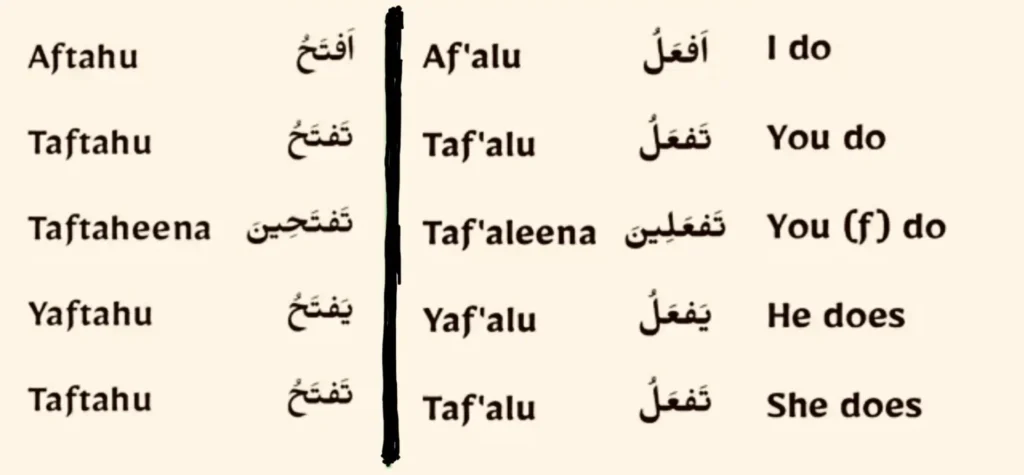
Notice the four prefixes: أَ (I), تَ (you/she), يَ (he/they m.), نَ (we). These prefixes are the most important feature to memorize first — they apply across almost all Arabic present tense verbs.
How to Read the Arabic Present Tense Conjugation Chart Systematically?
Reading the chart systematically means understanding it in layers rather than memorizing all 14 rows at once. Start with the prefixes, then add the suffixes, and you will find significant overlap that reduces your memorization load considerably.
Layer One — The Four Prefixes
| Prefix | Arabic | Applies To |
| أَ (a-) | أَ | First person singular (I) |
| تَ (ta-) | تَ | Second person all forms + third person feminine |
| يَ (ya-) | يَ | Third person masculine (he, they m.) |
| نَ (na-) | نَ | First person plural (we) |
Layer Two — The Suffixes That Distinguish Number and Gender
Once the prefix identifies the general category, the suffix refines it:
- No suffix → singular (أَكْتُبُ, يَكْتُبُ, تَكْتُبُ)
- ـِينَ (-īna) → second person feminine singular (تَكْتُبِينَ)
- ـَانِ (-āni) → dual, all genders (يَكْتُبَانِ, تَكْتُبَانِ)
- ـُونَ (-ūna) → masculine plural (يَكْتُبُونَ, تَكْتُبُونَ)
- ـْنَ (-na) → feminine plural (يَكْتُبْنَ, تَكْتُبْنَ)
In our Arabic Grammar course at Buruj Academy, we teach this layered approach — prefixes first, then suffixes — because it reduces the apparent complexity from 14 separate items to two simple lists that combine logically.
Understand the Arabic Grammar with Buruj’s free trial lesson

Arabic Present Tense Conjugation Examples with Full Sentences
Abstract charts become real language only through examples in context. Below are present tense conjugation examples across multiple verbs, showing how the same prefix-suffix system applies consistently regardless of the root.
If you want to build vocabulary alongside these patterns, our guide to mastering Arabic vocabulary complements this conjugation practice well.
Examples with the Verb ذَهَبَ (to go)
| Form | Arabic Sentence | Translation |
| He goes | يَذْهَبُ أحمدُ إلى المدرسة | Ahmad goes to school |
| She goes | تَذْهَبُ فاطمةُ إلى السوق | Fatimah goes to the market |
| They (m.) go | يَذْهَبُونَ إلى المسجد | They go to the mosque |
| We go | نَذْهَبُ إلى البيت | We go to the house |
| You (m.) go | تَذْهَبُ إلى العمل | You go to work |
Examples with the Verb أَكَلَ (to eat)
| Form | Arabic Sentence | Translation |
| I eat | أأكُلُ الخبزَ كلَّ يومٍ | I eat bread every day |
| She eats | تَأْكُلُ التفاحةَ | She eats the apple |
| They (f.) eat | يَأْكُلْنَ في البيت | They (women) eat at home |
| You (f.) eat | تَأْكُلِينَ الطعامَ | You (f.) eat the food |
Examples with the Verb قَرَأَ (to read)
| Form | Arabic Sentence | Translation |
| He reads | يَقْرَأُ الكتابَ | He reads the book |
| We read | نَقْرَأُ القرآنَ | We read the Quran |
| You two read | تَقْرَأَانِ معاً | You two read together |
| They (m.) read | يَقْرَؤُونَ الدرسَ | They read the lesson |
A pattern emerges immediately: the root letters remain intact while only the prefix and suffix change. This is what makes Arabic verb conjugation a system rather than a list.
Master the Arabic Language
Join our expert-led courses and build a strong foundation in Classical and Modern Arabic.
Get Your Free TrialWhat Are the Most Common Mistakes in Arabic Present Tense Conjugation?
The most common mistakes non-Arabic speakers make in present tense conjugation fall into three predictable categories: confusing gender in the second and third persons, forgetting feminine plural forms, and misapplying dual suffixes. Knowing these pitfalls in advance lets you correct them before they become habits.
Mistake One — Confusing هي (She) and أنتَ (You m.)
Both هي (she) and أنتَ (you, masculine singular) use the prefix تَ and share the same base form — for example, تَكْتُبُ. Students frequently mix these forms up. The context (pronoun or subject) resolves the ambiguity in actual speech and writing, but learners must stay conscious of who the verb refers to.
Mistake Two — Skipping the Feminine Plural
The feminine plural forms يَكْتُبْنَ and تَكْتُبْنَ use the suffix ـْنَ with a sukoon (vowellessness) on the letter before it. Many beginners either omit this form entirely or substitute the masculine plural. In our experience at Buruj Academy, students who spend even one focused session drilling feminine plural forms eliminate this error almost completely.
Mistake Three — Misusing the Dual
Arabic’s dual number (مثنى, muthannā) does not exist in English, making it one of the hardest features for English speakers to internalize. The dual suffix ـَانِ (-āni) applies to exactly two actors — not “a couple” loosely, but precisely two. Overusing or underusing the dual is among the most consistent errors we observe in intermediate students.
How to Practice Arabic Present Tense Conjugation Exercises Effectively?
Effective practice for present tense conjugation requires structured repetition combined with meaningful context — not random drilling. The three most productive exercise types are conjugation substitution drills, sentence completion, and oral production with real-time correction.
Exercise Type One — Substitution Drills
Take one verb and one sentence frame, then substitute every pronoun systematically:
Frame: ___ يَذْهَبُ / تَذْهَبُ إلى المسجد (goes to the mosque)
- أنا → أَذْهَبُ إلى المسجد
- أنتَ → تَذْهَبُ إلى المسجد
- هو → يَذْهَبُ إلى المسجد
- هي → تَذْهَبُ إلى المسجد
- نحن → نَذْهَبُ إلى المسجد
- هم → يَذْهَبُونَ إلى المسجد
This exercise builds the prefix-suffix connection through repetition without isolating forms from meaning. Practicing this aloud — not just writing — accelerates fluency significantly. Our guide on improving Arabic speaking skills offers additional strategies for oral practice.
Exercise Type Two — Gap-Fill Sentences
Write or complete sentences where the pronoun is given and the student supplies the verb form:
- هو ___ (كتب) رسالةً. → يَكْتُبُ
- أنتِ ___ (قرأ) الكتاب. → تَقْرَئِينَ
- نحن ___ (ذهب) إلى السوق. → نَذْهَبُ
- هن ___ (أكل) في البيت. → يَأْكُلْنَ
Exercise Type Three — Translation Into Arabic
Translating from English to Arabic forces active recall rather than passive recognition:
- “She studies every day.” → تَدْرُسُ كلَّ يوم.
- “They (m.) play football.” → يَلْعَبُونَ كُرةَ القدم.
- “You (f.) write a letter.” → تَكْتُبِينَ رسالة.
- “We drink water.” → نَشْرَبُ الماء.
For learners who want structured exercises with teacher correction, Buruj Academy’s Arabic Grammar course provides systematically graded conjugation exercises with Al-Azhar-trained instructors giving real-time feedback.
Understand the Arabic Grammar with Buruj’s free trial lesson

How the Arabic Sentence Structure Affects Present Tense Verb Placement
Arabic sentence structure directly influences how present tense verbs are positioned — and understanding this context helps learners use conjugated verbs naturally, not just in isolation. Arabic is a flexible language that allows both verb-first (VSO) and subject-first (SVO) sentence orders.
In a verb-first sentence, the verb appears before the subject:
يَذْهَبُ الطالبُ إلى الجامعة
Yadh-habu al-ṭālibu ilā al-jāmi’ah
The student goes to the university.
In a subject-first sentence, the subject appears first:
الطالبُ يَذْهَبُ إلى الجامعة
Al-ṭālibu yadh-habu ilā al-jāmi’ah.
The student goes to the university.
Both are grammatically correct. The subject-first order is slightly more emphatic. Understanding word order helps learners read authentic Arabic texts with greater fluency. Our detailed guide on Arabic sentence structure explores this further with practical examples.
Our Online Arabic Classes at Buruj Academy build this bridge explicitly, taught by Al-Azhar graduates specializing in Arabic linguistics.
Book your FREE Arabic trial online Arabic class at Buruj

Discover the Buruj Academy Difference
Step into our virtual classrooms and see how our expert instructors make learning Quran and Arabic intuitive and clear. We focus on overcoming the specific hurdles non-native speakers face, building your confidence and connection with the Quran.
Master Arabic Grammar with Buruj Academy’s Expert Instructors
Arabic present tense conjugation becomes genuinely manageable when taught systematically by instructors who understand exactly where English speakers struggle.
Buruj Academy’s Arabic Grammar course takes you from foundational conjugation through advanced grammatical structures, with every session led by Al-Azhar University graduates with 12+ years of experience teaching non-Arabic speakers.
Our approach follows the Buruj Method: context before abstraction, meaning we introduce real sentences before abstract rules — so grammar always feels connected to actual communication.
- Ijazah-certified, Al-Azhar-trained instructors
- Personalized 1-on-1 sessions with flexible scheduling
- Real-time correction and individualized learning plans
- Progression from beginner to advanced mastery
Book your free trial lesson today and experience the difference structured instruction makes.
Begin your transformation today by choosing the path that fits your goals:
- Online Arabic Classes (General & Comprehensive)
- Arabic Course for Beginners
- Arabic Alphabet Learning Course
- Online Arabic Classes for Kids
- Arabic Classes for Adults
- Arabic Grammar Course (Nahw & Sarf)
- Intermediate Arabic Course (B1/B2)
- Arabic Speaking Course (Conversational Fluency)
- Arabic Reading Course (Literary Excellence)
- Learn Arabic Writing Course (Calligraphy & Composition)
Ready to speak with confidence? Join the global community at Buruj Academy and book your free placement interview today!
Master the Arabic Language
Join our expert-led courses and build a strong foundation in Classical and Modern Arabic.
Get Your Free TrialConclusion
Arabic present tense conjugation is built on one elegant principle: a consistent prefix-suffix system applied to a three-letter root. Once that system clicks, learners stop memorizing isolated verb forms and start generating correct Arabic naturally. The 14 conjugation forms reduce to four prefixes and five suffix patterns — a manageable structure that rewards methodical study.
The examples, charts, and exercises above give you a solid framework. Consistent practice — especially oral production with real feedback — is what moves this knowledge from recognition to fluency.
Insha’Allah, with the right guidance and daily effort, Arabic verb conjugation becomes one of the most satisfying milestones in your learning path.
Frequently Asked Questions About Arabic Present Tense Conjugation
How Many Forms Does the Arabic Present Tense Have?
The Arabic present tense has 14 distinct conjugation forms, covering all combinations of person (first, second, third), gender (masculine, feminine), and number (singular, dual, plural). In practice, several forms share identical spelling — particularly the dual forms — which reduces the effective memorization load for new learners.
Is the Arabic Present Tense Used for Future Actions Too?
Yes. The Arabic al-muḍāri’ tense expresses present ongoing actions, habitual actions, and future actions. Context — or the addition of future particles like سَوْفَ (sawfa) or سَـ (sa-) — clarifies whether the meaning is present or future. This differs from English, which uses separate tense forms for each.
How Long Does It Take to Master Arabic Present Tense Conjugation?
In our instructors’ experience, most adult beginners achieve confident recognition of all 14 present tense forms within 1–3 weeks of structured daily practice (20–30 minutes per day). Active production — writing and speaking correct forms without prompting — typically follows 2–3 additional weeks of sentence-level practice with real-time correction.
Do Arabic Verbs Always Follow the Three-Letter Root Pattern?
The vast majority of Arabic verbs derive from three-letter roots, and the present tense conjugation system applies to these consistently. Some verbs have four-letter roots (رباعي, rubā’ī), which follow a parallel but slightly different conjugation pattern. For learners at the beginner and intermediate stages, focusing on three-letter roots covers the overwhelming majority of verbs encountered in MSA and Quranic Arabic.
Related Articles
Arabic