 Arabic
| Key Takeaways |
| Arabic has 6 non-connecting letters: أ ، د ، ذ ، ر ، ز ، و — they connect to the right but never to the left. |
| These 6 Arabic letters always appear in their isolated or final form, regardless of position within a word. |
| Words containing non-connecting letters visually “break” into separate clusters, which is a normal script feature. |
| Recognizing non-connecting Arabic letters early prevents the most common handwriting and typing errors adult beginners make. |
| All 28 Arabic letters connect from the right; only 22 connect on both sides — the 6 exceptions follow predictable rules. |
When students first encounter Arabic script, most expect every letter to connect seamlessly to its neighbors the way English cursive flows.
Arabic script is largely connected, but six specific letters break that flow consistently — and understanding why changes how quickly you read and write.
These six letters always connect to the letter preceding them on the right, but they never extend a connection to the left. This single rule governs their behavior everywhere in the language — in print, in handwriting, and in digital typing.
Table of Contents:
What Are the Non-Connecting Letters in Arabic?
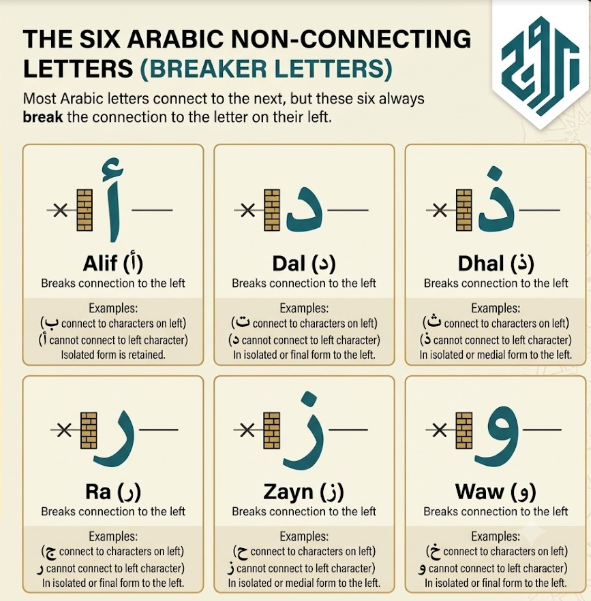
The six non-connecting letters in Arabic — also called الحروف غير المتصلة (al-huruf ghayr al-muttasila) — are letters that accept a connection from their right-side neighbor but refuse to pass that connection forward to the left. The non-connecting letters in Arabic are أ (Alif), د (Dal), ذ (Dhal), ر (Ra), ز (Zayn), و (Waw).
Every other letter in the Arabic alphabet connects on both sides when appearing in the middle of a word.
This means these six letters will always display in one of two forms only: their isolated form (مُنْفَرِدة) when they appear alone or after another non-connecting letter, or their final form (في آخر الكلمة) when they appear at the end of a word or after a connecting letter.
| Letter | Name | Transliteration | Connects Right? | Connects Left? |
| أ / ا | Alif | ā / a | Yes | No |
| د | Dal | d | Yes | No |
| ذ | Dhal | dh | Yes | No |
| ر | Ra | r | Yes | No |
| ز | Zayn | z | Yes | No |
| و | Waw | w / ū | Yes | No |
These six letters have only two written forms each — isolated and final. The connecting letters, by contrast, have four forms: isolated, initial, medial, and final.
Why Do The Non-Connecting Arabic Letters Not Connect to the Left?
The non-connecting letters in Arabic have their roots in the earliest Arabic scripts, where certain letter shapes were simply too narrow or structurally compact to extend a ligature to the left without creating visual confusion.
The letters Alif, Dal, Dhal, Ra, Zayn, and Waw all share a characteristic: their bodies end in a point or a small curve that does not naturally produce a horizontal baseline extension.
This is not a rule imposed on the letters — it reflects their natural calligraphic structure. Classical Arabic calligraphers worked with these constraints for centuries, and the result is a script where these six letters act as natural visual “breaks” in a word’s horizontal flow.
How Do Non-Connecting Arabic Letters Change the Look of Arabic Words?
When a non-connecting letter appears inside a word, it splits that word into two or more visual clusters. This is one of the most disorienting features for beginners — the word looks like two separate words, but it is one.
Consider the word كِتَابٌ (kitābun — “a book”). The Alif in the middle connects to the ك on its right but not to the ب on its left, producing two visible clusters: كِتَا and بٌ. Both clusters belong to one word.
Here are more examples showing how this works in practice:
| Arabic Word | Meaning | Non-Connecting Letter | Visual Split |
| كِتَابٌ | a book | ا (Alif) | كِتَا + بٌ |
| وَلَدٌ | a boy | و (Waw) | و + لَدٌ |
| دَرْسٌ | a lesson | د (Dal) | دَ + رْسٌ |
| زَيْتٌ | oil | ز (Zayn) | زَ + يْتٌ |
| ذَهَبَ | he went | ذ (Dhal) | ذَ + هَبَ |
| رَجُلٌ | a man | ر (Ra) | رَ + جُلٌ |
In our Online Arabic Classes at Buruj Academy, we see this cause real confusion during the first two to three weeks of reading practice. Students read the visual clusters as separate words.
Once we name the non-connecting letters explicitly and drill them in context, the confusion resolves quickly — usually within a single focused session.
Book your FREE Arabic trial online Arabic class at Buruj

Each Non-Connecting Arabic Letter with Examples
Arabic script is largely connected, but six specific letters break that flow consistently — and understanding why changes how quickly you read and write.
1. Alif (ا) — The Most Frequently Encountered Non-Connector
Alif is the most common non-connecting letter in Arabic. It appears in thousands of everyday words, including the definite article الـ (al-), which itself begins with Alif. Its written shape — a simple vertical stroke — does not extend leftward.
Examples in words:
- بَابٌ (bābun) — a door → بَا + بٌ
- كَانَ (kāna) — he was → كَا + نَ
- سَاعَةٌ (sā’atun) — an hour → سَا + عَةٌ
Practice sentence: الْبَابُ مَفْتُوحٌ — al-bābu maftūḥun — “The door is open.”
Notice the Alif in الْبَابُ: it breaks the word into الْبَا and بُ — yet it reads as one word.
2. Dal (د) — Short, Sharp, Stops Abruptly
Dal has a small, shallow cup shape that curves slightly downward to the right. It accepts connections from the right but offers nothing to the left.
Examples in words:
- يَدٌ (yadun) — a hand → يَ + دٌ
- مَدِينَةٌ (madīnatun) — a city → مَ + دِينَةٌ
3. Dhal (ذ) — Dal with a Dot
Dhal is identical in shape to Dal, with a single distinguishing dot above it. Its non-connecting behavior is identical to Dal’s.
Examples in words:
- أُذُنٌ (udhunun) — an ear → أُ + ذُنٌ
- هَٰذَا (hādhā) — this → هَا + ذَا
- الأُسْتَاذُ (al-ustādhu) — the teacher → الأُسْتَا + ذُ
Read also:Understanding Arabic Connecting Letters
4. Ra (ر) — The Flowing Curve
Ra curves down and to the right in a smooth arc. Because its tail extends rightward and downward rather than leftward, it cannot connect to the following letter.
Examples in words:
- دَرَسَ (darasa) — he studied → دَرَ + سَ
- شَجَرَةٌ (shajaratun) — a tree → شَجَرَ + ةٌ
Practice sentence: دَرَسَ تَحْتَ الشَّجَرَةِ — darasa taḥta al-shajarati — “He studied under the tree.”
Ra appears in دَرَسَ and الشَّجَرَةِ — two breaks within the same sentence.
5. Zayn (ز) — Ra with a Dot
Zayn shares Ra’s shape exactly, distinguished only by a dot above. Its non-connecting rule is identical.
Examples in words:
- زَيْتٌ (zaytun) — oil → زَ + يْتٌ
- رُزٌّ (ruzzun) — rice → رُ + زٌّ
- مَنْزِلٌ (manzilun) — a house/home → مَنْزِ + لٌ
Practice sentence: الزَّيْتُ فِي الْمَنْزِلِ — al-zaytu fī al-manzili — “The oil is in the house.”
Spot Zayn in both الزَّيْتُ and الْمَنْزِلِ.
Read also: How to Speak Arabic?
6. Waw (و) — The Connector That Refuses to Connect
Waw is a small loop that curves down and slightly rightward. Despite looking like it could extend a connection, its structure terminates at the bottom of the loop.
Examples in words:
- نَوْمٌ (nawmun) — sleep → نَوْ + مٌ (Waw breaks before م)
- يَوْمٌ (yawmun) — a day → يَوْ + مٌ
- لَوْنٌ (lawnun) — a color → لَوْ + نٌ
Discover the Buruj Academy Difference
Step into our virtual classrooms and see how our expert instructors make learning Quran and Arabic intuitive and clear. We focus on overcoming the specific hurdles non-native speakers face, building your confidence and connection with the Quran.
Master the Arabic Language
Join our expert-led courses and build a strong foundation in Classical and Modern Arabic.
Get Your Free TrialWhat Happens When Two Non-Connecting Arabic Letters Appear Together?
When two non-connecting letters appear consecutively inside a word, the visual gap doubles. Each non-connecting letter starts a new cluster from its position forward — until a connecting letter extends the chain.
Example: وَرَدٌ (wardun — “a rose” / “a flower”)
This word contains both و (Waw) and ر (Ra) — two non-connecting letters in sequence.
- و connects to nothing on its left → break
- رَ connects to nothing on its left → break
- دٌ receives the connection from ر’s right, then terminates as Dal
Result: Three visual clusters — و + رَ + دٌ — yet it is one word.
This is where beginners in our experience at Buruj Academy’s Arabic course for beginners feel most uncertain.
Seeing three separate-looking clusters inside what should be one word feels genuinely alarming until we show students the pattern: count the non-connectors, predict the breaks, then read confidently.
Begin learning Arabic at Buruj with a FREE trial lesson

Practical Exercises to Identify Non-Connecting Arabic Letters
These exercises are designed for active practice — not passive reading. Work through each one before checking the answers.
Exercise 1 — Identify and Count
Read each word below. Write down which non-connecting letters are present and how many visual clusters the word produces.
| Word | Meaning | Your Answer |
| زَيْتُونٌ | olive | — |
| دَرَجَةٌ | a grade / step | — |
| أَزْرَقُ | blue | — |
| مَوْزٌ | banana | — |
Answers:
- زَيْتُونٌ: Zayn (ز) + Waw (و) → 3 clusters: زَ + يْتُو + نٌ — wait, Waw breaks before ن → زَ + يْتُو + نٌ ✓
- دَرَجَةٌ: Dal (د) + Ra (ر) → 3 clusters: دَ + رَ + جَةٌ
- أَزْرَقُ: Alif (أ) + Zayn (ز) + Ra (ر) → 4 clusters: أَ + زْ + رَ + قُ
- مَوْزٌ: Waw (و) + Zayn (ز) → 3 clusters: مَ + وْ + زٌ
Exercise 2 — Write from Dictation
Have a study partner (or use a text-to-speech tool) read these words aloud. Write each one, paying attention to where your pen must lift from the paper.
- دَرَجَةٌ (a step / grade)
- زَرَعَ (he planted)
- وَرَقَةٌ (a paper / leaf)
- رِيَاضَةٌ (sport / exercise)
- دَوَاءٌ (medicine)
For a structured approach to building this writing skill further, our Learn Arabic Writing Course provides systematic handwriting practice with live instructor correction, which dramatically accelerates accuracy.
Book your free trial to start writing Arabic
Does Alif Connect to Other Letters?
Alif does not connect to the letter following it on the left — this is its defining non-connecting property. However, Alif behaves differently from the other five non-connecting letters in one important way: it participates in ligatures with the letter Lam (ل).
When Lam precedes Alif, they merge into a single mandatory ligature form called لا (Lam-Alif). This is not an exception to the non-connecting rule — Alif still does not connect leftward from itself.
Rather, Lam reaches rightward and wraps around Alif in a single combined shape.
| Lam-Alif Form | Used When |
| لَا | Lam + Alif (standard) |
| لَأ | Lam + Alif with Hamza above |
| لِإ | Lam + Alif with Hamza below |
| لآ | Lam + Alif with Madda |
This ligature is obligatory in standard Arabic script — you will never write ل followed by ا as two separate shapes.
Learning these four Lam-Alif combinations early prevents one of the most persistent writing errors we see among beginner students, particularly when they transition from printed worksheets to handwriting practice.
For a fuller picture of the Arabic alphabet and its written forms, our guide to learning the Arabic alphabet walks through every letter’s forms with clear visual examples.
Read also: Arabic Alphabet Cursive
How Do Non-Connecting Arabic Letters Affect Arabic Typing and Word Processing?
In digital Arabic typing, the keyboard automatically applies connecting rules — but only if you understand which letters should break the connection.
When students type Arabic without this knowledge, they sometimes insert manual spaces where no space belongs, producing distorted words.
Understanding non-connecting letters helps you:
- Type Arabic words without artificial spacing errors
- Recognize when a visual gap in typed text is a letter property, not a missing space
- Correctly format Arabic text in word processors, where right-to-left rendering can confuse beginners
Buruj Academy’s Arabic Reading Course specifically addresses digital Arabic literacy alongside traditional script reading — a combination today’s learners genuinely need.
Read Arabic fluently with a free Buruj trial
Non-Connecting Arabic Letters vs. Connecting Arabic Letters
| Feature | Connecting Letters (22) | Non-Connecting Letters (6) |
| Number of written forms | 4 (isolated, initial, medial, final) | 2 (isolated, final only) |
| Connect right? | Yes | Yes |
| Connect left? | Yes | No |
| Appear in medial form? | Yes | No — always isolated or final |
| Examples | ب ، ت ، ث ، ج ، ح… | ا ، د ، ذ ، ر ، ز ، و |
This comparison is one of the most useful frameworks we introduce in the first week of the Arabic Alphabet Learning Course — it organizes the entire alphabet into two clear behavioral groups from the beginning.
Get a free trial now in Buruj’s Alphabet course
Learn Arabic Script Confidently with Buruj Academy’s Expert Instructors
Mastering Arabic letters that don’t connect is one of the foundational steps toward reading and writing Arabic fluently — and it is far easier to internalize with guided instruction than through self-study guesswork.
At Buruj Academy, our Online Arabic Classes are taught by Al-Azhar University graduates with 12+ years of experience teaching non-Arabic speakers.
Our instructors use the Buruj Method — context-before-abstraction and consistency-before-speed — ensuring you build correct reading habits from your first lesson.
Every session is personalized 1-on-1, scheduled to fit your life, with real-time correction and a structured progression plan.
Book your free trial lesson and experience the difference expert instruction makes.
Begin your transformation today by choosing the path that fits your goals:
- Online Arabic Classes (General & Comprehensive)
- Arabic Course for Beginners
- Arabic Alphabet Learning Course
- Online Arabic Classes for Kids
- Arabic Classes for Adults
- Arabic Grammar Course (Nahw & Sarf)
- Intermediate Arabic Course (B1/B2)
- Arabic Speaking Course (Conversational Fluency)
- Arabic Reading Course (Literary Excellence)
- Learn Arabic Writing Course (Calligraphy & Composition)
Ready to speak with confidence? Join the global community at Buruj Academy and book your free placement interview today!
Master the Arabic Language
Join our expert-led courses and build a strong foundation in Classical and Modern Arabic.
Get Your Free TrialConclusion
The six non-connecting letters in Arabic — Alif, Dal, Dhal, Ra, Zayn, and Waw — follow a single, consistent rule that governs their behavior across every word in the language. Once you internalize which letters break the left-side connection and why, what once looked like chaotic gaps in Arabic text becomes a readable, predictable system.
Recognizing these letters confidently is not just a writing skill — it reshapes how you read, how you type, and how you process Arabic visually.
Build this foundation early, practice it actively with the exercises above, and you will find that Arabic script begins to feel genuinely approachable.
Frequently Asked Questions About Non-Connecting Letters in Arabic
How Many Non-Connecting Letters Are There in Arabic?
There are exactly 6 non-connecting letters in Arabic: Alif (ا), Dal (د), Dhal (ذ), Ra (ر), Zayn (ز), and Waw (و). These letters connect to the letter on their right side but never extend a connection to the letter on their left, regardless of their position within a word.
Does Alif Connect to Other Letters in Arabic?
Alif connects to the letter preceding it on the right but never connects leftward to the following letter. The one special case is the mandatory Lam-Alif (لا) ligature, where Lam wraps around Alif — but Alif itself still does not produce a left-side connection from its own body.
Why Do Arabic Words Sometimes Look Like They Have Spaces Inside Them?
Visual breaks inside an Arabic word occur when a non-connecting letter appears mid-word. The gap is not a space — it is a letter property. Any of the six non-connecting letters (ا، د، ذ، ر، ز، و) will cause this visual cluster break. The more non-connecting letters in a word, the more clusters it produces.
Do Non-Connecting Letters Have Fewer Written Forms Than Other Letters?
Yes. Non-connecting letters have only two written forms — isolated and final. The 22 connecting letters each have four forms: isolated, initial, medial, and final. Because non-connecting letters can never appear at the start of a joined cluster or in the middle of one, their initial and medial forms simply do not exist.