 Quran

Watching a child sit down for their daily hifz portion, notebook open, murmuring the same lines from yesterday, is one of the quieter joys of this work. We have sat beside hundreds of these sessions over the years, and one pattern holds steady: the children whose parents pair effort with sincere dua tend to move through plateaus with far less frustration.
The most reliable duas for a child memorizing the Quran are the ones the Prophet ﷺ himself taught, drawn directly from the Quran and authenticated Sunnah.
Below are ten such supplications, each with its Arabic text, transliteration, meaning, and verified source, chosen specifically for a child’s memorization journey.
Table of Contents:
1. “My Lord Increase Me in Knowledge Is the Shortest Dua for a Young Memorizer
Rabbi zidni ‘ilma is the most concise Quranic dua available to a child, drawn directly from Allah’s own instruction to Prophet Muhammad ﷺ. Its five Arabic words make it the easiest supplication for a beginner to memorize and repeat before every hifz session with full understanding.
رَبِّ زِدْنِي عِلْمًا
Rabbi zidni ‘ilma
“My Lord, increase me in knowledge.” (Taha 20:114)
This phrase closes a verse in which Allah instructs the Prophet ﷺ not to rush the Quran before its revelation is complete, then to ask for more knowledge — a fitting lesson for a child learning that patience precedes mastery.
In our sessions at Buruj Academy, this is often the very first dua we teach a new hifz student, precisely because a five-year-old can memorize it in one sitting. We ask children to say it quietly before opening their mus’haf, and we have noticed that the small ritual settles restless students within a few repetitions. It reframes memorization as something asked for, not just performed.
Parents new to structured hifz guidance sometimes underestimate how much a consistent opening dua does for a child’s focus.
Establishing how to learn the Quran for kids around small, repeatable spiritual habits like this one tends to outperform longer, irregular routines.
At Buruj Academy, our online Hifz program builds this exact habit into every session, guided by Al-Azhar-trained Hifz specialists who understand how young attention spans respond to ritual.
Start Hifz today with a FREE trial session

2. Benefit Me With What You Have Taught Me Asks Allah to Make Memorized Knowledge Useful
This hadith dua specifically asks for three connected things: benefit from what has already been learned, more beneficial knowledge ahead, and an increase in knowledge overall. It directly addresses a common parental worry — that a child might memorize verses without the meaning ever settling into their heart.
اللَّهُمَّ انْفَعْنِي بِمَا عَلَّمْتَنِي، وَعَلِّمْنِي مَا يَنْفَعُنِي، وَزِدْنِي عِلْمًا
Allahummanfa’ni bima ‘allamtani, wa ‘allimni ma yanfa’uni, wa zidni ‘ilma
“O Allah, benefit me with what You have taught me, and teach me what will benefit me, and increase me in knowledge.” (Sunan Ibn Majah 3833)
This was among the supplications the Prophet ﷺ used to say regularly, according to the hadith’s wording.
For a child memorizing juz after juz, this dua’s focus on retention and utility distinguishes it from a simple request for more knowledge; it asks for the knowledge already gained to actually stay and be of use.
This is why we encourage parents enrolled in our online Hifz classes for kids to build their own dua habit alongside their child’s memorization schedule, not instead of one.
Start your child’s Hifz classes with free session
Discover the Buruj Academy Difference
Step into our virtual classrooms and see how our expert instructors make learning Quran and Arabic intuitive and clear. We focus on overcoming the specific hurdles non-native speakers face, building your confidence and connection with the Quran.
Excel in Your Quranic Studies
Join Buruj Academy and master the Quran with our structured, professional curriculum.
Book Your Free TrialRead also: The Youngest People to Memorize the Quran
3. The Dua of Entrustment Protects What a Child Has Just Memorized
Reciting the Dua of Entrustment after a memorization session asks Allah to safeguard what has just been learned until the child needs it again. This traditional supplication functions as a spiritual seal on the lesson, distinct from duas recited before study begins.
اللَّهُمَّ إِنِّي أَسْتَوْدِعُكَ مَا قَرَأْتُ وَمَا حَفِظْتُ وَمَا تَعَلَّمْتُ، فَرُدَّهُ إِلَيَّ عِنْدَ حَاجَتِي إِلَيْهِ، إِنَّكَ عَلَى كُلِّ شَيْءٍ قَدِيرٌ
Allahumma inni astawdi’uka ma qara’tu wa ma hafidhtu wa ma ta’allamtu, faruddahu ilayya ‘inda hajati ilayhi, innaka ‘ala kulli shay’in qadir
“O Allah, I entrust to You what I have read, memorized, and learned; return it to me whenever I need it, for You are capable over all things.”
We teach this as the closing ritual of every hifz session in our classes, and we have watched it become a genuine comfort for children after a hard lesson.
A student who struggled through a difficult passage in Surah Al-Baqarah leaves the session having “handed it over” rather than worrying they will forget it by morning.
Read More: Arabic Root Words
4. Untie the Knot From My Tongue Helps Children Struggling With Pronunciation
This dua of Prophet Musa (AS), recorded in Surah Taha, asks Allah specifically for ease in speech and clarity in expression — making it especially fitting for a child wrestling with unfamiliar Arabic sounds during Tajweed-focused memorization.
رَبِّ اشْرَحْ لِي صَدْرِي وَيَسِّرْ لِي أَمْرِي وَاحْلُلْ عُقْدَةً مِنْ لِسَانِي يَفْقَهُوا قَوْلِي
Rabbi ishrah li sadri wa yassir li amri wahlul ‘uqdatam min lisani yafqahu qawli
“O my Lord, expand for me my breast, ease for me my task, and untie the knot from my tongue so they may understand my speech.” (Taha 20:25-28)
Students who struggle with makharij almost always show the same pattern: they tense up the moment a difficult letter approaches, which makes the sound harder to produce, not easier.
Introducing this dua alongside patient articulation drills — the kind we cover in tajweed games and activities for kids — gives a struggling reciter language for the frustration itself.
Read also:Top 5 Websites for Online Quran Classes for Children
5. There Is No Ease Except What Allah Makes Easy Comforts a Child Facing a Difficult Passage
This hadith dua directly addresses discouragement, reminding a child that difficulty is temporary and entirely within Allah’s power to lift. It is short enough for a young child to memorize within a single sitting and versatile enough to use for any hard lesson, not only hifz.
اللَّهُمَّ لَا سَهْلَ إِلَّا مَا جَعَلْتَهُ سَهْلًا، وَأَنْتَ تَجْعَلُ الْحَزْنَ إِذَا شِئْتَ سَهْلًا
Allahumma la sahla illa ma ja’altahu sahlan, wa anta taj’alul hazna idha shi’ta sahlan
“O Allah, there is no ease except in what You make easy, and You make the difficult easy if You wish.”
In our experience, this dua works best when a parent says it out loud with the child right before a lesson the child has been dreading — a long surah, a page with several unfamiliar words, a review session after a forgetful week.
Saying it together, rather than only instructing the child to say it alone, tends to reduce resistance before the lesson even starts.
Read More: Understanding Arabic Swear Words and Insults
6. O Allah Remind Me of What I Have Forgotten Addresses the Ordinary Frustration of Lapses
This specific Prophetic dua was taught for the exact moment memorization slips — when a previously memorized verse suddenly will not come. It reframes forgetting as something to bring to Allah directly rather than something shameful to hide from a teacher or parent.
اللَّهُمَّ ذَكِّرْنِي مِنْهُ مَا نَسِيتُ
Allahumma dhakkirni minhu ma nasitu
“O Allah, remind me of what I have forgotten.”
Nearly every child memorizing the Quran hits a stretch where review feels like starting over. We have found that naming this dua explicitly — telling a child “this is the exact dua for exactly this problem” — does more for their confidence than any encouragement about trying harder.
It normalizes forgetting as part of the process rather than a personal failing, a distinction explored further in our piece on the benefits of memorizing Quran.
7. Make Me From the People of the Quran Asks for a Lasting Bond With the Book Itself
This supplication, commonly taught in traditional circles of Quran instruction, asks Allah for something beyond memorization: genuine belonging among “the people of the Quran,” those who carry it with special closeness to Allah. It suits an older child who already grasps that hifz is a relationship, not only a task.
اللَّهُمَّ اجْعَلْنِي مِنْ أَهْلِ الْقُرْآنِ الَّذِينَ هُمْ أَهْلُكَ وَخَاصَّتُكَ
Allahumma aj’alni min ahlil-Qur’ani alladhina hum ahluka wa khasatuk
“O Allah, make me among the people of the Qur’an, those who are Your own people and Your special ones.”
This phrase draws on the concept of “Ahl al-Qur’an” found in traditional hadith commentary, describing those closest to Allah through the Quran; parents should present it as a heartfelt traditional supplication rather than a directly quoted verse or hadith text.
We reserve this dua for students around age nine or ten, once a child has internalized that memorization is worship and not merely a school-style assignment.
Framing hifz this way connects naturally to lessons in our Islamic topics for kids and youth series, where identity and practice are taught together rather than separately.
Read also: Best Duas for a Sick Child from the Quran and Sunnah
8. A Short Consistent Dua Outperforms a Long One Recited Only Occasionally
Children retain and benefit from short duas repeated at the same moment every single day far more than long supplications recited inconsistently or only during difficult weeks. Anchoring one dua to one daily moment — before the lesson, after the lesson, before sleep — builds automatic habit within a matter of weeks.
In our instructors’ experience, children aged five to eight typically need three to four weeks of daily repetition before a short dua becomes automatic without prompting.
Older children pick it up faster, usually within one to two weeks, since they already understand why the words matter.
This mirrors the broader principle behind how to make reading Quran fun for kids: consistency, not intensity, is what a young learner’s memory actually responds to. A single sincere line said daily will outlast an elaborate ritual attempted twice a month.
Read More: Arabic Words in Spanish
Strengthen Your Child’s Hifz Journey With Buruj Academy’s Online Hifz Program
A child’s memorization progresses fastest when sincere dua is paired with structured, expert instruction rather than left to either element alone. Buruj Academy’s Online Hifz Program combines both.
Our Al-Azhar University graduates and Ijazah-certified instructors bring 12+ years of experience teaching non-Arabic speaking children specifically.
We apply the Buruj Method’s consistency-before-speed principle, building personalized revision schedules suited to your child’s age and pace.
Every session includes real-time correction, flexible 24/7 scheduling for families anywhere in the world, and a clear, structured path from a child’s first surah to complete hifz.
Book a free trial lesson today and let us help your child carry the Quran with both discipline and heart.
Take the first step toward this lifelong blessing by enrolling in a program tailored to your pace:
- Online Hifz Program (Comprehensive Quran Memorization)
- Juz 30 Memorization Course (Perfect for focused starts)
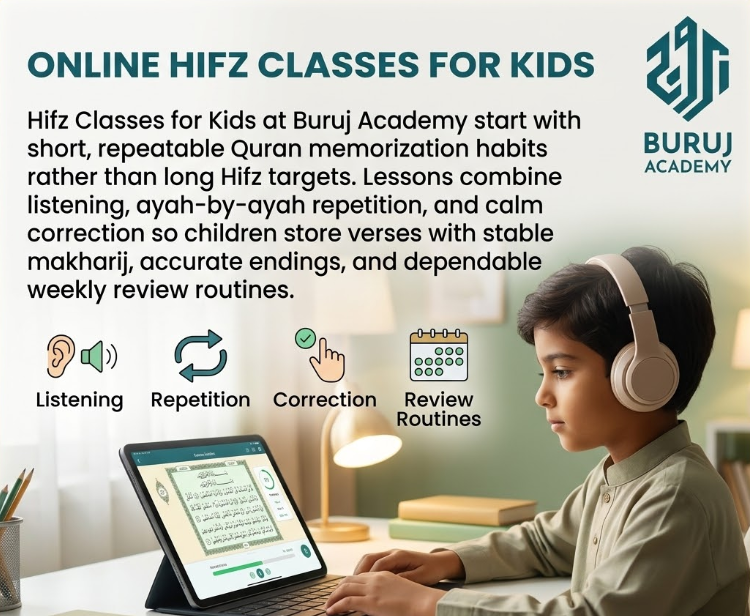
- Hifz Classes for Kids (Engaging and interactive)
- Hifz Classes for Adults (Flexible scheduling for busy lives)
- Hifz Classes for Sisters (Private, supportive learning)
- Short Surah Memorization Course (Ideal for daily prayers)
- Hifz Ijazah Course (For advanced students seeking certification)
Don’t let another day pass without moving closer to your goal. Join Buruj Academy today and schedule your free trial session to begin your Hifz journey!
Excel in Your Quranic Studies
Join Buruj Academy and master the Quran with our structured, professional curriculum.
Book Your Free TrialConclusion
A child’s hifz journey rests on two supports that work best together: consistent practice and sincere dua. The ten supplications above, each drawn from the Quran or authenticated Sunnah, give parents concrete words for the exact moments a young memorizer needs them most — starting a lesson, facing a hard page, or drifting off after a long day of review.
None of these need reciting all at once. Choosing one or two that fit your child’s age and current struggle, and repeating them at the same daily moment, does more for a young heart than any lengthy list ever could. The words matter less than the consistency behind them, and the quiet trust they build between a child and their Creator.
Frequently Asked Questions About Dua for Children Memorizing Quran
What Is the Best Dua for a Young Child Just Starting Hifz?
Rabbi zidni ‘ilma (“My Lord, increase me in knowledge,” Taha 20:114) is ideal for beginners. Its five words are easy for even a four or five-year-old to memorize, and its meaning is simple enough to explain in one sentence.
Can Parents Make Dua for Their Child’s Hifz Without the Child Present?
Yes. The Prophet ﷺ specifically named a parent’s dua for their child as one of three supplications accepted without doubt (Tirmidhi 1905). Parents can and should recite it privately, in addition to any dua taught directly to the child.
Is It Permissible to Make Up a New Dua for Quran Memorization?
A Muslim may always ask Allah in their own words for anything permissible, including hifz success. However, when teaching a child a fixed, memorized supplication, it is best to rely on duas from the Quran or authenticated hadith rather than composed phrases attributed as prophetic sayings.
How Often Should a Child Recite These Duas During Hifz Sessions?
Once before the session and once after tends to work best, paired consistently with the same routine each day. Repetition at the same daily moment builds the habit faster than reciting several different duas irregularly throughout the week.
What Should a Parent Do if Their Child Forgets a Memorized Dua?
Gently remind them of the words rather than expressing frustration, and consider pairing the dua with the specific supplication for forgetfulness, Allahumma dhakkirni minhu ma nasitu (“O Allah, remind me of what I have forgotten”), which directly addresses this exact situation.