 Quran

Choosing where a child learns Quran online feels different from choosing an ordinary tutoring service. The teacher shapes not just a skill, but a child’s relationship with the Quran itself.
Buruj Academy leads this list for structured, 1-on-1 instruction from Al-Azhar University graduates trained in child-specific teaching methods, followed by five other established options worth knowing.
Table of Contents:
Buruj Academy Offers the Most Structured Path from Qaida to Confident Recitation for Kids
Buruj Academy’s Online Quran Classes for Kids pair certified instructors with age-specific progression, moving children from Arabic letter recognition through independent recitation without rushing foundational stages.
Lessons run 20–30 minutes — long enough to build momentum, short enough to hold a child’s attention span. This structure is why it ranks first among online Quran programs for children.
In our sessions, the most common pattern we see among enrolling families is a child who has tried a general app or a group class and stalled after the first few weeks.
Buruj Academy’s instructors are Al-Azhar University graduates, many holding Ijazah in Hafs ‘an ‘Asim recitation, and every teacher completes additional training in child pedagogy before leading a kids’ class.
That distinction matters more than parents often expect. A teacher who recites beautifully is not automatically equipped to explain why a five-year-old keeps confusing ح and ه, or to keep an eight-year-old’s attention through a 30-minute Tajweed drill.
Start your child’s Quran path with a free session
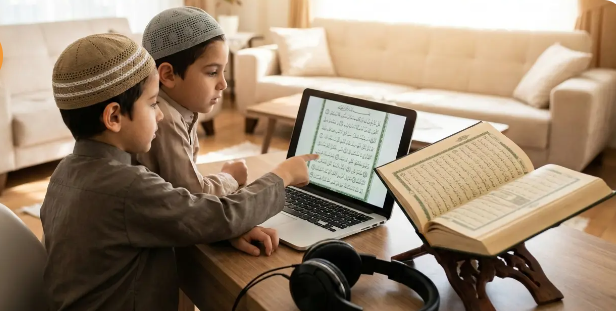
How the Buruj Method Applies to Young Learners
The Buruj Method rests on three sequenced principles: sound-before-rules, context-before-abstraction, and consistency-before-speed. For a young learner, this means a child hears and repeats the correct pronunciation of a letter dozens of times before ever learning the rule’s name.
We have found this ordering prevents a specific failure mode: children who can recite rule definitions perfectly but cannot apply them while reading.
Younger children (ages 4–7) begin with sound recognition and short Surahs using color-coded Mushafs and gamified review sessions.
Older children (ages 8–12) transition into applied Tajweed and longer memorization segments, with instructors explaining the reasoning behind each rule to match their developing logical thinking. This progression mirrors the structure covered in our guide on how to learn Quran for non-Arabic speaking kids.
| Age Range | Primary Focus | Typical Session Length |
| 4–7 years | Letter sounds, Qaida, short Surahs | 20 minutes |
| 8–12 years | Tajweed application, longer memorization | 25–30 minutes |
| 13+ years | Advanced Tajweed, Hifz consolidation | 30 minutes |
This table reflects general pacing; individual children may move faster or slower depending on prior exposure and consistency at home.
What Sets Buruj Academy Apart from Generic Kids’ Quran Programs
Buruj Academy distinguishes itself through teacher-selection rigor rather than volume. Every instructor passes a multi-stage hiring process and receives ongoing training specifically for teaching non-Arabic speaking children — not adult students taught with slightly softer language.
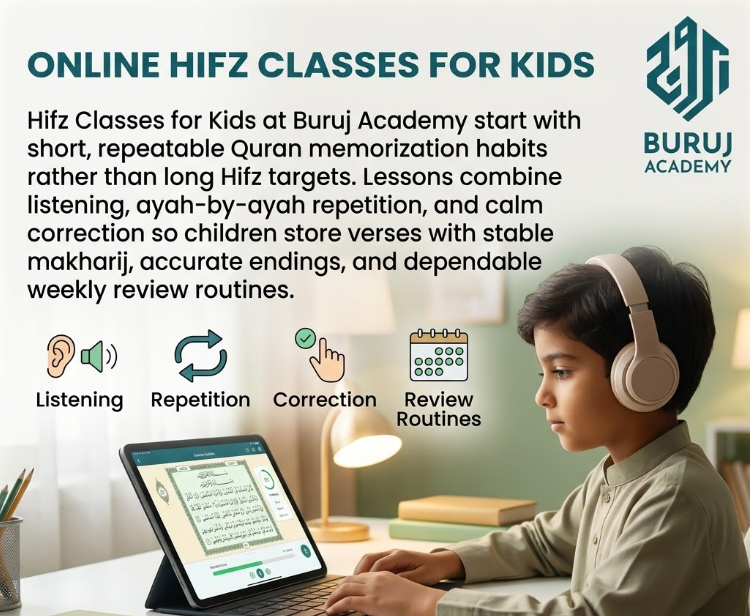
Lessons in our Hifz classes for kids integrate meaning alongside memorization. While teaching Surah Al-Ikhlas, instructors explain Tawheed in terms a child can grasp; while teaching Surah Al-Falaq, they discuss seeking Allah’s protection in daily life.
This prevents the common outcome where a child recites fluently but has no idea what the words mean, a concern we address further in how to make reading Quran fun for kids.
Parents also receive weekly progress assessments identifying exactly where a child hesitates or guesses instead of reading with confidence — a diagnostic most self-paced apps cannot offer, since no one is listening in real time.
Start your child’s Hifz classes with free session
Other Options for Online Quran Classes for Kids
Beyond Buruj Academy, several other programs and apps serve non-Arabic speaking families teaching Quran to children.
Each takes a genuinely different approach — live tutoring, gamified apps, marketplace platforms — so the right fit depends on the child and household.
1. Noor Kids and Noor Academy Combine Live Teachers with a Character-Based Curriculum
Noor Academy pairs live instructors with its own “Noor Curriculum,” built specifically for children ages 5–18 and delivered through animated characters named Noor and Nora. Classes cover Quran, Tajweed, Arabic, and Islamic Studies as an integrated track rather than separate subjects.
This works well for families wanting one long-term, K-12-style pathway rather than a single Quran-focused course. The tradeoff is less flexibility to focus narrowly on recitation alone if that is the immediate priority.
Read also:The Difference Between Juz and Hizb in the Quran
2. Quran Era Uses Gamified Animation for Independent Practice
Quran Era is a self-paced app built around animated characters and a “64 countries” adventure framing, designed to teach letter recognition and Tajweed through story and repeated play rather than live correction. It suits children who respond well to game-based learning and can work independently between formal lessons.
Because there is no live teacher listening to each child’s recitation, it functions better as a supplement to instruction than a replacement for it — a distinction worth understanding before treating any app as a full Quran education path.
3. Learning Roots’ Kiitab App Reads Pages Aloud for Independent Reinforcement
Kiitab, from Learning Roots, pairs with the printed Juz Amma and Read & Rise books to read pages aloud and reward correct responses with simple games. It is designed for children practicing recitation independently, reinforcing what a teacher has already introduced rather than introducing new material itself.
Families often use it between live sessions to keep daily practice consistent, which supports the five-minutes-a-day habit we recommend in our piece on Quranic games for kids.
Discover the Buruj Academy Difference
Step into our virtual classrooms and see how our expert instructors make learning Quran and Arabic intuitive and clear. We focus on overcoming the specific hurdles non-native speakers face, building your confidence and connection with the Quran.
Excel in Your Quranic Studies
Join Buruj Academy and master the Quran with our structured, professional curriculum.
Book Your Free TrialRead also: The Best Quran Stories for Bedtime Reading
4. Qutor Operates as a Marketplace Where Parents Choose Any Available Tutor
Qutor functions differently from a curriculum-owned academy: parents browse individual tutor profiles, use a free 30-minute session to interview candidates, then purchase credits redeemable with whichever tutor they select. There is no single, unified curriculum applied across every teacher on the platform.
This structure appeals to families who want maximum control over teacher selection and pricing, though consistency of teaching method depends entirely on which individual tutor a family picks.
5. TarteeleQuran Offers Budget-Priced Live 1-on-1 Sessions
TarteeleQuran provides live, 1-on-1 Quran and Tajweed instruction starting around $39 per month for two 30-minute sessions weekly, along with quizzes and completion certificates. It positions itself primarily on affordability and flexible scheduling across time zones.
For families prioritizing cost above a named pedagogical framework, this represents one of the more accessible live-tutoring entry points available.
Read More: Should Muslims Read the Quran in Arabic?
What Should Parents Look for When Comparing Programs
The right program depends on matching a platform’s actual structure to a specific child’s needs, not just its marketing claims. Four criteria matter most: live correction versus self-paced practice, teacher qualifications, session length matched to attention span, and whether a free trial is offered before payment.
Does the Program Offer Live Correction or Only Self-Paced Practice?
Live correction from a real instructor catches pronunciation errors the moment they happen, before they become habits. Apps and self-paced tools are valuable for daily reinforcement but cannot substitute for a teacher hearing a child recite in real time.
Most families find the strongest results come from combining both: live weekly sessions anchored by daily independent practice through Quran learning tools for kids.
Are the Teachers Specifically Trained to Teach Children?
A qualified adult-focused Quran teacher is not automatically equipped to teach a distracted seven-year-old. Look specifically for child-pedagogy training, not just Tajweed credentials or an Ijazah, since reciting well and teaching children well are separate skills entirely.
Does Session Length Match the Child’s Actual Attention Span?
Sessions exceeding 30 minutes routinely lose younger children well before the lesson ends, regardless of how engaging the content is. Twenty to thirty minutes remains the practical ceiling for children under twelve, a principle reflected across our guidance on keeping Islamic identity strong for kids.
Is a Free Trial Available Before Any Payment Commitment?
A trial class reveals more about teacher fit than any amount of website copy — how patient the instructor is, whether the child engages, and whether the platform’s promises match the actual classroom experience.
Get a free trial for your child today.
Start Your Child’s Quran Journey with Buruj Academy Today
Choosing the right program shapes whether a child builds lasting confidence with the Quran or loses motivation within weeks.
Buruj Academy offers Al-Azhar-trained, Ijazah-certified instructors specialized in child pedagogy, personalized learning plans by age and level, flexible 24/7 scheduling, and the proven Buruj Method progression from sound recognition to confident recitation.
Every enrollment begins with a free trial lesson, so parents can see the teaching style firsthand before committing.
Enroll your child in one of our specialized, kid-friendly tracks today:
- Online Quran Classes for Kids
- Tajweed Classes for Kids
- Hifz Classes for Kids
- Online Arabic Classes for Kids
- Quranic Arabic Course for Kids
- Noorani Qaida Course for Kids
- Islamic Studies Classes for Kids
Ready to watch your child grow in knowledge and character? Join the Buruj Academy family and book a free trial session for your child today!
Excel in Your Quranic Studies
Join Buruj Academy and master the Quran with our structured, professional curriculum.
Book Your Free TrialConclusion
Selecting a Quran program for a child ultimately comes down to matching structure to that specific child — a live teacher for real-time correction, a gamified app for independent play, or a hybrid of both.
Programs succeed when session length respects a child’s attention span, instructors hold genuine child-teaching training rather than general credentials alone, and progress stays visible to parents throughout. A free trial remains the clearest way to test that fit before enrolling.
Frequently Asked Questions About Online Quran Classes for Kids
What Age Should a Child Start Online Quran Classes?
Most programs, including Buruj Academy, recommend starting between ages 4 and 7, when children absorb new sounds quickly. Starting later is never too late — older children simply progress through foundational stages faster than younger beginners typically do.
Are Gamified Apps as Effective as Live Tutoring for Kids?
Gamified apps like Quran Era work well for independent daily practice and reinforcement, but they cannot correct a child’s pronunciation in real time. Most instructors recommend pairing app-based practice with live sessions for meaningful, lasting progress.
How Long Should a Kids’ Online Quran Class Last?
Twenty to thirty minutes suits most children under twelve, matching realistic attention spans without causing fatigue. Sessions running longer typically see diminishing focus well before the lesson’s actual content concludes.
Can Parents Choose a Female Teacher for Their Daughter?
Yes — most established platforms, including Buruj Academy, offer both male and female Quran and Tajweed instructors, letting parents select based on comfort and cultural preference for their child.
Is One-on-One Tutoring Better Than Group Classes for Kids?
One-on-one sessions allow full teacher attention and pacing tailored to a single child’s needs, which most specialists consider more effective for building correct pronunciation early. Group classes can still offer social motivation as a secondary benefit.