 Quran
Quran

| Key Takeaways |
| Forgotten portions of memorized Quran can be recovered systematically by starting from short surahs and rebuilding daily revision before adding new memorization. |
| Students who lost memorization due to long gaps recover faster when they listen actively to recordings before attempting silent recitation from memory. |
| A structured daily session of 20–30 minutes focused on revision outperforms longer, irregular sessions for re-memorization retention. |
| Reconnecting with a qualified teacher accelerates recovery by identifying exactly which portions are weak versus completely lost. |
| Re-memorization is spiritually valid and encouraged — forgetting Quran does not erase your previous reward for having memorized it. |
Many Muslims who once held portions of the Quran in their hearts carry a quiet grief when life causes that connection to fade. Whether it was years of study interruption, illness, family demands, or simply distance from consistent practice — the loss feels heavy.
The good news is that re-memorization is not the same as starting from zero. The neural pathways your brain built during the original memorization still exist, and with the right approach, forgotten Quran can be recovered — often faster than the first time — using a structured, gradual method that we have guided hundreds of students through at Buruj Academy.
Table of Contents:
1. Make an Honest Assessment of What You Have Actually Forgotten
Before you can rebuild, you need to know exactly what remains. Many students who believe they have “forgotten everything” are surprised to discover that significant portions are simply dormant, not gone.
Sit with a Mushaf and recite aloud, surah by surah or juz by juz, whichever scope applies to what you had memorized. Mark three categories clearly: what comes back fluently without looking, what comes back partially with prompting, and what is genuinely blank.
This mapping exercise is something we walk every returning student through in our Online Hifz Program, because rushing into revision without this foundation wastes weeks.
This assessment takes honesty. Avoid the temptation to count a verse as “retained” if you need to see the first word before it flows. Be precise — your recovery plan depends entirely on accurate self-evaluation at this stage.
Start Hifz today with a FREE trial session
2. Reactivate Dormant Verses Through Intensive Listening Before You Recite
One of the most effective tools for recovering forgotten memorization is returning to the auditory input that first built it. Before attempting to recite from memory, spend several days doing nothing but listening to the portions you want to recover.
Choose a reciter whose style matches the way you originally learned — for most students following the Hafs ‘an ‘Asim recitation, reciters such as Sheikh Mahmoud Khalil al-Husary (specifically his Muallim/teaching recordings) are highly effective for re-activation.
Listen repeatedly while following along in the Mushaf, allowing your ears and eyes to work together.
In our Quran instructors’ experience, students who spend three to five days in intensive listening before attempting to recite aloud recover dormant verses up to 40% faster than those who begin from silent reading immediately.
This listening phase is not passive — it is active auditory rehearsal that reconstructs the memorized sound-form of each verse before your tongue is asked to produce it independently.
3. Begin Re-Memorization From Short Surahs and Firmly Retained Portions
Once your assessment is complete and your listening phase has begun, start your active re-memorization from the portions that came back most easily — not from where you want to be.
This principle, which we call Consistency-before-speed in the Buruj Method, prevents discouragement and builds momentum through early wins.
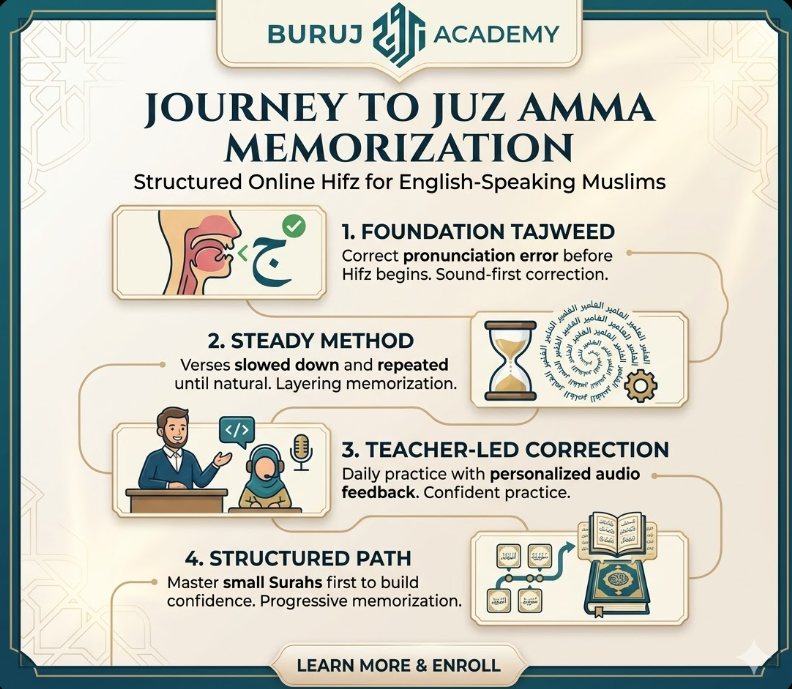
For most returning students, this means beginning with Juz 30 (Juz ‘Amma), which contains the short surahs most frequently recited in prayer. These surahs have usually been partially preserved through daily Salah even during years of neglect.
| Recovery Starting Point | Why It Works |
| Surahs used in daily Salah (Al-Fatiha, Al-Ikhlas, Al-Falaq, An-Nas) | Constant repetition in prayer keeps these most active |
| Last verses of longer surahs | Endings are often stronger due to original completion emphasis |
| Portions tied to emotional memory | Personal connection accelerates reactivation |
| Juz 30 short surahs | High-frequency recitation preserves these even unintentionally |
Working through our dedicated Juz 30 Memorization course is a natural starting point for many returning students who need to re-establish both memorization and Tajweed accuracy simultaneously.
Book Your Kid’s First Session in Buruj’s Juz 30 Memorization Course
4. Build a Daily Re-Memorization Schedule That Prioritizes Revision Over New Material
The most common mistake returning students make is focusing all their energy on recovering new portions while neglecting what they have just re-established. This creates a cycle where previously recovered verses slip away as new ones are added.
Your daily session structure during re-memorization must prioritize revision first, new recovery second. A proven structure for adults with 30 minutes per day looks like this:
| Session Component | Time Allocation | Purpose |
| Revision of fully recovered portions | 15 minutes | Cement what is already stable |
| Active re-memorization of weak portions | 10 minutes | Recover dormant or partially lost verses |
| Listening to upcoming target portion | 5 minutes | Prepare auditory memory for next session |
For a structured daily framework, our guide on building a Quran memorization schedule provides detailed breakdowns for different time commitments and life situations.
5. Recite Your Recovered Portions in Every Salah to Cement Retention
Salah is the most powerful revision tool available to every Muslim — and it is completely free. The scholars of Tajweed and Hifz have long recognized that memorization recited in prayer carries a distinct depth of retention because it is embedded in an act of worship rather than mechanical rehearsal.
As you recover each surah or section, immediately begin reciting it in your voluntary prayers (Sunnah and Nafl).
If you have recovered three short surahs this week, rotate them through your Fajr and ‘Isha Sunnah prayers. This embeds the recovered material in a context your brain associates with attentiveness and presence.
The Prophet ﷺ linked consistent Quran recitation directly to retention, as reported in Sahih al-Bukhari: 5031, where he said:
“Keep on reciting the Quran, for, by Him in Whose Hand my life is, it escapes faster than camels from their tying ropes.”
This is not a warning of hopelessness — it is a practical prescription for consistent engagement as the antidote to forgetting.
Excel in Your Quranic Studies
Join Buruj Academy and master the Quran with our structured, professional curriculum.
Book Your Free Trial6. Work With a Qualified Teacher Who Can Hear Your Recitation and Correct Your Tajweed
Returning to Quran memorization without a teacher creates a serious risk: you may be re-memorizing with errors. After years without regular recitation, Tajweed precision deteriorates silently — you cannot always hear your own mispronunciations, and a dormant verse recalled incorrectly becomes a memorized error.
Buruj Academy’s Hifz for Adults course pairs returning students with Al-Azhar-trained Hifz specialists who assess both the memorization gaps and the Tajweed accuracy of what remains.
In our experience, the most significant barrier for adult returners is not the memory work itself — it is the accumulated Tajweed drift that makes them hesitant to recite to anyone, including themselves.
A teacher also provides accountability that self-study cannot replicate. The external structure of a weekly session with live recitation creates a commitment that reshapes daily habits within three to four weeks for most students.
Read also: How to Revise Memorized Quran?
Book Your Free Trial Lesson with Burruj’s Hifz Course for Adults

7. Address Your Tajweed Alongside Re-Memorization to Prevent Repeated Forgetting
There is a well-established connection between proper Tajweed application and stronger memorization retention.
Verses memorized with correct articulation — proper makharij (articulation points), natural rhythm, and applied elongation rules — are retained significantly longer than verses memorized with approximated pronunciation.
If your original memorization was done without solid Tajweed grounding, re-memorization is the ideal time to build that foundation simultaneously.
This is not about perfectionism — it is about creating the phonetic infrastructure that makes verses stick.
For those who need to rebuild Tajweed from the ground up, our foundational guide on Tajweed for beginners covers the rule system in the logical progression we use at Buruj Academy — sound recognition before rule labeling, exactly as the Buruj Method prescribes.
Discover the Buruj Academy Difference
Step into our virtual classrooms and see how our expert instructors make learning Quran and Arabic intuitive and clear. We focus on overcoming the specific hurdles non-native speakers face, building your confidence and connection with the Quran.
How Can I Improve My Quran Memorization Memory During Re-Memorization?
Improving memory retention during re-memorization requires combining auditory, visual, kinesthetic, and contextual reinforcement rather than relying on repetition alone.
Each modality activates a different memory system, and the overlap between them creates far stronger retention than any single method can achieve.
Practical strategies that our instructors have seen produce measurable improvements for returning students:
- Understand the meaning of what you are memorizing — even basic Tafsir awareness dramatically improves retention for adults. Our Tafseer Al-Quran course supports this directly.
- Write verses by hand from memory after each session — kinesthetic encoding reinforces auditory memory.
- Record yourself reciting and listen back — self-monitoring accelerates error correction.
- Vary your recitation posture — seated, standing, and during walking all create distinct memory cues.
- Connect verses to their context — knowing why a verse was revealed (Asbab al-Nuzul) creates meaning-based memory that outlasts rote repetition.
For a broader toolkit on retention strategies, our article on how to memorize Quran faster provides practical techniques applicable to both first-time memorization and re-memorization contexts.
How To Retain Memorised Quran Once You Have Recovered It?
Recovering forgotten Quran is one challenge — ensuring it stays is the longer-term commitment that requires a permanent habit structure. The students who successfully retain recovered memorization share one consistent trait: they build non-negotiable daily revision into their routine before it feels “earned.”
The critical retention threshold is 40 consecutive days of consistent review of any recovered portion. Before that point, the memorization is vulnerable to rapid loss under any disruption. After it, the retention becomes significantly more durable.
| Retention Stage | Daily Review Required | Risk Level |
| Days 1–7 after recovery | Daily recitation mandatory | Very High — easily lost |
| Days 8–21 | Daily recitation + Salah integration | High — needs reinforcement |
| Days 22–40 | Salah integration + weekly teacher review | Moderate — stabilizing |
| Day 40+ | Rotating weekly revision cycle | Low — durably retained |
Reviewing what you have memorized is itself an act of worship. The best way to retain memorized Quran long-term is documented in detail in our guide on the best way to memorize Quran, which addresses both initial memorization and lifelong retention systems.
Read also: Best Web Resources to Read the Holy Quran
How to Revise Forgotten Quran Without Becoming Overwhelmed?
The psychological weight of seeing large portions of forgotten memorization can cause paralysis — students see the full scope of what they have lost and feel they cannot begin. This is one of the most common patterns we observe in students who contact Buruj Academy after years away from their Hifz.
The solution is strict scope limitation during the early phase. Do not look at the full scope of what you have forgotten. Focus only on one surah or one page for the current week. Block everything else from view — literally and mentally.
Three practical rules for managing re-memorization without overwhelm:
Set a micro-target, not a macro-target.
“I will recover Surah Al-Mulk this month” is a workable goal. “I will re-memorize my five juz” is a paralysis-inducing macro-goal that should never drive daily sessions.
Celebrate small recovery milestones.
Each surah or page recovered is a genuine achievement. Acknowledge it, thank Allah, and move forward with that momentum intact.
Use the best time to memorize Quran
Fajr time offers the clearest mind and fewest distractions, and the spiritual atmosphere of early morning creates optimal conditions for both focus and sincerity.
Re-Memorise Your Quran With Buruj Academy’s Dedicated Hifz Specialists
Recovering forgotten memorization requires the right structure, the right teacher, and the right method — not willpower alone.
Buruj Academy’s Online Hifz Program provides personalized 1-on-1 recovery plans built around your specific memorization history, current retention level, and daily availability.
Our Al-Azhar-trained Hifz specialists bring 12+ years of experience guiding returning students back to their Quran — with Tajweed accuracy and retention systems built into every session.
Whether you need the Hifz for Adults course or our dedicated Hifz for Ladies program, flexible 1-on-1 scheduling makes consistent daily sessions achievable regardless of your commitments.
Book your free trial lesson today and begin your recovery with a teacher who knows exactly where to start.
Take the first step toward this lifelong blessing by enrolling in a program tailored to your pace:
- Online Hifz Program (Comprehensive Quran Memorization)
- Juz 30 Memorization Course (Perfect for focused starts)
- Hifz Classes for Kids (Engaging and interactive)
- Hifz Classes for Adults (Flexible scheduling for busy lives)
- Hifz Classes for Sisters (Private, supportive learning)
- Short Surah Memorization Course (Ideal for daily prayers)
- Hifz Ijazah Course (For advanced students seeking certification)
Don’t let another day pass without moving closer to your goal. Join Buruj Academy today and schedule your free trial session to begin your Hifz journey!
Excel in Your Quranic Studies
Join Buruj Academy and master the Quran with our structured, professional curriculum.
Book Your Free TrialConclusion
Forgetting Quran is a human experience — and returning to it is one of the most spiritually significant decisions a Muslim can make. The steps outlined here form a gradual, realistic path: honest self-assessment, auditory reactivation, revision-first scheduling, Salah integration, Tajweed accuracy, and teacher accountability working together as a unified system.
The brain remembers more than we realize after a long absence. What feels entirely lost is often simply dormant, waiting for structured, consistent engagement to reawaken it.
With the right approach and sincere intention, re-memorization is not just possible — for many students, it becomes the most meaningful phase of their entire Quran relationship.
Read also: How Hard Is It to Memorize the Quran?
Frequently Asked Questions About Re-Memorising Quran
Is It a Sin To Have Forgotten Quran That You Once Memorized?
Scholarly opinion on this is clear: forgetting Quran due to neglect is considered blameworthy in classical Islamic scholarship. The appropriate response is to return with sincerity and commitment. Allah is Ar-Rahman — the Most Merciful — and sincere return is always accepted.
How Long Does It Take To Re-Memorize a Juz You Have Forgotten?
For students who originally memorized a juz with solid Tajweed and then lost it over several years, recovery typically takes four to eight weeks with daily 20–30 minute sessions. Students who had weaker original memorization may need ten to twelve weeks. These are our instructors’ experience-based estimates, not fixed timelines — individual variation is significant.
Can I Re-Memorize Quran Without a Teacher?
Self-directed re-memorization is possible but carries real risks: undetected Tajweed errors becoming permanently embedded, and the absence of accountability leading to inconsistent sessions. A teacher provides real-time correction and structured progression that self-study cannot replicate. For serious recovery of significant portions, qualified guidance is strongly recommended.
Should I Fix My Tajweed Before Re-Memorizing or Alongside It?
Both simultaneously is the most efficient approach for returning students. Attempting to complete Tajweed study before beginning re-memorization delays recovery unnecessarily. Work with a teacher who can correct Tajweed errors during the same session in which you practice re-memorization — the two reinforce each other when taught together.
How Do I Stop Forgetting Quran Again After Recovering It?
The single most reliable preventive system is daily recitation in Salah combined with a rotating weekly revision cycle. Recovered portions must be recited — not just reviewed silently — at least once every three days to remain stable. After 40 consecutive days of active recitation, retention becomes significantly more durable and resistant to life disruption.