 Arabic

Many non-Arabic speaking Muslims feel torn between two goals: reciting the Quran as it was revealed, and actually understanding what it says. This tension leads to a common question that deserves a direct, well-grounded answer rather than vague reassurance.
Yes, Muslims should read the Quran in Arabic. The Quran’s linguistic miracle, its role in Salah, and specific hadiths about letter-based reward all point to Arabic recitation as foundational — while translation remains a valuable companion for understanding, not a replacement.
Table of Contents:
Should Muslims Read the Quran in Arabic?
Yes, Muslims should read the Quran in Arabic because it is the exact language of revelation, preserved without alteration, and the language in which the Prophet Muhammad ﷺ recited it. Arabic recitation is also required for Salah and carries specific textual rewards that translation does not replicate.
The Quran repeatedly describes itself as an Arabic revelation, and its miraculous linguistic structure — the i’jaz — exists only in the original text.
Why Does the Original Arabic Matter So Much in Reading the Quran?
The Quran describes its own revelation in Arabic directly. Allah says regarding the nature of this revelation:
إِنَّا أَنزَلْنَاهُ قُرْآنًا عَرَبِيًّا لَّعَلَّكُمْ تَعْقِلُونَ
Inna anzalnahu Qur’anan ‘Arabiyyan la’allakum ta’qiloon
“Indeed, We have sent it down as an Arabic Qur’an that you might understand.” (Yusuf 12:2)
This verse establishes Arabic as intrinsic to comprehension, not incidental to it — the language itself was chosen to facilitate understanding for its first audience.
In our years teaching non-Arabic speaking adults at Buruj Academy, we’ve noticed a recurring realization among students partway through their Online Quran Classes for Beginners: the Arabic text isn’t simply a barrier to cross before reaching “the real meaning” in translation — it carries rhythm, sound patterns, and grammatical precision that translation cannot fully capture.
Begin Learning Quran With a FREE Trial Lesson
What Rewards Come From Reading the Quran in Arabic?
Reading the Quran in Arabic carries a specific, textually-grounded reward: ten good deeds for every letter recited, according to the authentic hadith narrated by Ibn Mas’ud. This reward applies to the Arabic letters themselves, independent of whether the reader fully understands their meaning.
The Prophet ﷺ said:
“Whoever recites a letter from the Book of Allah, he will receive a good deed, and that good deed will be multiplied ten times over. I do not say that Alif-Lam-Meem is one letter — rather, Alif is a letter, Lam is a letter, and Meem is a letter.” (Jami’ at-Tirmidhi 2910)
This hadith is central to understanding why Arabic recitation matters practically, not just symbolically.
How the Letter-Based Reward System Works
The tenfold multiplication in this hadith applies specifically to individual Arabic letters, meaning even a single short surah generates a substantial cumulative reward.
Reciting Surah Al-Fatihah alone, which contains roughly 139 letters, could theoretically yield close to 1,390 hasanat in a single recitation.
We regularly walk students through this calculation during our Tajweed for beginners classes, because it reframes recitation practice.
Students stop viewing repetition as tedious drilling and start seeing each pass through a surah as an independent, cumulative source of reward.
Book Your FREE Trial Lesson to Begin Your Tajweed Journey
Does Understanding the Quran Change the Reward?
Understanding the meaning adds a separate category of reward — tadabbur, or reflective contemplation — but does not replace or diminish the base letter-reward from Arabic recitation itself.
A person reciting Arabic without full comprehension still earns the tenfold hasanat described in Tirmidhi 2910.
This distinction matters enormously for beginners who feel discouraged because they don’t yet understand every word. The reward structure doesn’t wait for fluency; it begins with the very first letter correctly recited.
| Recitation Type | Reward Basis | Understanding Required |
| Arabic recitation (fluent) | Tenfold hasanat per letter | Not required for base reward |
| Arabic recitation (struggling) | Tenfold hasanat + doubled effort reward | Not required |
| Translation reading | General reward for seeking knowledge | Enables meaning, not letter-reward |
| Arabic recitation with reflection | Letter reward + tadabbur reward | Adds comprehension layer |
Read More: The Best Online Quran Classes for Kids
Do We Have to Read the Quran in Arabic, or Is Translation Permitted?
Reading Quran translations is permitted and valuable for building comprehension, but translations do not substitute for Arabic recitation in worship contexts such as Salah, and they do not carry the same letter-based recitation reward. Classical scholarship treats a translation as an explanation of meaning, not as the Quran itself.
This distinction is not a technicality — it reflects the linguistic reality that a translation is one interpreter’s understanding of the Arabic, filtered through their own scholarly lens and the limitations of the target language.
Why a Translation Cannot Replace the Arabic Text
A translation inevitably narrows the Quran’s meaning because Arabic words often carry multiple layered senses that no single English word captures.
Classical exegetes (mufassireen) wrote entire volumes explaining single verses precisely because the Arabic contains depth that direct translation flattens.
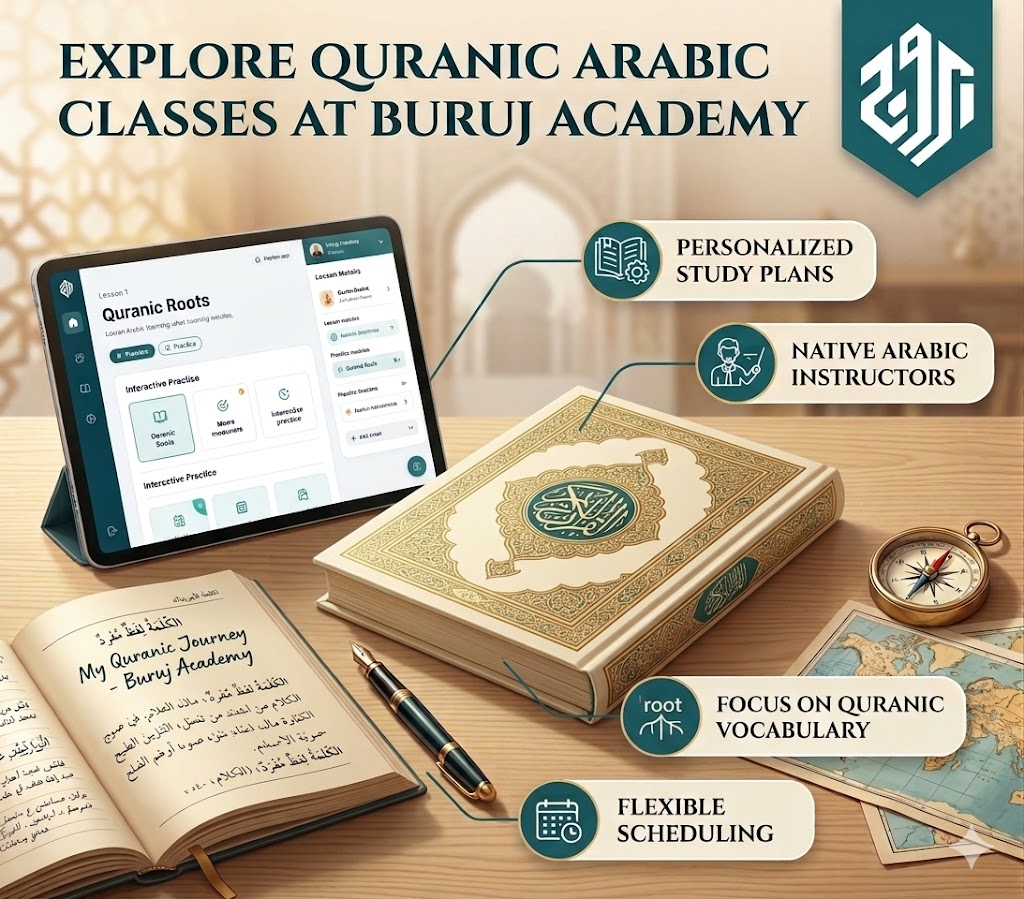
We see this constantly in our Quranic Arabic classes. Students who begin studying Quranic grammar often express surprise at how much nuance disappears in translation — a single Arabic root can generate related words carrying shades of meaning that English requires several different words to approximate.
Begin Understanding Quranic Arabic with a FREE Lesson
What About Reading Quran Only in Translation?
Reading only in translation, without ever engaging the Arabic, is not sinful, but it means missing the recitation-specific reward structure and the direct linguistic connection to revelation.
Scholars generally recommend translation as a supplement for understanding, paired with genuine effort toward Arabic literacy over time.
For beginners approaching the Quran for the first time, starting with translation to grasp the overall message, while simultaneously building Arabic reading skills, is a reasonable and commonly recommended approach — not an either-or choice.
Discover the Buruj Academy Difference
Step into our virtual classrooms and see how our expert instructors make learning Quran and Arabic intuitive and clear. We focus on overcoming the specific hurdles non-native speakers face, building your confidence and connection with the Quran.
Master the Arabic Language
Join our expert-led courses and build a strong foundation in Classical and Modern Arabic.
Get Your Free TrialIs It Necessary to Understand Arabic to Recite the Quran Correctly?
Understanding Arabic vocabulary is not a prerequisite for correct Quranic recitation, because Tajweed — the science of accurate pronunciation — can be learned independently of fluency in spoken or written Arabic comprehension.
Millions of non-Arabic speaking Muslims recite accurately without full linguistic understanding.
This is one of the most liberating facts we share with adult beginners who assume they must “learn Arabic first” before touching the Quran.
Read also: Can You Read the Quran While Wearing Shorts?
Separating Recitation Skill From Language Comprehension
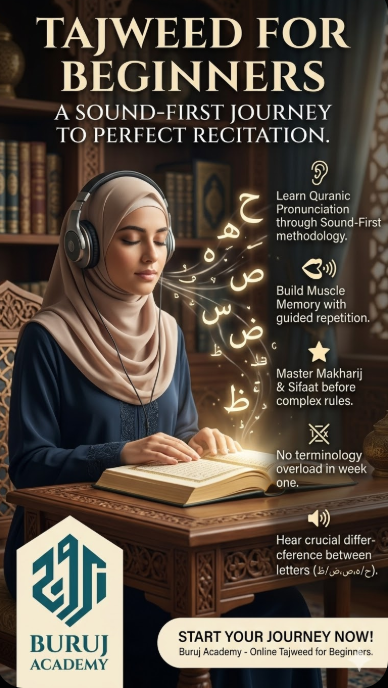
Correct recitation depends on mastering makharij al-huruf (articulation points) and sifat al-huruf (letter attributes) — physical and acoustic skills, not vocabulary knowledge.
A student can pronounce the heavy dhad or the guttural ‘ayn correctly without knowing what the surrounding sentence means.
In our sessions at Buruj Academy, the most common misconception among adult beginners is believing they need conversational Arabic fluency before starting Tajweed.
We consistently clarify that these are separate skill tracks that can develop in parallel, not sequence.
How Long Does Accurate Recitation Typically Take to Develop?
In our instructors’ experience, adult beginners with no prior Arabic exposure typically need eight to twelve weeks of consistent, guided practice before basic Tajweed rules like Ikhfa and Qalqalah start feeling natural rather than mechanical. This timeline varies by practice consistency and prior exposure to Arabic sounds.
Students who dedicate 20 minutes daily tend to progress faster than those attempting longer, infrequent sessions, since Tajweed relies heavily on muscle memory built through repetition.
Read More: How to Learn to Read Quran for Kids?
Why Should a Non-Arab Muslim Read the Quran in Arabic Specifically?
Non-Arab Muslims should read the Quran in Arabic because Salah requires it, the linguistic miracle of the Quran exists only in Arabic, and the specific hadith-based rewards attach to Arabic letters rather than translated words. These three factors together make Arabic recitation foundational rather than optional for serious practice.
1. The Salah Requirement
Valid Salah requires reciting Quranic verses, particularly Surah Al-Fatihah, in Arabic; a translation cannot fulfill this requirement according to mainstream scholarly consensus across the major schools of jurisprudence.
This alone makes basic Arabic recitation a practical necessity for every practicing Muslim, not merely a spiritual preference.
2. Building Confidence Despite Pronunciation Struggles
Many adult students worry that mispronouncing Arabic during Salah invalidates their prayer or diminishes their standing before Allah. The authentic hadith directly addresses this fear with genuine encouragement:
“The one who is proficient in the recitation of the Qur’an will be with the honorable and obedient scribes, and the one who recites it with difficulty, stammering through it, will have two rewards.” (Sahih Muslim 798a)
This hadith reframes the entire struggle. Students who read Arabic hesitantly, sounding out unfamiliar letters, are not falling short — they are earning a doubled reward specifically because of that effort.
We share this hadith often with adult learners in our best time to read Quran discussions, because discouragement typically peaks during the early, halting phase of learning. Knowing that struggle itself carries reward changes how students approach daily practice.
3. Building Systematic Reading Skills From the Ground Up
Non-Arabic speakers benefit most from a structured progression: mastering letter recognition first, then connecting letters into words, then applying Tajweed rules for accurate recitation. Skipping stages typically produces reading habits that must later be unlearned.
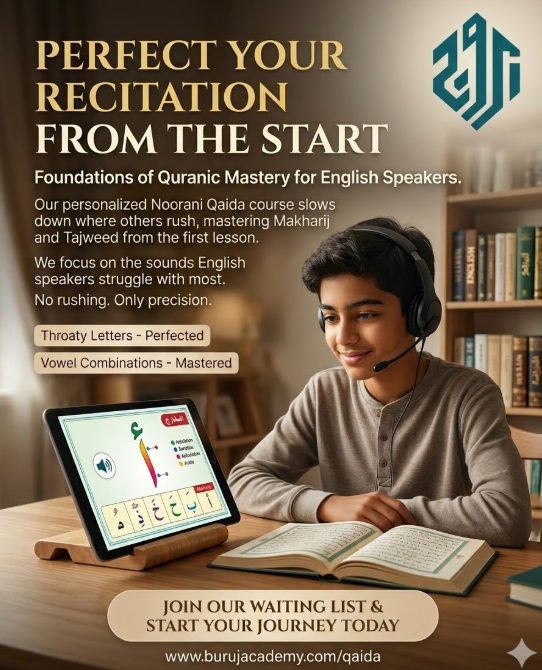
Our Noorani Qaida Online Course exists specifically for this foundational stage, teaching letter shapes, sounds, and basic joining rules before students move into full Quranic text. Students who complete this foundation report far less frustration when they transition to reading actual Surahs.
Book your FREE trial lesson in the Noorani Qaida course
Can Muslims Read the Quran in Their Own Language Instead of Arabic?
Muslims can read Quran translations in their own language for study and understanding, but this does not fulfill recitation obligations in worship and does not carry the letter-based reward exclusive to Arabic text. Translation serves comprehension; Arabic recitation serves both comprehension and worship simultaneously.
Read also:Is Memorizing the Quran Different from Reading It?
When Translation-Only Reading Makes Sense
New Muslims and complete beginners often start with translation to grasp foundational concepts — Tawhid, the stories of the prophets, core moral guidance — before building Arabic literacy. This sequencing is practical, not a scholarly shortcut around Arabic.
Why Long-Term Growth Should Include Arabic
Relying solely on translation indefinitely limits a Muslim’s connection to Salah, to the specific recitation rewards, and to the deeper study of Tafsir, which requires engaging the original Arabic terms scholars analyze.
Long-term spiritual growth benefits significantly from developing genuine Arabic reading ability, even at a modest level.
Read More: Dua for Children Memorizing Quran
How Can Beginners Start Reading the Quran If They Don’t Know Arabic?
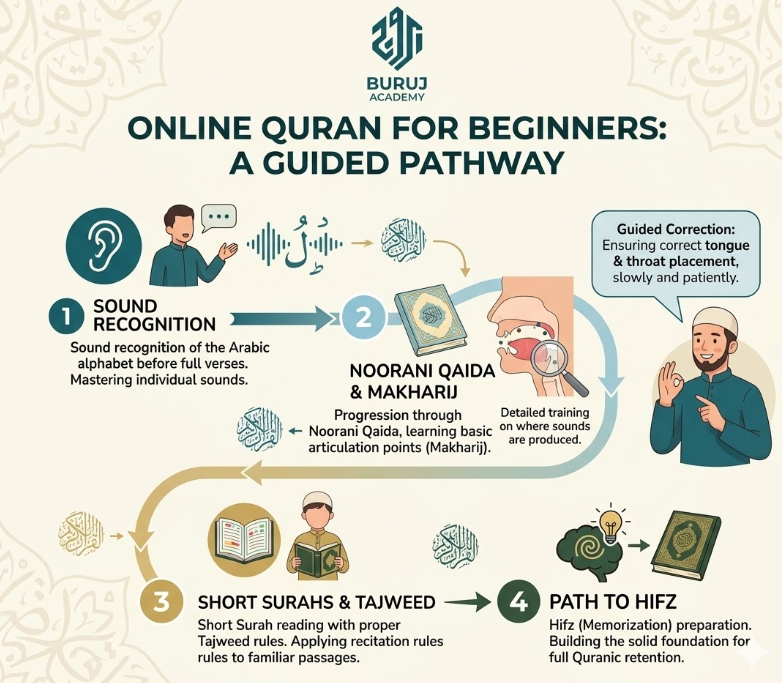
Beginners with no Arabic background should start with the Arabic alphabet and basic letter sounds, progress through guided reading practice using resources like Noorani Qaida, then layer in Tajweed rules once basic reading fluency develops.
This sequence prevents the common mistake of attempting Tajweed rules before mastering letter recognition.
A Realistic Starting Sequence
The most sustainable beginner path follows three stages: alphabet and sound mastery, connected word reading, then Tajweed rule application — each stage building directly on the previous one. Attempting to skip ahead typically creates pronunciation habits instructors must later correct, which takes longer than learning correctly from the start.
Before beginners tackle the alphabet independently, understanding how to start reading Quran daily as a sustainable habit matters just as much as the technical skill itself. Consistency compounds far more than intensity.
Characteristics That Make Arabic Approachable
Arabic possesses a phonetic writing system where each letter maps to a consistent sound, unlike English’s often irregular spelling-to-sound relationships. This regularity actually makes Arabic reading more predictable to learn than many students initially expect, once the unfamiliar script becomes recognizable.
Arabic also uses root-based word formation, where three-letter roots generate families of related words — a structural feature that, once understood, helps students recognize vocabulary patterns rather than memorizing every word individually.
Read More: How to Learn Quranic Arabic Free?
Start Reading the Quran in Arabic With Buruj Academy’s Expert Instructors
Understanding why Arabic recitation matters is only the first step — building the actual skill requires structured, personalized guidance. Buruj Academy provides exactly that pathway for non-Arabic speaking Muslims worldwide.
Our teaching approach includes:
- Ijazah-certified instructors and Al-Azhar University graduates with 12+ years teaching non-Arabic speakers
- The Buruj Method: sound-before-rules progression for genuine pronunciation accuracy
- Personalized Learning Plans matched to your current reading level and pace
- Flexible 1-on-1 online sessions available 24/7 for students across time zones
- Real-time correction that catches pronunciation errors before they become habits
- Clear progression from first Arabic letters to confident, fluent recitation
Book your free trial lesson today and begin building genuine Arabic reading skills, guided by instructors who understand exactly where non-Arabic speakers typically struggle.
Begin your transformation today by choosing the path that fits your goals:
- Online Arabic Classes (General & Comprehensive)
- Arabic Course for Beginners
- Arabic Alphabet Learning Course
- Online Arabic Classes for Kids
- Arabic Classes for Adults
- Arabic Grammar Course (Nahw & Sarf)
- Intermediate Arabic Course (B1/B2)
- Arabic Speaking Course (Conversational Fluency)
- Arabic Reading Course (Literary Excellence)
- Learn Arabic Writing Course (Calligraphy & Composition)
Ready to speak with confidence? Join the global community at Buruj Academy and book your free placement interview today!
Master the Arabic Language
Join our expert-led courses and build a strong foundation in Classical and Modern Arabic.
Get Your Free TrialConclusion
The evidence consistently points in one direction: Arabic recitation carries a reward structure, a worship function in Salah, and a linguistic depth that translation cannot replicate on its own. This doesn’t diminish translation’s real value for building understanding — it simply means the two serve different, complementary purposes rather than competing ones.
For non-Arabic speaking Muslims, the path forward isn’t choosing between comprehension and correct recitation. It’s building both gradually, starting wherever comfort currently allows, and trusting that even hesitant, imperfect Arabic recitation carries genuine, doubled reward according to authentic hadith.
Frequently Asked Questions About Reading the Quran in Arabic
Is It Sinful to Read Only Quran Translation Without Learning Arabic?
No, reading only translation is not sinful, but it means missing the letter-based recitation reward described in Tirmidhi 2910 and cannot fulfill the Arabic recitation requirement during Salah. Scholars encourage gradually building Arabic literacy alongside translation-based study.
Do Non-Arabic Speakers Get Extra Reward for Struggling With Arabic Pronunciation?
Yes, according to Sahih Muslim 798a, Muslims who recite Arabic with difficulty, stammering through unfamiliar letters, receive a doubled reward compared to fluent reciters. This hadith specifically encourages non-Arabic speakers rather than discouraging their efforts.
Can I Perform Salah Using an English Translation Instead of Arabic?
No, valid Salah requires reciting Quranic verses, especially Surah Al-Fatihah, in the original Arabic according to mainstream scholarly consensus across major schools of jurisprudence. Translation can aid understanding outside of Salah but cannot substitute within formal prayer.