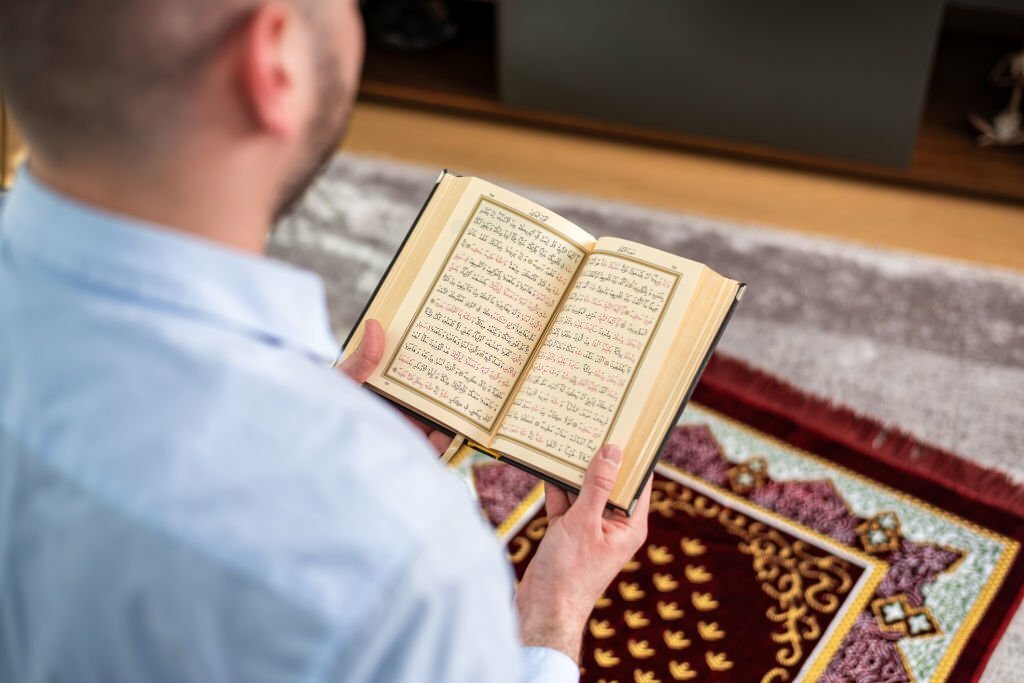
 Quran
Quran
| Key Takeaways |
| Reading the Quran while wearing shorts, sleepwear, or clothes that expose the awrah is permissible but not the most respectful practice. |
| For men, the awrah covers the area from the navel to the knee; scholars recommend covering it out of reverence during recitation. |
| Impure clothing does not invalidate Quran recitation, though cleaning it promptly reflects the Prophet’s ﷺ own habit. |
| Reciting from memory without a shirt is valid, but dressing modestly is considered mustahabb (recommended), not obligatory. |
| Physical ritual purity (wudu) is only required for touching the physical Mushaf, not for verbal recitation from memory. |
You finish a long day, change into sleep shorts, and pick up your phone to read a few verses before bed. Then a thought stops you: is this even allowed? It’s a question we hear constantly from students at Buruj Academy, especially converts and busy adults squeezing Quran time into packed schedules.
Reading the Quran while dressed in shorts, sleepwear, or clothing that does not fully cover the awrah is permissible according to mainstream Islamic scholarship.
It is not the most virtuous way to approach recitation, since a Muslim is directly addressing Allah, but it does not invalidate the reward of reciting.
Table of Contents:
Can I Read the Quran with Shorts On?
Yes, reading the Quran while wearing shorts is permissible, provided the area between the navel and knee is not exposed in front of others. If shorts do not reach the knee, most scholars still consider the recitation valid, though covering the knee is preferred as a matter of reverence rather than a strict requirement for the recitation itself.
This distinction matters because people often confuse validity with etiquette (adab). A ruling being “permissible” (jaiz) means no sin is incurred and the recitation counts fully. A ruling being “preferred” (mustahabb) means there is a better, more dignified option available.
Quran recitation while under-dressed falls into the first category by default, and scholars encourage the second as an act of respect toward the Words of Allah.
At Buruj Academy, we’ve noticed that new students often assume anything short of “the most correct” way is sinful.
In our sessions, we gently correct this misconception early, because guilt over minor matters like clothing can quietly discourage daily recitation altogether — the opposite of what any of these rulings intend.
Read also:Can You Keep the Quran on Your Lap While Reading? 6 Essential Islamic Rulings
What Counts as the Awrah for Men and Women?
The awrah for men is defined as the area from the navel to the knee, based on established Hadith scholarship, while the awrah for women in front of non-mahrams is far more extensive, covering the entire body except the face and hands. This distinction shapes how modesty guidelines apply differently by gender during recitation.
For men, this means shorts that clearly sit above the knee leave part of the awrah uncovered in a technical sense, even at home.
For women, the standard used for private recitation at home (without non-mahram men present) is considerably more relaxed than the standard used in public, since the awrah in front of mahrams, other women, or in seclusion is treated differently than the awrah required in mixed or public settings.
| Context | Male Awrah | Female Awrah (Front of Non-Mahrams) |
| In public / mixed company | Navel to knee | Entire body except face & hands |
| In front of mahrams / other women | Navel to knee | Navel to knee (per majority view) |
| Alone in private | Recommended to cover, not obligatory | Recommended to cover, not obligatory |
This table reflects the general majority position; individual madhabs vary slightly on private, in-seclusion coverage.
Why Dressing Well Still Matters for Recitation
Scholars consistently describe Quran recitation as a person “conversing with their Lord,” which is the reasoning behind recommending presentable dress even though it is not a legal condition. This framing shifts the emphasis from rule-following to relationship, encouraging believers to approach the Quran the way they would approach an honored guest.
We often draw this comparison directly with students: you likely wouldn’t answer the door in sleepwear if royalty came to visit unannounced. Recitation is a private but real audience with Allah’s own speech.
Structured guidance — the kind offered in our Online Quran Classes — helps students build these habits of reverence from day one, rather than picking them up haphazardly.
Start Learning Quran With a FREE Trial Lesson

Do You Have to Be Dressed to Read Quran?
No, being fully dressed is not a legal requirement to read the Quran, whether reciting from memory or from a screen, as long as the awrah is not exposed in front of others who are present.
The requirement to be “dressed” scales with context: solitary reading at home carries lighter expectations than reciting in a gathering.
This differs sharply from the requirements for salah (formal prayer), where covering the awrah is an actual condition for the prayer’s validity.
Confusing the two leads many well-meaning students to unnecessarily restrict when and how they engage with the Quran outside of prayer.
How This Differs From the Conditions of Salah
Salah requires covering the awrah as one of its conditions of validity, alongside facing the qiblah and possessing wudu, whereas Quran recitation outside of prayer carries no such conditions for validity.
A prayer performed with an exposed awrah must be repeated; a recitation done the same way does not need to be repeated, though it is discouraged.
| Requirement | Salah (Prayer) | Quran Recitation (Outside Salah) |
| Covering the awrah | Obligatory condition | Recommended, not obligatory |
| Wudu | Obligatory | Only needed to touch the physical Mushaf |
| Facing the qiblah | Obligatory | Not required |
| Clean clothing | Obligatory | Recommended |
Understanding this table clears up most of the confusion students bring to us. Once the two acts of worship are separated conceptually, questions about pajamas, shorts, or a missing shirt tend to resolve themselves quickly.
Read also: Is Reading the Quran the Same as Memorizing It? 7 Key Differences
Can I Read Quran If My Clothes Are Impure?
Yes, reciting the Quran while wearing clothes with physical impurity (najasah) on them is permissible, and it does not invalidate the recitation or its reward.
Removing the impurity before engaging in acts like salah or touching the Mushaf is either recommended or, according to some scholars, obligatory specifically for those particular acts — not for verbal recitation itself.
This is a distinct issue from ritual impurity (hadath), which relates to needing wudu or ghusl. Najasah refers to a physical substance considered unclean under Islamic law, such as certain bodily fluids.
The general scholarly position treats cleaning it as good practice, not as a precondition for the words of recitation to count.
Discover the Buruj Academy Difference
Step into our virtual classrooms and see how our expert instructors make learning Quran and Arabic intuitive and clear. We focus on overcoming the specific hurdles non-native speakers face, building your confidence and connection with the Quran.
Excel in Your Quranic Studies
Join Buruj Academy and master the Quran with our structured, professional curriculum.
Book Your Free TrialWhat Are the Actual Etiquettes of Reciting the Quran?
The etiquettes (adab) of reciting the Quran include facing the qiblah when possible, being in a state of wudu as a preference, dressing modestly, choosing a clean location, and approaching the text with humility and presence of heart.
None of these etiquettes are conditions for validity; they are recommended practices that elevate the quality and reward of recitation.
Buruj Academy’s teaching approach places heavy emphasis on adab alongside mechanical accuracy, because reciting correctly while rushing or distracted misses the deeper purpose of engaging with revelation.
Our Online Tajweed Classes integrate this from the very first lesson, pairing correct articulation with the mindset a student should bring to the text.
Book Your FREE Trial Lesson to Begin Your Tajweed Journey
Common Adab Practices Students Often Overlook
Beyond clothing, several etiquettes are frequently skipped by beginners learning independently, including seeking refuge from Shaytan (ta’awwudh) before starting, reciting slowly with reflection (tarteel) rather than rushing, and maintaining a physically clean environment. These practices are drawn from cumulative classical scholarship on Quranic etiquette rather than a single isolated ruling.
- Beginning with ta’awwudh and, where applicable, the basmalah
- Reciting with tarteel (measured pace) rather than speed-reading
- Choosing a clean, distraction-free space when possible
- Reflecting on meaning (tadabbur), not only pronunciation
- Lowering the voice appropriately in shared or public spaces
We consistently find that students who build these habits early retain far more from their recitation sessions, even when their Tajweed is still developing.
If you’re just starting this journey, our guide on reading the Quran for the first time walks through these foundational habits in more depth.
Read also: Finding the Best Quran Hifz Classes for Ladies
Can We Recite Quran Without Wearing a Shirt?
Yes, reciting the Quran without a shirt is permissible for men specifically because the male awrah is limited to the navel-to-knee area, meaning the chest and back are not included in what must be covered.
This ruling applies distinctly to men; the same leniency does not extend to women, whose awrah requirements are considerably broader even in private settings among non-mahrams.
This is a frequently asked variation of the clothing question, and the underlying principle is identical to the shorts scenario: recitation validity depends on presence of heart and correct articulation, not full-body coverage, though modesty remains the preferred standard.
Gender-Specific Guidance Worth Understanding
Female students frequently ask us whether the same leniency applies to them, and the honest answer is that the standards genuinely differ by gender under majority scholarly opinion. Women’s awrah in front of non-mahram men is essentially the entire body aside from the face and hands, a standard rooted in broader Quranic and Hadith-based modesty principles rather than the recitation ruling alone.
For sisters specifically navigating these questions in a supportive, single-gender learning space, our Online Hifz Classes for Ladies pair students with qualified female instructors who understand these nuances firsthand.
Book Your Free Trial Lesson with Burruj’s Hifz Course for Ladies

The Value of Learning These Rulings With Guidance
Self-study through scattered online searches often produces half-answers or context-free rulings, which is precisely why structured learning matters.
In our experience at Buruj Academy, students who learn fiqh basics alongside recitation mechanics develop far more confidence than those piecing together fragments from forums and social media.
Our Online Islamic Studies Classes are built by Al-Azhar University graduates with 9+ years of Islamic studies instruction in English, specifically to give English-speaking students accurate, contextualized answers instead of oversimplified yes-or-no rulings.
This matters most on questions like clothing and purity, where the gap between “permissible” and “preferred” causes genuine confusion.
Recite With Confidence Through Buruj Academy’s Guided Programs
Understanding that shorts, sleepwear, or a missing shirt don’t invalidate your recitation should free you to read more often, not less. Buruj Academy helps turn that confidence into consistent, correct practice.
Our Ijazah-certified instructors and Al-Azhar University graduates bring 12+ years of experience teaching non-Arabic speakers worldwide.
Using the Buruj Method — sound-before-rules, context-before-abstraction, consistency-before-speed — we build personalized learning plans through flexible 1-on-1 online sessions with real-time correction.
Book a free trial lesson today and experience patient, expert-led instruction firsthand.
Take the next step in your learning journey today by enrolling in one of our specialized programs:
- Online Quran Classes
- Online Quran Classes for Beginners
- Online Quran Classes for Adults
- Online Quran Classes for Ladies
- Online Quran Classes for Kids
- Quran Reading Course
- Quran Recitation Course
- Online Ijazah Course
- Online Qirat Course
Don’t wait to transform your relationship with the Holy Quran. Join our global community of students and book your free evaluation session now!
Excel in Your Quranic Studies
Join Buruj Academy and master the Quran with our structured, professional curriculum.
Book Your Free TrialConclusion
Clothing anxiety shouldn’t be what stands between you and daily Quran engagement. The rulings covered here draw a clear line between what makes recitation valid — correct articulation and sincere intention — and what makes it more virtuous, like modest, clean attire chosen out of reverence.
Shorts, sleepwear, an uncovered chest for men, or clothing with unnoticed impurity all fall short of the ideal, but none of them erase the reward of turning to Allah’s words. The healthier habit isn’t perfect dress; it’s consistent return to the Quran, dressed as well as circumstances reasonably allow.
If this nuance was new to you, it’s worth exploring the broader manners of reading the Quran to build a fuller picture of respectful, sustainable recitation habits.
Frequently Asked Questions About Reading Quran and Proper Dress
Is Wudu Required Before Reading the Quran in Any Clothing?
No, wudu is not required to recite the Quran from memory in any state of dress, though it is highly recommended as a sign of respect. Wudu becomes necessary specifically when physically touching a printed Mushaf, not for verbal recitation or reading from a phone screen.
Can Women Read Quran at Home Without a Hijab?
It is not obligatory for a woman to wear hijab in order to read the Quran, as there is no evidence indicating this is required. Covering remains recommended as a matter of modesty and reverence, particularly if non-mahrams are present.
Does Reciting in Impure Clothing Need to Be Repeated?
No, recitation performed while wearing clothing with physical impurity does not need to be repeated, since impurity on clothing does not invalidate Quran recitation the way it invalidates salah. Cleaning the clothing afterward reflects good sunnah practice rather than a corrective requirement.