 Quran
Quran
| Key Takeaways |
| A Hafiz is a Muslim who has memorized the entire Quran — all 114 surahs and 6,236 verses — by heart. |
| The Prophet ﷺ promised that a Hafiz will intercede for ten family members on the Day of Judgment, according to authenticated hadith. |
| Becoming a Hafiz typically requires 1–5 years of structured daily memorization, depending on age, method, and consistency of revision. |
| Women who memorize the Quran are called Hafizah — the title carries full spiritual weight and scholarly recognition in Islam. |
Every year, tens of thousands of Muslims worldwide complete one of the most demanding acts of worship in Islamic tradition — committing the entire Quran to memory. This achievement is celebrated across cultures, honored in families, and carries profound spiritual rewards that extend beyond the individual.
A Hafiz is someone who has memorized the complete Quran — all 30 Juz’, 114 surahs, and 6,236 verses — with accuracy and proper recitation. The title is not ceremonial. It reflects a living relationship with the Book of Allah, sustained through daily revision and rooted in years of disciplined study.
Table of Contents:
Who Is a Hafiz in Islam?
A Hafiz (حافظ) in Islam is a Muslim who has memorized the entire Quran by heart, verified through recitation to a qualified teacher. The word comes from the Arabic root ḥ-f-ẓ (حفظ), meaning to preserve, guard, and protect. A Hafiz is, in the most literal sense, a living guardian of Allah’s words.
The memorization must be complete — no partial Quran qualifies for the title. The student must recite the full text to a certified teacher or examiner without error, typically within a formal Hifz program. This verification process ensures the title carries genuine scholarly weight.
For women who complete this achievement, the title is Hafizah (حافظة) — the feminine form — and carries identical religious and academic standing.
What Does Hafiz Mean in English?
The most accurate English translation of Hafiz is “guardian” or “preserver.” Some translate it as “one who memorizes,” but the deeper meaning reflects stewardship — the Hafiz carries the Quran not only in memory but in responsibility.
In classical Islamic scholarship, “Hafiz” also referred to scholars who had memorized large numbers of hadiths. Today, the term is almost exclusively used to describe someone who has memorized the complete Quran.
What Is a Hafiz’s Spiritual Status in Islam?
The Prophet Muhammad ﷺ described the Hafiz as one of the closest people to the Quran and to Allah’s mercy. According to a hadith recorded in Sunan Ibn Majah, the Hafiz is among the carriers of the Quran — Ahlul Quran — whom Allah honors.

Another narration is recorded in Sunan Ibn Majah (hadith 3781) and is used by scholars to illustrate the immense reward tied to Quran memorization.

The Quran itself affirms the honor of those who carry it:
بَلْ هُوَ آيَاتٌ بَيِّنَاتٌ فِي صُدُورِ الَّذِينَ أُوتُوا الْعِلْمَ
Bal huwa āyātun bayyinātun fī ṣudūri alladhīna ūtū al-ʿilm
“Rather, it is distinct verses preserved in the breasts of those who have been given knowledge.” (Al-Ankabut 29:49)
How Many Hafiz Are There in the World?
Precise global figures for the number of Hafiz do not exist in any single verified database, because no international Islamic authority maintains a centralized registry. Scholarly estimates — drawn from national Waqf ministries, Islamic educational bodies, and regional mosque data — consistently place the number between 150 million and 200 million Hafiz worldwide.
This number is growing. The expansion of structured online Hifz education and the proliferation of Quran schools across South Asia, the Middle East, Africa, and the Western world have dramatically increased access to Hifz programs over the past two decades.
Countries with the Most Hafiz
The countries with the highest numbers of Hafiz are concentrated in South Asia and the Muslim-majority world, where Quran schools (madrasas) have been formally organized for centuries.
| Country | Estimated Hafiz Population | Notable Factor |
| Pakistan | 3–4 million+ | Largest madrasa network globally |
| Bangladesh | 1–2 million+ | High madrasa enrollment rates |
| Indonesia | 2–3 million+ | Largest Muslim population worldwide |
| India | 2–4 million+ | Large Muslim minority with strong Hifz tradition |
| Egypt | 2–3 million+ | Al-Azhar institutional infrastructure |
| Saudi Arabia | 2.5–4 million+ | Government-funded Quran programs |
| Nigeria | 1–2 million+ | Rapidly growing Islamic education sector |
| Iran | 1–2 million+ | State-supported memorization programs |
These figures are estimates drawn from reports by national Islamic councils and regional education ministries. They should be understood as approximations rather than census-verified data.
Growth of Hafiz Numbers Over the Years
The global Hafiz population has expanded significantly since the early 2000s. Three factors explain this growth:
Structured online learning has made qualified Hifz teachers accessible to Muslim communities in Europe, North America, and Australia — regions where local Quran schools were previously scarce.
At Buruj Academy, we have witnessed this directly: our Online Hifz Program now serves students from several countries who have no access to in-person Hifz instruction.
Start Hifz today with a FREE trial session
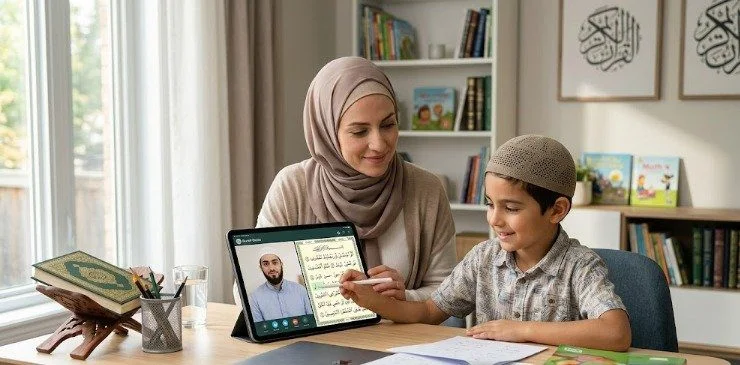
Female Hafizah numbers have grown dramatically. Dedicated programs for women — including female-only classes and flexible scheduling for mothers — have opened Hifz to demographics previously underserved by traditional madrasa structures.
Book Your Free Trial Lesson with Buruj’s Hifz Course for Ladies
Youth programs targeting children aged 5–12 have expanded globally, with parents increasingly prioritizing Hifz alongside secular schooling. Earlier age of enrollment means more completions per generation.
Read also: Why Does Allah Use “We” in the Quran?
How Long Does It Take to Become a Hafiz?
The time required to become a Hafiz varies significantly based on age, daily study time, teaching quality, and revision consistency. Across our years at Buruj Academy, we have observed the following general patterns:
| Student Profile | Daily Study Time | Typical Completion Time |
| Child (ages 6–12) | 2–4 hours | 2–4 years |
| Teenager (ages 13–18) | 3–5 hours | 1.5–3 years |
| Adult (full-time) | 4–6 hours | 1–2 years |
| Adult (part-time) | 1–2 hours | 3–5 years |
These are instructional estimates based on our teaching experience — individual outcomes vary. Students who pair new memorization with consistent daily revision progress significantly faster than those who memorize without structured review.
If you are considering beginning this path, our guide on how to become a Hafiz of the Quran provides a practical step-by-step framework, and our article on the best time to memorize Quran covers the science and Islamic guidance behind optimal memorization hours.
One of the most common challenges we see in adult students is underestimating the revision load. Memorizing new pages is only half the work — a Hafiz must also maintain everything already memorized. Our Quran memorization schedule guide addresses exactly how to balance new memorization with systematic revision.
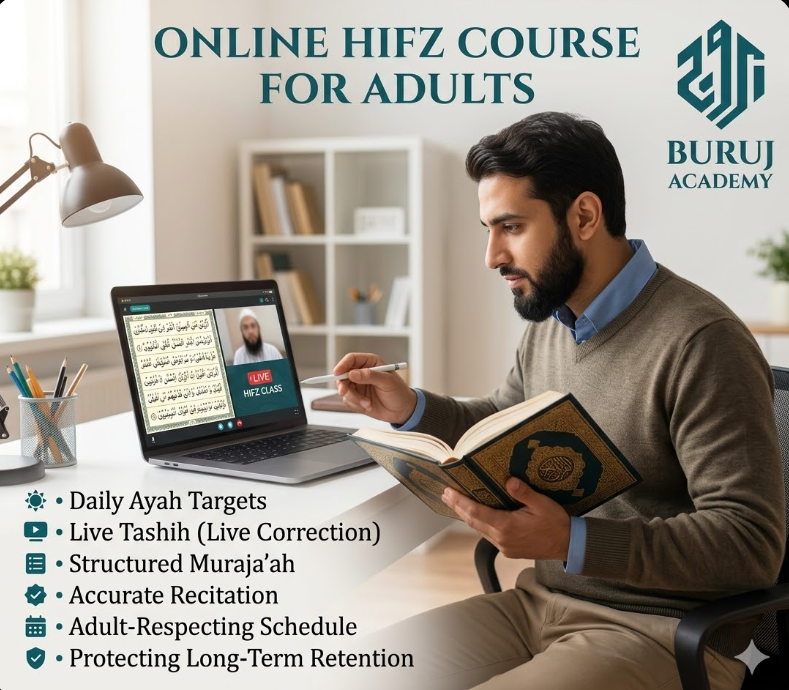
Buruj Academy’s Hifz for Adults course was designed specifically for this challenge — providing structured revision systems alongside new memorization, taught by Al-Azhar-trained Hifz specialists who understand how adult learners retain and recall.
Book Your Free Trial Lesson with Buruj’s Hifz Course for Adults
What Are the Responsibilities of a Hafiz After Completing Hifz?
Completing Hifz is not a finish line — it is a covenant. Classical Islamic scholars uniformly emphasized that a Hafiz who allows their memorization to deteriorate through neglect has abandoned a trust.
This is why ongoing revision is considered a religious obligation, not a personal preference.
The Prophet ﷺ warned that forgetting the Quran after memorization is among the gravest of spiritual losses.
Maintaining the memorization requires a structured revision system — many scholars recommend completing a full review of the Quran every seven to ten days, depending on strength of memorization.
Excel in Your Quranic Studies
Join Buruj Academy and master the Quran with our structured, professional curriculum.
Book Your Free TrialA Hafiz also carries a community responsibility. They are given priority in leading congregational prayers (Salah), particularly Tarawih in Ramadan. They are sought as Quran teachers, recitation correctors, and spiritual guides within their communities.
For students who want to extend their achievement toward formal certification, Buruj Academy’s Hifz Ijazah course provides a path to receiving an authenticated chain of transmission (sanad) back to the Prophet ﷺ — one of the most honored credentials in Islamic scholarship.
Book your FREE trial lesson in your path to Ijazah
What Is the Difference Between a Hafiz and an Alim?
A Hafiz and an Alim represent two distinct but sometimes overlapping scholarly roles. Understanding the difference helps students plan their Islamic educational goals.
A Hafiz has memorized the complete Quran text. Their achievement is in preservation and recitation. A Hafiz may or may not have studied Tafsir, Fiqh, or Arabic grammar in depth.
An Alim (عالم) is an Islamic scholar who has studied the full range of Islamic sciences — Fiqh, Hadith, Tafsir, Usul, Arabic, and more — typically through a formal multi-year program at an institution like Al-Azhar.
| Title | Primary Achievement | Core Skill |
| Hafiz | Quran memorization | Preservation and recitation |
| Hafizah | Same, for women | Same |
| Alim / Alimah | Islamic sciences | Scholarship and legal reasoning |
| Qari / Qariah | Mastery of Tajweed and recitation styles | Beautiful, rule-correct recitation |
| Muqri | Certified in multiple recitation styles (Qira’at) | Teaching and transmitting recitation |
Many students pursue Hifz as a foundation before advancing to broader Islamic studies. Pairing Quran memorization with proper Tajweed study strengthens both the quality of recitation and the depth of connection to the text.
Our article on the benefits of memorizing the Quran explores how Hifz intersects with broader Islamic learning.
How to Support a Child Becoming a Hafiz?
Parents play an indispensable role in a child’s Hifz success. In our experience working with children at Buruj Academy, the students who progress most consistently are those whose parents maintain a structured home environment around memorization — even without being Hafiz themselves.
Practical support includes maintaining a consistent daily memorization schedule, listening to the child’s recitation each evening, and reducing entertainment distractions during the Hifz period. The emotional dimension matters equally: celebrating milestones, providing patience during plateaus, and framing Hifz as worship rather than performance creates the internal motivation children need for long-term success.
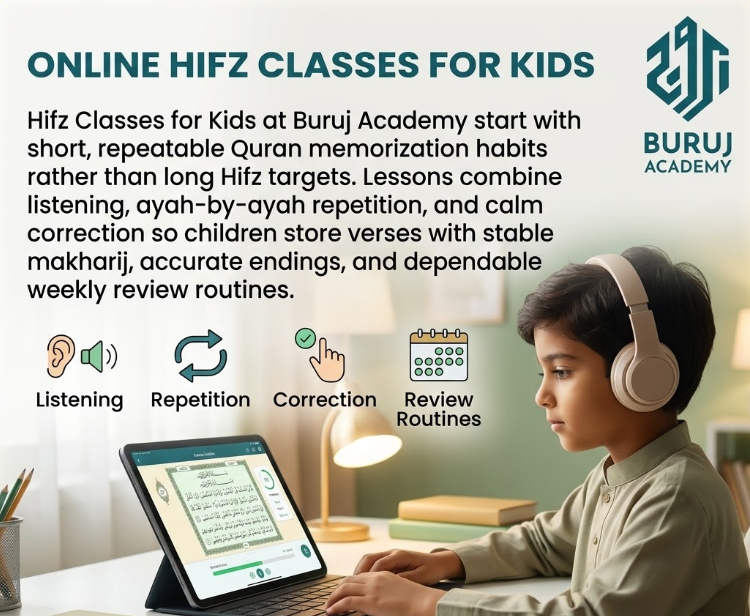
Our Hifz for Kids course pairs children with Ijazah-certified instructors who specialize in child-appropriate memorization techniques — short sessions, positive reinforcement, and age-calibrated revision systems that avoid overwhelming young learners. Many parents also benefit from reading our guide on how to stay motivated during Hifz to better support their child’s emotional journey.
Start your child’s Hifz classes with free session
Read also: How to Understand the Quran Word by Word?
Discover the Buruj Academy Difference
Step into our virtual classrooms and see how our expert instructors make learning Quran and Arabic intuitive and clear. We focus on overcoming the specific hurdles non-native speakers face, building your confidence and connection with the Quran.
Begin Your Hifz Path with Buruj Academy’s Expert Instructors
Becoming a Hafiz is one of the greatest gifts a Muslim can give to themselves and their family. Whether you are starting from the first page or returning to complete an interrupted journey, the right guidance makes all the difference.
Buruj Academy’s Online Hifz Program provides:
- Al-Azhar-trained Hifz specialists with 12+ years of experience
- Personalized 1-on-1 sessions with flexible 24/7 scheduling
- Structured revision systems built on the Buruj Method: Consistency-before-speed
- Age-specific tracks: Hifz for Kids, Hifz for Adults, and Hifz for Ladies
- Real-time recitation correction and individualized learning plans
Book your free trial lesson today and take the first step toward joining the millions who carry the Quran in their hearts.
Take the first step toward this lifelong blessing by enrolling in a program tailored to your pace:
- Online Hifz Program (Comprehensive Quran Memorization)
- Juz 30 Memorization Course (Perfect for focused starts)
- Hifz Classes for Kids (Engaging and interactive)
- Hifz Classes for Adults (Flexible scheduling for busy lives)
- Hifz Classes for Sisters (Private, supportive learning)
- Short Surah Memorization Course (Ideal for daily prayers)
- Hifz Ijazah Course (For advanced students seeking certification)
Don’t let another day pass without moving closer to your goal. Join Buruj Academy today and schedule your free trial session to begin your Hifz journey!
Excel in Your Quranic Studies
Join Buruj Academy and master the Quran with our structured, professional curriculum.
Book Your Free TrialConclusion
The title of Hafiz represents far more than a memorization achievement — it is a living covenant with the Quran, a source of intercession, and a responsibility that the memorizer carries for life.
Whether you are a parent considering Hifz for your child, an adult ready to begin, or someone simply learning what this title means — the path is open, the rewards are profound, and qualified guidance is available. Insha’Allah, the Quran you memorize today will be a light for you and your family in this life and the next.
Frequently Asked Questions About Who Is a Hafiz
What Is the Difference Between a Hafiz and a Qari?
A Hafiz has memorized the complete Quran by heart. A Qari has mastered Tajweed — the rules of correct Quranic recitation — and is known for beautiful, technically precise recitation. A person can be both simultaneously, which is considered the ideal: memorization paired with correct, rule-governed recitation.
Can a Woman Be Called a Hafiz?
Yes. A woman who memorizes the complete Quran is called a Hafizah — the feminine form of Hafiz in Arabic. The title carries full scholarly and spiritual recognition. Female Hafizah numbers have grown significantly in recent decades as dedicated women’s Hifz programs have expanded globally, including online options with qualified female instructors.
Is It Possible to Become a Hafiz While Working Full-Time?
Yes, though it requires realistic scheduling and disciplined consistency. Full-time working adults typically dedicate 1–2 focused hours daily and may take 3–5 years to complete the full Quran. The key is maintaining revision of memorized portions alongside learning new material — without revision, memorization deteriorates regardless of how much new content is learned.