 Quran
Quran
| Key Takeaways |
| Quranic Arabic has a core vocabulary of roughly 300–400 high-frequency words that cover the majority of the Quran’s text. |
| Connecting word meanings directly to Salah vocabulary accelerates comprehension because you encounter those words multiple times daily. |
| Classical Arabic grammar (النحو) is essential for word-by-word study — a word’s meaning shifts based on its grammatical role in the sentence. |
| Consistent daily practice of even 15–20 minutes of word-by-word study produces measurable comprehension gains within 8–12 weeks. |
Many students try memorizing glossaries or scanning translations, only to find that isolated word lists never connect into real comprehension during recitation.
The structured path to word-by-word Quran understanding combines three pillars: learning high-frequency Quranic vocabulary, understanding how Arabic root letters generate meaning, and applying basic grammar patterns that reveal each word’s role in the verse.
When these three work together, the Quran begins to speak to you directly — word by word, verse by verse.
Table of Contents:
1. Start with the Arabic Root System Before Memorizing Individual Words
To understand the Quran word by word, your first step is mastering the Arabic root letter system. Arabic is a root-based language, meaning that most words are built from a three-letter root (الجذر الثلاثي) that carries a core meaning. Every word derived from that root shares a family of related meanings.
Understanding this system prevents the most common beginner mistake we see at Buruj Academy: students memorizing long lists of isolated words that they cannot recognize in different grammatical forms during actual recitation. The root system gives you a key that opens dozens of words at once.
How the Root System Works in Practice
Consider the root ك-ت-ب (k-t-b), which carries the core meaning of “writing.” From this single root, the Quran uses: كَتَبَ (he wrote), كِتَاب (book), كَاتِب (writer), مَكْتُوب (written). Recognizing the root means you can decode all four — not just one.
| Root | Core Meaning | Quranic Words Derived |
| ك-ت-ب | Writing | كِتَاب، كَتَبَ، مَكْتُوب |
| ع-ل-م | Knowledge | عِلْم، عَالِم، عَلَّمَ، يَعْلَم |
| ر-ح-م | Mercy | رَحْمَة، رَحِيم، رَحْمَن |
| ع-ب-د | Worship | عِبَادَة، عَبْد، يَعْبُدُون |
| ح-م-د | Praise | حَمْد، حَامِد |
Begin with the 50 most frequent Quranic roots. Investing two to three weeks here saves months of vocabulary memorization later.
Buruj Academy’s Quranic Arabic course builds this root awareness from the very first lesson, ensuring students develop pattern recognition rather than rote memory.
Begin Understanding Quranic Arabic with a FREE Lesson
2. Build Your Vocabulary Around the 300 Most Frequent Quranic Words First
The most practical step for word-by-word comprehension is prioritizing high-frequency Quranic vocabulary before rare or advanced terms.
Classical Arabic scholarship has long noted that a relatively small core vocabulary accounts for the overwhelming majority of Quranic text — and this principle shapes every effective Quranic Arabic curriculum.
Researchers in Quranic vocabulary studies have identified approximately 300–400 words that appear with very high frequency throughout the Quran.
Mastering these words — before tackling longer, rarer terms — gives you the fastest path to reading comprehension in actual recitation.
Which Words to Prioritize First
Begin with particles, pronouns, and prepositions since they appear on virtually every page:
| Category | Examples | Approximate Frequency |
| Particles | إِنَّ، وَ، فَ، أَوْ، لَ | Thousands of times |
| Pronouns | هُوَ، هِيَ، هُمْ، أَنْتَ، نَحْنُ | Extremely high |
| Prepositions | فِي، مِنْ، إِلَى، عَلَى، بِ | Thousands of times |
| Common verbs | قَالَ، جَعَلَ، كَانَ، يَعْلَمُ | Very high |
| Common nouns | اللَّه، رَبّ، يَوْم، قَوْم | Very high |
In our instructors’ experience at Buruj Academy, students who front-load these high-frequency words report that they begin recognizing familiar vocabulary within their Salah within the first four to six weeks — a milestone that powerfully reinforces motivation to continue.
If you are still building your foundational Quran reading skills alongside vocabulary study, our Quran Reading course ensures you can read Arabic text fluently before layering in comprehension work.
Book your Free trial lesson and start reading the Quran
3. Connect Every New Word Directly to Its Occurrence in Salah
One of the most effective strategies for word-by-word Quran understanding is anchoring new vocabulary to words you already recite in daily prayer. Salah provides five daily exposure sessions to a fixed set of Quranic phrases — making it the ideal reinforcement environment for vocabulary retention.
This is not just a motivational technique. From a memory science perspective, spaced repetition tied to a recurring, meaningful ritual produces stronger long-term retention than flashcard review alone.
And from a spiritual perspective, the moment you understand بِسْمِ اللَّهِ الرَّحْمَٰنِ الرَّحِيمِ word by word as you recite it in Fatiha, your Salah changes permanently.
High-Priority Salah Vocabulary to Learn First
بِسْمِ اللَّهِ الرَّحْمَٰنِ الرَّحِيمِ
Bismillāhi r-raḥmāni r-raḥīm
“In the name of Allah, the Entirely Merciful, the Especially Merciful.” (Al-Fatiha 1:1)
Break this down word by word: بِسْمِ (in the name of), اللَّهِ (Allah), الرَّحْمَٰنِ (the Entirely Merciful — mercy vast and encompassing all creation), الرَّحِيمِ (the Especially Merciful — mercy specific and enduring for believers).
Two words from the same root ر-ح-م, yet carrying distinct meanings. This single phrase teaches root variations in real Quranic context.
Build your personal Salah vocabulary glossary — every phrase from Al-Fatiha, Tashahhud, Ruku, and Sujood supplications — and learn each component word by word. This alone covers dozens of high-frequency Quranic terms.
4. Learn the Essential Grammar Patterns That Change Word Meanings in Context
Word-by-word Quran understanding requires basic Arabic grammar (النحو) because Arabic is an inflected language — the same word changes form based on its grammatical function. Without grammar, you may know a word in one form but fail to recognize it in another.
You do not need to master classical Arabic grammar in full. However, three foundational grammar concepts are non-negotiable for word-by-word comprehension: the three grammatical states (رَفْع، نَصْب، جَرّ), the difference between definite and indefinite nouns (المعرفة والنكرة), and verb conjugation by person and number.
The Three Grammatical States Every Student Must Know
| State | Name | Marker | Function |
| Nominative | رَفْع (Raf’) | Dammah (ُ) | Subject of the sentence |
| Accusative | نَصْب (Nasb) | Fathah (َ) | Object or adverb |
| Genitive | جَرّ (Jarr) | Kasrah (ِ) | After prepositions; possession |
A practical Quranic example: the word رَبّ (Lord/Rabb) appears as رَبُّنَا (our Lord — nominative, subject), رَبَّنَا (our Lord — accusative, in supplication), and رَبِّنَا (our Lord — genitive, after prepositions). Recognizing which state you are reading reveals the word’s role in the verse immediately.
In our sessions at Buruj Academy, students who grasp these three states — even without memorizing their Arabic names — report a significant leap in their word-by-word reading confidence within the first month of structured grammar study.
Read also: Is It Easy to Understand the Quran?
5. Use a Word-by-Word Quran Interlinear Tool as a Daily Study Companion
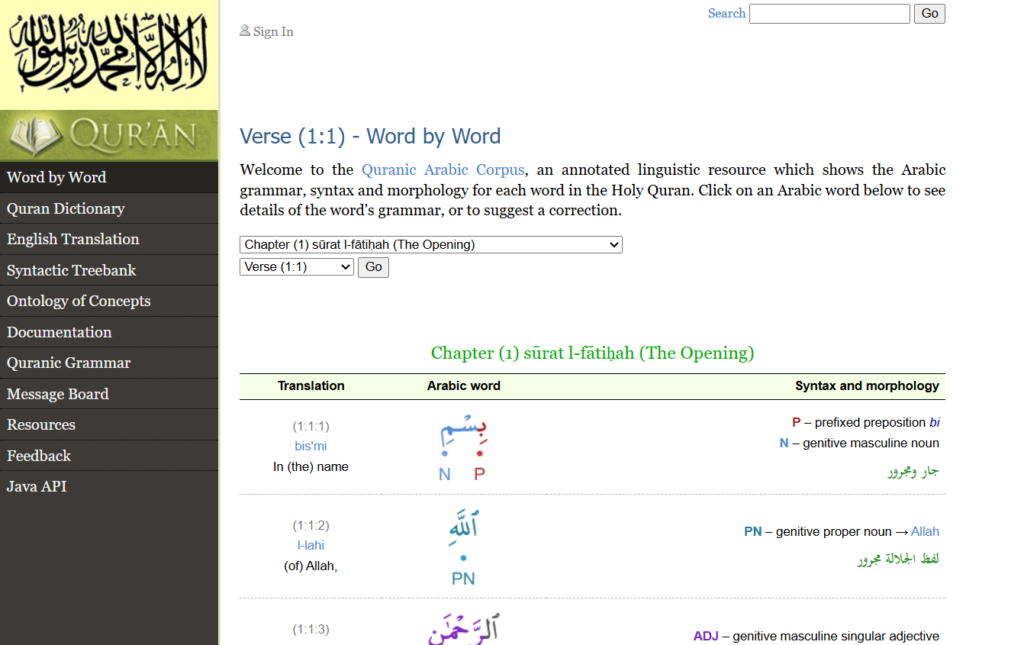
A structured word-by-word interlinear Quran tool — one that shows Arabic text, morphological breakdown, and translation for each word — is the most direct practical resource for this study method. Using it correctly, however, requires a deliberate approach rather than passive reading.
The most widely used scholarly resource for this purpose is the Quran Word by Word project on Corpus Quran, which provides morphological tagging — grammatical analysis — for every single word in the Quran.
This resource is built on classical Arabic grammatical scholarship and is referenced in academic Quranic Arabic study globally.
How to Use a Word-by-Word Tool Effectively?
Do not simply read through the English glosses passively. Instead, follow this active method:
- Cover the translation first. Read the Arabic word and attempt to recall its meaning from your vocabulary study.
- Check the morphological tag. Identify the word’s grammatical form — is it a verb, noun, particle? What root is it from?
- Connect to the root. Identify the three-letter root and recall other words you know from the same root.
- Read the full verse in translation. Confirm how the individual word meaning contributes to the verse’s overall meaning.
This active engagement — rather than passive reading — is what builds genuine comprehension. We recommend 15–20 minutes of this focused word-by-word analysis daily over passive translation reading for an hour.
Excel in Your Quranic Studies
Join Buruj Academy and master the Quran with our structured, professional curriculum.
Book Your Free Trial6. Study Surat Al-Fatiha Word by Word as Your First Complete Model
Before attempting any other surah, study Surat Al-Fatiha word by word in complete grammatical and semantic detail. Al-Fatiha is recited a minimum of 17 times daily in obligatory prayers — making it the highest-return text for word-by-word investment in the entire Quran.
Al-Fatiha contains 29 words (not counting the Basmala in some counts) covering key Quranic vocabulary categories: divine attributes (الرَّحْمَٰنِ، الرَّحِيمِ، الْمَلِكِ), worship terminology (نَعْبُدُ، نَسْتَعِينُ), and supplication grammar (اهْدِنَا).
Mastering these 29 words with their grammatical roles gives you a word-by-word model you can extend to all other surahs.
الْحَمْدُ لِلَّهِ رَبِّ الْعَالَمِينَ
Al-ḥamdu lillāhi rabbi l-ʿālamīn
“All praise is due to Allah, Lord of the worlds.” (Al-Fatiha 1:2)
Word-by-word breakdown: الْحَمْدُ (the praise — definite, nominative subject), لِلَّهِ (to/for Allah — لِ preposition + Allah in genitive), رَبِّ (Lord of — genitive, possessive construction beginning), الْعَالَمِينَ (the worlds — plural, genitive).
Notice how the grammatical state of رَبّ (genitive/Jarr) is immediately explained by its relationship to الْحَمْدُ through the possessive construction (الإضافة).
7. Progress Through Short Surahs Using a Thematic Vocabulary Approach
After mastering Al-Fatiha, progress through the short surahs of Juz Amma (the 30th Juz) using a thematic vocabulary approach — grouping words by theme rather than studying each surah in isolation. This dramatically accelerates retention because thematic clusters reinforce each other.
Juz Amma is the ideal word-by-word study corpus because its surahs are short, frequently recited, and rich in high-frequency Quranic vocabulary.
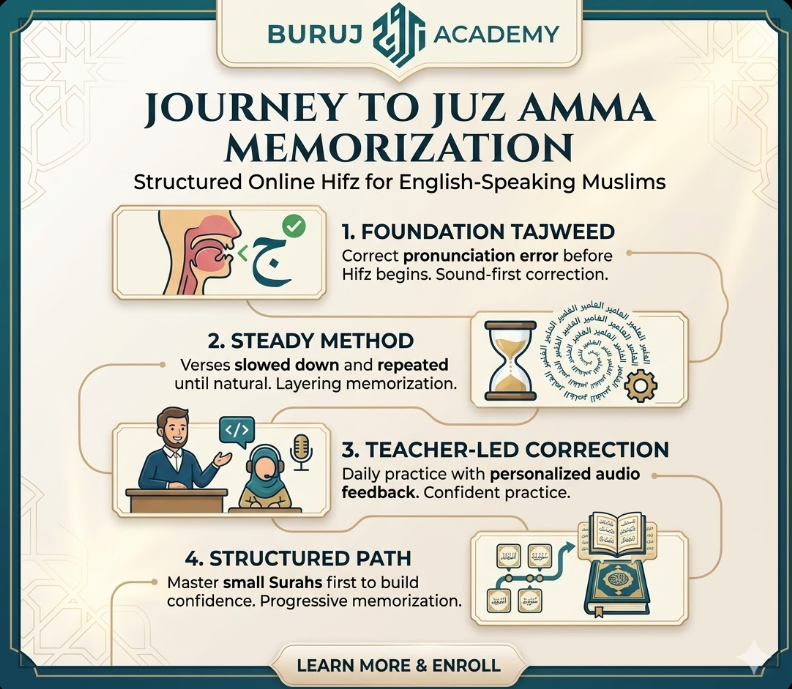
If you are simultaneously working on memorizing these surahs, our Juz 30 Memorization course pairs naturally with word-by-word vocabulary study — comprehension deepens memorization, and memorization reinforces vocabulary retention.
Book Your Kid’s First Session in Buruj’s Juz 30 Memorization Course
Thematic Vocabulary Clusters Across Juz Amma
| Theme | Key Words | Surahs Where They Appear |
| Day of Judgment | يَوْم، دِين، حِسَاب، مِيزَان | Al-Infitar, Al-Inshiqaq, Az-Zalzalah |
| Divine Power | خَلَقَ، أَمْر، قَدَر، عَظِيم | Al-Qadr, Al-Buruj, At-Tariq |
| Human nature | إِنسَان، نَفْس، هَوَى، غَفَلَة | Al-‘Asr, Al-‘Alaq, Al-Fajr |
| Reward and punishment | جَنَّة، نَار، عَذَاب، نَعِيم | Al-Ghashiyah, Al-Mutaffifin |
Working through Juz Amma thematically means that when you encounter يَوْم in Az-Zalzalah after studying it in Al-Infitar, recognition is immediate.
Thematic reinforcement cuts vocabulary memorization time significantly in our instructors’ experience.
8. Practice Reading Tafsir Summaries to Understand Words in Their Full Contextual Meaning
Word-by-word study of vocabulary and grammar is the foundation — but true understanding requires knowing why a specific word was chosen over its synonym in a given verse.
This is the domain of Tafsir (تفسير), and even brief engagement with classical Tafsir sources adds a dimension that vocabulary lists alone cannot provide.
You do not need to read multi-volume Tafsir works as a beginner. Accessible, reliable English-language Tafsir summaries — such as those derived from Ibn Kathir or Al-Tabari — provide the contextual insight that explains why الرَّحْمَٰن and الرَّحِيم both come from the root ر-ح-م yet mean different aspects of divine mercy, or why الصِّرَاطَ الْمُسْتَقِيمَ uses the specific grammatical construction it does.
The Prophet ﷺ said, as recorded in Sahih al-Bukhari 5027:
“The best among you are those who learn the Quran and teach it.”
Word-by-word comprehension is precisely this kind of deep engagement with the Quran’s text — not merely recitation, but understanding.
Begin Understanding Quran With a FREE Trial in
Buruj’s Tafseer Al-Quran Course
9. Establish a Consistent Daily Word-by-Word Study Routine with Measurable Milestones
Consistent, structured daily practice is what separates students who achieve genuine Quran comprehension from those who remain at the vocabulary list stage indefinitely. Word-by-word Quran understanding is not a one-time study session — it is a cumulative skill that builds through disciplined repetition over months.
We recommend a daily minimum of 15–20 minutes of active word-by-word study, separate from general Quran recitation or memorization time. This focused block — dedicated entirely to breaking down individual words grammatically and semantically — produces measurable results within 8–12 weeks.
Read also: Why Does Allah Use “We” in the Quran?
A Practical 12-Week Word-by-Word Study Milestone Plan
| Weeks | Focus | Measurable Milestone |
| 1–2 | Arabic root system (top 50 roots) | Recognize 150+ word derivatives |
| 3–4 | High-frequency particles, pronouns, prepositions | Understand connective words throughout Al-Fatiha |
| 5–6 | Al-Fatiha word-by-word with full grammar | Explain every word’s grammatical role in Al-Fatiha |
| 7–8 | Juz Amma short surahs (Al-Ikhlas through An-Nas) | Word-by-word recognition in 10 short surahs |
| 9–10 | Salah vocabulary glossary — complete | Understand every word in obligatory prayer |
| 11–12 | Thematic vocabulary expansion + Tafsir introduction | Begin word-by-word study of Surah Al-Baqarah opening |
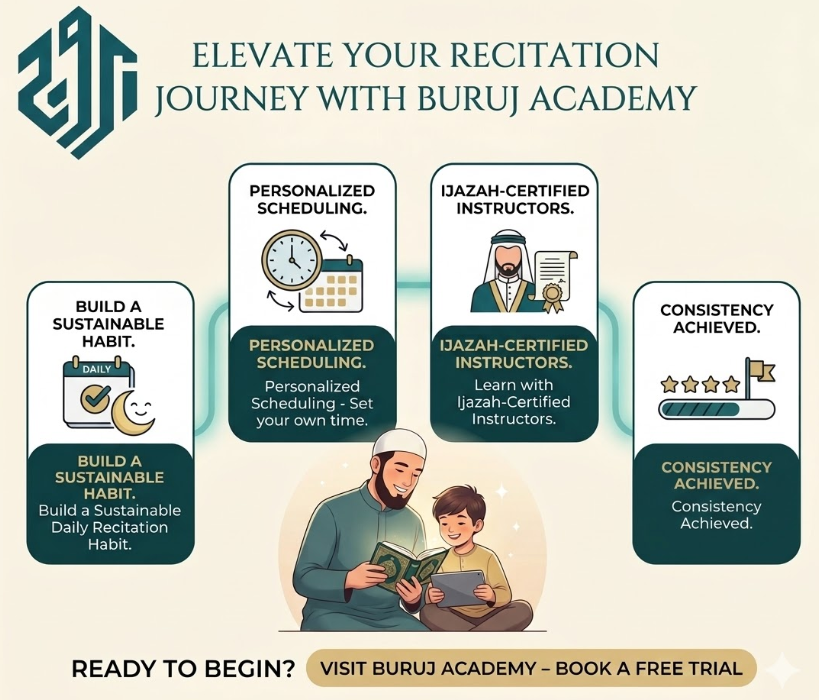
For students who are also pursuing Quran recitation alongside comprehension, visit our Quran Recitation course — beautiful, accurate recitation and deep word understanding strengthen each other. You can also explore our dedicated guide on reading the Quran for the first time for foundational orientation.
Book your first FREE recitation lesson
Discover the Buruj Academy Difference
Step into our virtual classrooms and see how our expert instructors make learning Quran and Arabic intuitive and clear. We focus on overcoming the specific hurdles non-native speakers face, building your confidence and connection with the Quran.
Start Your Word-by-Word Quran Understanding Journey with Buruj Academy’s Expert Instructors
Word-by-word comprehension is entirely achievable — with the right method and the right teacher.
Buruj Academy’s Quranic Arabic course provides exactly this: structured vocabulary, root-system training, and grammar application taught by Al-Azhar University graduates with 12+ years of experience teaching non-Arabic speakers globally.
What sets Buruj Academy apart:
- Ijazah-certified instructors and Al-Azhar University graduates
- The Buruj Method: Context-before-abstraction for natural Quranic Arabic comprehension
- Personalized 1-on-1 online sessions — no group classes where you fall behind
- Flexible 24/7 scheduling for busy adults and parents
- Real-time vocabulary correction and grammar feedback during every lesson
Book your free trial lesson today and experience what it feels like to understand the Quran word by word in your very first session.
Take the next step in your learning journey today by enrolling in one of our specialized programs:
- Online Quran Classes
- Online Quran Classes for Beginners
- Online Quran Classes for Adults
- Online Quran Classes for Ladies
- Online Quran Classes for Kids
- Quran Reading Course
- Quran Recitation Course
- Online Ijazah Course
- Online Qirat Course
Don’t wait to transform your relationship with the Holy Quran. Join our global community of students and book your free evaluation session now!
Excel in Your Quranic Studies
Join Buruj Academy and master the Quran with our structured, professional curriculum.
Book Your Free TrialConclusion
Understanding the Quran word by word is not a distant goal reserved for Arabic scholars — it is an accessible, structured discipline that any committed Muslim can pursue. The path combines three reinforcing pillars: a root-based approach to vocabulary, foundational grammar awareness, and consistent daily practice anchored to the words you already recite in Salah.
What we consistently observe at Buruj Academy is that students who follow this structured sequence — beginning with roots, moving to high-frequency vocabulary, then applying grammar — reach genuine comprehension milestones far faster than those who study translations alone. The Quran was revealed in clear Arabic, and its words carry layers of precision that translations can only approximate.
Begin with Al-Fatiha. Master its 29 words completely. Then let that foundation carry you forward — word by word, verse by verse, surah by surah. For further support along your reading and comprehension path, explore our guides on how to get better at reading Quran and how to start reading Quran daily.
Frequently Asked Questions About Understanding the Quran Word by Word
How Long Does It Take to Understand the Quran Word by Word?
Most non-Arabic speaking students achieve basic word-by-word recognition in frequently recited surahs within 5–12 weeks of daily 15–20 minute structured study. Full Quran comprehension is a longer process — typically 1–2 years of consistent effort — but meaningful, rewarding comprehension begins within the first few months of correct study.
Do I Need to Learn Full Arabic Grammar to Understand the Quran Word by Word?
Full classical Arabic grammar mastery is not required to begin word-by-word study. However, three foundational concepts are essential: the three grammatical states (Raf’, Nasb, Jarr), the definite article and its effect, and basic verb conjugation by person and number. These three patterns explain the majority of word-form changes you will encounter.
Can I Learn the Quran Word by Word Without a Teacher?
Self-study using interlinear tools and vocabulary resources is possible, but a qualified teacher accelerates progress significantly and prevents foundational errors in grammar understanding and root identification. Errors made at the early stages — particularly in grammatical state recognition — compound over time and require correction later. Structured guidance from the outset is always more efficient.
Should I Study Word-by-Word Quran Understanding Alongside Hifz?
Yes — and the two disciplines complement each other powerfully. Understanding a word’s meaning deepens its memorization, while memorization provides constant reinforcement of vocabulary. Students in Buruj Academy’s Online Hifz Program who pair memorization with word-by-word vocabulary study consistently demonstrate stronger retention and faster recall than those who memorize without comprehension. Explore our guide on how to memorize Quran faster for complementary strategies.