 Quran
Quran

| Key Takeaways |
| Becoming a Hafiz requires mastering correct Tajweed first — memorizing without proper recitation creates deeply ingrained errors that are difficult to correct later. |
| The Quran contains 604 pages across 30 Juz’; a realistic daily commitment of 1–2 pages allows full memorization within 2–4 years for most students. |
| Consistent daily revision is more important than the volume of new memorization — without structured review, previously memorized portions fade within weeks. |
| Enrolling with a qualified Hifz teacher provides accountability, error correction, and a structured revision system that self-study alone cannot replicate. |
| Adults, children, and students at home can all complete Hifz successfully when following a systematic, teacher-guided plan with realistic milestones. |
The title of Hafiz carries immense honor in Islam, and the path toward it is one that millions of Muslims across every age group and background have walked successfully.
Becoming a Hafiz means committing to a structured, step-by-step process: mastering foundational recitation, building a daily memorization habit, establishing a rigorous revision system, and working with a qualified teacher who guides each stage. With the right method, this sacred goal is within reach for any sincere student.
Table of Contents:
1. Build a Correct Recitation Foundation Before Memorizing a Single Verse
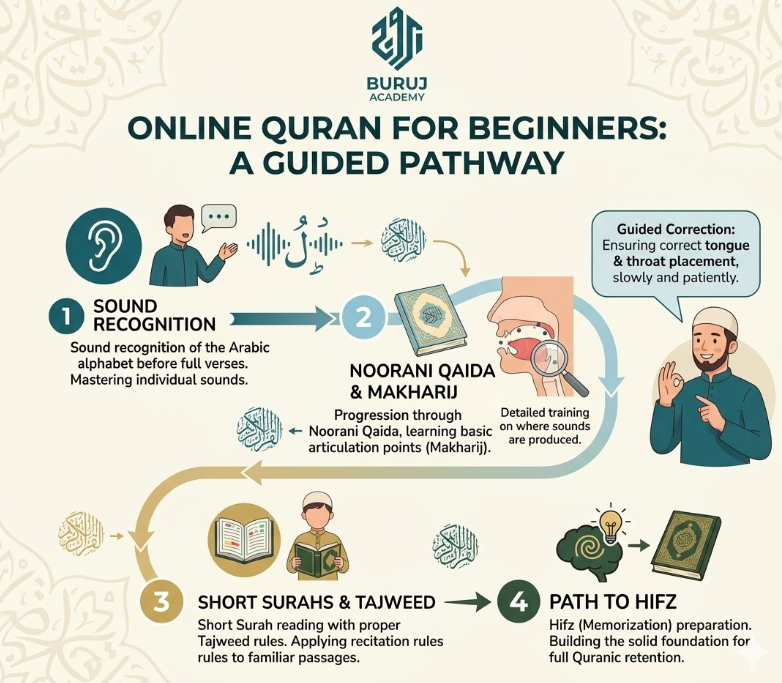
Before committing any verse to memory, every aspiring Hafiz must first recite with correct Tajweed. This is not a preliminary step to rush through — it is the foundation on which your entire Hifz rests.
Memorizing incorrect recitation creates deeply embedded habits. When a student memorizes a verse with a mispronounced letter or incorrect vowel, that error becomes part of the memory itself. Correcting it later requires essentially re-memorizing the verse from scratch — a frustrating and time-consuming process we have seen many students go through unnecessarily.
How Does Tajweed Mastery Protect Your Memorization?
The rules of Tajweed — including proper makharij (articulation points), sifat (letter attributes), and rules of Noon sakinah and Meem sakinah — directly affect how verses sound and how they connect to one another.
A student who memorizes without Tajweed will also struggle with the natural flow between verses, since Tajweed rules govern how words link together during recitation.
Our Tajweed for Beginners course at Buruj Academy is specifically designed to build this foundation efficiently before Hifz begins. Students who complete even 8–12 weeks of structured Tajweed instruction before starting memorization consistently outperform those who begin Hifz without it.
You can also explore our beginner’s guide to Tajweed to understand what this foundation involves.
Begin Learning Quran With a FREE Trial Lesson
2. Set a Realistic Daily Memorization Target That You Can Sustain Long-Term
The Quran contains 604 pages across 30 Juz’. Your daily memorization target determines your entire timeline — and choosing a sustainable amount is more important than choosing an ambitious one.
| Daily Target | Estimated Time to Complete Full Quran |
| Half a page per day | Approximately 3.5–4 years |
| 1 page per day | Approximately 1.5–2 years |
| 2 pages per day | Approximately 10–12 months |
| 3 pages per day | Approximately 7–8 months |
These timelines assume consistent daily memorization with no extended breaks. In our experience at Buruj Academy, adult learners balancing work and family responsibilities typically sustain 1 page per day most reliably. Children in structured programs often manage 1–2 pages with teacher guidance.
The most dangerous mistake we see is students setting an aggressive target in the first weeks, burning out within two months, and abandoning the program entirely.
Consistency before speed is the Buruj Method principle that governs our entire Hifz curriculum — and it is the single factor that separates those who complete Hifz from those who do not.
3. Choose the Right Surah to Begin With and Understand Why It Matters
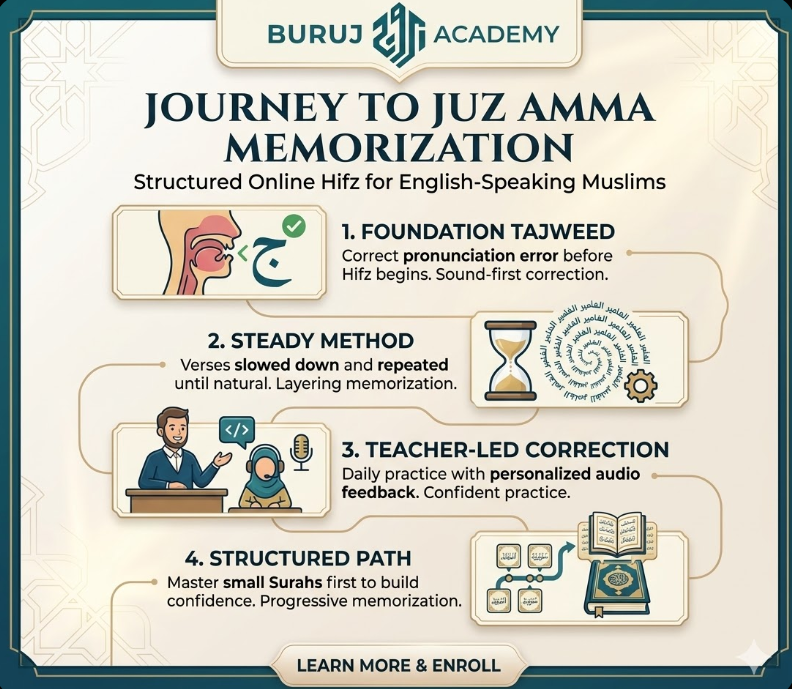
Most established Hifz programs begin memorization from Juz’ 30 — the final section of the Quran containing the shorter surahs most Muslims already recite in Salah. This is not arbitrary.
Beginning with Juz’ 30 provides immediate practical benefit: students memorize surahs they use in daily prayer within the first few weeks, reinforcing motivation.
Shorter surahs also train the memorization process — the techniques of repetition, linkage, and revision — before longer, more complex chapters are introduced.
After completing Juz’ 30, most classical programs proceed from Surah Al-Baqarah (Juz’ 1) and move forward, or alternatively begin from Juz’ 29 and work backward.
Our Juz 30 Memorization course provides a structured entry point for students at any level, including those who want to confirm and solidify surahs they already know before advancing.
Book Your Kid’s First Session in Buruj’s Juz 30 Memorization Course
4. Establish a Three-Part Daily Routine of New Memorization, Recent Review, and Old Revision
The most critical structural element of any successful Hifz plan is a three-tier daily routine.
Without this system, new memorization accumulates while old memorization deteriorates — and the student eventually collapses under the weight of forgotten portions.
| Session | Arabic Term | Content | Recommended Daily Time |
| New Memorization | Hifz Jadeed | Today’s new verses or page | 20–40 minutes |
| Recent Review | Muraja’ah Qareeba | Last 7 days’ memorization | 15–20 minutes |
| Older Revision | Muraja’ah Ba’eeda | Older completed Juz’ | 20–30 minutes |
This three-part structure is what our Al-Azhar-trained Hifz specialists at Buruj Academy implement from day one of the Online Hifz Program. Students who skip the revision tiers — even for a few days — consistently report significant memory loss in older sections.
For a detailed breakdown of how to structure your sessions across a full week, our Quran memorization schedule guide provides practical templates you can adapt immediately.
Start Hifz today with a FREE trial session
5. Select the Best Time of Day for Memorization Based on Cognitive Research and Prophetic Guidance
Timing your memorization session is not a minor logistical detail — it significantly affects how quickly verses embed into long-term memory. Both Islamic tradition and modern cognitive science point toward the same optimal window.
The Prophet Muhammad ﷺ said, as recorded in Sahih al-Bukhari 5023:
“Recite the Quran, for it will come as an intercessor for its reciters on the Day of Resurrection.”
The early morning hours — particularly after Fajr — are consistently recommended in classical Islamic scholarship for Quran recitation and memorization, as the mind is clear, distraction is minimal, and barakah (blessing) is abundant.
Neurologically, sleep consolidates declarative memory. Memorizing immediately after Fajr — following a night of sleep — means the brain is working with freshly consolidated memory structures.
The result is faster embedding and stronger retention. Our full breakdown of the best times to memorize Quran explains both the spiritual and scientific dimensions in detail.
Excel in Your Quranic Studies
Join Buruj Academy and master the Quran with our structured, professional curriculum.
Book Your Free Trial6. Use Proven Memorization Techniques That Work for Non-Arabic Speakers
Knowing how to memorize effectively is as important as knowing what to memorize. Several techniques consistently produce stronger retention, particularly for students whose first language is not Arabic.
A. The Repetition-Linkage Method
Read the new verse aloud 20–30 times without looking, then connect it to the previous verse and recite both together.
This creates a chain of associations that mirrors how the Quran flows naturally. Students who memorize verses in isolation often struggle to recite continuously — the linkage step resolves this.
B. The Listening-First Approach
Before memorizing, listen to a trusted reciter — such as Sheikh Mahmoud Khalil Al-Husary or Sheikh Mishary Rashid Al-Afasy — recite the target verses 10–15 times.
The ear learns the melody, rhythm, and natural pauses of the verse before the tongue attempts it. This is especially effective for non-Arabic speakers, who benefit from hearing correct pronunciation modeled repeatedly.
Read also: What Are the Common Mistakes in Quran Memorization?
C. Writing as a Memorization Tool
Writing verses by hand — without looking — activates kinesthetic memory alongside auditory and visual memory. Students who write what they have memorized report significantly higher confidence during recitation testing. Our guide to practical memorization techniques covers these methods with actionable daily applications.
Discover the Buruj Academy Difference
Step into our virtual classrooms and see how our expert instructors make learning Quran and Arabic intuitive and clear. We focus on overcoming the specific hurdles non-native speakers face, building your confidence and connection with the Quran.
7. Work With a Qualified Hifz Teacher Who Provides Weekly Testing and Error Correction
Self-study can support Hifz, but it cannot replace a qualified teacher. The teacher’s role in Hifz is not simply to listen — it is to catch errors the student cannot hear in themselves, structure the revision system, adjust the daily target when needed, and maintain accountability.
A student memorizing independently has no mechanism for identifying their own mispronunciations.
We have corrected students at Buruj Academy who had memorized entire Juz’ with consistent errors in specific letters — errors they were completely unaware of because they had no teacher checking their recitation. Those errors would have remained permanently embedded without correction.
Weekly testing by a teacher should include: reciting the week’s new memorization without prompting, reciting a random section from older memorization on demand, and receiving specific correction on Tajweed errors within the memorized text.
Our Hifz for Adults course and Hifz for Kids course both include weekly testing sessions with Ijazah-certified instructors who specialize in error correction and personalized revision scheduling.
Start your child’s Hifz classes with free session

8. Build a Long-Term Revision System to Protect What You Have Already Memorized
Completing memorization of a Juz’ is not the finish line — it is the beginning of a lifelong maintenance responsibility. The Quran must be revised continuously, or previously memorized portions will fade.
Classical Hifz scholarship recommends completing a full revision of memorized portions every 7–10 days at minimum. As the total amount memorized grows, a structured rotation system becomes essential.
| Memorized Amount | Suggested Revision Cycle |
| 1–5 Juz’ | Full revision every 5–7 days |
| 6–15 Juz’ | Full revision every 10–14 days |
| 16–25 Juz’ | Full revision every 14–20 days |
| 26–30 Juz’ (full Quran) | Full revision every 20–30 days |
This rotation ensures every portion of the Quran receives regular attention. Our guide to the best Quran memorization methods includes revision rotation templates adapted for different memorization stages.
Can You Become a Hafiz at Home?
Yes, you can become a Hafiz at home — and online Hifz programs have made this more accessible and structured than ever before. However, studying at home without a teacher is not the same as studying at home with one.
Home-based Hifz succeeds when the student has a dedicated, distraction-free space for daily sessions, a fixed schedule they protect consistently, and a live online teacher providing weekly recitation testing and accountability.
Home-based Hifz without a teacher — relying solely on apps or audio recordings — has a significantly lower completion rate and a much higher risk of embedded recitation errors.
Buruj Academy’s Online Hifz Program is specifically built for home-based learners: Al-Azhar-trained specialists provide 1-on-1 sessions with flexible scheduling,
personalized revision plans, and real-time error correction — everything a traditional Hifz school provides, adapted for students learning from home anywhere in the world.
Read also: Quran Revision Timetable: Structured Plans for Every Hifz Level
What Are the Responsibilities of a Hafiz After Completing Memorization?
Completing the memorization of the entire Quran is a monumental achievement — but it comes with ongoing responsibilities that every Hafiz must understand before beginning their path.
The primary responsibility of a Hafiz is continuous revision. The Quran, unlike other memorized material, requires regular recitation to maintain.
Scholars unanimously emphasize that allowing the Quran to fade from memory after having memorized it is a serious matter. A Hafiz is expected to recite their memorized portions regularly — ideally maintaining a personal revision cycle even after completion.
Additionally, a Hafiz carries the responsibility of accurate recitation. Leading Tarawih prayers, teaching others, and reciting in communal settings all demand the standard of Tajweed befitting a guardian of the Quran.
Many Huffaz pursue Hifz Ijazah certification to formalize this standard and connect their recitation to an authenticated chain of transmission reaching back to the Prophet ﷺ.
Book your FREE trial lesson in your path to Ijazah

Begin Your Hifz with Buruj Academy’s Expert-Guided Online Hifz Program
Becoming a Hafiz is one of the most rewarding commitments a Muslim can make — and the right guidance from the very first page makes all the difference.
Buruj Academy’s Online Hifz Program provides:
- Al-Azhar University graduates and Ijazah-certified Hifz specialists
- 12+ years of experience guiding non-Arabic speakers through complete Quran memorization
- The Buruj Method: Consistency-before-speed — personalized daily targets built around your schedule
- Structured three-tier revision systems managed by your teacher
- Flexible 1-on-1 online sessions available 24/7 for global students
- Age-specific programs: Hifz for Kids,Hifz for Adults, and Hifz for Ladies
Book your free trial lesson today and take the first step toward becoming a Hafiz — with expert guidance every step of the way.
Take the first step toward this lifelong blessing by enrolling in a program tailored to your pace:
- Online Hifz Program (Comprehensive Quran Memorization)
- Juz 30 Memorization Course (Perfect for focused starts)
- Hifz Classes for Kids (Engaging and interactive)
- Hifz Classes for Adults (Flexible scheduling for busy lives)
- Hifz Classes for Sisters (Private, supportive learning)
- Short Surah Memorization Course (Ideal for daily prayers)
- Hifz Ijazah Course (For advanced students seeking certification)
Don’t let another day pass without moving closer to your goal. Join Buruj Academy today and schedule your free trial session to begin your Hifz journey!
Excel in Your Quranic Studies
Join Buruj Academy and master the Quran with our structured, professional curriculum.
Book Your Free TrialConclusion
The path to becoming a Hafiz is not about natural gifting or extraordinary memory — it is about method, consistency, and the right guidance.
Every step in this process builds on the one before it: correct recitation enables accurate memorization, daily targets build the habit, and a structured revision system protects what you have worked to earn.
What we have seen across twelve years of teaching at Buruj Academy is that students who succeed share one common trait — they start before they feel fully ready, and they trust the process. Insha’Allah, your name will one day be counted among the Huffaz of this Ummah.
Frequently Asked Questions About How To Become a Hafiz of the Quran
Do Hafiz Have Good Memory, or Can Anyone Memorize the Quran?
Hafiz do not necessarily have exceptional natural memory — most have simply developed strong memorization habits through consistent daily practice and effective techniques. The Quran’s rhythmic structure, poetic flow, and repetition of themes actually supports memorization significantly. With the right method and a qualified teacher, any committed student can achieve Hifz regardless of their baseline memory ability.
How Long Does It Realistically Take to Become a Hafiz?
The timeline depends on your daily commitment. Memorizing 1 page per day — a sustainable target for most adult learners — leads to full completion in approximately 20 months. Children in structured programs often progress faster. The key variable is not natural ability but daily consistency: even 30 focused minutes per day, sustained without long gaps, produces steady, measurable progress toward becoming a Hafiz.
How Can You Become a Hafiz at Home Without Attending a Traditional School?
Becoming a Hafiz at home is entirely achievable through a structured online Hifz program with a live teacher. The essential requirements are: a fixed daily memorization time, a distraction-free environment, and weekly recitation sessions with an Ijazah-certified instructor who tests new memorization and older revision. Apps and audio recordings alone are insufficient — real-time error correction from a teacher is non-negotiable for accurate Hifz.
What Is the Best Age to Start Hifz?
There is no single best age — children aged 6–15 typically benefit from stronger neurological plasticity and fewer life commitments, making memorization faster. However, adults complete Hifz successfully every day. The determining factor is not age but structure: adult learners who follow a realistic daily target, use effective revision systems, and work with a teacher consistently achieve full memorization. Buruj Academy offers dedicated programs for both children and adults.
What Happens If You Forget Part of the Quran After Completing Hifz?
Forgetting portions of previously memorized Quran is a serious concern that every Hafiz must actively prevent through continuous revision. Classical scholarship strongly warns against neglecting revision after completion. The solution is a permanent personal revision cycle — rotating through the full Quran every 20–30 days — which most Huffaz maintain for life. This is why learning to build a revision system during Hifz, not after it, is so important.