 Arabic
| Key Takeaways |
| Hollow verbs in Arabic contain واو (waw) or ياء (ya’) as their middle root letter, which weakens or disappears during conjugation. |
| The middle weak letter determines how a hollow verb behaves — واو verbs and ياء verbs follow distinct but predictable patterns. |
| In the past tense, the weak middle letter is replaced by a long vowel (ا), making the verb appear to have only two visible letters. |
| In the present tense, the weak middle letter disappears entirely, and the vowel on the first root letter shortens to a kasra or damma. |
Arabic grammar has a reputation for being complicated — but most of that complexity is actually a system waiting to be decoded. When students first encounter words like قَالَ (qāla, he said) or نَامَ (nāma, he slept) in their Arabic grammar studies, they often wonder where the verb’s “missing” letters went.
Hollow verbs in Arabic are triples — three-letter root verbs — whose middle letter is the weak letter واو (waw) or ياء (ya’).
Because these weak middle letters are unstable in Arabic phonology, they shift, shorten, or disappear during conjugation, producing forms that look irregular but follow completely predictable rules.
Table of Contents:
What Are Hollow Verbs in Arabic?
Hollow verbs in Arabic (al-fi’l al-ajwaf — الفعل الأجوف) are verbs whose second root letter is either واو or ياء. These letters are called “weak” (harfun ‘illah) because they resist carrying a vowel in certain grammatical environments, causing them to be replaced, lengthened, or dropped entirely. The result is a verb that appears “hollow” in the middle — hence the name.
Every Arabic verb is built on a three-letter root. In sound verbs (الفعل الصحيح), all three root letters are strong consonants that remain visible in every conjugation.
In hollow verbs, the middle root letter behaves differently depending on which grammatical form the verb takes. This is not random — it is governed by one of Arabic’s most consistent phonological principles: weak letters avoid short vowels.
Understanding hollow verbs is inseparable from understanding Arabic verb tenses more broadly. We recommend students first build confidence with sound verb conjugation before approaching hollow forms — the contrast makes the pattern far easier to see.
In our Online Arabic Classes, we teach hollow verbs as one of Arabic’s most elegant grammatical patterns — not a hurdle, but a key that opens hundreds of vocabulary items at once.
Book your FREE Arabic trial online Arabic class at Buruj

What Are the Three Root Letters of a Hollow Verb?
The root of a hollow verb always follows the pattern فَـ ـ َـ لَ (fa-‘a-la), where the middle position (‘ain al-fi’l) holds the weak letter.
Identifying the root correctly is the essential first step, because Arabic dictionaries list verbs under their three root letters — and the hidden weak letter must be known to find the word.
Arabic Hollow Verbs with واو as the Middle Root Letter
When واو is the middle root letter, the verb’s base form in the third-person masculine past tense shows a long alif (ا) in place of the original waw. The root واو is identifiable when the present tense form restores a damma (ـُـ) on the first letter.
Examples:
| Root | Meaning | Past Tense (3ms) | Present Tense (3ms) |
| ق – و – ل | to say | قَالَ (qāla) | يَقُولُ (yaqūlu) |
| ك – و – ن | to be | كَانَ (kāna) | يَكُونُ (yakūnu) |
| ع – و – د | to return | عَادَ (‘āda) | يَعُودُ (ya’ūdu) |
| ن – و – م | to sleep | نَامَ (nāma) | يَنَامُ (yanāmu) |
| ط – و – ف | to circumambulate | طَافَ (ṭāfa) | يَطُوفُ (yaṭūfu) |
Read also:Arabic Present Tense Conjugation
Arabic Hollow Verbs with ياء as the Middle Root Letter
When ياء is the middle root letter, the present tense form carries a kasra (ـِـ) on the first root letter, distinguishing it clearly from واو-middle verbs.
Examples:
| Root | Meaning | Past Tense (3ms) | Present Tense (3ms) |
| ب – ي – ع | to sell | بَاعَ (bā’a) | يَبِيعُ (yabī’u) |
| س – ي – ر | to walk/travel | سَارَ (sāra) | يَسِيرُ (yasīru) |
| ز – ي – د | to increase | زَادَ (zāda) | يَزِيدُ (yazīdu) |
| ج – ي – ء | to come | جَاءَ (jā’a) | يَجِيءُ (yajī’u) |
| خَ – ي – ط | to sew | خَاطَ (khāṭa) | يَخِيطُ (yakhīṭu) |
The vowel on the first root letter in the present tense (damma for واو, kasra for ياء) is the clearest diagnostic tool for identifying the original weak middle letter.
How Do Hollow Verbs Change in the Arabic Past Tense?
In the Arabic past tense, hollow verbs replace their weak middle letter with a long alif (ا) in the third-person singular forms. This substitution happens because the weak letter — واو or ياء — cannot sustain a sukoon (vowelless state) between two consonants when the vowel before it is an alif-sound, causing it to lengthen into ا and then fuse with the preceding vowel.
The pattern becomes visible when you conjugate across all pronouns. Notice that the long alif disappears in connected forms (like dual and plural) where a suffix vowel follows:
| Pronoun | قَالَ (he said) | بَاعَ (he sold) |
| هُوَ (he) | قَالَ | بَاعَ |
| هِيَ (she) | قَالَتْ | بَاعَتْ |
| هُمَا (they, dual m.) | قَالَا | بَاعَا |
| هُمْ (they, pl. m.) | قَالُوا | بَاعُوا |
| أَنْتَ (you, m.) | قُلْتَ | بِعْتَ |
| أَنَا (I) | قُلْتُ | بِعْتُ |
| نَحْنُ (we) | قُلْنَا | بِعْنَا |
In our Arabic grammar sessions at Buruj Academy, this table consistently produces the most productive classroom moments.
Students notice immediately that قُلْتَ (qulta, you said) looks nothing like قَالَ (qāla, he said) — and that observation drives genuine curiosity about why.
The answer is elegant: when a personal suffix beginning with a sukoon (like -ta = تَ) attaches, the long vowel shortens back to the original weak letter’s influence, leaving only the compressed vowel on the first root letter (damma for واو-verbs, kasra for ياء-verbs).
This is why قَالَ → قُلْتَ and بَاعَ → بِعْتَ — the vowel color (damma vs. kasra) tells you which weak letter the root contains.
How Do Hollow Verbs Change in the Arabic Present Tense?
In the Arabic present tense, hollow verbs drop their weak middle letter entirely in most forms, replacing it with a lengthened vowel (madd). The first root letter carries either a damma (for واو-roots) or a kasra (for ياء-roots), and this lengthens into the long vowel ـُو or ـِي respectively.
| Pronoun | يَقُولُ (he says) | يَبِيعُ (he sells) |
| هُوَ (he) | يَقُولُ | يَبِيعُ |
| هِيَ (she) | تَقُولُ | تَبِيعُ |
| هُمَا (they, dual m.) | يَقُولَانِ | يَبِيعَانِ |
| هُمْ (they, pl. m.) | يَقُولُونَ | يَبِيعُونَ |
| أَنْتَ (you, m.) | تَقُولُ | تَبِيعُ |
| أَنَا (I) | أَقُولُ | أَبِيعُ |
| نَحْنُ (we) | نَقُولُ | نَبِيعُ |
One critical observation: in the feminine plural form هُنَّ (hunna), the long vowel shortens again. يَقُلْنَ and يَبِعْنَ — the nun suffix forces compression back to the root. Students who understand this pattern stop making errors across the entire verb system.
For the Arabic future tense, the same present-tense form is used, simply preceded by سَـ (sa-) or سَوْفَ (sawfa): سَيَقُولُ (he will say), سَيَبِيعُ (he will sell).
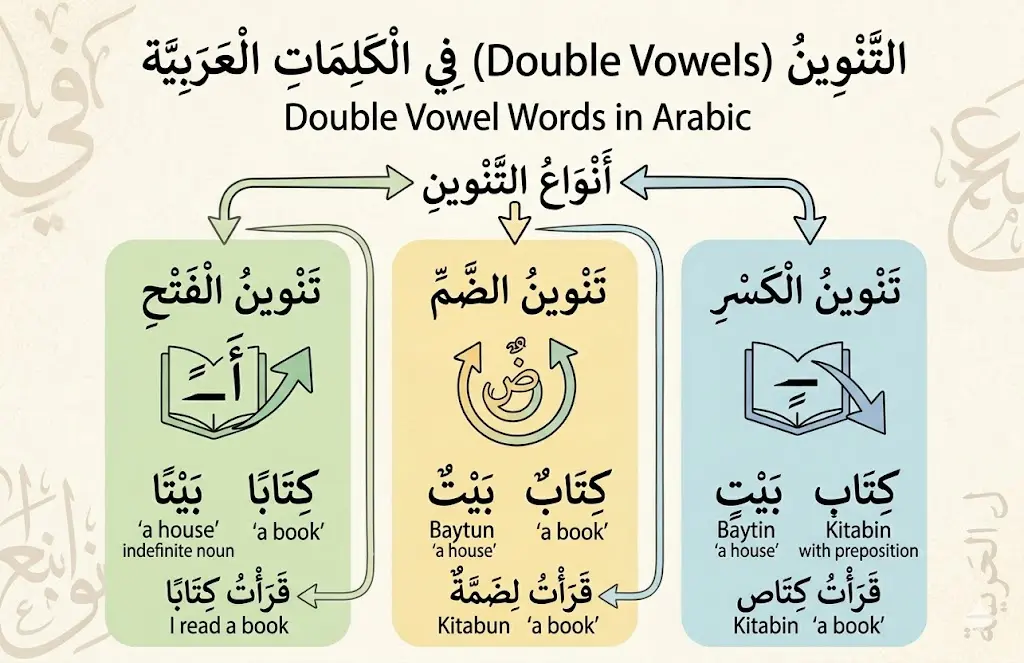
Read also: Double Vowel Words in Arabic
Discover the Buruj Academy Difference
Step into our virtual classrooms and see how our expert instructors make learning Quran and Arabic intuitive and clear. We focus on overcoming the specific hurdles non-native speakers face, building your confidence and connection with the Quran.
Master the Arabic Language
Join our expert-led courses and build a strong foundation in Classical and Modern Arabic.
Get Your Free TrialHollow Verbs Arabic Examples in Full Sentences
Seeing hollow verbs inside real sentences makes the patterns click. The following examples use everyday Modern Standard Arabic (MSA) and colloquial contexts to illustrate conjugation in practice:
| Arabic Sentence | Transliteration | English Meaning |
| قَالَ الْمُعَلِّمُ الْحَقِيقَةَ | Qāla al-mu’allimu al-ḥaqīqah. | The teacher said the truth. |
| هِيَ تَبِيعُ الْكُتُبَ فِي السُّوقِ | Hiya tabī’u al-kutuba fī al-sūq. | She sells books in the market. |
| كُنَّا فِي الْمَدْرَسَةِ أَمْسِ | Kunnā fī al-madrasah ams. | We were at school yesterday. |
| زَادَ الثَّمَنُ هَذَا الْأُسْبُوعَ | Zāda al-thamanu hādhā al-usbū’. | The price increased this week. |
| هَلْ تَقُولُ الصِّدْقَ دَائِمًا؟ | Hal taqūlu al-ṣidqa dā’iman? | Do you always tell the truth? |
| سَارَتِ الْقَافِلَةُ لِيَوْمَيْنِ | Sārati al-qāfilatu li-yawmayn. | The caravan travelled for two days. |
| عَادَ أَبِي مِنَ الْعَمَلِ مُتَأَخِّرًا | ‘Āda abī mina al-‘amal muta’akhkhiran. | My father returned from work late. |
| يَنَامُ الطِّفْلُ مُبَكِّرًا | Yanāmu al-ṭiflu mubakkiran. | The child sleeps early. |
Notice how كَانَ → كُنَّا follows the same compression rule seen in the past-tense conjugation table above. This consistency is the foundation of Arabic sentence structure — once you recognize the pattern in one verb, you apply it to the whole class.
Students working through our Arabic Grammar Course practice hollow verb sentences from week three onward, embedding them into speaking exercises before moving to written drills.
The sentence-first approach — consistent with the Buruj Method’s context-before-abstraction principle — dramatically reduces conjugation errors in production.
Understand the Arabic Grammar with Buruj’s free trial lesson
Practice Exercises for Arabic Hollow Verbs
These exercises are designed for active engagement — work through them before checking the answers below. We structure them the same way we do in live sessions: identification first, then production.
Read also:How to Conjugate the Arabic Future Tense
Exercise 1: Identify the Hollow Verb and Its Root
For each sentence, identify the hollow verb, state whether its middle root letter is واو or ياء, and write the three-letter root.
- قَالَ أَحْمَدُ إِنَّهُ مَشْغُولٌ.
- بَاعَتِ الشَّرِكَةُ كَثِيرًا مِنَ الْمَنْتَجَاتِ.
- كُنْتُمْ طُلَّابًا مُجْتَهِدِينَ.
- يَسِيرُ الرَّجُلُ بِسُرْعَةٍ.
- نَامَ الْوَلَدُ بَاكِرًا.
Answers:
| # | Hollow Verb | Root | Middle Letter |
| 1 | قَالَ | ق-و-ل | واو |
| 2 | بَاعَتْ | ب-ي-ع | ياء |
| 3 | كُنْتُمْ | ك-و-ن | واو |
| 4 | يَسِيرُ | س-ي-ر | ياء |
| 5 | نَامَ | ن-و-م | واو |
Exercise 2: Conjugate the Hollow Verb
Conjugate the verb قَالَ in the past tense for these pronouns:
| Pronoun | Your Answer |
| هِيَ | __________ |
| أَنْتَ | __________ |
| نَحْنُ | __________ |
| هُمْ | __________ |
Answers: قَالَتْ — قُلْتَ — قُلْنَا — قَالُوا
Now repeat with بَاعَ: بَاعَتْ — بِعْتَ — بِعْنَا — بَاعُوا
Exercise 3: Translate into Arabic
- She returned home. (root: ع-و-د)
- They (m.) sell cars. (root: ب-ي-ع, present tense)
- I was a student. (root: ك-و-ن)
Answers: عَادَتْ إِلَى الْبَيْتِ — يَبِيعُونَ السَّيَّارَاتِ — كُنْتُ طَالِبًا
Consistent practice with these patterns — even fifteen minutes daily — builds the pattern recognition that makes hollow verbs automatic.
Students who struggle most with irregular verbs in Arabic typically benefit most from slowing down and drilling just two or three hollow verb roots until the compression and lengthening feel instinctive.
Read also: Arabic Prepositions
Master Arabic Grammar with Buruj Academy’s Expert Instructors
Hollow verbs are one of Arabic grammar’s most systematic patterns — but they require structured guidance to internalize correctly. At Buruj Academy, our Arabic Grammar Course covers hollow verbs, doubled verbs, and all major irregular verb categories with the clarity and depth that self-study rarely achieves.
Our instructors are Al-Azhar University graduates with 12+ years of experience teaching non-native speakers.
Every session is personalized, 1-on-1, and built around the Buruj Method’s context-before-abstraction approach — you practice real sentences from day one, not abstract paradigm drills in isolation. Flexible scheduling means you learn when it suits your life.
Book your free trial lesson today and start building the Arabic grammar foundation that makes every other skill — reading, speaking, and writing — significantly easier.
Begin your transformation today by choosing the path that fits your goals:
- Online Arabic Classes (General & Comprehensive)
- Arabic Course for Beginners
- Arabic Alphabet Learning Course
- Online Arabic Classes for Kids
- Arabic Classes for Adults
- Arabic Grammar Course (Nahw & Sarf)
- Intermediate Arabic Course (B1/B2)
- Arabic Speaking Course (Conversational Fluency)
- Arabic Reading Course (Literary Excellence)
- Learn Arabic Writing Course (Calligraphy & Composition)
Ready to speak with confidence? Join the global community at Buruj Academy and book your free placement interview today!
Master the Arabic Language
Join our expert-led courses and build a strong foundation in Classical and Modern Arabic.
Get Your Free TrialConclusion
Hollow verbs follow one of Arabic grammar’s most elegant and consistent systems. The weak middle letter — واو or ياء — leaves clear fingerprints across every conjugation: the vowel color in the present tense, the compression in suffixed past-tense forms, the lengthening in base forms.
Once these patterns are internalized through targeted practice, hollow verbs stop feeling like exceptions and start functioning as predictable building blocks. Mastering them opens the door to hundreds of high-frequency Arabic words used in everyday MSA conversation and beyond.
Frequently Asked Questions About Hollow Verbs in Arabic
What Is a Hollow Verb in Arabic?
A hollow verb in Arabic (al-fi’l al-ajwaf) is a three-letter root verb whose middle letter is the weak letter واو or ياء. Because these letters resist carrying short vowels, they lengthen, shorten, or disappear during conjugation, producing forms that look different from sound verbs but follow completely predictable rules.
How Do I Know If a Hollow Verb Has واو or ياء as Its Middle Letter?
The clearest indicator is the vowel on the first root letter in the present tense. A damma (ـُـ) — as in يَقُولُ — signals واو as the original middle letter. A kasra (ـِـ) — as in يَبِيعُ — signals ياء. This distinction is also preserved in the compressed past-tense forms: قُلْتَ (damma) vs. بِعْتَ (kasra).
Why Does the Hollow Verb Look So Different Across Conjugations?
The variation is caused by Arabic phonology’s treatment of weak letters. When a weak letter (واو or ياء) would be vowelless between two consonants, it cannot stand and either lengthens the preceding vowel, shortens, or drops entirely. The Arabic tense system determines which phonological environment the verb enters — and thus which change occurs.
What Are the Most Common Hollow Verbs I Should Learn First?
The highest-frequency hollow verbs for MSA learners are: كَانَ (to be), قَالَ (to say), عَادَ (to return), جَاءَ (to come), بَاعَ (to sell), سَارَ (to walk/travel), نَامَ (to sleep), and زَادَ (to increase). These appear constantly in reading, listening, and conversation, making them the most productive starting point.