 Arabic
| Key Takeaways |
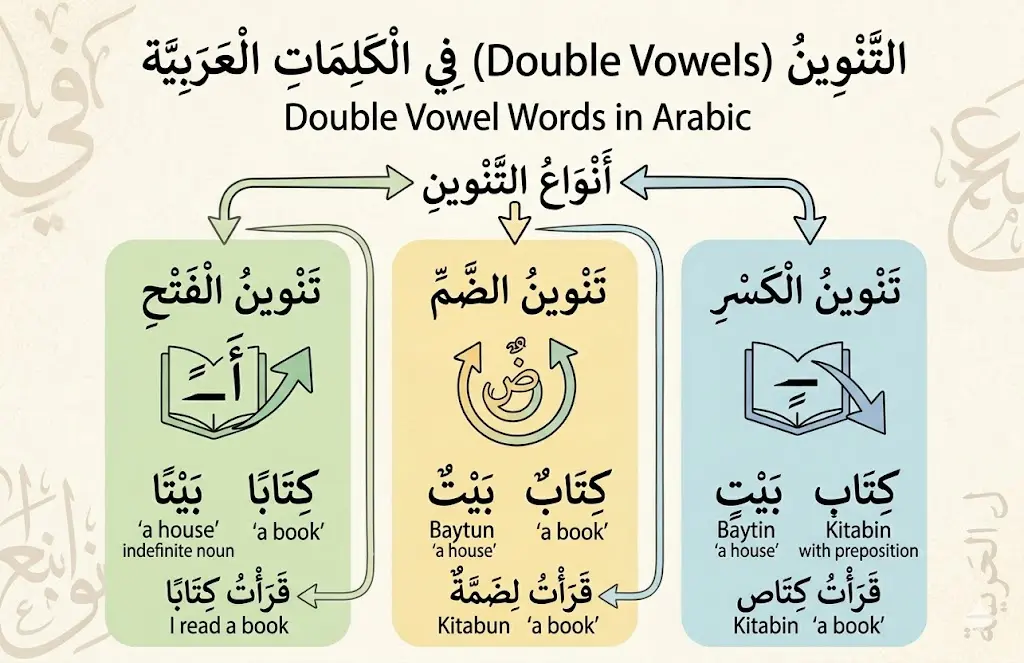
| Tanwin (nunation) is the Arabic double vowel system, adding an “n” sound to word endings via three forms: double fatha, double kasra, or double damma. |
| Double fatha (fathatan ـً) marks indefinite nouns in the accusative case and is the only tanwin form written with an extra alif in most words. |
| Double damma (dammatan ـٌ) marks indefinite nouns in the nominative case — the subject position — and sounds like the English “un” added to a word. |
| Double kasra (kasratan ـٍ) marks indefinite nouns in the genitive case, appearing after prepositions and in possessive constructions throughout Modern Standard Arabic. |
When adult learners first encounter Arabic vowel markings, the short vowels — fatha, kasra, damma — feel manageable. Then the doubled versions appear, and the questions begin: Why are there two marks? What’s the extra “n” sound for? Why does this one need an alif? These reactions are completely normal, and we hear them regularly in our sessions at Buruj Academy.
Double vowel words in Arabic use a system called Tanwin (التنوين), meaning “nunation” — the addition of an “n” sound to indefinite nouns. Mastering the three tanwin forms — double fatha, double kasra, and double damma — unlocks your ability to read, write, and understand Arabic noun cases with accuracy.
Table of Contents:
What Is Tanwin in Arabic?
Tanwin is a grammatical marker placed at the end of indefinite Arabic nouns to signal their grammatical case. Tanwin consists of doubling one of the three short vowel signs — fatha (ـَ), kasra (ـِ), or damma (ـُ) — and produces an “n” sound when the word is pronounced. For example, the word كِتَاب (kitāb, “a book”) becomes كِتَابٌ (kitābun) in the nominative case with double damma.
Tanwin only appears on indefinite nouns — nouns without the definite article الـ (al-). The moment you add الـ to a word, the tanwin drops completely.
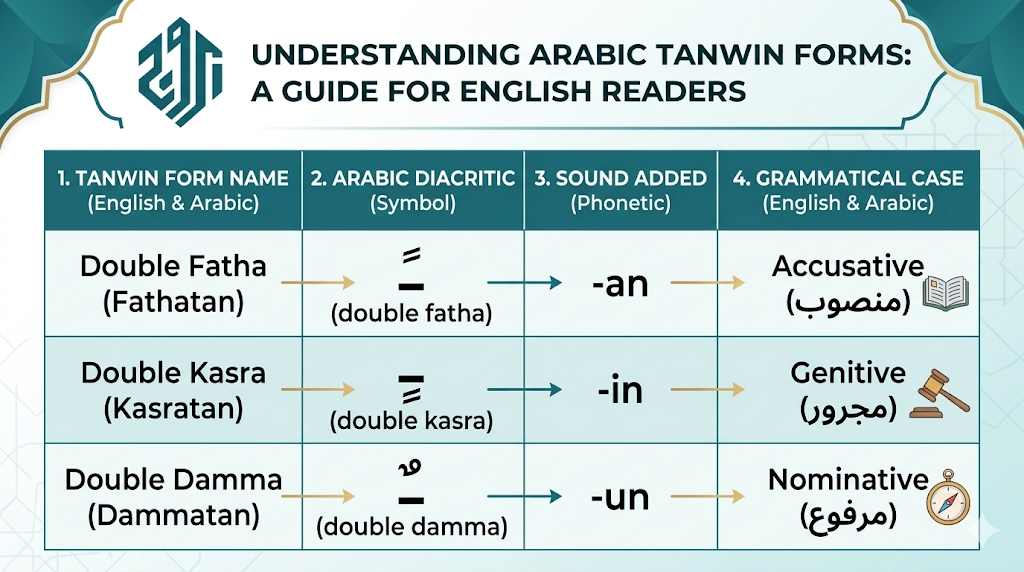
The three tanwin forms correspond directly to the three Arabic grammatical cases:
| Tanwin Form | Arabic Symbol | Sound Added | Grammatical Case |
| Double Fatha (Fathatan) | ـً | “-an” | Accusative (منصوب) |
| Double Kasra (Kasratan) | ـٍ | “-in” | Genitive (مجرور) |
| Double Damma (Dammatan) | ـٌ | “-un” | Nominative (مرفوع) |
Each form does a specific grammatical job, and learning which one to use depends on where the noun sits within an Arabic sentence.
1. Double Damma in Arabic
Double damma (ـٌ), called dammatan or tanwin al-dhamm, is placed on indefinite nouns functioning as the subject (مبتدأ or فاعل) of a sentence. It sounds like adding “-un” to the end of a word and appears as two small comma-shaped marks stacked above the final letter.
In our Online Arabic Classes, this is often the first tanwin form we introduce, because identifying the subject is the most natural starting point for understanding sentence structure.
Double damma answers the question: Who or what is performing the action, or what is being described?
Book your FREE Arabic trial online Arabic class at Buruj

Double Damma Examples in Arabic Words
| Arabic Word | Transliteration | Meaning | Role |
| بَيْتٌ | baytun | a house | Indefinite subject noun |
| رَجُلٌ | rajulun | a man | Indefinite subject noun |
| كَلْبٌ | kalbun | a dog | Indefinite subject noun |
| طَالِبٌ | ṭālibun | a student | Indefinite subject noun |
| مَدْرَسَةٌ | madrasatun | a school | Indefinite subject noun |
A complete sentence using double damma: بَيْتٌ كَبِيرٌ (baytun kabīrun) — “A house is big.” Both the noun and the adjective take double damma because both are indefinite and in the nominative position.
2. Double Kasra in Arabic
Double kasra (ـٍ), called kasratan or tanwin al-kasr, marks indefinite nouns in the genitive case (مجرور). It sounds like adding “-in” to a word’s end. Genitive nouns appear after Arabic prepositions (حروف الجر) such as:
فِي (in), مِنْ (from), إِلَى (to), عَلَى (on), بِ (with/by), لِ (for).
They also appear as the second noun in possessive constructions called إضافة (iḍāfa). Understanding where double kasra appears requires some familiarity with Arabic sentence structure, particularly how prepositions govern the nouns that follow them.
Double Kasra Examples in Arabic Sentences
| Arabic Phrase | Transliteration | Meaning |
| فِي بَيْتٍ | fī baytin | in a house |
| مِنْ مَدِينَةٍ | min madīnatin | from a city |
| عَلَى طَاوِلَةٍ | ‘alā ṭāwilatin | on a table |
| إِلَى مَدْرَسَةٍ | ilā madrasatin | to a school |
| مَعَ طَالِبٍ | ma’a ṭālibin | with a student |
One experience signal worth sharing: students at Buruj Academy consistently misread double kasra as simply a low kasra when they first encounter it in texts.
The reason is visual — two marks placed close together below the letter can look like one thick mark at a glance.
Training yourself to slow down and distinguish single from double diacritics is a foundational reading habit we emphasize from week one of our Arabic reading course.
Read Arabic fluently with a free Buruj trial

3. Double Fatha in Arabic
Double fatha (ـً), called fathatan or tanwin al-fatḥ, marks indefinite nouns in the accusative case (منصوب). It sounds like adding “-an” to a word. Double fatha is the most visually distinctive tanwin form for one important reason: in most words, it is written with an extra alif after the final letter.
So the word كِتَاب (kitāb) becomes كِتَابًا (kitāban) — not كِتَابً. This alif is not pronounced as a vowel; it is a spelling convention specific to double fatha.
There are exceptions, such as words ending in taa marbuta (ةً) or alif maqsura (ىً), which take the double marks without an added alif.
When Does Double Fatha Appear?
The accusative case covers a wide range of grammatical functions. The most common include:
| Function | Arabic Term | Example | Meaning |
| Direct object | مفعول به | قَرَأَ كِتَابًا | He read a book |
| Adverb of manner | حال | جَاءَ سَرِيعًا | He came quickly |
| Absolute object | مفعول مطلق | ضَرَبَ ضَرْبًا | He struck a striking |
| Adverb of reason | مفعول لأجله | جِئْتُ حُبًّا | I came out of love |
Double Fatha Words with Examples and Meaning
| Arabic Word | Transliteration | Meaning in Accusative Use |
| كِتَابًا | kitāban | a book (as object) |
| وَلَدًا | waladan | a boy (as object) |
| سَرِيعًا | sarī’an | quickly (as adverb) |
| شُكْرًا | shukran | thank you (frozen form) |
| أَيْضًا | ayḍan | also (frozen form) |
Notice that شُكْرًا (shukran, “thank you”) and أَيْضًا (ayḍan, “also”) are commonly used Arabic expressions frozen in the accusative tanwin form.
Read also: Hollow Verbs in Arabic
Discover the Buruj Academy Difference
Step into our virtual classrooms and see how our expert instructors make learning Quran and Arabic intuitive and clear. We focus on overcoming the specific hurdles non-native speakers face, building your confidence and connection with the Quran.
Master the Arabic Language
Join our expert-led courses and build a strong foundation in Classical and Modern Arabic.
Get Your Free TrialDouble Vowel Words in Arabic for Kids
Teaching double vowels to children requires a different approach from grammar-first instruction. Young learners at Buruj Academy respond best to sound-first exposure — hearing and repeating tanwin endings before seeing the written symbol or understanding the case system. We typically introduce tanwin to children through three stages:
Stage 1 — Sound Recognition: Children hear “-un,” “-in,” and “-an” endings in words they already know. They learn to identify them by ear before touching a pen.
Stage 2 — Symbol Matching: Children match the sounds to the visual symbols on flashcards. Double marks above = “-un” or “-an.” Double marks below = “-in.”
Stage 3 — Word Building: Children add tanwin to simple nouns they know — قَلَمٌ (qalamun, a pen), كُرَّاسَةٌ (kurrāsatun, a notebook) — to see how the vowel changes a word’s grammatical role.
For foundational letter learning before introducing tanwin, our Arabic alphabet learning course ensures children have solid letter recognition before diacritics add complexity. Parents can also explore our Online Arabic Classes for Kids for age-appropriate, step-by-step tanwin instruction.
Book a FREE Arabic trial for your Child

What Happens to Double Vowels When You Add “Al-” (The Definite Article)?
One of the clearest rules in Arabic grammar is this: Tanwin and the definite article الـ (al-) never appear on the same noun simultaneously. When you make a noun definite, the double vowel disappears and is replaced by a single short vowel.
| Indefinite (with Tanwin) | Definite (with Al-) | Meaning Change |
| بَيْتٌ (baytun) | الْبَيْتُ (al-baytu) | a house → the house |
| كِتَابًا (kitāban) | الْكِتَابَ (al-kitāba) | a book → the book |
| مَدْرَسَةٍ (madrasatin) | الْمَدْرَسَةِ (al-madrasati) | a school → the school |
This rule has no exceptions in standard Arabic. It is one of the most reliable tests when proofreading Arabic writing: if a word carries both الـ and a tanwin, one of them is wrong.
Which Arabic Words Cannot Take Tanwin?
Not all Arabic nouns accept tanwin. A category called diptotes (الممنوع من الصرف — al-mamnū’ min al-ṣarf) includes nouns and adjectives that refuse both tanwin and the kasra case ending. Instead, they use a single fatha in both the accusative and genitive cases.
Common patterns of diptotes include proper foreign names (إِبْرَاهِيمُ, Ibrāhīm), words ending in alif + hamza (حَمْرَاءُ, ḥamrā’, “red” feminine), words on the patterns of colours and physical traits (أَحْمَرُ, aḥmaru, “red” masculine), and words following the pattern أَفْعَلُ comparatives.
| Diptote Word | Meaning | Why No Tanwin |
| أَحْمَرُ | red (masc.) | Colour/trait pattern |
| مَسَاجِدُ | mosques | Broken plural pattern |
| إِبْرَاهِيمُ | Ibrahim | Foreign proper name |
| حَمْرَاءُ | red (fem.) | Ends in elongated alif + hamza |
This is one of the areas where learners who try to self-study Arabic often hit a wall. The diptote rules are logical once explained systematically, but they require structured instruction to apply correctly. Our Arabic Grammar course addresses diptotes in dedicated modules with targeted practice exercises.
Understand the Arabic Grammar with Buruj’s free trial lesson
Practice Exercises: Using Double Vowels in Arabic
The best way to internalize tanwin is through active production — reading aloud, filling in blanks, and translating sentences. Here are structured exercises we use in Buruj Academy‘s beginner and intermediate Arabic sessions.
Exercise 1: Identify the Tanwin Type
Read each word and state whether it carries double fatha, double kasra, or double damma:
- مُعَلِّمٌ — teacher
- فِي مَدِينَةٍ — in a city
- قَرَأَ كِتَابًا — he read a book
- وَلَدٌ طَوِيلٌ — a tall boy
- جَلَسَ عَلَى كُرْسِيٍّ — he sat on a chair
Answers: 1. Double damma (dammatan) | 2. Double kasra (kasratan) | 3. Double fatha (fathatan) | 4. Double damma on both words | 5. Double kasra (kasratan)
Exercise 2: Add the Correct Tanwin
Add the correct double vowel to each blank. Use the context clue in brackets:
- جَاءَ _____ (رَجُل) [subject] → رَجُلٌ
- رَأَيْتُ _____ (طِفْل) [direct object] → طِفْلًا
- سَكَنْتُ فِي _____ (شَقَّة) [after preposition] → شَقَّةٍ
- عِنْدِي _____ (قَلَم) [subject of possession] → قَلَمٌ
- ذَهَبَ إِلَى _____ (سُوق) [after preposition] → سُوقٍ
Exercise 3: Translate and Apply
Translate the following sentences and identify the tanwin in each:
| Arabic Sentence | Translation | Tanwin Type Used |
| فِي الْفَصْلِ طَالِبٌ جَدِيدٌ | In the classroom is a new student | Double damma (subject) |
| أَكَلَ الطِّفْلُ تُفَّاحَةً | The child ate an apple | Double fatha (object) |
| وَجَدْتُ الْكِتَابَ عَلَى طَاوِلَةٍ | I found the book on a table | Double kasra (after على) |
These exercises mirror what we use in live sessions to build tanwin fluency. Students who practice reading their answers aloud — not just writing them — internalize the sound patterns 30–40% faster, in our instructors’ experience.
Read also: Arabic Prepositions
Master Arabic Grammar with Buruj Academy’s Expert Instructors
Understanding double vowels is one key step in reading and writing Arabic with accuracy. Mastering the full system requires consistent, expert-guided practice from instructors who understand exactly where non-native speakers struggle.
Buruj Academy’s Arabic Grammar course and Online Arabic Classes are taught by Al-Azhar University graduates with 12+ years of experience teaching non-native speakers.
Our Buruj Method — Context-before-abstraction — means you learn tanwin through real sentences first, not isolated rules.
Every lesson is a personalized 1-on-1 online session with real-time correction and flexible scheduling.
Book your free trial lesson today and start reading Arabic with confidence.
Begin your transformation today by choosing the path that fits your goals:
- Online Arabic Classes (General & Comprehensive)
- Arabic Course for Beginners
- Arabic Alphabet Learning Course
- Online Arabic Classes for Kids
- Arabic Classes for Adults
- Arabic Grammar Course (Nahw & Sarf)
- Intermediate Arabic Course (B1/B2)
- Arabic Speaking Course (Conversational Fluency)
- Arabic Reading Course (Literary Excellence)
- Learn Arabic Writing Course (Calligraphy & Composition)
Ready to speak with confidence? Join the global community at Buruj Academy and book your free placement interview today!
Master the Arabic Language
Join our expert-led courses and build a strong foundation in Classical and Modern Arabic.
Get Your Free TrialConclusion
Double vowels in Arabic are not decorative marks — they carry grammatical meaning that changes how every sentence is read and understood. Double damma identifies subjects, double fatha marks objects and adverbial functions, and double kasra follows prepositions and possessive constructions. Once you learn to recognize them by both sight and sound, your Arabic reading accuracy increases measurably and quickly.
For learners at any stage, the key is regular exposure through real sentences rather than isolated drills. Whether you’re a beginner encountering tanwin for the first time or a parent guiding a child through Arabic foundations, consistent practice with varied examples builds the instinct that grammar explanations alone cannot provide.
Frequently Asked Questions About Double Vowel Words in Arabic
What Is the Difference Between Fatha and Double Fatha in Arabic?
A single fatha (ـَ) is a short vowel producing the “a” sound with no grammatical case implication beyond basic vocalization. Double fatha (ـً), or fathatan, is a tanwin marker adding an “-an” sound and specifically marking indefinite nouns in the accusative case. Double fatha also uniquely requires an added alif in spelling for most words.
Why Does Double Fatha Often Have an Extra Alif in Arabic?
The extra alif after double fatha is a historical spelling convention in Arabic orthography, not a phonetic vowel. It originated in early Arabic manuscript tradition and became standardized in written Arabic. Words ending in taa marbuta (ة) or alif maqsura (ى) are exempt from this rule and take the double marks without the added alif — for example, مَدْرَسَةً (madrasatan) and ذِكْرَى.
Can Children Learn Tanwin Before Learning Full Arabic Grammar?
Yes — and in our experience at Buruj Academy, children benefit from learning tanwin sounds before understanding case theory. The sound patterns “-un,” “-in,” and “-an” are straightforward for young ears, and children can begin reading and writing tanwin-marked words accurately well before formal grammar instruction begins. Our Online Arabic Classes for Kids sequence tanwin introduction precisely this way.