 Islamic
| Key Takeaways |
| Islamic games work best when they pair physical movement or competition with a single learning goal, such as one Surah or one set of Islamic manners. |
| Letter-recognition games like Qaida Bingo and Arabic Alphabet Treasure Hunt build phonetic foundations before children begin formal Tajweed instruction. |
| Memorization games such as Ayah Relay and the Juz Amma Memory Match reinforce retention through repetition disguised as play, not drilling. |
| Board games and printable trackers focused on the Five Pillars help children connect abstract worship concepts to daily, tangible actions. |
| Rotating game formats — matching, racing, building, and role-play — prevents burnout better than repeating one single game type. |
Many parents raising Muslim children in Western countries face the same quiet worry: how do you make Quran and Islamic identity feel as exciting as everything else competing for a child’s attention? Games are often the missing bridge.
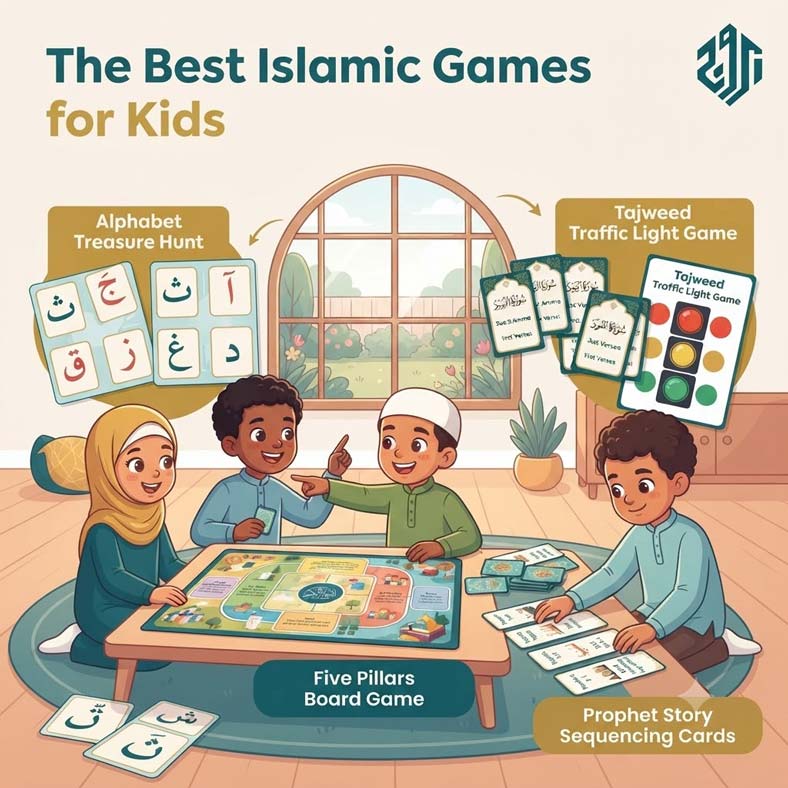
The best Islamic games for kids combine a clear learning target — a Surah, a set of manners, an Arabic letter — with movement, competition, or storytelling.
Below, we outline fifteen games organized by age and skill level that our instructors have found genuinely effective in building lasting Quranic and Islamic knowledge.
Table of Contents:
1. Noorani Qaida Bingo Turns Arabic Letter Recognition Into a Family Competition
Qaida Bingo takes the 28 Arabic letters children encounter in the Noorani Qaida course for kids and turns them into a bingo card game. A caller announces letter names or sounds while players mark matching squares on personalized cards.
To set it up, print bingo cards with random Arabic letters in each square, five across and five down. One family member calls out letters aloud, either by name or by isolated sound, while children scan their cards.
In our sessions, the most common early mistake young beginners make is confusing letters that share a base shape, like Baa, Taa, and Thaa, which differ only in dot placement. Qaida Bingo forces repeated visual scanning that corrects this quickly.
This game pairs naturally with our Noorani Qaida for Kids course, where instructors reinforce the same letters using phonetics-first teaching methods. Playing Qaida Bingo at home between lessons keeps the letters fresh without feeling like additional homework.
Sign up your kid for a free Noorani Qaida lesson
2. The Arabic Alphabet Treasure Hunt Builds Letter Fluency Through Movement
The Arabic Alphabet Treasure Hunt hides printed letter cards around the house or yard, and children search for each one in sequence, calling out the letter name and sound upon discovery. It converts static memorization into an active physical game.
Parents hide 28 laminated letter cards in visible but scattered locations. Children receive a checklist and must find every letter in alphabetical order, pronouncing each correctly before moving to the next.
This activity works particularly well for children who struggle to sit still during traditional Qaida drilling.
In our experience, kinesthetic learners often retain letter sounds faster when the learning is attached to physical searching and discovery rather than repeated seated recitation.
Consider pairing treasure hunts with structured lessons from our Online Quran Classes for Kids, where instructors trained in child pedagogy build on this foundational recognition systematically.
Help your child start learning the Quran with a FREE trial
3. Ayah Relay Race Reinforces Short Surah Memorization Through Team Play
Ayah Relay Race divides children into teams, where each runner must correctly recite one verse of a chosen Surah before tagging the next teammate. It transforms repetitive memorization drilling into an energetic, team-based physical activity.
Choose a short Surah appropriate to the group’s current memorization level, ideally one already introduced through the best age to memorize Quran guidelines.
Each team member recites their assigned Ayah accurately before the relay baton passes forward.
In our sessions at Buruj Academy, we’ve observed that students often memorize verses in isolation but struggle to recall them under any social pressure or time constraint.
Relay races simulate mild pressure in a fun, low-stakes setting, building genuine recall confidence.
This game complements structured guidance from our easy Surahs of Quran to memorize list, ensuring families choose age-appropriate verses before racing.
4. The Five Pillars Board Game Connects Worship Concepts to Daily Actions
The Five Pillars Board Game uses a simple path-and-dice format where players advance by correctly answering questions or completing small tasks tied to Shahada, Salah, Zakat, Sawm, and Hajj. Landing on themed squares triggers action cards, quiz cards, or bonus moves.
Design the board with five colored zones, one per pillar, each containing three to four squares. Question cards ask age-appropriate factual questions, such as naming the five daily prayers in order or explaining why Zakat is given.
A common challenge we notice among children learning the Pillars abstractly is that they memorize the list without connecting each pillar to lived, daily practice. This board game format forces children to link concept and action repeatedly during play.
Our Islamic Studies Classes for Kids expand on this foundation, moving from playful introduction to structured understanding of Fiqh behind each pillar, taught by Al-Azhar University graduate instructors.
The first session is free in Buruj’s Islamic Studies Classes for Kids
5. Prophet Story Sequencing Cards Build Comprehension Beyond Memorization
Prophet Story Sequencing Cards present illustrated scenes from a Prophet’s story in scrambled order, and children must arrange them correctly to reconstruct the narrative sequence. This game develops comprehension skill rather than rote fact recall.
Print six to eight illustrated cards depicting key moments in a chosen Prophet’s story, drawing from resources like our Prophets in Islam for kids guide. Children physically arrange cards chronologically, then narrate the story aloud in their own words.
In our experience teaching young learners, children who only hear Prophet stories passively often forget sequence and cause-effect relationships within weeks. Physically manipulating and reordering cards significantly improves long-term narrative retention.
Our Prophet Muhammad story for kids article offers a strong starting Seerah narrative that adapts well into this sequencing format for beginners.
Discover the Buruj Academy Difference
Step into our virtual classrooms and see how our expert instructors make learning Quran and Arabic intuitive and clear. We focus on overcoming the specific hurdles non-native speakers face, building your confidence and connection with the Quran.
Expand Your Islamic Knowledge
Join our structured online courses led by qualified instructors to deepen your understanding of the Deen.
Join a Free Trial Class6. Juz Amma Memory Match Strengthens Surah Recall Through Repetition
Juz Amma Memory Match uses the classic face-down card matching format, where each pair consists of a Surah name card and its corresponding first-verse card. Children flip two cards per turn, searching for correct matches while unintentionally repeating verse openings dozens of times per session.
Print pairs of cards covering eight to ten short Surahs from Juz Amma, one card showing the Surah name in Arabic and English, the other showing its opening words. Players take turns flipping two cards, keeping matched pairs when successful.
Instructors at Buruj Academy consistently observe that repetitive incidental exposure, such as reading the same opening phrase multiple times while searching for a match, builds recognition faster than isolated flashcard drilling alone.
This game reinforces structured learning from our Juz Amma memorization for kids guide and pairs naturally with our Hifz for Kids course, which uses age-appropriate revision systems for young memorizers.
Start your child’s Hifz classes with a FREE session
7. Islamic Manners Charades Teaches Adab Through Role-Play and Performance
Islamic Manners Charades has children act out specific Islamic etiquette scenarios silently, such as greeting an elder, eating with the right hand, or entering the home saying Salam, while other players guess the correct manner being demonstrated.
Write ten to fifteen Adab scenarios on separate cards, drawn from everyday situations like mealtime, mosque entry, and guest hosting.
One child acts out the scenario without speaking while others shout guesses until someone identifies it correctly.
A pattern we notice frequently is that children can list Islamic manners verbally but fail to apply them consistently in real situations. Acting out the behavior physically, rather than only naming it, reinforces the muscle memory of the action itself.
Our comprehensive guide on Islamic manners provides additional scenario ideas suitable for expanding this game across multiple sessions.
Read also:Islamic Motivation for Kids
8. Tajweed Traffic Light Game Teaches Qalqalah and Stopping Rules Visually
Tajweed Traffic Light Game assigns colors to specific Tajweed actions: green for continuing normal recitation, yellow for slowing down at a Waqf sign, and red for a full stop, often paired with Qalqalah letters. Children hold up colored cards while reading assigned verses aloud.
Prepare a short passage containing Waqf signs and Qalqalah letters (ق ط ب ج د). As children recite, they hold up the matching colored card the instant they reach a relevant marker, reinforcing visual-to-action association.
The most common mistake we see among children learning Qalqalah is stopping the letter abruptly instead of releasing it with the required slight echoing bounce. The traffic light format visually cues the correct pause-and-release timing before the sound is even produced.
This game builds directly on concepts from our Qalqalah letters guide and supports lessons in our Online Tajweed Classes for Children, taught using the Buruj Method’s sound-before-rules approach.
Book your child’s free Tajweed trial lesson today
9. The Iqra Word Race Rewards Fast, Accurate Root Word Recognition
The Iqra Word Race challenges pairs of children to race against a timer, correctly reading aloud a strip of Arabic words or short phrases as fast and accurately as possible, with points deducted for mispronunciation rather than awarded purely for speed.
Prepare word strips containing 10 to 15 vocabulary words appropriate to the child’s current Qaida or Arabic level. Set a 60-second timer per turn, and track both completion time and pronunciation accuracy on a simple scorecard.
Pairing this game with our Online Arabic Classes for Kids builds genuine reading fluency behind the speed, rather than encouraging guessing under time pressure.
Book a FREE Arabic trial for your Child

10. Salah Steps Simon Says Reinforces Prayer Sequence Through Physical Mimicry
Salah Steps Simon Says adapts the classic Simon Says format, where a leader calls out prayer positions such as Qiyam, Ruku, Sujood, and Tashahhud, and children must perform the correct physical position only when the leader says “Simon says” first.
The leader calls positions randomly and quickly, occasionally omitting the “Simon says” prefix to catch children performing an incorrect or premature movement. Children who move incorrectly sit out one round.
In our observation of young beginners, physical sequence errors during Salah, such as rushing from Ruku directly to Sujood, often persist because children rarely practice the transitions in isolation from full prayer. This game isolates and drills just the transitions.
Read also:How to Teach a Child to Pray in Islam
11. Dua Memory Chain Builds a Growing Repertoire of Daily Supplications
Dua Memory Chain has each player repeat every previously recited Dua in order before adding a new one, similar to the classic “I packed my suitcase” memory game format. The chain grows longer each round, testing cumulative recall.
Start with a short, commonly used Dua, such as the one for entering the home or before eating. Each subsequent player must recite all prior Duas correctly, in sequence, before introducing the next one from an agreed list.
A recurring pattern we notice is that children learn daily Duas individually but rarely connect them into an integrated daily routine. This cumulative chain format mirrors how Duas actually function across a real day, reinforcing sequence alongside content.
Explore our Islamic topics for kids and youth resource for a starter list of essential daily Duas appropriate for this memory chain format.
12. Quran Trivia Jeopardy Rewards Deeper Comprehension Beyond Recitation
Quran Trivia Jeopardy organizes questions into categories such as Prophet Stories, Surah Facts, Tajweed Rules, and Islamic History, with point values increasing by difficulty. Teams select a category and point value, then answer within a set time limit.
Build a simple grid with four to five categories and point values from 100 to 500. Base questions on content children have already studied, such as facts drawn from our Quran facts for kids collection.
We’ve found in our teaching that trivia formats reveal comprehension gaps invisible during standard recitation practice, since a child can recite a verse perfectly while misunderstanding its meaning or context entirely.
Learn Islamic Games That Build Real Quranic and Faith Foundations with Buruj Academy
Games open the door, but consistent instruction is what builds lasting Quranic fluency and Islamic understanding in children. Buruj Academy offers personalized pathways that turn playful curiosity into structured, lasting knowledge.
Our Ijazah-certified instructors and Al-Azhar University graduates bring over 12 years of experience teaching non-Arabic speaking children worldwide. The Buruj Method — sound-before-rules, context-before-abstraction, consistency-before-speed — guides every lesson.
Whether your child needs the Online Quran Classes for Kids, our Hifz for Kids program, or foundational Noorani Qaida course, our instructors build personalized learning plans matched to your child’s age and pace.
Book a free trial lesson today and see how structured, expert instruction complements the games your family already loves.
Join a global community of learners and find the path that best supports your spiritual and intellectual growth:
- Online Studies Islamic Classes (General & Flexible)
- Islamic Studies Course for Beginners (Foundational Knowledge)
- Islamic Studies Classes for Kids (Engaging & Values-Based)
- Islamic Studies Classes for Adults (In-Depth Theological Discussion)
- Islamic Studies Classes for Ladies (Sisterhood & Specialized Learning)
- Islamic Studies Classes for New Muslims (Guided Support & Essentials)
- Tafseer Al Quran Course (Unlocking Divine Meanings)
- Quranic Sciences (Uloom Al Quran) Course (Advanced Linguistic & Historical Context)
Ready to enrich your life with sacred knowledge? Connect with Buruj Academy today and book your free introductory session to begin your journey!
Discover the Buruj Academy Difference
Step into our virtual classrooms and see how our expert instructors make learning Quran and Arabic intuitive and clear. We focus on overcoming the specific hurdles non-native speakers face, building your confidence and connection with the Quran.
Expand Your Islamic Knowledge
Join our structured online courses led by qualified instructors to deepen your understanding of the Deen.
Join a Free Trial ClassConclusion
Play is not a distraction from serious Quranic learning — it is often the very mechanism that makes memorization, letter recognition, and Islamic manners stick. The strongest results come from rotating game formats regularly rather than repeating a single favorite indefinitely, since variety keeps recall pathways active across different senses and contexts.
Pairing home games with structured instruction gives children both the joy of discovery and the correction only a qualified teacher can offer, ensuring Tajweed habits, Arabic pronunciation, and comprehension develop accurately from the start rather than needing to be unlearned later.
Frequently Asked Questions About Islamic Games for Kids
What Age Should Children Start Playing Islamic Learning Games?
Most children can begin simple Islamic games, such as letter matching or Dua chains, around age four or five. In our experience, games involving Tajweed concepts like Ghunnah or Qalqalah work best once formal Qaida instruction has already begun, typically around age six or seven.
How Often Should Families Play Islamic Games with Kids?
Two to three short sessions weekly, lasting 15 to 20 minutes each, tend to produce stronger retention than infrequent, longer sessions. Consistency matters more than duration, since spaced repetition through games reinforces memory far better than occasional marathon play.
Can Islamic Games Replace Formal Quran or Tajweed Instruction?
No, games reinforce and make learning enjoyable, but they cannot replace correction from a qualified instructor. Tajweed articulation errors, in particular, require live, real-time correction that only a trained teacher listening closely can reliably provide.
Are These Games Suitable for Homeschooling Muslim Families?
Yes, most of these games integrate well into a homeschool schedule as review activities between formal lessons. Many families use them specifically to reinforce material already introduced through structured courses, keeping retention active between sessions.
What Materials Are Needed to Start Playing These Islamic Games?
Most games require only printed cards, a die, or basic household items families likely already own. None require specialized equipment, making these games accessible and low-cost for families just beginning their child’s Islamic education journey.