 Quran
Quran
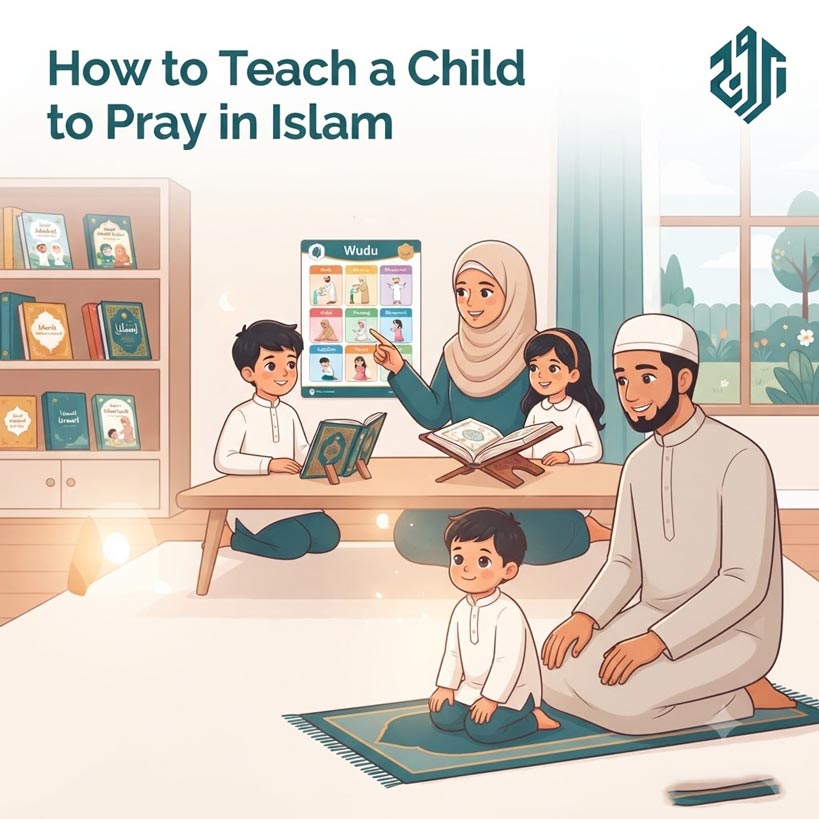
Many parents raising Muslim children in the West feel the weight of this responsibility alone, especially without a local community reinforcing daily prayer habits at home.
The good news is that teaching a child to pray follows a clear, gradual sequence — one that Al-Azhar-trained instructors have refined over years of guiding families through exactly this process, step by step, from first exposure to independent practice.
Table of Contents:
Step 1: Introduce the Concept of Prayer Through Simple Imitation Around Age Three
Prayer instruction begins long before children understand its meaning, through quiet exposure rather than formal lessons. Toddlers around age three benefit most from simply watching a parent pray and being invited to stand nearby.
This stage is about familiarity, not correctness — there is no pressure for accurate movements yet.
In our sessions at Buruj Academy, we consistently observe that children who are physically present during family prayer from this early age transition into formal instruction with far less resistance later on. They already associate the prayer mat with something calm and normal, rather than something new and demanding.
Keep a small prayer mat next to yours during your own Salah. Let your child mimic your standing, bowing, and prostration positions without correcting the details.
Islamic studies instructors at Buruj Academy often describe this stage as “planting the seed” — the goal is emotional association, not technical accuracy.
For structured guidance on introducing broader Islamic concepts alongside prayer, our Islamic Studies Classes for Kids course covers this foundational stage in depth.
The first session is free in Buruj’s Islamic Studies Classes for Kids

Step 2: Teach the Meaning and Importance of Salah Before Teaching the Movements
Children retain prayer habits far longer when they understand why they are praying, not just how. A short, age-appropriate explanation — that Salah is how Muslims speak directly to Allah five times a day — should precede any movement instruction.
Luqman’s advice to his son in the Quran offers a natural teaching anchor for this stage:
يَا بُنَيَّ أَقِمِ الصَّلَاةَ وَأْمُرْ بِالْمَعْرُوفِ وَٱنْهَ عَنِ ٱلْمُنكَرِ وَٱصْبِرْ عَلَىٰ مَآ أَصَابَكَ ۖ إِنَّ ذَٰلِكَ مِنْ عَزْمِ ٱلْأُمُورِ
Ya bunayya aqimis-salata wa’mur bil-ma’rufi wanha ‘anil-munkari wasbir ‘ala ma asabak, inna dhalika min ‘azmil-umur
“O my son, establish prayer, enjoin what is right, forbid what is wrong, and be patient over what befalls you. Indeed, [all] that is of the matters [requiring] determination.” (Luqman 31:17)
This verse models exactly how a parent should introduce Salah — direct, personal address rooted in love, not obligation alone.
We often tell parents that this single verse does more pedagogical work than any worksheet. It frames prayer as a father’s loving instruction, which is precisely the tone this stage requires.
Read also: The Islamic Way of Raising a Child
Step 3: Teach Wudu as a Separate, Standalone Skill Before Combining It With Prayer
Wudu should be taught and practiced independently for one to two weeks before it is ever combined with the prayer sequence itself. Layering two new skills at once overwhelms most children between ages four and six.
Break wudu into its individual steps: washing hands, rinsing the mouth, washing the face, arms, wiping the head, and washing the feet. Practice each step at the sink during regular handwashing, not only before Salah.
Islamic studies instructors at Buruj Academy find that children who master wudu as a standalone habit — say, by making it part of the bedtime or morning routine — internalize it far more securely than those who only encounter it right before prayer time.
| Wudu Step | Common Child Error | Correction Technique |
| Rinsing mouth | Skips or rushes | Count to three aloud together |
| Washing arms | Stops below elbow | Mark elbow with a wristband cue |
| Wiping head | Wipes only forehead | Guide hand from front to back once |
This table reflects patterns we see repeatedly during early wudu instruction. None of these errors indicate a lack of ability — they simply reflect a skill still being formed.
Read also:How the Quran Teaches Parents to Discipline Children
Step 4: Teach the Physical Movements of Salah Using Short, Repeated Practice Sessions
The physical sequence of Salah — standing, bowing, prostrating, and sitting — should be taught in five-minute sessions repeated daily rather than in one long lesson. Short bursts of practice build muscle memory without triggering fatigue or frustration in young learners.
Demonstrate one position at a time: Qiyam (standing), Ruku (bowing), Sujood (prostration), and Juloos (sitting). Have your child copy each position immediately after you, correcting gently and only one detail per session.
Before introducing the Buruj Method’s structured movement sequencing, most students we teach mix up the order of Ruku and Sujood or forget to pause between positions. This is completely typical for children under seven and resolves quickly with repetition.
Our Online Quran Classes for Kids course integrates this movement practice alongside early Quran reading for families who want both taught together.
Help your child start learning the Quran with a FREE trial

Step 5: Teach Al-Fatihah and One Short Surah Before Attempting a Full Prayer
A child needs at least Surah Al-Fatihah and one short surah memorized with reasonable accuracy before attempting to combine recitation with movement. Attempting a full prayer without this foundation causes children to freeze mid-sequence, which damages confidence.
Surah Al-Ikhlas or Surah Al-Kawthar are commonly taught first due to their brevity and repetitive structure, making them accessible even for children just beginning memorization.
Our guide on easy surahs of the Quran to memorize outlines several strong starting options in more depth.
In our experience, children typically need two to three weeks of short daily sessions to memorize Al-Fatihah with acceptable pronunciation, though this varies by age and prior exposure to Arabic sounds.
Families beginning this stage often benefit from parallel instruction in tajweed for beginners, which reinforces correct pronunciation from the start rather than requiring correction later.
Step 6: Combine Movements and Recitation Into One Complete Rak’ah Before Attempting a Full Prayer
Once wudu, movements, and recitation are each secure individually, combine them into a single complete Rak’ah before attempting the full two-, three-, or four-Rak’ah prayer. This intermediate step prevents the overwhelm that comes from introducing every element simultaneously.
Walk through one Rak’ah slowly together, narrating each transition aloud: “Now we say Allahu Akbar and go into Ruku.” Repeat this single Rak’ah daily for several days before adding a second.
Consistency-before-speed is a principle we return to constantly at this stage. A child who prays one accurate Rak’ah confidently is far better positioned than one rushed through four incomplete ones.
Read also: Essential Quran Ayat About Prayer
Step 7: Formally Command Daily Prayer at Age Seven, Following the Prophetic Guidance
Islamic scholarship establishes age seven as the point when parents should begin formally and consistently instructing children to pray, based on explicit Prophetic guidance. This marks a shift from voluntary practice to an expected daily habit.
The Prophet ﷺ said:
“Command your children to pray when they become seven years old, and beat them for it (prayer) when they become ten years old; and arrange their beds (to sleep) separately.” (Sunan Abi Dawud 495)
Classical scholars explain the second clause within strict limits: correction must be non-harmful, age-appropriate, and a last resort after gentler methods, and is meant to instill discipline, never distress.
At Buruj Academy, we consistently emphasize the first clause to parents far more than the second. Commanding prayer at seven means establishing daily reminders, routine, and gentle accountability — not sudden strictness.
Most families find that a consistent evening check-in, paired with genuine praise for effort, achieves far more than pressure ever does.
Read also:The Islamic Way to Boost Children’s Brain
Discover the Buruj Academy Difference
Step into our virtual classrooms and see how our expert instructors make learning Quran and Arabic intuitive and clear. We focus on overcoming the specific hurdles non-native speakers face, building your confidence and connection with the Quran.
Expand Your Islamic Knowledge
Join our structured online courses led by qualified instructors to deepen your understanding of the Deen.
Join a Free Trial ClassStep 8: Build Consistency Through Family Prayer Routines Rather Than Individual Reminders
Children between ages seven and ten build lasting prayer habits far more reliably through shared family routines than through individual parental reminders alone. Praying Maghrib or Isha together as a household normalizes the practice as simply part of daily life.
Set a fixed time — even just one prayer daily — where the whole family prays together, ideally led visibly by a parent. Children model behavior far more than they respond to verbal instruction at this age.
We have observed that families who maintain even one consistent shared prayer daily see significantly stronger independent practice from their children by age ten, compared to families relying solely on individual reminders.
Our article on keeping Islamic identity for kids explores how routines like this support broader religious identity in Western environments.
Step 9: Use Positive Reinforcement and Prayer Tracking Tools to Sustain Motivation
Children between ages seven and twelve respond strongly to visible, tangible progress markers rather than abstract encouragement alone. A simple prayer tracker — a chart, sticker system, or checklist — gives children ownership over their own consistency.
Avoid tying rewards directly to religious obligation in a transactional way; instead, frame tracking as a tool for self-awareness, similar to how a child tracks reading progress. Celebrate streaks of consistency rather than punishing individual missed prayers.
Islamic studies instructors at Buruj Academy find that children who track their own prayers, even informally, develop a stronger internal sense of ownership over Salah by the time formal accountability begins.
Pairing this with engaging content, such as our Quranic games and activities for kids, keeps the broader learning environment enjoyable rather than purely obligatory.
Book Your Kid a Free Trial Lesson With One of Buruj’s Islamic Studies Instructors’ Children

Step 10: Address Setbacks and Plateaus With Patience Rather Than Punishment
Every child experiences periods of resistance, forgetfulness, or reduced enthusiasm toward prayer, and this is a normal part of the learning process rather than a failure. Reacting with frustration typically deepens resistance rather than resolving it.
When a child skips prayer or resists practice, address the pattern calmly rather than the single incident. Ask what specifically feels difficult — timing, tiredness, or lack of understanding — before assuming defiance.
Patience-before-performance guides how we coach parents through these plateaus. A child who prays imperfectly but consistently at age nine is on a far stronger trajectory than one pushed toward perfection who quietly begins avoiding prayer altogether.
Read also:Best Websites to Learn Quran Online for kids
Step 11: Strengthen Prayer Learning With Structured Quran and Tajweed Instruction
Prayer recitation quality improves significantly once children receive structured Quran and Tajweed instruction rather than relying solely on parent-led memorization. Correct pronunciation from a qualified teacher prevents habits that become harder to correct later.
At Buruj Academy, our Online Quran Classes for Kids use age-appropriate gamification and engaging methods to make Quran learning enjoyable for children aged four to fifteen, guided by instructors trained in child pedagogy.
Structured lessons complement the home-based routines outlined in this guide rather than replacing them.
Families often pair this with our resource on how to make reading Quran fun for kids, which offers additional engagement strategies for the recitation side of prayer preparation.
Step 12: Build a Foundation for Independent, Lifelong Prayer Through Gradual Release
By ages ten to twelve, children should be gradually transitioning from parent-guided prayer to independent practice with light parental oversight. This final stage is about stepping back deliberately rather than continuing constant supervision.
Shift from performing wudu and prayer alongside your child to simply confirming it happened, then eventually to trusting the established habit entirely. Praise independence explicitly when you notice it.
This gradual release mirrors how the Buruj Method approaches every subject — building genuine internal ownership rather than external dependence on parental presence, so the habit survives well beyond childhood supervision.
Read also: Best Bedtime Quran Stories for Kids
Master Prayer Instruction With Buruj Academy’s Expert Teaching Team
Teaching a child to pray is a gradual, structured process — one that becomes far more manageable with expert guidance rather than guesswork alone.
Buruj Academy’s Online Islamic Studies Classes for Kids provide exactly this structure, led by Al-Azhar University graduates with 9+ years of Islamic education experience.
Our instructors use the Buruj Method — Sound-before-rules, Context-before-abstraction, Consistency-before-speed — across personalized 1-on-1 sessions tailored to your child’s age and pace.
With flexible 24/7 scheduling and real-time correction from Ijazah-certified instructors, families worldwide build lasting prayer habits without pressure or guesswork.
Ready to give your child expert guidance in their prayer journey? Book a free trial lesson with Buruj Academy today.
Join a global community of learners and find the path that best supports your spiritual and intellectual growth:
- Online Studies Islamic Classes (General & Flexible)
- Islamic Studies Course for Beginners (Foundational Knowledge)
- Islamic Studies Classes for Kids (Engaging & Values-Based)
- Islamic Studies Classes for Adults (In-Depth Theological Discussion)
- Islamic Studies Classes for Ladies (Sisterhood & Specialized Learning)
- Islamic Studies Classes for New Muslims (Guided Support & Essentials)
- Tafseer Al Quran Course (Unlocking Divine Meanings)
- Quranic Sciences (Uloom Al Quran) Course (Advanced Linguistic & Historical Context)
Ready to enrich your life with sacred knowledge? Connect with Buruj Academy today and book your free introductory session to begin your journey!
Expand Your Islamic Knowledge
Join our structured online courses led by qualified instructors to deepen your understanding of the Deen.
Join a Free Trial ClassConclusion
Teaching a child to pray is not a single conversation but a gradual sequence — imitation, meaning, wudu, movement, recitation, and finally independence — built patiently over years rather than weeks. Each stage prepares the next, and skipping ahead usually costs families more time than it saves.
What matters most is consistency delivered with warmth, not early perfection. A child who prays imperfectly but happily today is far more likely to pray faithfully, and independently, for a lifetime.
Frequently Asked Questions About Teaching Children to Pray in Islam
What Age Should a Muslim Child Start Learning to Pray?
Most scholars recommend introducing prayer informally around age three through imitation, with formal instruction beginning gradually between ages five and six. Formal commanding of daily prayer begins at age seven, based on the Prophet’s ﷺ guidance in Sunan Abi Dawud 495.
How Do You Teach a Toddler to Pray?
Toddlers learn best through quiet imitation rather than instruction. Let them stand beside you during Salah, copy your positions loosely, and associate the prayer mat with calm, positive routine, without correcting technical accuracy at this stage.
What Surahs Should a Child Memorize First for Prayer?
Short, repetitive surahs like Al-Ikhlas or Al-Kawthar are typically taught first, alongside Al-Fatihah, which is required in every Rak’ah. Our guide to easy surahs to memorize offers additional beginner-friendly options.
How Long Does It Take a Child to Learn the Full Prayer?
Timelines vary by age and consistency, but most children who practice short daily sessions learn a complete, confident Rak’ah within four to six weeks, with full prayer fluency typically developing over several months of continued practice.
What Should Parents Do If Their Child Refuses to Pray?
Address resistance calmly by identifying the underlying cause — fatigue, confusion, or overwhelm — rather than reacting to the refusal itself. Consistent, pressure-free family prayer routines typically resolve resistance far more effectively than punishment.