 Tajweed
| Key Takeaways |
| Makhraj (plural: makharij) refers to the precise articulation point where each Arabic letter originates in the vocal tract. |
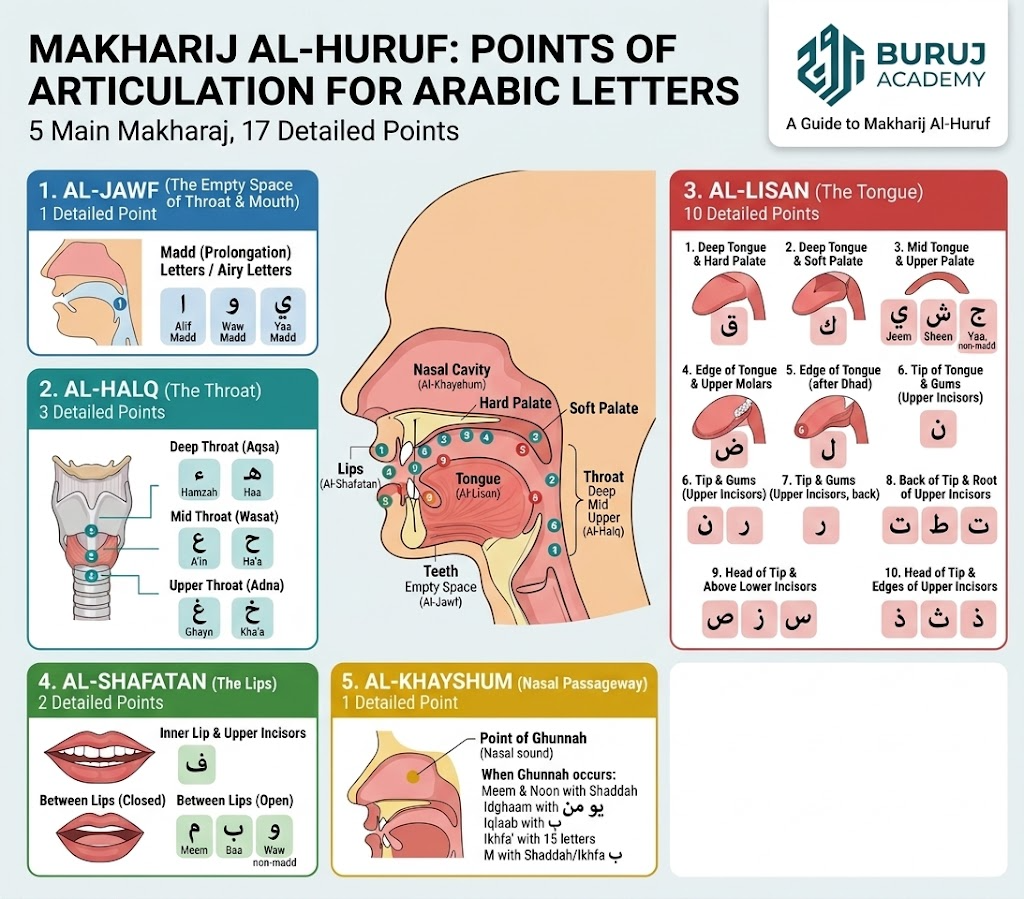
| Classical Tajweed scholarship identifies 17 detailed articulation points grouped under 5 primary regions of the mouth and throat. |
| The tongue alone contains 10 distinct makharij producing 18 different Arabic letters, making it the most complex articulation organ. |
| Makhraj accuracy directly determines whether a Quranic word changes meaning — mispronouncing ع (Ayn) as أ (Hamza) is a recitation error. |
| Ghunnah is the only letter attribute (sifah) with its own independent makhraj — the nasal cavity — separate from Noon and Meem’s primary points. |
Reciting the Quran is an act of worship — and like all worship, precision matters. One of the most common struggles we see among non-Arabic speaking students is reciting letters that sound correct to untrained ears but originate from entirely the wrong position in the mouth or throat.
Tajweed and makhraj rules are inseparable. Makhraj is the anatomical foundation — the specific point in the vocal tract where a letter is born.
Without accurate makharij, every Tajweed rule applied on top is built on an unstable base. Understanding both together is what separates beautiful recitation from merely correct-sounding recitation.
Table of Contents:
What Are Makharij Al-Huruf in Tajweed?
Makharij al-huruf (مَخَارِجُ الحُرُوف) are the precise articulation points from which each Arabic letter originates. In classical Tajweed scholarship, scholars have identified 17 detailed articulation points housed within 5 primary regions of the vocal tract. Every Arabic letter belongs to exactly one of these 17 points.
This precision is not academic. When a student mispronounces the letter خ (Kha) as ح (Ha), or confuses ع (Ayn) with أ (Hamza), the word’s meaning often changes entirely.
Our Al-Azhar-trained instructors at Buruj Academy consistently identify makhraj errors as the root cause of recitation mistakes that students had practiced incorrectly for years.
If you are beginning your Tajweed study, our Tajweed for Beginners course addresses makharij systematically before introducing any rules — because correct articulation must come before rule application.
Book Your FREE Trial Lesson to Begin Your Tajweed Journey
How Many Makharij Are There in Tajweed?
Tajweed scholars identify 17 detailed (tafseeli) makharij organized under 5 primary (ra’eesiyyah) makharij. This is the dominant position in classical scholarship, though some scholars counted 16 or 14 by grouping certain points differently.
The table below gives a complete structural overview:
| Primary Makhraj | Number of Detailed Points | Letters Produced |
| Al-Jawf (the oral cavity) | 1 | ا، و، ي (long vowel letters) |
| Al-Halq (the throat) | 3 | ء، هـ، ع، ح، غ، خ |
| Al-Lisan (the tongue) | 10 | ق، ك، ج، ش، ي، ض، ل، ن، ر، ط، د، ت، س، ص، ز، ث، ذ، ظ |
| Al-Shafatan (the two lips) | 2 | ب، م، و، ف |
| Al-Khayshum (the nasal cavity) | 1 | Ghunnah only |
Each of these regions has distinct anatomical characteristics that determine the letter’s sound quality — its resonance, strength, and phonetic relationship to surrounding letters.
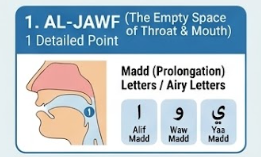
1. Al-Jawf: The Articulation Point of the Three Madd Letters
Al-Jawf (الجَوْف) refers to the open空间 — the extended empty space from behind the throat through the oral cavity. It is the articulation region for the three letters of natural extension (madd):
- ا — the silent Alif preceded by a Fathah (ـَا)
- و — the silent Waw preceded by a Dhammah (ـُو)
- ي — the silent Ya preceded by a Kasrah (ـِي)
These three letters appear together in the word نُوحِيهَا in the verse:
تِلْكَ مِنْ أَنبَاءِ الْغَيْبِ نُوحِيهَا إِلَيْكَ
Tilka min anba’il-ghaybi nooheehaa ilayk
“That is from the news of the unseen which We reveal to you.” (Aal Imran 3:44)
(This verse is traditionally used by scholars to demonstrate all three madd letters in a single word — نُوحِيهَا contains Waw madd and Ya madd together.)
Al-Jawf is described as a taqdeeri (estimative) makhraj — meaning these letters have no fixed contact point. They begin in the throat and extend until the sound ends naturally in the air.
This is precisely why madd letters require a held, sustained sound rather than a quick release. For a full treatment of natural extension, see our article on Madd Asli.
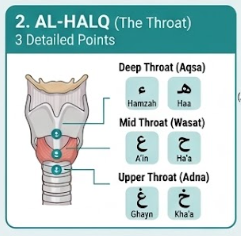
2. Al-Halq: The Three Throat Articulation Points
The throat (الحَلْق) contains 3 distinct makharij producing 6 letters. Students frequently confuse letter pairs within this region because they sound similar to untrained ears. The anatomical distinctions, however, are precise.
Aqsa Al-Halq: The Deepest Throat Point
The deepest throat region — closest to the chest — produces Hamza (أ) and Ha (هـ). Hamza originates slightly deeper than Ha. Both require the throat to close and reopen, which is why Hamza produces that characteristic glottal stop.
Wasat Al-Halq: The Middle Throat Point
The middle throat produces Ayn (ع) and Ha (ح). Ayn originates slightly deeper than Ha. This is one of the most challenging pairs for non-Arabic speakers — Ayn requires constriction of the middle throat with voiced airflow, while Ha is its unvoiced counterpart.
Adna Al-Halq: The Closest Throat Point
The throat region nearest the mouth produces Ghayn (غ) and Kha (خ). Kha is closer to the mouth than Ghayn. Both involve the back of the tongue rising toward the throat — Ghayn with voice, Kha without.
| Throat Region | Letters | Key Distinction |
| Aqsa (deepest) | أ، هـ | Hamza deeper than Ha |
| Wasat (middle) | ع، ح | Ayn deeper than Ha; Ayn voiced, Ha unvoiced |
| Adna (closest) | غ، خ | Kha closer to mouth; Ghayn voiced, Kha unvoiced |
In our experience at Buruj Academy, students learning the throat letters almost always conflate ح (Ha) with the English “h” sound.
Read also: What is the Difference Between Tajweed and Qirat?
The English “h” is purely aspirated air with no throat constriction — the Arabic ح requires deliberate middle-throat narrowing that produces a distinct friction. This correction alone significantly improves recitation quality within the first few sessions.
When you enroll in our Online Tajweed Classes, this foundational understanding shapes everything that follows.
Book Your FREE Trial Lesson to Begin Your Tajweed Journey

read also: What is the Difference Between Tajweed and Tafseer?
3. Al-Lisan: The Ten Tongue Articulation Points
The tongue (اللِّسَان) is the most complex articulation organ in Arabic phonology. It produces 18 letters across 10 distinct points — more than any other primary makhraj. Understanding which part of the tongue contacts which surface is essential for Tajweed accuracy.
Aqsa Al-Lisan: The Back Tongue — Qaf and Kaf
The furthest back of the tongue, meeting the upper palate, produces Qaf (ق). Slightly forward from that same back-tongue region — with the tongue positioned a fraction closer to the mouth — produces Kaf (ك).
Both involve the back tongue rising to contact the upper palate, but Qaf is deeper and Kaf is slightly anterior.
Wasat Al-Lisan: The Middle Tongue — Jeem, Sheen, and Ya
The middle of the tongue meeting the upper gum ridge produces three letters: Jeem (ج), Sheen (ش), and non-madd Ya (ي). Jeem requires complete contact between the middle tongue and upper palate.
Sheen and non-madd Ya use the same region but with a slight gap — the tongue does not fully contact the palate, allowing air to flow through.
Hafat Al-Lisan: The Tongue Edge — Dhad
Dhad (ض) is famously described as the most difficult Arabic letter to articulate correctly. It emerges from one or both edges of the tongue meeting the upper molars.
Most reciters find the left edge (hayfa yusra) easier. Dhad is unique — no other Arabic letter uses the lateral tongue edge in this way.
Excel in Your Quranic Studies
Join Buruj Academy and master the Quran with our structured, professional curriculum.
Book Your Free TrialHafat Al-Lisan with the Upper Gum — Lam
Lam (ل) emerges from one or both lateral tongue edges meeting the upper gum line along the full arc from the wisdom teeth down to the two front incisors. It covers the broadest gum contact of any Arabic letter.
Taraf Al-Lisan: The Tongue Tip — Noon, Ra, and the Group Letters
| Letter | Contact Point | Notes |
| ن (Noon) | Tongue tip + upper gum opposite the front teeth | Standard tip-to-gum contact |
| ر (Ra) | Tongue tip + slightly back from upper gum | Deeper than Noon; tongue dorsum involved |
| ط، د، ت | Tongue tip + roots of upper front teeth | Taa is lightest contact; Ta is strongest |
| س، ص، ز | Tongue tip + lower front teeth (with narrow air gap above) | Air hisses through the narrow channel |
| ث، ذ، ظ | Tongue tip + edges of upper front teeth | Interdental — tongue slightly between teeth |
The Ra (ر) deserves special note: its makhraj is close to Noon but the tongue body is pulled slightly further back, which is precisely why Ra carries the attribute of tikrar (repetition tendency) — the tongue’s proximity to the Noon position creates a natural rolling tendency that must be controlled.
For a deeper treatment of heavy and light letter distinctions that intersect with tongue positioning, see our article on heavy and light letters in Tajweed.
When you learn Tajweed from an Ijazah-certified instructor, you are not merely acquiring a skill — you are connecting to a spiritual lineage.
For those who wish to formalize this connection, Buruj Academy’s Online Ijazah Course provides structured preparation under qualified Ijazah-holding scholars, preparing students for certification through an authentic sanad.
Book your FREE trial lesson in your path to Ijazah
4. Al-Shafatan: The Two Lip Articulation Points
The lips (الشَّفَتَان) contain 2 detailed makharij producing 4 letters.
Between both lips — with the lips pressing together — produces Ba (ب) and Meem (م). Ba requires stronger lip closure than Meem. The same region with lips open (not pressed) produces the non-madd Waw (و).
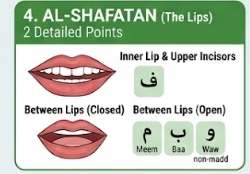
The inner lower lip meeting the edges of the upper front teeth produces Fa (ف). This is the only letter that involves the lip and teeth simultaneously.
| Makhraj | Letters | Lip Position |
| Between both lips (closed) | ب، م | Complete lip closure — Ba stronger than Meem |
| Between both lips (open) | و (non-madd) | Lips rounded but not fully pressed |
| Inner lower lip + upper teeth edges | ف | Lower lip lifts to upper teeth |
read also: Tajweed Hafs – Full Guide
5. Al-Khayshum: The Nasal Cavity and Ghunnah
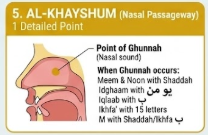
The nasal cavity (الخَيْشُوم) is unique among the five primary makharij. It does not produce a letter — it produces the Ghunnah (غُنَّة), the nasal resonance that accompanies Meem (م) and Noon (ن).
Ghunnah is the only sifah (letter attribute) in all of Tajweed that has its own independent makhraj separate from the letter it accompanies.
When you pronounce Noon, the letter itself exits from the tongue tip — but the Ghunnah sound resonates simultaneously through the nasal passage.
This is why blocking your nose while reciting a shaddah Noon or Meem causes the sound to collapse.
Classical scholars categorized Ghunnah into five levels based on the nasal resonance’s prominence:
| Ghunnah Level | Condition | Example |
| Level 1 (strongest) | Meem or Noon with Shaddah | آمَنَّا، إنَّ |
| Level 2 | Noon with Idgham (with Ghunnah) | فَمَن يُؤْمِن |
| Level 3 | Meem or Noon with Ikhfa | كُنتُمْ بِهِ |
| Level 4 | Meem or Noon silent, clearly pronounced | Standard Izhar |
| Level 5 (lightest) | Meem or Noon with a vowel | Standard moving letters |
For Levels 1–3, Ghunnah must be held for two counts (harakatan). For a complete breakdown of Ghunnah application across Tajweed rules, see our complete guide to Ghunnah and its rules.
Discover the Buruj Academy Difference
Step into our virtual classrooms and see how our expert instructors make learning Quran and Arabic intuitive and clear. We focus on overcoming the specific hurdles non-native speakers face, building your confidence and connection with the Quran.
What Are the Most Common Makhraj Errors Non-Arabic Speakers Make?
After 12+ years of teaching non-Arabic speaking students at Buruj Academy, our Ijazah-certified instructors have identified consistent, predictable patterns of makhraj error. Understanding these in advance accelerates correction significantly.
The Ayn-Hamza Confusion is the single most frequent throat error. Students raised on European languages have no equivalent of the voiced pharyngeal constriction required for Ayn. They default to Hamza (glottal stop) instead. The correction requires weeks of isolated throat exercises before integration into recitation.
The Ha-Ha Confusion — conflating هـ (glottal Ha from deep throat) with ح (pharyngeal Ha from middle throat) — is nearly universal among beginners. These sound nearly identical to untrained ears but are anatomically distinct.
The Dhad Misconception is particularly common among students who learned Arabic informally. Many dialects pronounce Dhad identically to Dhal (ظ) or even Dal (د). Classical Tajweed requires the lateral tongue-edge articulation that most Arabic dialects have abandoned.
Replacing Arabic Seen/Sad with English “s” is a consistent substitution. The Arabic س requires the tongue tip to approach — but not touch — the lower front teeth, creating a clean hiss. The English “s” is typically produced further back in the mouth.
Our Tajweed rules essential guide covers how these articulation errors interact with broader Tajweed rules when unaddressed.
Read also: How to Read the Quran Correctly?
How do Makharij Interact with Key Tajweed Rules?
Makhraj knowledge is not isolated — it directly governs how Tajweed rules function. The three rules most affected by makhraj precision are Ikhfa, Idgham, and Qalqalah.
Ikhfa (concealment) requires Noon Sakinah or Tanween to be partially hidden before 15 letters. The concealment is anatomically defined — the tongue tip leaves its Noon position before fully arriving at the next letter’s makhraj.
The nasal Ghunnah fills the transition. Without understanding Noon’s makhraj, Ikhfa becomes guesswork. See our full article on Ikhfa letters in Tajweed.
Idgham (merging) works by carrying one letter’s sound into another’s makhraj — the first letter dissolves as the second letter’s point of articulation takes over.
Understanding both makharij involved makes the merge anatomically logical rather than a memorized rule. Our Idgham rules guide explains this in detail.
Qalqalah (echoing bounce) applies to five letters: ق، ط، ب، ج، د. The echo occurs because these letters require complete closure at their makhraj — when they are sakin (vowelless), releasing that closure without a following vowel produces the characteristic bounce.
The strength of the Qalqalah varies by makhraj depth: Qaf and Ta produce stronger echoes than Ba, Jeem, and Dal. See our Qalqalah letters guide for full details.
Master Tajweed and Makhraj with Buruj Academy’s Expert Instructors
Accurate makharij cannot be self-taught from text alone — the ear and the muscle memory both require trained correction in real time.
At Buruj Academy, our Online Tajweed Classes are taught by Al-Azhar University graduates holding Ijazah certification in Hafs ‘an ‘Asim recitation, with 12+ years of experience teaching non-Arabic speakers globally.
We apply the Buruj Method — Sound-before-rules — training your articulation points before introducing Tajweed rules, so every rule you learn is built on a correct phonetic foundation.
Sessions are personalized 1-on-1, scheduled flexibly around your life, with real-time correction every lesson.
Book your free trial lesson today and hear the difference accurate makharij makes.
Join a supportive learning environment tailored to your pace and lifestyle. Start your journey toward excellence by enrolling in one of our specialized tracks:
- Online Tajweed Classes
- Tajweed Classes for Beginners
- Tajweed Classes for Adults
- Tajweed Classes for Sisters
- Tajweed Classes for Kids
- Advanced Tajweed Course
- Amli Tajweed Course (Practical Application)
Ready to transform your recitation? book your free assessment and start your path to Tajweed mastery today!
Excel in Your Quranic Studies
Join Buruj Academy and master the Quran with our structured, professional curriculum.
Book Your Free TrialConclusion
Makharij al-huruf are the anatomical backbone of every Tajweed rule you will ever study. The 17 detailed articulation points — distributed across the oral cavity, throat, tongue, lips, and nasal passage — are not abstract categories. They are precise physical coordinates that determine whether your recitation is accurate or distorted.
Mastering them takes time, trained ears, and consistent correction. But every student who commits to this foundation finds that Tajweed rules begin to make physical sense — because articulation and rule finally align.
That is when recitation stops being a technical exercise and becomes what it was always meant to be: worship offered with care.
Frequently Asked Questions About Tajweed and Makhraj
How Many Makhraj Are There in Tajweed?
Classical Tajweed scholarship — the dominant scholarly position — identifies 17 detailed (tafseeli) makharij organized under 5 primary (ra’eesiyyah) makharij: Al-Jawf, Al-Halq, Al-Lisan, Al-Shafatan, and Al-Khayshum. Some earlier scholars counted 16 or 14 by merging certain adjacent points, but 17 is the accepted standard in Hafs ‘an ‘Asim recitation pedagogy.
What Is the Difference Between Makhraj and Sifah in Tajweed?
Makhraj is the physical origin point of a letter — where in the vocal tract it is produced. Sifah is a quality or attribute of that letter, such as its strength, resonance, or airflow characteristic. Both must be correct for accurate recitation. A letter can exit from the right makhraj but still be mispronounced if its sifah — like Tafkhim (heaviness) or Rakhawah (softness) — is ignored.
What Are the Tajweed and Makhraj Benefits of Systematic Study?
Systematic makhraj study produces three measurable benefits: it eliminates meaning-changing mispronunciations (like Ayn pronounced as Hamza), it makes Tajweed rules anatomically logical rather than memorized abstractions, and it permanently corrects error patterns before they become habitual. Students who learn makharij first progress through Tajweed rules significantly faster than those who learn rules first. For structured rule study, see ourTajweed for beginners guide.
Can Adults Learn Correct Makharij Without Prior Arabic Background?
Yes — and this is one of the most common concerns we hear from adult beginners. Articulation points are physical, trainable skills. Adults learn them through isolated sound drilling, mirror practice, and real-time instructor correction. In our experience, non-Arabic speaking adults typically achieve consistent makhraj accuracy for the throat letters within 4–6 weeks of structured daily practice. The tongue letters for interdental sounds (ث، ذ، ظ) and lateral Dhad follow shortly after.
Is It Necessary to Learn Makharij Before Tajweed Rules?
Learning makharij before Tajweed rules is the approach we follow at Buruj Academy for a precise reason: Tajweed rules describe what to do with sounds that must already exist correctly. Ikhfa, Idgham, and Qalqalah all assume the baseline letters are articulated accurately. Teaching rules before makharij is like teaching grammar before pronunciation — students memorize rules they cannot apply. Ourhow to read Quran with Tajweed guide explains this sequencing in full.