 Quran
Quran
| Key Takeaways |
| Correct Quran reading requires mastering Arabic letters, vowel signs, and Tajweed rules in a specific sequence. |
| Noorani Qaida is the proven foundational method for non-Arabic speakers to build accurate Quran reading from scratch. |
| Tajweed rules govern how each Quranic letter is pronounced; reading without them produces errors that alter Quranic meaning. |
| Learning with a qualified teacher is the single most effective way to correct pronunciation errors non-Arabic speakers cannot self-detect. |
| Consistent daily practice of 20–30 minutes outperforms longer irregular sessions for building lasting Quran reading accuracy. |
Most non-Arabic speaking Muslims learn to recognize Quranic letters early in life — yet reading the Quran correctly, with proper pronunciation and applied rules, remains one of the most commonly unfinished goals in a Muslim’s learning life.
Reading Quran with correct pronunciation means pronouncing every letter from its precise articulation point, applying Tajweed rules consistently, and understanding how vowel signs shape each word.
Table of Contents:
1. Understand What “Reading the Quran Correctly” Actually Means
Reading the Quran correctly means producing each Arabic letter accurately from its designated articulation point (makhraj), applying the governing Tajweed rules for that letter’s context, and observing the vowel and pause markers throughout. It is not simply recognizing written letters — it is a trained physical and auditory skill.
Many students come to us having read Quran for years with deeply ingrained mispronunciations they were never aware of.
The Arabic letters ع (Ayn) and ء (Hamzah), for instance, are consistently confused by English speakers because English has no equivalent sounds.
Reading correctly requires more than good intentions — it requires structured instruction that trains the ear and the mouth simultaneously.
The Prophet ﷺ said:
“The one who is proficient in the Quran will be with the noble, righteous scribes.” (Sahih Muslim 798)
This hadith reflects the spiritual weight of reciting with accuracy — and it motivates the structured approach this guide presents.
2. Begin with the Arabic Alphabet Before Attempting Any Quranic Text
To read the Quran correctly, you must first master the Arabic alphabet in isolation — 28 letters, each with a unique sound produced from a specific point in the vocal tract.
Skipping this step produces reading that is approximate at best and meaning-altering at worst.
Why Letter Recognition Must Come Before Quran Reading
Arabic letters change shape depending on their position in a word — initial, medial, final, or isolated. A beginner who has not internalized all four forms of each letter will misread words, guess at text, and build habits that are extremely difficult to correct later.
In our experience at Buruj Academy, students who rush past letter mastery almost always plateau at the same point: they can recite familiar surahs from memory but cannot read unfamiliar text fluently. True reading ability begins with letter fluency.
The Most Challenging Quranic Letters for English Speakers
| Arabic Letter | Common English-Speaker Error | Correct Production |
| ع (Ayn) | Replaced with Alif or ignored | Deep pharyngeal constriction |
| غ (Ghayn) | Replaced with “g” sound | Voiced uvular fricative |
| ح (Ha) | Replaced with “h” as in “hat” | Voiceless pharyngeal fricative |
| ق (Qaf) | Replaced with “k” | Uvular stop — back of throat |
| ر (Ra) | Flat English “r” | Tapped or trilled, position-sensitive |
Each of these letters requires targeted physical training — not just explanation. A qualified instructor provides the corrective feedback that self-study cannot replicate.
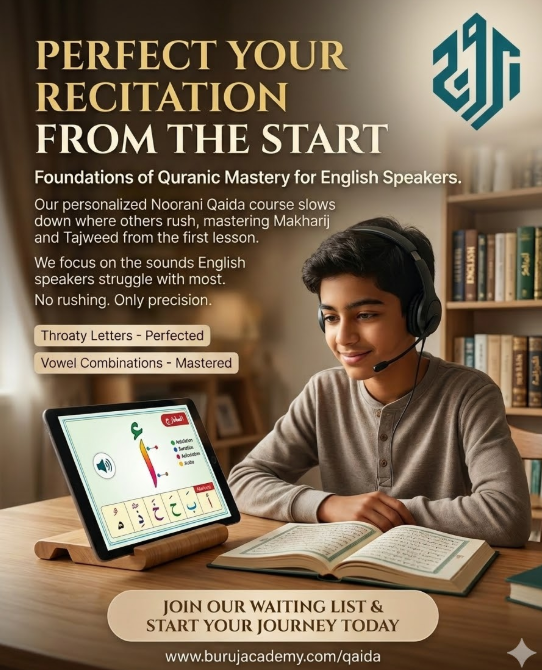
3. Use Noorani Qaida as the Structured Foundation for Non-Arabic Speakers
Noorani Qaida is the most widely used and pedagogically sound method for teaching non-Arabic speakers to read the Quran correctly from the beginning. It introduces letters in isolation, then in joined combinations, then with vowel signs, then in Quranic-style text — building reading ability in a logical sequence that prevents guessing.
Buruj Academy’s Noorani Qaida Online Course follows this exact progression, taught by instructors who specialize in non-Arabic speaker phonetics.
Students typically complete foundational Qaida in 2–4 months with consistent daily practice, emerging with the ability to sound out any Quranic word — not just memorized text.
Some of What Noorani Qaida Teaches
- Arabic letters in isolation (all four forms)
- Joining letters into syllables
- Short vowels (Fathah, Kasrah, Dammah)
- Long vowels (Madd letters)
- Tanwin and Sukoon
- Combined letter rules in Quran-like text
This sequence reflects genuine phonics logic — the same principle behind how children are taught to read in any language.
Book your FREE trial lesson in the Noorani Qaida course
4. Master Arabic Vowel Signs Before Moving to Full Quranic Text
Arabic vowels — the diacritical marks (tashkeel) above and below letters — determine the correct pronunciation of every word in the Quran.
Without mastering these, a reader cannot distinguish between words that share the same consonantal root but carry different meanings depending on their vowel pattern.
The three short vowels are Fathah (ـَ), Kasrah (ـِ), and Dammah (ـُ). The Tanwin forms add a doubling (nunation) to word endings.
Sukoon (ـْ) marks a vowel-less consonant, which is particularly important because Sukoon triggers several Tajweed rules — including Qalqalah, Ikhfa, and Idgham.
Read also: Tajweed and Makhraj – Full Guide
The Sukoon-Triggered Rules Every Beginner Must Know Early
| Sukoon Situation | Rule Triggered | Effect on Pronunciation |
| Noon Sakinah + Meem/Noon | Idgham with Ghunnah | Merge Noon into following letter |
| Noon Sakinah + 15 letters | Ikhfa Haqiqi | Nasal concealment for 2 counts |
| Qalqalah letters with Sukoon | Qalqalah | Echo/bounce sound on release |
| Meem Sakinah + Baa | Ikhfa Shafawi | Labial nasal concealment |
Understanding vowel signs is not an optional advanced topic — it is the structural core of correct Quranic reading at every level.
5. Learn Tajweed Rules Systematically to Read the Quran with Correct Pronunciation
Tajweed is the science of reciting the Quran correctly — governing how each letter is produced, how letters interact with each other, how long vowels are held, and how to pause and resume recitation. Reading the Quran with correct pronunciation is impossible without applied Tajweed knowledge.
At Buruj Academy, our Online Tajweed Classes use the Buruj Method’s sound-before-rules approach — students first hear and produce correct sounds before they learn the technical rule name. This produces genuine application, not just rule memorization.
Book Your FREE Trial Lesson to Begin Your Tajweed Journey

For a structured entry point into this science, our Tajweed for Beginners guide covers the essential rules in the sequence we teach them at Buruj Academy.
Some of Tajweed Rules Every Reader Must Apply
Ghunnah (Nasalization)
A nasal sound held for two counts (two beat pulses), applied to Noon and Meem when they carry Shaddah, and in rules like Idgham and Ikhfa. Our complete guide to Ghunnah explains its conditions in detail.
Madd (Prolongation)
Long vowels are held for specific counts — 2, 4, or 6 beats — depending on the type of Madd. Applying the wrong duration alters the recitation’s validity.
Tafkhim and Tarqiq (Heaviness and Lightness)
Certain letters are always pronounced with a heavy, full-mouth quality (Tafkhim) — the Isti’la letters (خ ص ض غ ط ق ظ) — while others are always light (Tarqiq). The letter Ra has context-dependent rules for both.
Excel in Your Quranic Studies
Join Buruj Academy and master the Quran with our structured, professional curriculum.
Book Your Free Trial6. Train Your Ear Before Relying on Your Eye for Correct Pronunciation
Reading the Quran correctly is fundamentally an auditory skill before it is a visual one. A reader who has never heard correct Arabic pronunciation cannot self-correct from text alone — they will read the written letter and produce the closest English-equivalent sound automatically.
The practical method: listen to a verified reciter reading a short passage, then repeat it aloud, then read the same text yourself.
Sheikh Mahmoud Khalil Al-Husary‘s recitation is the most widely recommended for clarity of Tajweed application among our instructors, as each rule is precisely and unhurriedly applied.

In our sessions, students who spend the first 10 minutes of each lesson listening before reading show measurably faster pronunciation improvement than those who begin reading immediately.
The ear trains the mouth — this is not anecdotal, it reflects how motor learning works for spoken language.
Discover the Buruj Academy Difference
Step into our virtual classrooms and see how our expert instructors make learning Quran and Arabic intuitive and clear. We focus on overcoming the specific hurdles non-native speakers face, building your confidence and connection with the Quran.
7. Learn the Rules of Waqf (Pause) and Ibtida (Resumption) for Accurate Quran Reading
Waqf refers to the rules governing where and how to pause during Quran recitation. Reading without knowledge of Waqf produces pauses that break words incorrectly, cut sentences at grammatically inappropriate points, and in some cases reverse the meaning of what is being recited.
The Quran contains specific Waqf markers printed in the Uthmani rasm text: (م) marks a mandatory stop, (لا) marks a prohibited stop, (ج) marks a permissible stop, and (صلى) marks that continuing is preferable but stopping is acceptable.
Recognizing these markers and applying them correctly is part of reading the Quran correctly.
Ibtida — where to resume after a pause — is equally governed. Resumption must begin at a word that produces correct meaning without the words before the pause.
This requires both grammatical awareness and practical recitation experience under guidance.
Read also: What is the Difference Between Tajweed and Qirat?
8. Read the Quran Daily with a Qualified Teacher Who Can Correct You in Real Time
Reading the Quran correctly cannot be achieved through self-study alone. Mispronunciations that are invisible to the reader are immediately detectable to a trained ear — and without correction, they calcify into permanent habits.
This is why the tradition of reading aloud to a qualified teacher (Talaqqi) has been the standard method of Quran transmission since the time of the Prophet ﷺ.
Buruj Academy’s Quran Reading Course provides exactly this: 1-on-1 sessions with Ijazah-certified instructors who provide real-time correction on every session, with a learning plan customized to each student’s current level.
Book your Free trial lesson and start reading the Quran
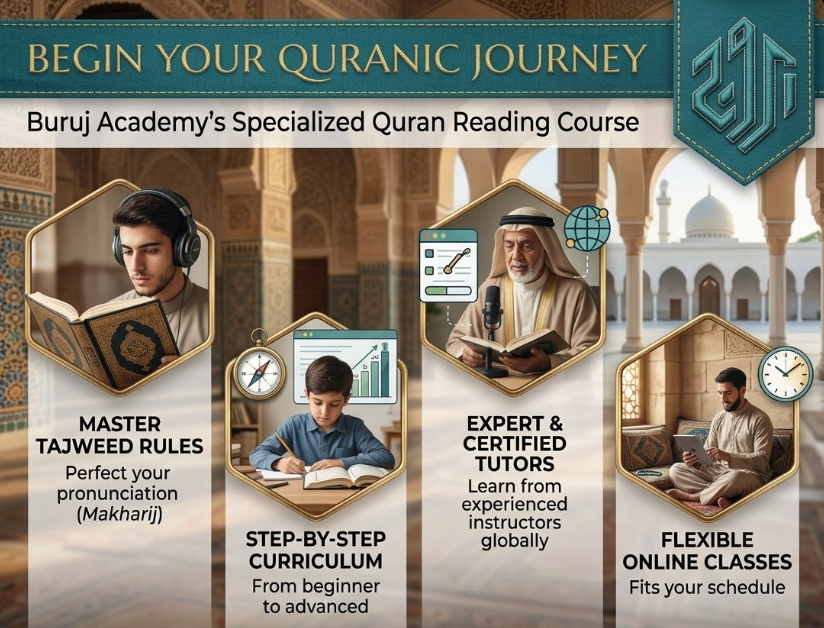
For those beginning from zero, our Quran for Beginners course offers the same structured, teacher-led approach.
If you are reading the Quran for the first time and wondering where to begin practically, our guide on reading the Quran for the first time walks through the exact first steps with accompanying context.
What a Qualified Quran Teacher Provides That Self-Study Cannot
| Self-Study | Teacher-Led Learning |
| Errors go undetected and reinforce | Errors corrected immediately before reinforcement |
| Progress stalls without external feedback | Progress tracked and adjusted systematically |
| No verification of rule application | Live rule verification during recitation |
| Motivation depends entirely on self | Accountability and encouragement built in |
| Cannot hear own mispronunciation | Teacher identifies exactly what the student cannot hear |
9. Build a Consistent Daily Reading Practice Around Realistic Time Targets
Consistency produces correct reading far more reliably than intensity. Twenty minutes of focused daily practice with correct technique builds genuine Quran reading ability.
Irregular three-hour sessions do not — they produce fatigue, inconsistency, and the reinforcement of both good and bad habits without the ability to distinguish them.
For practical session structure, we recommend: 5 minutes of targeted letter or rule review, 10–15 minutes of reading new text aloud with the teacher, and 5 minutes of revision from the previous session.
This mirrors the Buruj Method’s consistency-before-speed principle — we train students to read accurately at a slow pace before increasing speed, because accuracy at slow pace always precedes fluency at natural pace.
Students who struggle with maintaining consistent practice often benefit from anchoring their reading session to an existing daily habit — after Fajr prayer is the most commonly effective anchor among our adult students, supported by classical Islamic guidance on the blessing of the early morning hours.
Start Reading the Quran Correctly with Buruj Academy’s Expert Instructors
Correct Quran reading is a teachable, learnable skill — and every Muslim, regardless of age or starting level, can achieve it with the right guidance and consistent effort.
Buruj Academy’s Online Quran Recitation Course is designed specifically for non-Arabic speakers at every level, taught by Al-Azhar University graduates and Ijazah-certified instructors with 12+ years of experience.
Our Buruj Method ensures you build correct habits from day one — not correcting years of errors later.
Features include personalized 1-on-1 sessions, real-time pronunciation correction, flexible 24/7 scheduling, and a customized learning plan tailored to your current level.
Book your free trial lesson today and read your first session correctly.
Take the next step in your learning journey today by enrolling in one of our specialized programs:
- Online Quran Classes
- Online Quran Classes for Beginners
- Online Quran Classes for Adults
- Online Quran Classes for Ladies
- Online Quran Classes for Kids
- Quran Reading Course
- Quran Recitation Course
- Online Ijazah Course
- Online Qirat Course
Don’t wait to transform your relationship with the Holy Quran. Join our global community of students and book your free evaluation session now!
Excel in Your Quranic Studies
Join Buruj Academy and master the Quran with our structured, professional curriculum.
Book Your Free TrialConclusion
Reading the Quran correctly is not reserved for those born into Arabic-speaking households or those who memorized it in childhood. It is an achievable, structured skill built step by step — from letter mastery and vowel signs through Tajweed rules, Waqf markers, and daily practice under qualified guidance.
The steps in this guide reflect the actual instructional sequence our team at Buruj Academy uses with students globally.
What makes the difference is not talent — it is a sound methodology, a qualified teacher, and consistent daily effort. Insha’Allah, every Muslim who commits to these steps will reach a recitation they are confident and proud to offer.
Frequently Asked Questions About How to Read the Quran Correctly
Can I Learn to Read the Quran Correctly Without Knowing Arabic?
Yes — the vast majority of Buruj Academy students are non-Arabic speakers who achieve correct Quran reading without Arabic fluency. Quran reading requires letter recognition, vowel signs, and Tajweed rules — a distinct skill set from Arabic language comprehension. Most non-Arabic speakers reach basic reading accuracy within 4–6 months of structured instruction.
What Is the Difference Between Reading the Quran and Reading with Tajweed?
Reading the Quran refers to decoding the written text accurately. Reading with Tajweed means applying the full set of pronunciation rules — Ghunnah, Madd, Qalqalah, Ikhfa, and others — that govern how each letter sounds in context. Tajweed is not an add-on; it is the standard for correct recitation according to classical Islamic scholarship.
How Long Does It Take to Read the Quran Correctly from Scratch?
Most non-Arabic speaking adults with no prior foundation reach functional Quran reading — able to sound out any Quranic text — within 6–12 months of consistent daily practice with a qualified teacher. Timeline varies based on prior exposure, daily practice duration, and whether Tajweed is studied simultaneously with reading foundations.
Is It Sinful to Read the Quran with Incorrect Pronunciation?
Classical scholars distinguish between errors that alter meaning (Lahn Jali — major error) and those that affect pronunciation quality without altering meaning (Lahn Khafi — minor error). A person sincerely learning and making effort is not sinful — the Prophet ﷺ said in Sahih Muslim 798 that even the one who struggles with Quran reading receives a double reward. The obligation is to make genuine effort to improve.
What Is the Best Age to Start Learning to Read the Quran Correctly?
There is no age barrier. Children typically develop phonetic flexibility faster, making letter acquisition quicker — our Tajweed for children course is structured around this. Adults bring stronger comprehension and motivation. Buruj Academy has successfully taught students from age 4 to past 60 — correct Quran reading is achievable at every life stage with appropriate methods.