 Quran
Quran
| Key Takeaways |
| Correct Quran recitation begins with mastering Arabic letter pronunciation from their precise articulation points, called makharij. |
| Tajweed rules are obligatory for recitation — mispronouncing letters in a way that changes meaning constitutes a recitation error. |
| Beginners must learn with a qualified teacher; self-study alone cannot correct makharij errors the student cannot hear themselves. |
| Beautiful recitation develops through listening to master reciters daily, not just practicing rules in isolation. |
| Consistent short daily sessions — even 15 minutes — produce faster recitation progress than irregular long sessions. |
Most Muslims want to recite the Quran correctly, but many spend years reading without ever being told what “correctly” actually requires. The gap between reading Arabic letters and genuinely reciting Quran with proper Tajweed is wider than most beginners expect — and narrower than many advanced students fear.
Proper Quran recitation means pronouncing each letter from its correct makhraj (articulation point), applying Tajweed rules accurately, and sustaining proper rhythm.
Table of Contents:
1. Understand What Reciting Quran Requires
Reciting Quran correctly means three things operating simultaneously: accurate letter pronunciation, applied Tajweed rules, and appropriate recitation pace. These are not optional layers — they are the definition of proper recitation according to classical Islamic scholarship.
The Prophet ﷺ recited the Quran with measured, distinct pronunciation. As reported in Sahih al-Bukhari (5046), his companion Anas ibn Malik described his recitation as clearly distinct — elongating letters where elongation was required. This confirms that how you recite matters, not just what you recite.
Many students we work with at Buruj Academy arrive believing Tajweed is an advanced add-on for scholars.
In reality, the scholars of Tajweed — including those at Al-Azhar — classify deliberate mispronunciation that changes meaning as an error that must be corrected. Understanding this early prevents years of reinforcing incorrect habits.
If you are starting from the very beginning, our Quran Reading Course provides a structured path from letter recognition to connected recitation, guided by Ijazah-certified instructors with 12+ years of experience teaching non-Arabic speakers.
Book your Free trial lesson and start reading the Quran

2. Master the Arabic Letters Before Reciting the Quran
Before reciting a single ayah, every learner must be able to produce each Arabic letter accurately and distinctly. There are 28 letters in Arabic, each with a specific makhraj — a point in the vocal tract where the sound originates.
Mispronouncing foundational letters corrupts every word those letters appear in. The letter ع (Ayn), for example, is produced from the middle of the throat — a sound that does not exist in English. Replacing it with a glottal stop or a hamza changes the word entirely.
The Key Articulation Regions Every Beginner Must Know
Classical Tajweed scholars divide the makharij into five main regions:
| Articulation Region | Arabic Term | Letters Produced Here |
| Throat (deep) | Al-Jawf / Al-Halq | ء، هـ، ع، غ، ح، خ |
| Tongue | Al-Lisan | ق، ك، ج، ش، ي، ض، ل، ن، ر، ط، د، ت، ص، ز، س، ظ، ذ، ث |
| Lips | Al-Shafatan | ب، م، و، ف |
| Nasal Cavity | Al-Khayshum | Ghunnah (nasal resonance) |
| Empty Space (chest/throat) | Al-Jawf | Long vowels: ا، و، ي |
Spend time with each letter group before moving forward. In our experience, students who rush this step spend months later trying to unlearn incorrect sounds their mouths have memorized.
3. Learn Quran Recitation Through a Qualified Teacher, Not Self-Study Alone
To recite Quran correctly, you need a teacher who can hear your mistakes in real time — because the most common recitation errors are errors the student cannot detect in their own voice. This is not a limitation of effort; it is a feature of how pronunciation learning works.
Al-Azhar University’s Faculty of Islamic Studies emphasizes that Quran recitation must be taken directly from a teacher with an unbroken chain (sanad) — a principle upheld across centuries of Islamic scholarship.
Self-study using apps or videos can supplement learning, but cannot replace live correction.
At Buruj Academy, our Online Quran Recitation course connects students with Al-Azhar-trained instructors in personalized 1-on-1 sessions.
The Buruj Method places sound-before-rules — meaning your ear and mouth are trained on correct sounds before rules are formally introduced, which is the sequence that produces lasting accuracy.
Book your first FREE recitation lesson
Read also: Can Women Recite Quran in Front of Men?
4. Study Noorani Qaida as Your Recitation Foundation
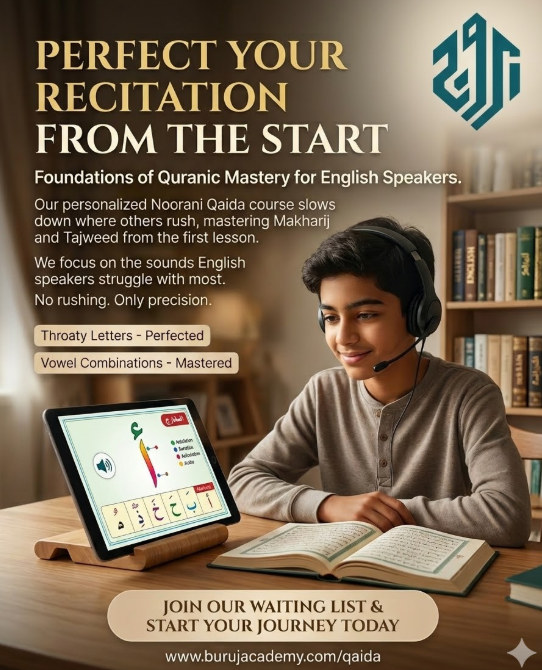
For beginners — including adults with no prior Arabic reading experience — Noorani Qaida is the structured pathway that connects letter knowledge to Quran reading. It is not a children’s tool; it is a phonetic system used by new learners of all ages across the Muslim world.
Noorani Qaida covers letter forms, vowel marks (harakat), tanween, sukoon, shaddah, and letter joining — all the mechanical components of reading Arabic script accurately. Completing it properly means you can decode Quranic text correctly before encountering the meaning.
What Noorani Qaida Builds Before Quran Reading
- Recognition of all 28 letters in isolated, initial, medial, and final forms
- Accurate production of short vowels: fathah, kasrah, dammah
- Understanding sukoon (vowel-less consonant) and its recitation effect
- Reading connected letters with correct voweling
- Introduction to basic Tajweed concepts through applied examples
Our Noorani Qaida Online Course guides students through every level systematically, ensuring no gap is left before Quran reading begins.
Book your FREE trial lesson in the Noorani Qaida course
5. Apply the Core Tajweed Rules That Govern Every Recitation
Tajweed rules are not decorative — they define what correct recitation sounds like. Every competent reciter applies these rules in every ayah, whether consciously or through trained habit. The four most essential rule categories every reciter must master are:
| Rule Category | Trigger Condition | Recitation Effect |
| Ghunnah (nasal resonance) | Noon or Meem with shaddah | Held nasal sound for 2 counts |
| Ikhfa (concealment) | Noon sakinah before 15 specific letters | Partial nasal sound, no full noon |
| Idgham (merging) | Noon sakinah before ي، ن، م، و، ل، ر | Noon merges into following letter |
| Qalqalah (echo) | Letters ق، ط، ب، ج، د in sukoon | Slight audible bounce at release |
| Madd (elongation) | Long vowels before hamzah or sukoon | 2, 4, or 6 counts of lengthening |
Each of these rules has precise conditions and applications. For a structured introduction to how these rules work together, our Tajweed for beginners guide explains each category in accessible, practical detail.
Understanding Ghunnah specifically — its duration, its trigger letters, and its nasal placement — is one area where students consistently need correction. Our full guide on Ghunnah and its rules covers this in the depth it deserves.
Buruj Academy’s Tajweed for Beginners course introduces all core rules systematically through the sound-before-rules sequence, training your ear on correct application before asking you to memorize rule names.
Book Your FREE Trial Lesson to Begin Your Tajweed Journey

6. Recite Slowly and Clearly Using Tarteel Pace
Allah commands in Surah Al-Muzzammil:
وَرَتِّلِ الْقُرْآنَ تَرْتِيلًا
Wa rattilil-Qur’aana tartila
“And recite the Quran with measured recitation.” (Al-Muzzammil 73:4)
Tarteel refers to deliberate, clear, unhurried recitation that allows each letter its full right.
Tarteel is not slow for slowness’s sake — it is the pace that allows Tajweed rules to be applied correctly and meaning to be reflected upon. New reciters who rush to “finish” an ayah will consistently drop sukoon, shorten madd, and swallow letters.
The Three Recognized Recitation Speeds in Tajweed Science
| Pace | Arabic Term | Appropriate Context |
| Slow and deliberate | Tahqeeq | Learning, teaching, correction |
| Moderate and clear | Tarteel / Tadweer | Personal recitation, Salah |
| Flowing and rapid (with rules) | Hadr | Advanced reciters in specific contexts |
For beginners and intermediate learners, Tarteel is the required pace. Speed is not a sign of mastery — applying all rules at any speed is.
Excel in Your Quranic Studies
Join Buruj Academy and master the Quran with our structured, professional curriculum.
Book Your Free Trial7. Practise Proper Waqf (Stopping Rules) During Recitation
Waqf — the rules governing where and how to pause during recitation — is a Tajweed discipline that directly affects the meaning of what is recited. Stopping at the wrong place can cause a grammatically complete but meaningfully incorrect phrase to be understood.
Classical Tajweed scholars identify four primary Waqf categories: Waqf Tam (complete stop), Waqf Kafi (sufficient stop), Waqf Hasan (acceptable stop), and Waqf Qabih (poor stop that distorts meaning).
Mushaf copies printed according to the Uthmani rasm include Waqf markers above the text — learning to read them is part of proper recitation.
In our recitation sessions at Buruj Academy, one of the most consistent patterns we observe is students pausing mid-phrase at breath points rather than at marked Waqf positions. Addressing this requires specific practice — reading whole phrases as units, not as individual words.
Book a FREE trial session with one of Buruj’s Azhari Quran tutors

8. Train Your Ear by Listening to Verified Master Reciters Daily
Recitation is a sound-based skill. The ear must be trained alongside the mouth — and the most effective way to train the ear is sustained, attentive listening to reciters whose recitation has been verified through Ijazah chains.
Recommended reciters for non-Arabic speakers developing their ear include Sheikh Mahmoud Khalil Al-Husary (known for his didactic, clear Tarteel pace), Sheikh Mishary Rashid Al-Afasy, and Sheikh Abdul Basit Abdul Samad. Al-Husary’s Muallim (teaching) recordings in particular are widely used in Tajweed instruction precisely because every rule is audible and clearly applied.
Listen with the Mushaf open. Track where the reciter pauses, how long elongations are held, and where nasal sounds appear. Passive listening builds familiarity; active listening with the text builds skill.
Discover the Buruj Academy Difference
Step into our virtual classrooms and see how our expert instructors make learning Quran and Arabic intuitive and clear. We focus on overcoming the specific hurdles non-native speakers face, building your confidence and connection with the Quran.
9. Recite Quran Beautifully Through Consistent Daily Practice
How to recite Quran beautifully is not a matter of natural talent — it is the result of consistent, deliberate practice over time.
Beautiful recitation, called Tajweed bil-ihsan (recitation with excellence), emerges when accurate pronunciation becomes automatic, freeing attention for rhythm, melody, and reflection.
As recorded in Sahih al-Bukhari (7527):
Abu Huraira said, “Allah’s Messenger (ﷺ) said, ‘Whoever does not recite Qur’an in a nice voice is not from us.”
This hadith demonstrates that effort and consistency — not perfection — are the foundation of the relationship between a Muslim and the Quran.
Practical Daily Habits That Build Beautiful Recitation
- Recite for 15–20 minutes daily rather than 90 minutes once a week
- Record yourself weekly and compare to your target reciter’s version
- Practise one surah at a pace slow enough to apply every rule, then gradually build
- Return to previously learned surahs weekly to maintain accuracy under revision
For those preparing to read Quran for the first time in a structured way, our guide on reading the Quran for the first time provides practical first-session guidance.
Read also: Can You Recite Quran Without Ghusl?
How to Recite Quran for Beginners — Your First 30 Days
How to recite Quran for beginners requires a realistic, structured plan for the first month. Many beginners abandon recitation practice early because they try to apply everything simultaneously before the foundational sounds are stable.
The Buruj Method — our pedagogical framework refined across 12+ years of teaching non-Arabic speakers — sequences learning as follows: sound before rules, confidence before speed, accuracy before fluency.
This sequence protects beginners from the most common failure pattern: memorizing rule names without being able to apply them during live recitation.
A Realistic 30-Day Beginner Recitation Plan
| Week | Focus Area | Daily Practice Time |
| Week 1 | Arabic letter sounds and makharij | 15 minutes |
| Week 2 | Short vowels, sukoon, shaddah with Noorani Qaida | 15–20 minutes |
| Week 3 | Connected reading with Surah Al-Fatiha and Juz Amma | 20 minutes |
| Week 4 | Ghunnah, Qalqalah, and basic Madd in recitation | 20–25 minutes |
This is a foundation-building month — not a mastery month. Students who complete this phase with a teacher have consistently better long-term outcomes than those who attempt to self-teach the entire Tajweed system before hearing themselves recite correctly.
For those considering Hifz alongside recitation development, our Quran memorization schedule guide outlines how to structure both goals without one undermining the other.
Begin Your Recitation Journey with Buruj Academy’s Expert Instructors
Proper Quran recitation requires structured guidance — and the right teacher changes everything about how quickly and accurately you progress.
Buruj Academy offers:
- Ijazah-certified instructors and Al-Azhar University graduates
- 12+ years teaching non-Arabic speakers across 50+ countries
- The Buruj Method: sound-before-rules recitation training
- Personalized 1-on-1 sessions with real-time pronunciation correction
- Flexible 24/7 scheduling for every time zone
- A proven progression path from letter recognition to beautiful Tajweed recitation
Book your free trial lesson through our Quran Recitation course or explore our Tajweed Classes — and start reciting with confidence, accuracy, and the reverence the Quran deserves.Claim your free trial today.
Excel in Your Quranic Studies
Join Buruj Academy and master the Quran with our structured, professional curriculum.
Book Your Free TrialConclusion
Reciting the Quran correctly is one of the most rewarding skills a Muslim can develop — and it is fully achievable for non-Arabic speakers at every stage of life. The path moves through foundational sounds, Tajweed rules, measured pace, and daily consistency, with each step building on the last.
What makes the difference is not aptitude — it is structure, qualified guidance, and the patience to let proper habits form before speed is pursued.
Begin with the letters, work through the rules, and let beautiful recitation develop as the natural outcome of sustained, attentive practice.
Frequently Asked Questions About Quran Recitation
Can I Learn How to Recite Quran Correctly Without Knowing Arabic?
Yes. Knowing Arabic as a language is not required to recite Quran correctly. Tajweed is a phonetic and pronunciation science — you learn to produce the sounds and apply the rules accurately, independently of understanding Arabic grammar or vocabulary. Millions of non-Arabic-speaking Muslims recite with full Tajweed accuracy.
How Long Does It Take to Learn How to Recite Quran for Beginners?
Most adult beginners with no prior Arabic exposure can achieve basic, rule-applied recitation of short surahs within 3–6 months of consistent daily practice with a qualified teacher. Full Quran recitation with Tajweed applied throughout typically requires 1–2 years of structured learning, depending on session frequency and daily practice.
What Is the Difference Between Reciting Quran and Reading Quran?
Reading Quran refers to decoding the Arabic script accurately — pronouncing words correctly. Reciting Quran adds Tajweed application — elongations, nasal sounds, letter merging, and echo sounds applied according to their rules. All Muslims are encouraged to recite with Tajweed; reading accurately is the prerequisite that recitation builds upon.
How Can I Recite Quran Beautifully if I Have No Musical Background?
Beautiful recitation is not about musicality — it is about accuracy, rhythm, and sincerity. The melodic quality in Quran recitation follows precise Tajweed rules, not improvised melody. Consistent daily listening to verified reciters and disciplined application of elongation rules (Madd) produces beauty in recitation over time, regardless of musical background.
Is It Necessary to Understand Arabic to Recite Quran Beautifully?
Understanding Arabic enriches your connection to the Quran deeply, but it is not required for beautiful recitation. Many of the world’s most revered Quranic reciters began without Arabic comprehension. However, if you want to build understanding alongside recitation, our Tajweed rules guide and resources on Quranic Arabic can be studied in parallel.