 Tajweed
| Key Takeaways |
| Hams (هَمْس) is a Tajweed sifa meaning “whisper,” where breath flows freely during letter pronunciation without complete vocal cord vibration. |
| The hams letters number ten, memorized by the phrase فَحَثَّهُ شَخْصٌ سَكَتَ. |
| Hams is the direct opposite of Jahr (جَهْر), where the breath is held and voice fully resonates during articulation. |
| Hams only fully manifests when a letter carries sukoon or is spoken with heavy pressure — voweled hams letters show reduced breath flow. |
Tajweed is built on precision — and that precision begins with understanding how your breath and voice interact with each Arabic letter.
One of the most misunderstood attributes in Tajweed is hams, a quality that directly governs how freely air moves when you pronounce certain letters.
Hams (هَمْس) means “whisper” and refers to the free passage of breath during a letter’s articulation, caused by weak pressure at the makhraj. It applies to ten specific Arabic letters and stands in direct contrast to Jahr, the attribute of voice. Knowing which letters carry hams — and when that breath flow is most prominent — is foundational to reciting the Quran accurately.
Table of Contents:
What Does Hams Mean in Tajweed?
Hams (هَمْس) in Tajweed means the continuation of breath during a letter’s pronunciation due to weakness at its articulation point (makhraj). The vocal cords do not fully compress, allowing air to pass through alongside — or instead of — voiced sound. It is classified among the Sifat al-Huruf (صِفاتُ الحُروف), the intrinsic qualities that distinguish every Arabic letter from every other.
Classical Tajweed scholars define hams as the opposite of jahr (جَهْر). Where jahr involves the breath being “held” — the makhraj closing firmly so voice dominates — hams involves the makhraj remaining relaxed enough that breath escapes freely.
This is not whispering in the colloquial sense; it is a specific acoustic and physiological phenomenon tied to reduced articulatory pressure.
What Are the Hams Letters in Tajweed?
The hams letters in Tajweed number exactly ten, and classical scholars encoded them in the memorable phrase:
فَحَثَّهُ شَخْصٌ سَكَتَ
Faḥaththa shakhṣun sakat
“A person urged him, then fell silent.”
This phrase is a mnemonic device — each letter in it represents one of the ten hams letters. The ten letters extracted from this phrase are:
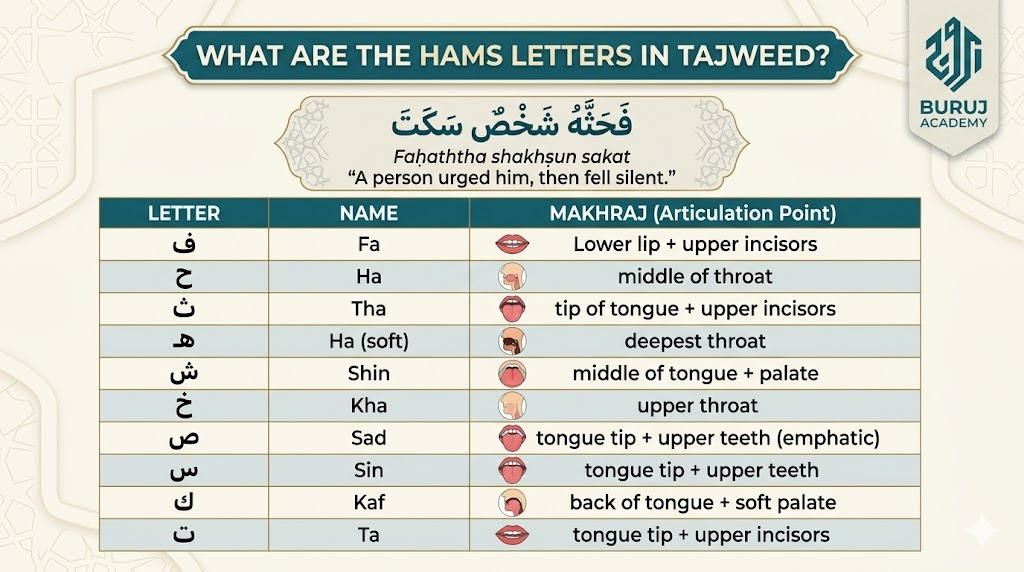
These ten letters share a common phonetic feature: when articulated correctly, breath continues to flow through or alongside their point of contact.
In our Online Tajweed Classes at Buruj Academy, we train students to feel this breath flow physically — placing the back of the hand near the mouth to detect airflow on key hams letters as a self-correction exercise.
Book Your FREE Trial Lesson to Begin Your Tajweed Journey

Examples of Hams Letters in the Quran
Seeing hams letters in real Quranic text — not isolated phonetics — is how understanding becomes application. Below are examples across several hams letters with their contexts:
1. The Letter ه (Ha) — Softest Hams Letter
The ه carries the most pronounced hams of all ten letters. It originates from the deepest point in the throat (أقصى الحلق) with almost no articulatory pressure, meaning breath flows almost entirely unrestricted. This makes it the letter most affected by hams in practice.
قُلْ هُوَ اللَّهُ أَحَدٌ
Qul huwa Allāhu aḥad
“Say: He is Allah, the One.” (Al-Ikhlas 112:1)
The ه in هُوَ demonstrates hams — breath flows openly from the deep throat with minimal voicing pressure.
2. The Letter س (Sin) — Hams with a Hissing Quality
The sin is articulated at the tongue tip near the upper front teeth, and its hams produces a clear hissing airflow. This is distinct from the ص (sad), which carries both hams and tafkhim (heaviness).
بِسْمِ اللَّهِ الرَّحْمَٰنِ الرَّحِيمِ
Bismillāhir-raḥmānir-raḥīm
“In the name of Allah, the Most Gracious, the Most Merciful.” (Al-Fatiha 1:1)
The سْ in بِسْمِ carries sukoon, making its hams — the soft breath at the tongue tip — clearly perceptible.
3. The Letter ك (Kaf) — Hams from the Back of the Tongue
The kaf is articulated at the back of the tongue meeting the soft palate. Its hams is felt as a light aspiration — a small puff of air — following the stop. This distinguishes it from the ق (qaf), a jahr letter articulated nearby but with full vocal cord engagement.
In our sessions at Buruj Academy, this kaf vs. qaf distinction is one of the first ear-training exercises we use with students learning Tajweed rules — because confusing these two letters is extremely common among English speakers.
read also: Nabr in Tajweed – Full Guide
When Is Hams Most Clearly Heard During Quran Recitation?
Hams is most prominent when the letter carries sukoon (سُكُون) — a vowel-less state — or when it appears at the end of a word where the reciter applies waqf (pause). In these positions, no vowel sound masks the breath, so the airflow becomes distinctly audible.
Consider the letter ك in the word مَلِكِ (Malik) versus مَلَكْ (Malak with sukoon). In the first, the kasra vowel on the kaf reduces the perceptibility of hams. In the second, with sukoon, the breath escapes cleanly and hams is unmistakable.
This is not merely theoretical — we hear this distinction constantly when students recite Surah Al-Fatiha.
مَالِكِ يَوْمِ الدِّينِ
Māliki yawmid-dīn
“Sovereign of the Day of Recompense.” (Al-Fatiha 1:4)
The كاف at the end of مَالِكِ — though voweled — subtly carries hams; in waqf on مَلِك it becomes fully audible.
Students who miss this distinction often recite hams letters with full voicing, inadvertently converting them into jahr letters — a technically incorrect recitation.
If you are working on perfecting these subtleties, our Tajweed for Beginners course provides structured, step-by-step instruction on all sifat al-huruf.
Book Your FREE Trial Lesson to Begin Your Tajweed Journey

Excel in Your Quranic Studies
Join Buruj Academy and master the Quran with our structured, professional curriculum.
Book Your Free TrialWhat Are the Most Common Mistakes Students Make with Hams Letters?
Most errors with hams fall into two categories: over-voicing and under-breathing. In our experience teaching at Buruj Academy, these patterns appear consistently across beginner and intermediate students.
| Common Mistake | Letter(s) Affected | Correction |
| Fully voicing the ه, making it sound like a harsh ‘H’ | ه | Relax the throat completely; let air pass without any friction |
| Pronouncing ك with the same voice as ق | ك | Feel the aspiration after the kaf; use the hand test |
| Merging ث with ز (adding voice) | ث | Keep tongue between teeth; let only air — no vibration — come through |
| Pressing ص too hard, losing the hams | ص | Remember sad carries both hams AND isti’la — don’t sacrifice one for the other |
| Pronouncing ف without lip-to-tooth contact, losing the hams channel | ف | Ensure the lower lip lightly touches the edge of the upper teeth |
These errors are particularly common when students transition from Noorani Qaida to full Quran recitation. If you are at that stage, our guide on reading the Quran for the first time addresses exactly this transition.
read also: How To Learn Tajweed From The Quran?
Discover the Buruj Academy Difference
Step into our virtual classrooms and see how our expert instructors make learning Quran and Arabic intuitive and clear. We focus on overcoming the specific hurdles non-native speakers face, building your confidence and connection with the Quran.
How Does Hams Differ from Jahr in Tajweed?
Hams and Jahr are opposing sifat — every Arabic letter carries one or the other, never both simultaneously. Understanding their contrast sharpens your ability to apply each correctly.
| Feature | Hams (هَمْس) | Jahr (جَهْر) |
| Meaning | Whisper — breath flows | Loudness — voice resonates |
| Vocal cords | Relaxed, not fully engaged | Fully compressed, vibrating |
| Breath | Escapes during articulation | Held or restricted |
| Letters | ف ح ث ه ش خ ص س ك ت (10) | Remaining 18 Arabic letters |
| Most audible when | Letter has sukoon | Letter has any vowel |
Jahr letters include all the remaining eighteen Arabic letters not listed in the hams group — among them ب، د، ذ، ر، ز، ط، ظ، ع، غ، ق، ل، م، ن، و، ي and the hamza (ء). When you pronounce a jahr letter, your vocal cords vibrate fully, and breath is essentially blocked during articulation.
A practical way to feel the difference: place your fingers lightly on your throat and say س (sin) versus ز (zayn). The zayn produces strong vibration — that is jahr. The sin produces minimal or no vibration — that is hams in action.
For a deeper understanding of how these attributes relate to articulation points, our guide on makharij al-huruf covers every makhraj in detail.
Master Tajweed Sifat with Buruj Academy’s Expert Instructors
Mastering hams — and all sifat al-huruf — requires trained ears, patient instruction, and real-time correction that self-study cannot reliably provide.
At Buruj Academy, our Online Tajweed Classes are taught by Ijazah-certified instructors and Al-Azhar University graduates with 12+ years of experience teaching non-Arabic speakers.
Our Buruj Method trains the ear before the rule — you hear and feel hams before we name it.
What we offer:
- Personalized 1-on-1 sessions with real-time pronunciation feedback
- Flexible 24/7 scheduling for students globally
- Systematic sifat training from foundational to advanced levels
Book your free trial lesson today and hear the difference expert guidance makes.
Join a supportive learning environment tailored to your pace and lifestyle. Start your journey toward excellence by enrolling in one of our specialized tracks:
- Online Tajweed Classes
- Tajweed Classes for Beginners
- Tajweed Classes for Adults
- Tajweed Classes for Sisters
- Tajweed Classes for Kids
- Advanced Tajweed Course
- Amli Tajweed Course (Practical Application)
Ready to transform your recitation? book your free assessment and start your path to Tajweed mastery today!
Excel in Your Quranic Studies
Join Buruj Academy and master the Quran with our structured, professional curriculum.
Book Your Free TrialConclusion
Hams is not simply “whispering” — it is a precise, physically grounded attribute describing how breath flows through ten specific Arabic letters when the makhraj applies insufficient pressure to block airflow.
Knowing the ten letters through the mnemonic فَحَثَّهُ شَخْصٌ سَكَتَ, understanding when hams is most audible (sukoon and waqf positions), and learning how it interacts with sifat like shidda and tafkhim gives your recitation accuracy and authenticity.
The Quran deserves to be recited as it was revealed — with every sifa applied in its rightful place. With consistent practice and qualified guidance, these attributes move from memorized rules to instinctive recitation.
Frequently Asked Questions About Hams in Tajweed
What Is the Meaning of Hams in Tajweed?
Hams (هَمْس) in Tajweed means “whisper” and refers to the free continuation of breath during a letter’s pronunciation. It occurs because the articulation point applies weak pressure, leaving the vocal cords insufficiently engaged. It is one of the intrinsic sifat al-huruf and directly contrasts with jahr, the attribute of full voice.
How Many Hams Letters Are There in Tajweed?
There are exactly ten hams letters in Tajweed, encoded in the mnemonic phrase فَحَثَّهُ شَخْصٌ سَكَتَ. These are: ف، ح، ث، ه، ش، خ، ص، س، ك، ت. Each of these letters allows breath to flow during articulation due to reduced pressure at its specific makhraj.
What Is the Difference Between Hams and Jahr Letters?
Hams letters allow breath to flow freely during pronunciation because the makhraj applies weak pressure. Jahr letters — the remaining eighteen Arabic letters — involve strong makhraj pressure that holds the breath back, allowing the vocal cords to vibrate fully. Every Arabic letter carries one of these two attributes exclusively.
When Is Hams Most Clearly Heard During Recitation?
Hams is most clearly audible when a hams letter carries sukoon (no vowel) or appears in a waqf (pause) position. In voweled positions, the vowel’s voicing partially masks the breath flow. Students can practice hearing hams by placing a hand near the mouth and feeling the airflow on letters like ه، س، and ك in sukoon.
Can a Letter Have Both Hams and Shidda at the Same Time?
Yes. Shidda refers to a firm, complete closure at the makhraj, while hams refers to breath flow. These are independent attributes. Letters like ت and ك carry both — the makhraj closes firmly (shidda) but breath still escapes during or after release (hams). They do not cancel each other out; both must be applied simultaneously.