 Arabic
| Key Takeaways |
| Arabic uses فاكهة (fākiha) for one fruit and فواكه (fawākih) for the plural, unlike English’s uncountable “fruit.” |
| Most fruit names in Arabic are masculine by default, but fruits ending in tāʾ marbūṭa (ة) like تفاحة (tuffāḥa) are feminine. |
| Collective nouns such as عنب (‘inab, grapes) name the whole fruit type, requiring a separate singular form (حبة عنب) for one piece. |
| Adjectives must match the fruit noun’s gender exactly, so “sweet apple” and “sweet banana” use two different words for “sweet.” |
| Regional dialects shift a handful of fruit names, but the Modern Standard Arabic forms taught here are understood across every Arabic-speaking country. |
Standing in front of a fruit stand in Cairo or Amman with no idea what to call the mangoes in your hand is a specific kind of frustrating.
Fruits in Arabic follow a clear naming and gender system once you learn the pattern. This guide covers 50+ individual fruit names, the grammar rules that govern them, and exercises to practice using them in real sentences.
Table of Contents:
What Is the Arabic Word for Fruit?
The Arabic word for fruit is فاكهة (fākiha), and its plural is فواكه (fawākih). In English “fruit” can be singular or plural depending on context, but Arabic marks this distinction with two separate, fully distinct words.
فاكهة refers to one piece of fruit, or to fruit as a general category, depending on sentence context. فواكه is used specifically when you mean multiple fruits or fruit varieties as a set.
This singular-plural pairing is the same pattern you’ll see repeated across nearly every fruit name in this list, so getting comfortable with فاكهة and فواكه early makes everything that follows easier to absorb.
Understanding this pattern connects directly to how masculine and feminine nouns in Arabic work more broadly, since fruit names are one of the clearest categories for practicing gender agreement as a beginner.
How Many Fruits Are There in Arabic Vocabulary Lists?
Most Arabic vocabulary lists for fruits include between 30 and 60 names, covering fruits common to Middle Eastern, North African, and international markets.
There’s no fixed official count, since new loanwords enter the language as fruits are imported and traded regionally.
Buruj Academy’s online Arabic classes teach vocabulary through the context-before-abstraction method, building grammar instincts from real, practical words like these rather than disconnected rules.
Book your FREE Arabic trial online Arabic class at Buruj

The table below in the next section names 50 of the most practically useful fruits for a learner. These cover what you’d realistically encounter at a Middle Eastern grocery store, in a restaurant menu, or in an Arabic cooking recipe.
Kist of 50 Fruit Names in Arabic With Pronunciation and Gender
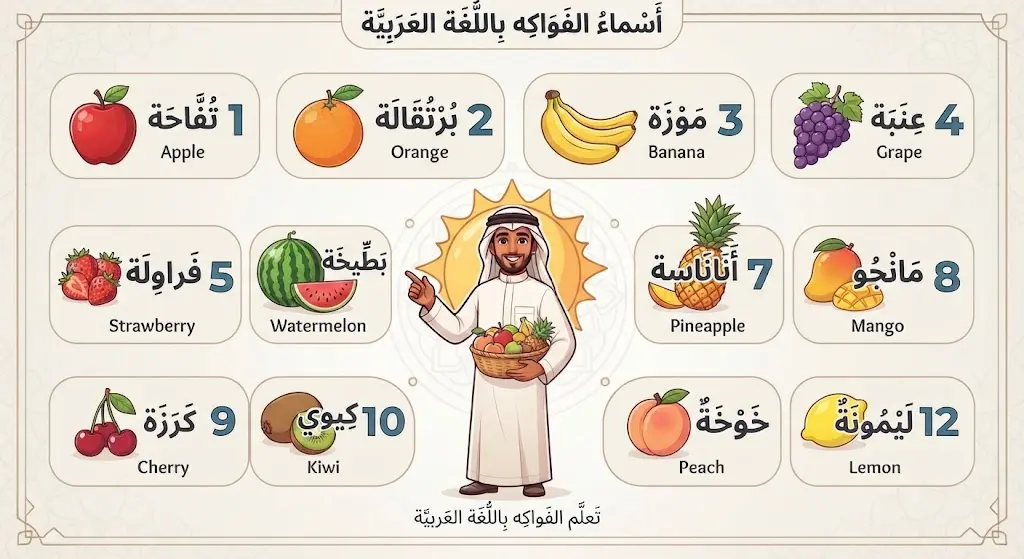
Fifty of the most commonly used fruit names in Arabic appear in the table below, each marked for gender since this determines which adjectives and verb forms pair correctly with it. Masculine nouns are marked (m) and feminine nouns are marked (f).
Knowing a fruit’s gender before you memorize its name saves you from re-learning the word later once grammar becomes part of your sentences.
| English | Arabic | Transliteration | Gender |
| Apple | تفاحة | tuffāḥa | f |
| Banana | موزة | mawza | f |
| Orange | برتقالة | burtuqāla | f |
| Grape (bunch/type) | عنب | ‘inab | m |
| Watermelon | بطيخة | baṭṭīkha | f |
| Strawberry | فراولة | farāwla | f |
| Mango | مانجو | mangū | m |
| Pineapple | أناناس | anānās | m |
| Pear | كمثرى | kummathrā | f |
| Peach | خوخة | khawkha | f |
| Cherry | كرزة | karaza | f |
| Fig | تينة | tīna | f |
| Date | تمرة | tamra | f |
| Pomegranate | رمانة | rummāna | f |
| Lemon | ليمونة | laymūna | f |
| Apricot | مشمشة | mishmisha | f |
| Plum | برقوقة | barqūqa | f |
| Kiwi | كيوي | kīwī | m |
| Guava | جوافة | jawāfa | f |
| Papaya | بابايا | bābāyā | f |
| Coconut | جوز الهند | jawz al-hind | m |
| Blueberry | توت أزرق | tūt azraq | m |
| Raspberry | توت العليق | tūt al-‘alīq | m |
| Blackberry | توت أسود | tūt aswad | m |
| Cantaloupe | شمام | shammām | m |
| Persimmon | كاكا | kākā | f |
| Cranberry | توت بري | tūt barrī | m |
| Tangerine | يوسفي | yūsufī | m |
| Avocado | أفوكادو | afūkādū | m |
| Mulberry | توت | tūt | m |
| Prickly pear | تين شوكي | tīn shawkī | m |
| Quince | سفرجل | safarjal | m |
| Melon | شمام | shammām | m |
| Olive | زيتونة | zaytūna | f |
| Cactus fruit | صبار | ṣabbār | m |
| Elderberry | توت البلسان | tūt al-balasān | m |
| Loquat | إسكدنيا | iskidinyā | f |
| Jujube | نبق | nabq | m |
| Sugarcane | قصب السكر | qaṣab al-sukkar | m |
Notice how most fruits ending in ة (tāʾ marbūṭa) are feminine, while borrowed international words like مانجو and كيوي default to masculine.
This pattern holds consistently enough that you can often guess a fruit’s gender correctly before you even check it.
Read also: Arabic Days of the Week
Why Do Arabic Fruit Names Have Gender?
Arabic fruit nouns take gender because every noun in the language is either masculine or feminine, with no neutral option available. The tāʾ marbūṭa ending (ة) is your most reliable visual clue — the large majority of fruits ending in it are feminine, while fruits without it default to masculine.
This isn’t a memorization burden so much as a pattern-recognition skill. Once the ة-ending rule clicks, you’ll correctly guess the gender of new fruit words you’ve never seen before.
What Happens Grammatically When You Get Fruit Gender Wrong?
Getting a fruit’s gender wrong causes every adjective, verb, and pronoun referring to it to mismatch, making the sentence sound clearly incorrect to a native speaker. Arabic requires strict agreement between a noun and everything describing it.
For example, “sweet” is حلو (ḥulw) for masculine nouns and حلوة (ḥulwa) for feminine ones. تفاحة حلوة (a sweet apple) is correct because تفاحة is feminine. موز حلو (sweet bananas) is correct because موز is masculine. Swap them, and the sentence breaks grammatically even if every individual word is spelled correctly.
In our teaching sessions at Buruj Academy, this is consistently the single most common error we see adult beginners make with fruit vocabulary — they memorize the noun perfectly but attach the wrong adjective form, because English gives them no equivalent instinct to draw on.
This gender-agreement pattern extends across the entire language, which is why Arabic grammar rewards learners who build the habit early rather than retrofitting it later.
Structured, guided practice makes this kind of pattern click far faster than self-study alone. Buruj Academy’s Arabic grammar course uses a context-before-abstraction method, teaching gender agreement through real vocabulary like fruit names rather than abstract grammar tables, guided by instructors with 12+ years of experience teaching non-native speakers.
Understand the Arabic Grammar with Buruj’s free trial lesson

Table of Gender-Paired Fruit Adjectives for Practice
The table below pairs six common fruits with the correct masculine or feminine form of three useful adjectives, so you can see the agreement pattern applied consistently across real vocabulary.
| Fruit | Sweet | Ripe | Fresh |
| تفاحة (apple, f) | حلوة | ناضجة | طازجة |
| موز (banana, m) | حلو | ناضج | طازج |
| برتقالة (orange, f) | حلوة | ناضجة | طازجة |
| عنب (grapes, m) | حلو | ناضج | طازج |
| بطيخة (watermelon, f) | حلوة | ناضجة | طازجة |
| مانجو (mango, m) | حلو | ناضج | طازج |
Read across any row and you’ll notice the adjective ending shifts to ة whenever the fruit noun does.
This is the entire gender-agreement system in miniature — once this table makes sense, you can apply the same logic to describe any fruit you haven’t memorized yet.
Discover the Buruj Academy Difference
Step into our virtual classrooms and see how our expert instructors make learning Quran and Arabic intuitive and clear. We focus on overcoming the specific hurdles non-native speakers face, building your confidence and connection with the Quran.
Master the Arabic Language
Join our expert-led courses and build a strong foundation in Classical and Modern Arabic.
Get Your Free TrialWhat Are the Arabic Number Rules for Counting Fruit?
Arabic counting rules for fruit change the noun’s form at three thresholds: the number 2 uses the dual form, numbers 3 to 10 use the plural, and numbers 11 and above use the singular noun again. تفاحتان (two apples) uses the dual ending, ثلاث تفاحات (three apples) uses the plural, and مئة تفاحة (100 apples) returns to the singular.
This last rule trips up almost every learner the first time they encounter it, because it feels backward — more fruit, but a “smaller” grammatical form.
In our experience teaching adult students at Buruj Academy, this 11-and-above singular rule is usually the moment where students either give up on Arabic numbers or finally see the whole system click into place, once we walk through it slowly with real objects like fruit.
This numbering pattern connects directly to dual nouns in Arabic, which governs the two-item form you’ll use constantly in daily conversation, and to numbers in Arabic more broadly for the full counting system beyond fruit.
Fruits in Arabic and English Side-by-Side Comparison Table
Comparing fruit names directly against their English counterparts highlights which Arabic words are native Semitic vocabulary and which are borrowed from other languages, a distinction that often makes memorization easier.
| Arabic (Native Origin) | English | Arabic (Borrowed Word) | English |
| تفاح | Apple | مانجو | Mango |
| عنب | Grapes | أناناس | Pineapple |
| تين | Fig | كيوي | Kiwi |
| رمان | Pomegranate | أفوكادو | Avocado |
| بطيخ | Watermelon | بابايا | Papaya |
| تمر | Dates | مشمشة | Apricot |
Borrowed words like مانجو and أفوكادو tend to sound close to their English equivalents, which makes them faster to recognize but occasionally trickier to spell correctly in Arabic script since they don’t follow native root patterns.
Read also: How to Learn Arabic in 10 Days?
What Are Some Practical Exercises to Practice Fruit Vocabulary in Arabic?
Practicing fruit vocabulary effectively means moving past flashcard memorization into applied sentence construction, gender-matching drills, and real conversational scenarios like grocery shopping or ordering food. The exercises below target the specific skills this guide has covered.
Try working through each exercise before checking the answer key that follows, since active recall builds stronger retention than passive review.
Exercise 1: Gender Matching
Match each fruit to its correct adjective form (حلو or حلوة):
- برتقالة ___ (sweet orange)
- موز ___ (sweet bananas)
- تفاحة ___ (sweet apple)
- عنب ___ (sweet grapes)
Exercise 2: Fill in the Plural
Convert each singular fruit name to its plural form:
- تفاحة → ___
- موزة → ___
- برتقالة → ___
Exercise 3: Build a Sentence
Using the vocabulary from this article, write one sentence describing your favorite fruit, including at least one gender-matched adjective. For example: أحب التفاح الأحمر (I love red apples).
Answer key:
Exercise 1:
1) حلوة
2) حلو
3) حلوة
4) حلو.
Exercise 2:
1) تفاح
2) موز
3) برتقال.
Consistent practice like this is exactly what separates learners who recognize fruit vocabulary from those who can actually use it in conversation.
Reinforcing new words through dictation practice and applying them within proper Arabic sentence structure turns passive vocabulary into active fluency.
Learn Arabic Fruit Vocabulary and Beyond with Buruj Academy’s Expert Instructors
Fruit vocabulary is a genuinely useful entry point into Arabic gender agreement, plural patterns, and number grammar — but it works best as part of structured, sequential learning rather than an isolated list.
Buruj Academy’s online Arabic classes teach vocabulary through the context-before-abstraction method, building grammar instincts from real, practical words like these rather than disconnected rules.
Our Al-Azhar University graduate instructors bring 12+ years of experience teaching non-native speakers specifically, with personalized 1-on-1 sessions, flexible 24/7 scheduling, and real-time correction on gender agreement, pronunciation, and sentence construction.
Whether you’re a complete beginner or refining existing vocabulary, book a free trial lesson with Buruj Academy and start building Arabic fluency with structured, expert guidance.
Begin your transformation today by choosing the path that fits your goals:
- Online Arabic Classes (General & Comprehensive)
- Arabic Course for Beginners
- Arabic Alphabet Learning Course
- Online Arabic Classes for Kids
- Arabic Classes for Adults
- Arabic Grammar Course (Nahw & Sarf)
- Intermediate Arabic Course (B1/B2)
- Arabic Speaking Course (Conversational Fluency)
- Arabic Reading Course (Literary Excellence)
- Learn Arabic Writing Course (Calligraphy & Composition)
Ready to speak with confidence? Join the global community at Buruj Academy and book your free placement interview today!
Master the Arabic Language
Join our expert-led courses and build a strong foundation in Classical and Modern Arabic.
Get Your Free TrialConclusion
Fruit vocabulary turns out to be one of the most efficient windows into Arabic grammar as a whole, since a single category of nouns exposes gender agreement, plural formation, and number-based noun shifts all at once.
The patterns covered here — tāʾ marbūṭa signaling feminine gender, the 3-to-10 versus 11-and-above plural shift, and adjective matching — repeat constantly across everyday Arabic conversation far beyond the produce aisle.
Treat this list as a starting toolkit rather than a finish line. Revisit the exercises periodically, and apply the same gender-matching logic to new vocabulary as you encounter it, and the instincts built here will carry directly into every other noun category you learn next.
Read also: Arabic Dictionary for Kids
Frequently Asked Questions About Fruits in Arabic
Is There One Standard Arabic Word for All Fruit?
Yes, فاكهة (fākiha) is the standard singular word for fruit, and فواكه (fawākih) is its plural, used across all Arabic-speaking regions. These two forms are understood everywhere, even where individual fruit names shift between dialects.
How Many Fruits Should a Beginner Learn First?
Beginners benefit most from learning 15 to 20 high-frequency fruits first, such as apple, banana, orange, grapes, and watermelon, before expanding to less common varieties. This mirrors how common words in Arabic are typically sequenced for new learners.
Why Are Some Arabic Fruit Names Masculine and Others Feminine?
Fruit names ending in tāʾ marbūṭa (ة), like تفاحة and موزة, are grammatically feminine, while fruits without that ending, like موز and عنب, default to masculine. This pattern applies across nearly all Arabic nouns, not just fruit.