 Arabic
| Key Takeaways |
| Six of the seven Arabic day names are built from ordinal numbers, making the sequence logical once you learn the pattern. |
| Friday breaks the number pattern entirely, named الجمعة (Al-Jumu’ah) after the congregational gathering for prayer. |
| Saturday and Sunday also stand apart, rooted in “rest” (سبت) and “first day of creation” (أحد) respectively. |
| The Arabic week traditionally begins on Sunday, not Monday, which affects how calendars and schedules are read. |
| Adding يوم (yawm, “day”) before each name is optional in casual speech but standard in formal writing. |
Learning the days of the week feels like it should be simple, yet many Arabic learners hit a wall here faster than almost anywhere else. The reason is that Arabic doesn’t borrow the “Moon-day, Saturn-day” logic English speakers rely on, and without that scaffolding, the names can feel arbitrary at first glance.
They aren’t arbitrary. Five of the seven Arabic days of the week are literally the numbers two through five, with Friday carrying its own distinct religious and linguistic root. Once you see the number pattern, the whole week clicks into place.
Table of Contents:
What Are the Days of the Week in Arabic in Order?
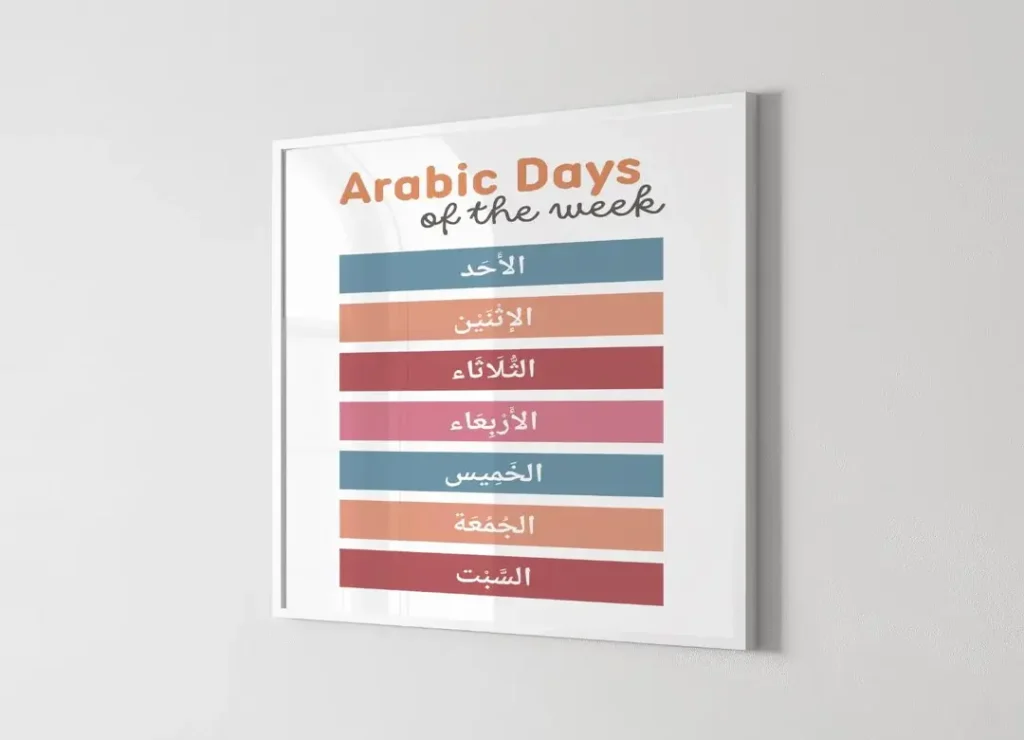
Starting from Sunday, the Arabic week runs: الأحد (Sunday), الاثنين (Monday), الثلاثاء (Tuesday), الأربعاء (Wednesday), الخميس (Thursday), الجمعة (Friday), and السبت (Saturday). Sunday through Thursday derive from the numbers one through five respectively.
1. Sunday in Arabic
Sunday is الأحد (Al-Ahad), pronounced al-ahad, and it derives from the Arabic word for “one,” reflecting its position as the first day of the traditional Arabic week. This single fact resolves a lot of confusion for learners who assume the week starts on Monday.
The root ح-د-د relates to concepts of “oneness” and “singularity,” the same root family that produces أحد (ahad, “one” or “someone”) in other contexts.
In Quranic Arabic, Al-Ahad is also one of the names of Allah, meaning “The One,” though the day name and the divine name, while sharing a root, function as separate vocabulary items in daily use.
In our sessions with adult beginners in Arabic classes for adults, the single most common error is assuming Monday opens the week simply because that’s the convention in their native language or workplace calendar.
We correct this early, because it affects how students read Arabic-language schedules, prayer timetables, and academic calendars throughout their learning journey.
| Element | Detail |
| Arabic | الأحد |
| Transliteration | Al-Ahad |
| Literal meaning | “The first” / relates to “one” |
| Formal usage | يوم الأحد (Yawm Al-Ahad) |
Book your free Arabic trial lesson at Buruj

2. Monday in Arabic
Monday is الاثنين (Al-Ithnayn), pronounced al-ith-nayn, directly derived from اثنان (ithnan), the Arabic number “two.” This makes Monday the second day of the week in Arabic numbering, consistent with Sunday being “one.”
The dual form here is worth pausing on. اثنين is technically the accusative/genitive dual form of the number two, and learners who’ve studied Arabic dual nouns will recognize the نين ending as the same dual marker that appears elsewhere in Arabic grammar.
This is one of the clearest real-world applications of dual number theory beginners encounter.
Students frequently ask why Monday uses the dual form of “two” rather than a simple ordinal like “second” (الثاني).
The answer lies in classical Arabic day-naming convention, which counted days as pairs following the first day, a pattern that persisted into Modern Standard Arabic despite not following strict ordinal logic throughout the rest of the week.
3. Tuesday in Arabic
Tuesday is الثلاثاء (Ath-Thulatha), pronounced ath-tha-la-thaa, built from ثلاثة (thalatha), the number “three.” Tuesday sits as the third day in the Arabic weekly sequence, continuing the numerical pattern established by Sunday and Monday.
Notice the pronunciation shift here. The definite article ال combines with the ث (thaa) sound to create what’s called a “sun letter” assimilation, a rule covered in depth in our guide to moon and sun letters in Arabic.
This is why native speakers say “ath-thulatha” rather than “al-thulatha” — the ل sound assimilates into the following consonant.
This assimilation rule applies to five of the seven day names, since most begin with sun letters.
Learners who master this pattern early avoid one of the most persistent pronunciation habits we see in non-native speakers: over-pronouncing the ل in contexts where native speakers naturally drop it.
4. Wednesday in Arabic
Wednesday is الأربعاء (Al-Arbi’a), pronounced al-ar-bi-aa, derived from أربعة (arba’a), the number “four.” As the fourth day, it continues the straightforward numerical logic that makes the middle of the Arabic week the easiest section to memorize.
The ع (ayn) sound in أربعاء is one of the letters English speakers find genuinely difficult, since English has no equivalent sound.
It’s produced from deep in the throat, a guttural articulation point shared with letters like ح and غ. Practicing this day name is actually useful pronunciation drilling beyond just vocabulary memorization.
In our experience, students who struggle with ayn pronunciation benefit from practicing Wednesday alongside other أربعة-based words, since repetition across contexts trains the muscle memory faster than isolated drilling. We often pair this with Arabic numbers practice for reinforcement.
Read also: Clothes in Arabic
5. Thursday in Arabic
Thursday is الخميس (Al-Khamees), pronounced al-kha-mees, from خمسة (khamsa), the number “five.” Thursday completes the pure numerical sequence, standing as the fifth day before Friday breaks the pattern entirely.
Al-Khamees has a secondary cultural association worth noting: in many Arab and Muslim communities, Thursday evening carries particular significance as the transition into the blessed day of Jumu’ah (Friday), influencing customs around extra worship and family gatherings in the hours leading into Friday.
This is also where the numerical naming convention ends. Every day from Sunday through Thursday follows the “day = number” formula, but Friday abandons it completely, which is the single detail that trips up learners who try to memorize the week as one continuous numerical chain rather than recognizing the break.
6. Friday in Arabic
Friday is الجمعة (Al-Jumu’ah), pronounced al-ju-mu-ah, and unlike the previous five days, it has no connection to the number six. The word comes from the root ج-م-ع, meaning “to gather” or “to congregate,” directly reflecting Friday’s role as the day of congregational prayer in Islam.
This naming departure isn’t a grammatical inconsistency — it’s intentional. Classical Arabic linguists and early Islamic scholars documented that pre-Islamic Arabs originally referred to this day as يوم العروبة (Yawm Al-‘Arubah), and the name shifted to Al-Jumu’ah specifically because of the community gathering for Friday congregational prayer that became central to the day’s identity.
We consider this the single most important vocabulary fact in the entire article for religious literacy.
Students studying in our Quranic Arabic classes will encounter الجمعة constantly, since it names both the weekday and the 62nd chapter of the Quran, Surah Al-Jumu’ah.
Why the pattern breaks matters pedagogically: learners who try to force Friday into the number-six slot consistently mispronounce or misremember it, because they’re fighting the language’s actual structure rather than working with it.
Discover the Buruj Academy Difference
Step into our virtual classrooms and see how our expert instructors make learning Quran and Arabic intuitive and clear. We focus on overcoming the specific hurdles non-native speakers face, building your confidence and connection with the Quran.
Master the Arabic Language
Join our expert-led courses and build a strong foundation in Classical and Modern Arabic.
Get Your Free Trial7. Saturday in Arabic
Saturday is السبت (As-Sabt), pronounced as-sabt, from the root س-ب-ت, meaning “to rest” or “to cease.” Saturday closes the traditional Arabic week as the seventh and final day, named for rest rather than for a number.
This root connects directly to the concept of Sabbath observance, and the linguistic relationship between السبت and the Hebrew “Shabbat” reflects the shared Semitic language family both Arabic and Hebrew belong to.
This is a genuinely useful comparative linguistics point for students who’ve encountered Sabbath terminology in other contexts.
Some learners assume Saturday is “day seven” numerically the way Sunday is “day one,” but that’s not how the root functions here. سبت doesn’t mean “seven” in any numerical sense — it’s purely about rest, making it grammatically distinct from every day except Friday and Sunday.
Read also: How to Learn Arabic in 10 Days?
Complete week-day overview in Arabic:
| Day (English) | Arabic | Transliteration | Root Meaning |
| Sunday | الأحد | Al-Ahad | One |
| Monday | الاثنين | Al-Ithnayn | Two |
| Tuesday | الثلاثاء | Ath-Thulatha | Three |
| Wednesday | الأربعاء | Al-Arbi’a | Four |
| Thursday | الخميس | Al-Khamees | Five |
| Friday | الجمعة | Al-Jumu’ah | Gathering |
| Saturday | السبت | As-Sabt | Rest |
How Do You Say “Day” Before Each Arabic Weekday?
Formal Arabic writing pairs each day name with يوم (yawm), meaning “day,” producing phrases like يوم الأحد (Yawm Al-Ahad, “the day of Sunday”) rather than the bare day name alone. This construction is standard in news, official documents, and academic Arabic.
In everyday spoken Arabic, particularly in casual conversation, native speakers frequently drop يوم and simply say الأحد or الاثنين when the context of “day” is already understood. Both forms are correct; the choice depends on formality level rather than grammatical necessity.
This يوم + day-name structure is a genitive construction, or إضافة (idafa), a grammar pattern that appears throughout Arabic sentence structure well beyond just weekday expressions. Understanding it here reinforces a concept students will meet repeatedly in Arabic grammar study more broadly, we notice this in our Arabic grammar course.
Understand the Arabic Grammar with Buruj’s free trial lesson
Formal vs. casual usage:
| Context | Example | When Used |
| Formal/written | يوم الثلاثاء | News, documents, formal speech |
| Casual/spoken | الثلاثاء | Everyday conversation |
| Question form | أي يوم اليوم؟ | “What day is it today?” |
Practice Exercises for Mastering Arabic Days of the Week
Active recall consistently outperforms passive review when memorizing Arabic vocabulary, and the days of the week respond especially well to structured drilling because of their internal numerical logic. We recommend working through these exercises in order, since each builds on the last.
Exercise 1 — Number-to-day matching
Without looking at the table above, write the Arabic numbers one through five (واحد through خمسة) on paper, then try to derive each corresponding day name from the number alone. This reinforces the root connection directly rather than treating vocabulary as isolated memorization.
Exercise 2 — Fill-in-the-blank sentences
Complete short sentences such as ” ___اليوم هو” (Today is ___) using a different day each time you practice, ideally at the same time you’d naturally say the sentence in your first language during your day.
Exercise 3 — Sun letter identification
Go through all seven day names and identify which begin with sun letters (triggering ل assimilation) versus moon letters (where ل is pronounced clearly). This connects the vocabulary directly to a pronunciation rule you’ll need throughout Arabic.
Exercise 4 — Weekly schedule writing
Write out a full week’s schedule in Arabic, using both formal (يوم + day) and casual (day alone) forms for different entries, mimicking how a real Arabic calendar or planner would mix registers.
Consistent short sessions beat occasional long ones for this kind of vocabulary. Students working through our Arabic for beginners course typically report the days of the week solidifying within one to two weeks of daily five-minute review, though individual pacing naturally varies.
Begin learning Arabic at Buruj with a FREE trial lesson

Read also: Seasons and Weather in Arabic
Build Real Arabic Fluency with Buruj Academy’s Expert Instructors
Mastering the days of the week is one small piece of the larger Arabic fluency puzzle, and getting personalized correction on pronunciation, grammar logic, and usage patterns accelerates progress far beyond self-study alone.
At Buruj Academy, our online Arabic classes use the context-before-abstraction method, teaching vocabulary like this through meaningful, real-use patterns rather than rote lists, guided by Al-Azhar University graduate instructors with 12+ years of experience teaching non-Arabic speakers.
Every session is personalized 1-on-1, with real-time pronunciation correction and flexible scheduling built for busy adults and families worldwide.
Ready to move beyond memorized lists into genuine conversational confidence?
Book your free trial lesson and experience the Buruj Method firsthand.
Begin your transformation today by choosing the path that fits your goals:
- Online Arabic Classes (General & Comprehensive)
- Arabic Course for Beginners
- Arabic Alphabet Learning Course
- Online Arabic Classes for Kids
- Arabic Classes for Adults
- Arabic Grammar Course (Nahw & Sarf)
- Intermediate Arabic Course (B1/B2)
- Arabic Speaking Course (Conversational Fluency)
- Arabic Reading Course (Literary Excellence)
- Learn Arabic Writing Course (Calligraphy & Composition)
Ready to speak with confidence? Join the global community at Buruj Academy and book your free placement interview today!
Master the Arabic Language
Join our expert-led courses and build a strong foundation in Classical and Modern Arabic.
Get Your Free TrialConclusion
The Arabic week reveals its own internal logic once the number pattern becomes visible: Sunday through Thursday map directly onto the numbers one through five, while Friday’s gathering-rooted name and Saturday’s rest-rooted name carry distinct cultural weight that pure numbering never could.
Rather than seven unrelated words to memorize by brute force, the days of the week become a structured system connecting numbers, roots, and pronunciation rules students will reuse throughout their entire Arabic learning path.
Frequently Asked Questions About Arabic Days of the Week
Why Doesn’t Friday Follow the Number Pattern Like Other Days?
Friday is named الجمعة (Al-Jumu’ah), from the root meaning “to gather,” because of its role as the day of congregational Friday prayer in Islam. This naming reflects religious and social significance rather than continuing the numerical sequence used for Sunday through Thursday.
How Do You Say “What Day Is It Today?” in Arabic?
The standard phrase is أي يوم اليوم؟ (Ayyu yawmin al-yawm?), literally “which day is today?” A simpler, more casual alternative some speakers use is إيه اليوم؟ in dialect, though the formal question works across all Arabic-speaking regions and contexts.
Is There a Connection Between Arabic and Hebrew Day Names?
Yes, particularly with Saturday. Arabic السبت (As-Sabt) and Hebrew “Shabbat” share the same Semitic root relating to rest, reflecting the common linguistic ancestry of both languages.
Related Articles
Arabic