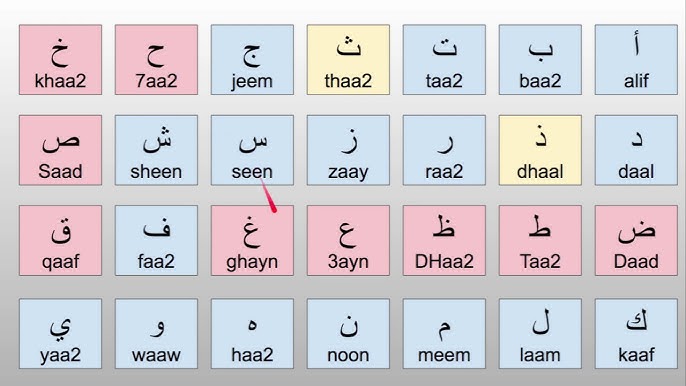
 Arabic
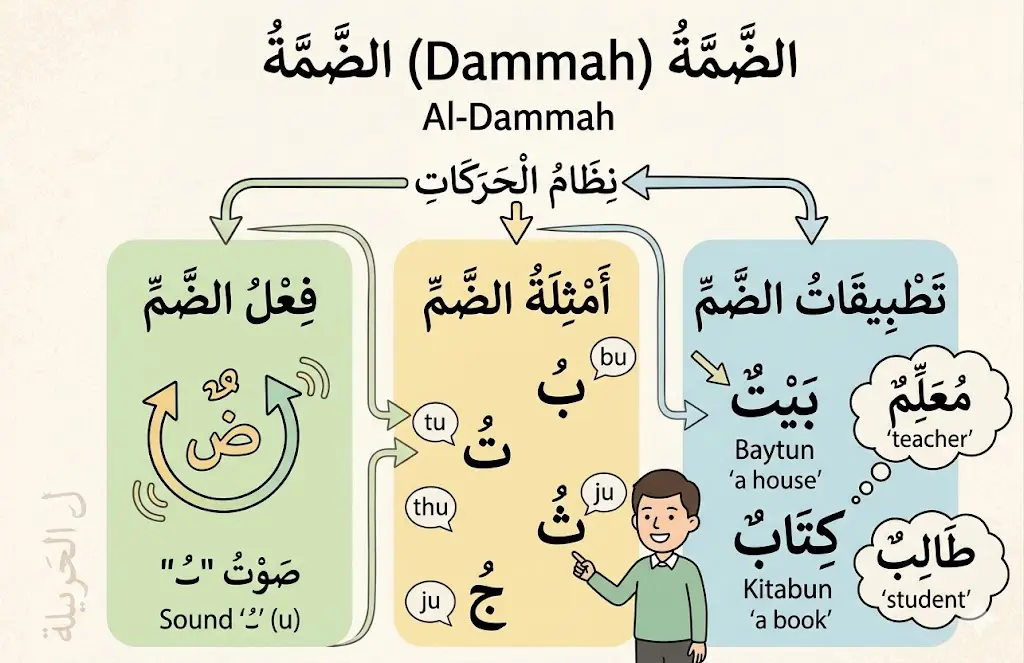
| Key Takeaways |
| The dammah (ضَمَّة) is a short vowel mark written as a small واو above a letter, producing the short “u” sound (as in “put”). |
| Arabic words change grammatical meaning based on dammah placement — it marks the nominative case (مرفوع) in nouns and verbs. |
| The dammah pairs with the letter و to form the long vowel “uu” (as in “moon”), a pattern essential for reading unvoweled Arabic text. |
| Tanwin al-damm (ـٌ) — double dammah — signals an indefinite nominative noun, appearing frequently in everyday Modern Standard Arabic writing. |
The dammah (ضَمَّة) is one of three core short vowel signs in Arabic, producing the short “u” sound. It controls how words are pronounced, how nouns are grammatically marked, and — when doubled — how indefinite subjects are signaled in a sentence. Understanding it fully is one of the first real milestones in Arabic literacy.
Table of Contents:
What Is the Dammah in Arabic?
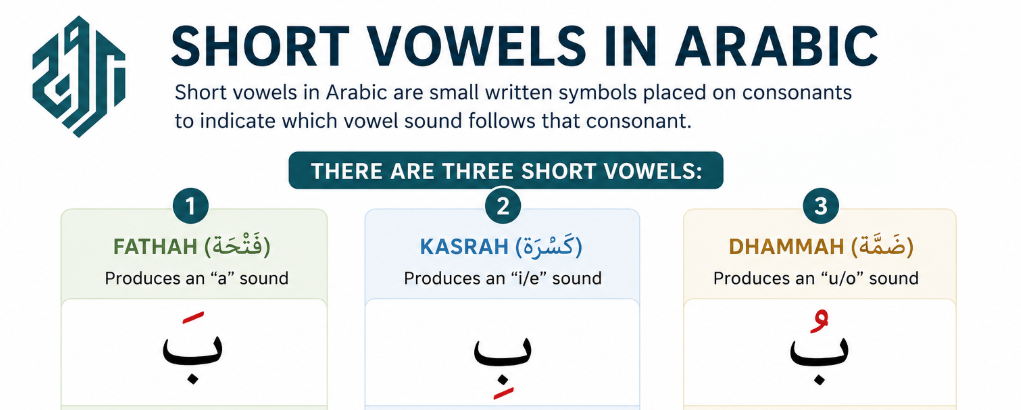
The dammah is a short vowel diacritic placed above an Arabic letter. It signals that the letter carries a short “u” sound — similar to the “u” in “put” or “book” in English, never the long “u” in “tune.” The sign itself resembles a small واو (waw) resting on top of the consonant it modifies.
When you see a letter with a dammah, you pronounce the consonant followed immediately by that short “u” sound — quick, rounded, and clipped. The lips slightly round when producing this sound, which is a physical movement English speakers often skip.
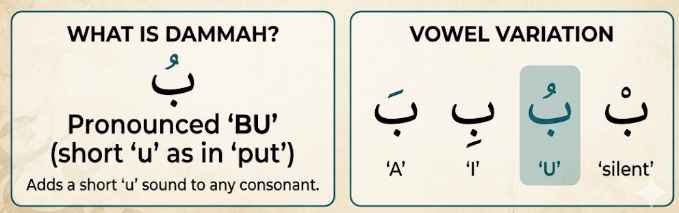
In our sessions at Buruj Academy, this lip-rounding step is where most beginners first struggle — they produce a flat “uh” rather than a true rounded “u.” Training the mouth position early prevents this habit from solidifying.
How the Dammah Looks on Different Arabic Letters
| Arabic Letter | With Dammah | Romanized Sound |
| ب | بُ | bu |
| ك | كُ | ku |
| م | مُ | mu |
| ن | نُ | nu |
| س | سُ | su |
Each of these combinations is a building block. Before moving to full words, practicing these letter-plus-dammah pairings aloud — repeating each one ten times — builds the muscle memory your mouth needs. This is exactly how we structure the first week of our Arabic Alphabet Learning Course.
Get a free trial now in Buruj’s Alphabet course
How to Write the Dammah in Arabic?
The dammah (ضَمَّة) is written as a small loop — resembling a miniature واو — placed directly above the letter it modifies. It never sits below the letter and never connects to the letter’s body. Its position is always centered above the main letterform.
Writers new to Arabic script sometimes confuse the dammah with the tanwin (double dammah) or place it too far to one side. In handwriting, the dammah should be small, neat, and lifted — not touching the letter beneath it.
Dammah vs. Other Harakat — A Visual Comparison
| Vowel Mark | Arabic Symbol | Position | Sound Produced |
| Fatha | َ | Above letter | Short “a” (as in “cat”) |
| Dammah | ُ | Above letter | Short “u” (as in “put”) |
| Kasra | ِ | Below letter | Short “i” (as in “bit”) |
| Sukoon | ْ | Above letter | No vowel — consonant stop |
Understanding this table is essential before moving to full word reading. If you are still building comfort with Arabic vowel marks in general, our guide on vowels in Arabic covers all three short vowels together with detailed examples.
Arabic Words with Dammah
The best way to internalize the dammah is through meaningful vocabulary, not isolated letters. Below we organize common Arabic words carrying the dammah sound into categories, with full voweling so you can read and practice them immediately.
Everyday Nouns with Dammah
| Arabic Word | Dammah Position | Meaning | Romanization |
| كُتُب | On ك and ت | Books | Kutub |
| قُلُوب | On ق and ل | Hearts | Quloob |
| دُروس | On د | Lessons | Duroos |
| نُجُوم | On ن | Stars | Nujoom |
| مُعَلِّم | On م | Teacher | Mu’allim |
| طُلَّاب | On ط | Students | Tullaab |
Practice reading each word aloud three times. Then cover the romanization column and test yourself. This active recall method — returning to the Arabic script without support — is one of the fastest ways to build reading fluency we use in our Online Arabic Classes.
Book your FREE Arabic trial online Arabic class at Buruj

Common Verbs Containing the Dammah Sound
| Arabic Verb | Meaning | Notes |
| كَتَبَ يَكْتُبُ | He wrote / He writes | Dammah on ب in present tense |
| ذَهَبَ يَذْهَبُ | He went / He goes | Dammah on ب in present tense |
| شَرِبَ يَشْرَبُ | He drank / He drinks | Dammah marks present tense ending |
| لَعِبَ يَلْعَبُ | He played / He plays | Dammah on ب in present tense |
| خَرَجَ يَخْرُجُ | He exited / He exits | Dammah on ر in present tense |
Notice the pattern: the present tense of many Arabic verbs ends in a dammah on the final letter. This is not coincidence — it is grammar. The dammah signals the indicative (al-mudari’ al-marfoo’) form of the present tense verb.
For a fuller picture of how Arabic tenses interact with these markers, see our guide on Arabic tenses.
Discover the Buruj Academy Difference
Step into our virtual classrooms and see how our expert instructors make learning Quran and Arabic intuitive and clear. We focus on overcoming the specific hurdles non-native speakers face, building your confidence and connection with the Quran.
Master the Arabic Language
Join our expert-led courses and build a strong foundation in Classical and Modern Arabic.
Get Your Free TrialWhat Is the Grammatical Role of the Dammah in Arabic?
The dammah is not only a pronunciation marker — it is a grammatical signal. In Arabic, the vowel ending of a word (called i’rab / الإعراب) tells you its grammatical function in the sentence.
The dammah specifically marks the nominative case (الحالة الرفع), meaning the word is the subject of the sentence or a predicate nominative.
This is one of the features that makes Arabic grammar precise and elegant. While English relies on word order to show grammar, Arabic often uses these vowel endings.
A noun ending in dammah is the subject (فاعل) or an independent predicate. Change that ending to a kasra or a fatha, and the grammatical role shifts entirely.
Read also: Long Vowels in Arabic
Dammah as the Nominative Case Marker — Examples
| Arabic Sentence | Role of Underlined Word | Case |
| المُعَلِّمُ في الفَصْل | Subject (the teacher) | Nominative — dammah |
| رَأَيْتُ المُعَلِّمَ | Object (the teacher) | Accusative — fatha |
| سَلَّمْتُ على المُعَلِّمِ | Object of preposition | Genitive — kasra |
The word مُعَلِّم (teacher) carries three different vowel endings depending on its function. This system is called I’rab, and it runs through the entire Arabic language. To go deeper into Arabic grammar structures, our article on Arabic grammar for beginners is a strong next step.
What Is Tanwin al-Damm and How Is It Used?
Tanwin al-damm (تنوين الضم) — written as a double dammah (ـٌ) — is the indefinite nominative marker in Arabic. It produces the sound “un” at the end of a word, and it tells you two things simultaneously: the noun is indefinite (no “the” / ال), and it is in the nominative case (subject position).
This marker appears constantly in Modern Standard Arabic writing and speech. Every time you want to say “a teacher” (not “the teacher”) as the subject of a sentence, the word carries tanwin al-damm.
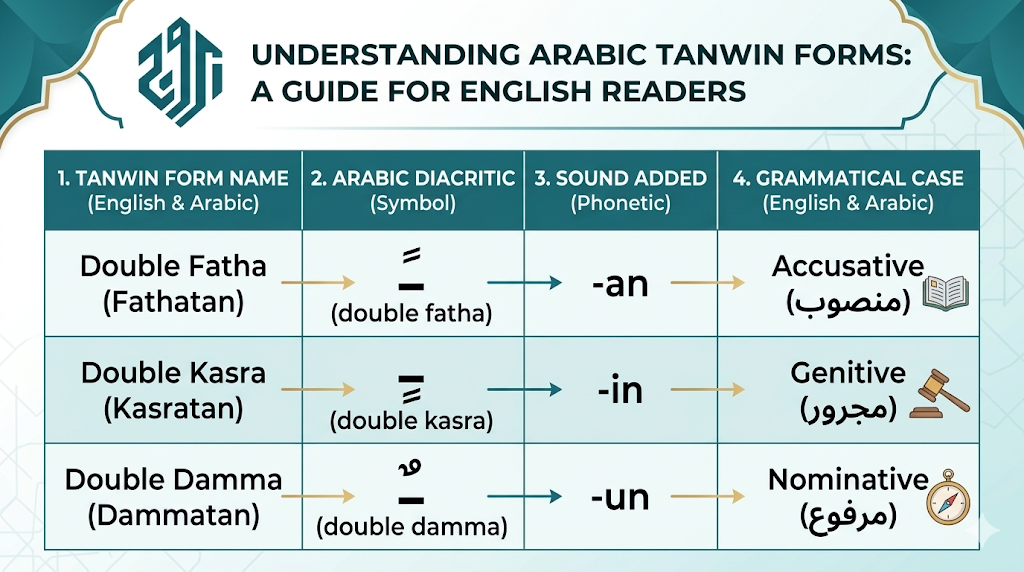
Learning to recognize and produce it correctly is not optional — it is woven into Arabic sentences at every level.
Definite vs. Indefinite Nominative — Dammah and Tanwin Compared
| Arabic | Transliteration | Meaning | Vowel Ending |
| المُعَلِّمُ | al-mu’allimu | The teacher (subject) | Single dammah |
| مُعَلِّمٌ | mu’allimun | A teacher (subject) | Double dammah — tanwin |
| الكِتَابُ | al-kitaabu | The book (subject) | Single dammah |
| كِتَابٌ | kitaabun | A book (subject) | Double dammah — tanwin |
In everyday written Arabic — newspapers, textbooks, formal writing — you will see tanwin al-damm frequently at sentence-final positions, especially in descriptions and simple statements.
Our beginner students often tell us that once they grasp this pattern, large sections of Arabic text begin to make structural sense for the first time.
For a wider understanding of how Arabic handles masculine and feminine nouns (which also affects how tanwin is added), see our detailed guide on masculine and feminine nouns in Arabic.
Practical Exercises to Master the Dammah
Reading rules without practice is the fastest route to frustration. Below are structured exercises we use at Buruj Academy with beginner students in the first two weeks of their Arabic for Beginners course. Work through each exercise set daily for consistent progress.
Begin learning Arabic at Buruj with a FREE trial lesson

Exercise 1 — Letter Recognition Drill
Read each syllable aloud, focusing on the rounded “u” lip position:
بُ — تُ — جُ — دُ — رُ — زُ — سُ — شُ — طُ — عُ
Repeat this row five times. Then write each syllable from memory.
Exercise 2 — Word Reading Practice
Read these fully voweled words aloud. Do not rush — prioritize correct mouth position over speed:
كُتُب — دُرُوس — مُعَلِّم — نُجُوم — بُيُوت — طُلَّاب — قُلُوب
After reading aloud, write each word in Arabic script from memory, then check your spelling.
Exercise 3 — Sentence Reading with Dammah Endings
Each sentence below demonstrates the dammah as a nominative case marker:
- المُعَلِّمُ مَاهِرٌ. — al-mu’allimu maahirun — “The teacher is skilled.”
- الطَّالِبُ مُجْتَهِدٌ. — al-taalibuu mujtahidun — “The student is diligent.”
- الكِتَابُ جَدِيدٌ. — al-kitaabu jadeedun — “The book is new.”
- البَيْتُ كَبِيرٌ. — al-baytu kabeerun — “The house is big.”
- المَدِينَةُ جَمِيلَةٌ. — al-madheenatu jameelatan — “The city is beautiful.”
Notice that both the subject and the predicate carry dammah endings (or tanwin) in each sentence. This is the standard pattern for nominal sentences in Arabic.
For a deeper look at how sentences are built, our article on Arabic sentence structure walks through this systematically.
Exercise 4 — Fill in the Correct Vowel
Below are words missing their dammah. Add the correct vowel marker (ُ or ٌ) based on the context clue provided:
| Sentence Context | Word | Answer |
| “The student is…” (subject, definite) | الطالب__ | الطَّالِبُ |
| “A book is…” (subject, indefinite) | كتاب__ | كِتَابٌ |
| “The teacher came” (subject) | المعلم__ | المُعَلِّمُ |
| “A man entered” (subject, indefinite) | رجل__ | رَجُلٌ |
How Does the Dammah Behave in Verb Conjugation?
The dammah appears in Arabic verb conjugation in a systematic, learnable pattern. In the present tense (المضارع), verbs begin with one of four prefix letters (أ، ن، ي، ت), and the default ending of an indicative present-tense verb is a dammah on the final letter. This is called the marfoo’ form of the mudari’.
Understanding this pattern means you can recognize the present tense even in text with minimal voweling. The dammah ending signals: this verb is in its base indicative form — not negated, not conditional, not in a subjunctive clause.
Present Tense Verb Conjugation — The Role of Dammah
| Arabic | Transliteration | Meaning | Dammah Position |
| يَكْتُبُ | yaktubu | He writes | Final ب |
| تَكْتُبُ | taktubu | She writes / You write | Final ب |
| أَكْتُبُ | aktubu | I write | Final ب |
| نَكْتُبُ | naktubu | We write | Final ب |
| يَذْهَبُ | yadhabu | He goes | Final ب |
| يَشْرَبُ | yashrabu | He drinks | Final ب |
When the verb moves into a subjunctive or jussive clause (after certain particles), the dammah ending changes — a reminder that this vowel marker is grammatically active, not decorative.
For a closer look at how Arabic verbs change across tenses, our article on the Arabic present tense explains these shifts with examples.
Read also: Fatha in Arabic
Learn Arabic Effectively with Buruj Academy’s Personalized Classes
Mastering the dammah — and the broader Arabic vowel and grammar system — is significantly faster with structured, personalized instruction. Correct pronunciation habits, particularly the rounded lip position the dammah requires, are nearly impossible to self-correct without expert feedback.
Buruj Academy’s Online Arabic Classes are taught by Al-Azhar University graduates with 12+ years of experience teaching non-Arabic speakers. Our instructors apply the Buruj Method — Context-before-abstraction, Consistency-before-speed — ensuring you build correct foundations rather than rushing through material.
- Personalized 1-on-1 sessions tailored to your level and pace
- Real-time pronunciation correction from expert instructors
- Flexible 24/7 scheduling designed for working adults and parents
- Structured progression from letter recognition to full reading fluency
Book your free trial lesson today and experience the difference expert instruction makes from day one.
Begin your transformation today by choosing the path that fits your goals:
- Online Arabic Classes (General & Comprehensive)
- Arabic Course for Beginners
- Arabic Alphabet Learning Course
- Online Arabic Classes for Kids
- Arabic Classes for Adults
- Arabic Grammar Course (Nahw & Sarf)
- Intermediate Arabic Course (B1/B2)
- Arabic Speaking Course (Conversational Fluency)
- Arabic Reading Course (Literary Excellence)
- Learn Arabic Writing Course (Calligraphy & Composition)
Ready to speak with confidence? Join the global community at Buruj Academy and book your free placement interview today!
Master the Arabic Language
Join our expert-led courses and build a strong foundation in Classical and Modern Arabic.
Get Your Free TrialConclusion
The dammah is far more than a small mark above a letter — it is a grammatical signal, a pronunciation guide, and a gateway into Arabic’s elegant case system. Once you understand that this tiny واو-shaped sign produces the short “u” sound, marks the subject of a sentence, and doubles to signal indefinite nouns, Arabic text begins to reveal its internal logic rather than appearing as a stream of unfamiliar shapes.
Work through the exercises in this guide consistently, return to the vocabulary tables regularly, and pair your reading practice with proper pronunciation feedback. Arabic rewards patience and systematic effort — and the dammah, mastered correctly, opens the door to everything that follows.
Frequently Asked Questions About the Dammah in Arabic
What does dammah mean in Arabic?
The word dammah (ضَمَّة) comes from the Arabic root ض-م-م, meaning to bring together or to compress. It refers to the rounding and compression of the lips when producing the “u” sound. Grammatically, it names the short vowel diacritic placed above Arabic letters to signal the short “u” vowel sound in reading and pronunciation.
What is the difference between dammah and tanwin al-damm?
A single dammah (ُ) marks a definite or grammatically determined noun or verb in the nominative case. Tanwin al-damm (ٌ) — a double dammah — marks an indefinite noun in the nominative case, producing the sound “un” at the word’s end. Both indicate the nominative case; the difference is definiteness, not grammatical function.
How do I practice reading Arabic words with dammah correctly?
Begin with isolated syllables — each letter of the alphabet with a dammah — read aloud with conscious lip-rounding. Progress to two-syllable words, then full words. Use fully voweled text before attempting unvoweled reading. Recording yourself and comparing with native audio sources accelerates progress. Consistent daily sessions of 15–20 minutes outperform infrequent longer sessions.