 Tajweed

| Key Takeaways |
| Tajweed is the science of correct Quranic pronunciation, governed by rules established from the Prophet’s ﷺ authentic recitation tradition. |
| Noon sakinah and Tanwin trigger four rules — Izhar, Idgham, Iqlab, and Ikhfa — each applied based on the following letter. |
| Meem sakinah has three distinct rules: Ikhfa Shafawi, Idgham Shafawi, and Izhar Shafawi, depending on the letter that follows. |
| Madd (elongation) rules require precise beat counts — natural Madd is two beats; connected and obligatory Madd extend to four or six. |
| Qalqalah applies to five letters (ق ط ب ج د) and produces a required echo sound when they appear with sukoon. |
Most beginners assume Tajweed is about Arabic fluency — that once you learn the letters, correct recitation follows naturally. It does not. Tajweed is a separate, systematic science with specific rules governing how every letter is produced, how sounds interact, and how long certain vowels are held.
Learning basic tajweed rules correctly from the start protects your recitation from errors that silently accumulate over years.
Table of Contents:
What Is Tajweed?
Tajweed is the science of reciting the Quran with precision — giving every letter its correct articulation point (makhraj) and its required attributes (sifat), while applying the rules governing letter interactions. The word itself comes from the Arabic root j-w-d, meaning to make excellent or to perfect.
وَرَتِّلِ ٱلْقُرْءَانَ تَرْتِيلًا
Wa rattilil-Qur’āna tartīlā
“And recite the Quran with measured recitation.” (Al-Muzzammil 73:4)
Tarteel here refers specifically to the careful, deliberate recitation that Tajweed produces.
The Prophet ﷺ also said, as recorded in Sahih al-Bukhari:
“The one who is proficient in the recitation of the Quran will be with the honorable and obedient scribes (angels) and he who recites the Quran and finds it difficult to recite, doing his best to recite it in the best way possible, will have a double reward.”
This hadith, beyond its reward, confirms that recitation quality matters in Islamic teaching.
Deliberate, careless mispronunciation that changes meaning is agreed upon by scholars as sinful. This is precisely why beginning correctly — before wrong habits form — is the single most important investment a new learner makes.
At Buruj Academy, we teach Tajweed classes for beginners using the Buruj Method: sound first, rules second — because hearing the correct sound before naming the rule is how the human brain actually acquires pronunciation. This guide walks you through every foundational rule you need to learn Tajweed properly.
Book Your FREE Trial Lesson to Begin Your Tajweed Journey

For a broader overview of how Tajweed fits within Quranic reading as a whole, our guide on reading the Quran for the first time provides helpful orientation before you begin.
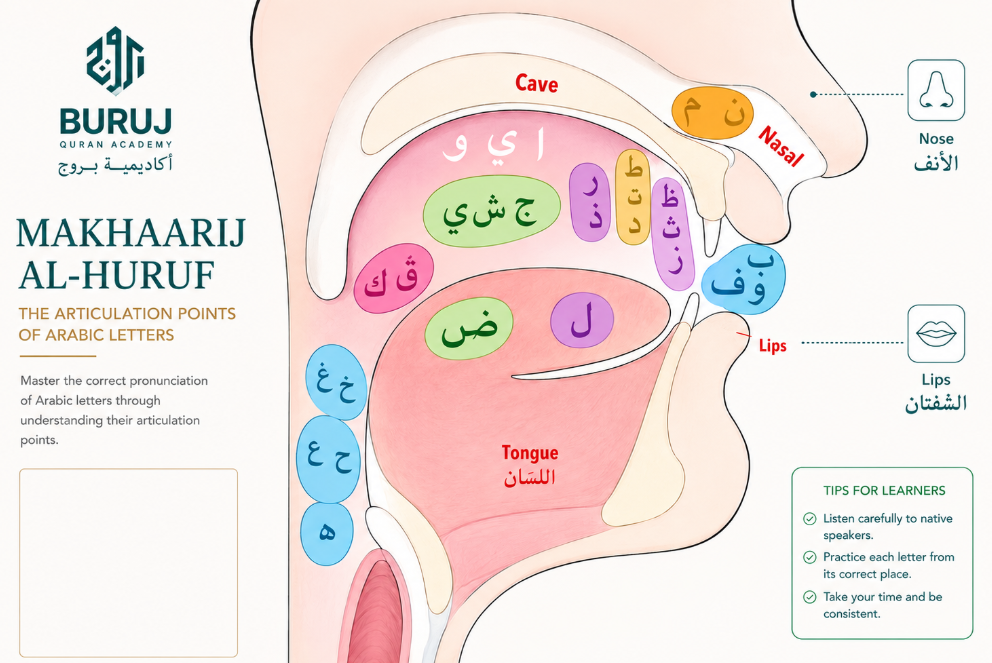
What Are the Makharij in Tajweed?
Makharij al-huruf — the articulation points of Arabic letters — are the precise locations in the mouth, throat, and nasal cavity from which each letter originates. Every Tajweed error ultimately traces back to a makhraj mistake.
Classical Tajweed scholarship, following Imam Ibn al-Jazari, identifies seventeen articulation points grouped across five main areas: the throat (halq), the tongue (lisan), the lips (shafatain), the nasal cavity (khayshum), and the empty space of the mouth and throat (jawf).
| Area | Letters | Key Point |
| Throat (Halq) | ء ه ع غ ح خ | Three zones: deepest, middle, uppermost |
| Tongue (Lisan) | ن ل ر ط د ت… | Ten distinct points across tongue positions |
| Lips (Shafatain) | ب م و ف | Lower lip interacts with upper teeth (ف) or upper lip (ب م و) |
| Nasal Cavity (Khayshum) | غُنَّة (Ghunnah) | Nasality in Noon and Meem — not a letter point but a sound property |
| Jawf (Empty Space) | Long vowels آ ي و | Elongated vowel sounds emanate from open cavity |
In our teaching at Buruj Academy, we see the same makhraj error appear consistently among beginners: the letter ع (‘Ayn) is produced from the middle of the throat, but students habitually produce it from the back of the tongue. Without correction from a qualified teacher, this error persists indefinitely.
For a thorough breakdown of all seventeen points with letter-by-letter examples, our detailed guide on Makharij al-Huruf covers this topic with the depth it deserves.
What Is Noon Sakinah and Tanwin for Beginners?
Noon sakinah (noon with sukoon: نْ) and Tanwin (double vowel endings: ً ٍ ٌ) are among the most frequently occurring sounds in the Quran. Four distinct rules govern how they are pronounced based entirely on the letter that follows them.
| Rule | Trigger Letters | How It Sounds | Example |
| Izhar (Clear) | ء ه ع غ ح خ | Noon pronounced clearly, no nasality | مِنْ عِلْمٍ |
| Idgham (Merging) | ي ن م و ل ر | Noon merges into next letter with Ghunnah (ي ن م و) or without (ل ر) | مَن يَقُولُ |
| Iqlab (Conversion) | ب only | Noon converts to Meem sound with Ghunnah | أَنبِئْهُم |
| Ikhfa (Concealment) | 15 letters | Noon is concealed with nasal resonance for two beats | مَن كَانَ |
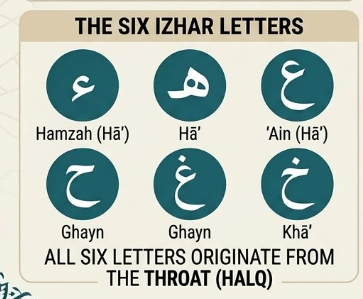
How Does Izhar Work in Actual Quranic Recitation?
Izhar requires the noon to be pronounced fully and clearly, with no nasal resonance extending beyond the letter itself. It activates when any of the six throat letters (ء ه ع غ ح خ) follows the noon sakinah or Tanwin.
وَلَا يُحِيطُونَ بِشَىْءٍ مِّنْ عِلْمِهِۦٓ إِلَّا بِمَا شَآءَ
Min ‘ilmihi ’ illā bimā shā’
“they encompass not a thing of His knowledge except for what He wills.” (Al-Baqarah 2:255)
The نْ in مِنْ before ع is a clear Izhar case — the throat position of ع creates natural separation that requires the noon to be distinct.
For a focused study of the Izhar letters and their recitation rules, we recommend reading our dedicated guide after covering this overview.
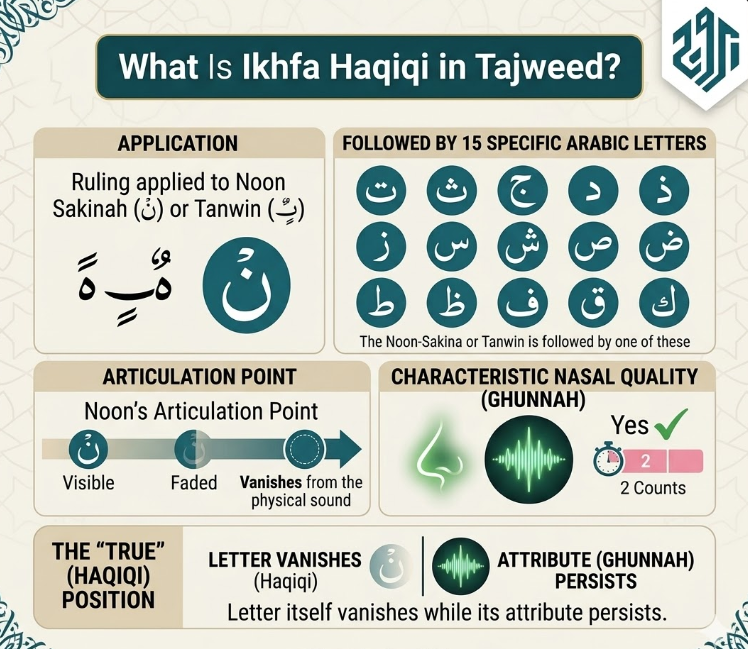
How Does Ikhfa Work and Which Letters Trigger It?
Ikhfa is the most nuanced of the four rules. The noon is neither fully pronounced nor fully merged — it is held in a nasal, concealed state for approximately two beats before transitioning into the next letter.
رِيحًا صَرْصَرًا
Reehan sarsara
“A screaming wind.” (Fussilat 41:16)
Tanwin before Sad across two words — middle-level concealment with clear Ghunnah.
The fifteen Ikhfa letters are: ص ذ ث ك ج ش ق س د ط ز ف ت ض ظ. Each letter produces a slightly different nasal quality because the tongue anticipates the makhraj of the following letter during the concealment phase.
Our detailed guide on Ikhfa letters in Tajweed breaks this down letter by letter.
How Does Idgham Create Merging Between Letters?
Idgham means the noon sakinah assimilates completely into the following letter — the two sounds merge into one, with no separation. It divides into two types:
Idgham with Ghunnah (ي ن م و): The merger is accompanied by nasal resonance lasting two beats.
مَن يَعْمَلْ مِثْقَالَ ذَرَّةٍ خَيْرًا يَرَهُ
Man ya’mal mithqāla dharratin khayray yarah
“So whoever does an atom’s weight of good will see it.” (Az-Zalzalah 99:7)
The نْ in مَن before يَعْمَلْ demonstrates Idgham with Ghunnah — the noon disappears completely into the Yaa with two beats of nasality.
Idgham without Ghunnah (ل ر): The noon merges silently, with no nasal hold.
مِنْ رَّبِّهِمْ
Min rabbihim
“From their Lord.” (Al-Baqarah 2:26)
Noon merges entirely into Ra — the Noon vanishes without a trace.
For a complete breakdown of both Idgham types and their conditions, our guide on Idgham rules in Tajweed covers every scenario with verified Quranic examples.
Our Ijazah-certified instructors train students to feel the complete absence of resonance by first exaggerating the Ra’s roll, then gradually softening it while keeping the Noon silent.
Book a FREE trial session with one of Buruj’s Azhari Quran tutors

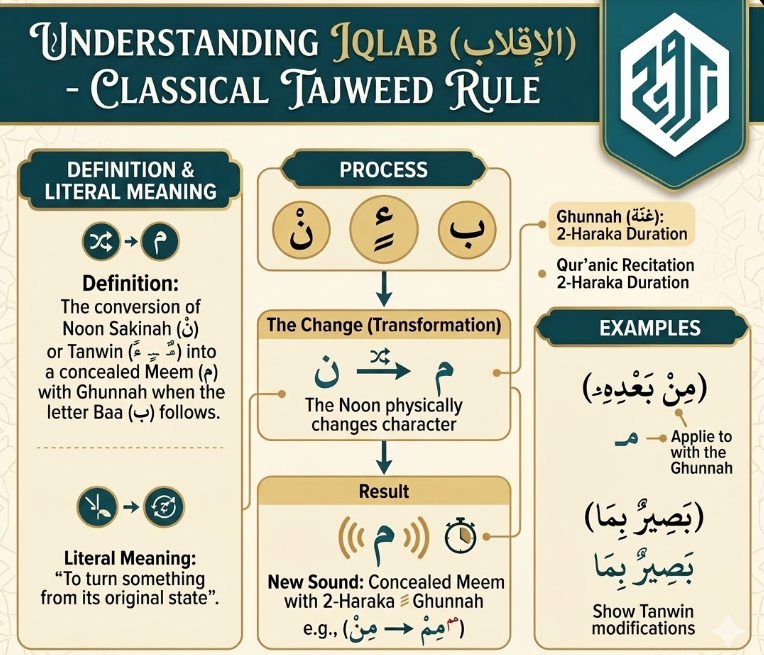
What Is Iqlab?
Iqlab means substitution or conversion. Iqlab letters in Tajweed have only one letter: Ba (ب). When Noon Sakinah or Tanwin is followed by Ba — whether in one word or across two words — the Noon sound is converted into a Meem sound, which is then held with Ikhfa (concealment) and Ghunnah for two counts before the Ba is pronounced.
The Meem is not written in the text. It exists only in recitation, which is why understanding Iqlab requires hearing it from a qualified teacher rather than reading about it.
Quranic Examples of Iqlab:
أَنْبِئْهُمْ
Ambi’hum
“Inform them.” (Al-Baqarah 2:33)
Noon Sakinah before Ba within one word — Noon converts to a concealed Meem with Ghunnah.
سَمِيعٌ بَصِيرٌ
Samee’um baseer
“All-Hearing, All-Seeing.” (Al-Hajj 22:75)
Tanwin before Ba across two words — Tanwin converts to a nasal Meem before Ba.
What Are the Three Rules of Meem Sakinah?
Meem sakinah (مْ) follows its own separate set of rules, distinct from Noon sakinah, despite both involving nasality. The three rules depend entirely on which letter follows the meem.
| Rule | Following Letter | Description |
| Ikhfa Shafawi | ب only | Meem concealed with labial Ghunnah for two beats |
| Idgham Shafawi | م only | Meem merges into following Meem with Ghunnah |
| Izhar Shafawi | All other letters | Meem pronounced clearly with no nasality |
Ikhfa Shafawi Example:
وَمَا هُم بِمُؤْمِنِينَ
Wa mā hum bi-mu’minīn
“And they are not believers.” (Al-Baqarah 2:8)
The مْ in هُم before ب triggers Ikhfa Shafawi — the lips partially close for two beats of nasal sound before completing the Baa. The term “shafawi” refers to the lips, the makhraj of both letters.
Excel in Your Quranic Studies
Join Buruj Academy and master the Quran with our structured, professional curriculum.
Book Your Free TrialQuranic Examples of Idgham Shafawi:
وَمَا هُمْ مِنَ الْمُؤْمِنِينَ
Wa maa hum-minal mu’miniin
“And they are not believers.” (Al-Baqarah 2:8)
The hum’s meem merges completely into the following meem of “min” — one doubled meem with extended ghunnah.
Quranic Examples of Izhar Shafawi:
أَنْعَمْتَ عَلَيْهِمْ
An’amta ‘alayhim
“You have bestowed favor upon them.” (Al-Fatihah 1:7)
Meem saakin before the taa — Izhar Shafawi from within a single word.
A common error we correct in Buruj Academy’s Tajweed classes is students applying Noon sakinah rules to Meem sakinah situations.
The mechanisms overlap conceptually but differ in execution — Ikhfa Shafawi is purely labial, while Noon Ikhfa involves the nasal passage interacting with a variety of tongue positions.
Book Your FREE Trial Lesson to Begin Your Tajweed Journey

What Is Ghunnah and When Is It Required?
Ghunnah is the nasal resonance sound produced through the nasal cavity (khayshum), always associated with Noon (ن) and Meem (م). It is not optional — when Ghunnah is required by a rule, omitting it is a Tajweed violation.
The standard Ghunnah duration is two beats (two harakah counts). Ghunnah applies in four situations:
Noon or Meem with shaddah (ّ): Always carries Ghunnah.
كَلَّا إِنَّ ٱلْإِنسَانَ لَيَطْغَىٰ
Kallā innal-insāna layaṭghā
“No! Indeed, mankind does transgress.” (Al-‘Alaq 96:6)
إِنَّ carries a shaddah on the Noon — this is one of the clearest Ghunnah examples in the Quran, universally used in classrooms.
Ghunnah also appears during Idgham with Ghunnah, Ikhfa, Ikhfa Shafawi, and Idgham Shafawi — all four of which we covered above.
For a complete study of Ghunnah mechanics and practice exercises, our guide on Ghunnah and its rules provides extensive coverage.
What Is Madd (Elongation) for Beginners?
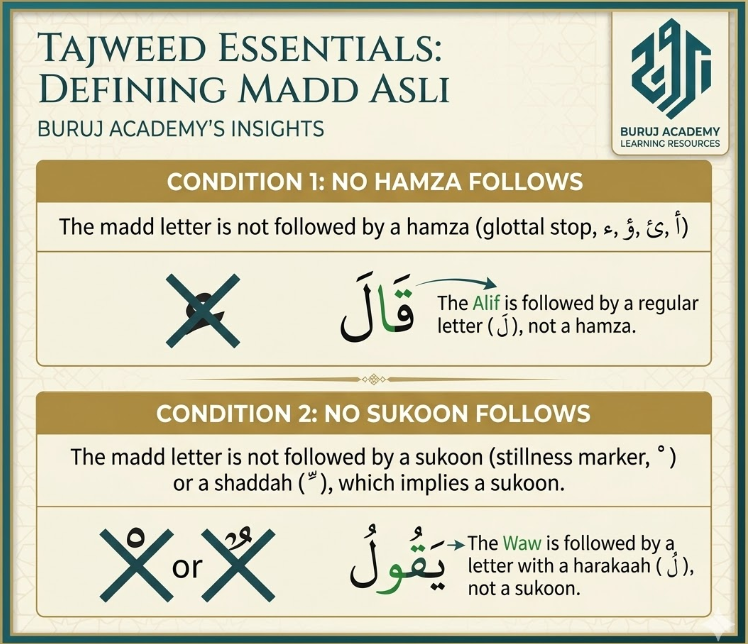
Madd refers to the elongation of specific vowel sounds beyond their natural length. The three Madd letters are: Alif (ا) preceded by a fathah, Waw (و) preceded by a dammah, and Yaa (ي) preceded by a kasrah.
Every Madd application requires a precise beat count — guessing the length is one of the most common beginner errors we encounter.
| Madd Type | Arabic Term | Beat Count | Trigger |
| Natural Madd | Madd Asli / Madd Tab’i | 2 beats | Madd letter with no hamzah or sukoon following |
| Connected Madd | Madd Muttasil | 4–5 beats | Madd letter followed by hamzah in same word |
| Separated Madd | Madd Munfasil | 2, 4, or 5 counts | Madd letter at word end, hamzah begins next word |
| Obligatory Madd | Madd Wajib Muttasil | 4–5 beats | As above, within one word (no separation) |
| Sukoon Madd | Madd ‘Arid lil-Sukoon | 2, 4, or 6 beats | Madd letter before letter stopped upon at waqf |
What Is Madd Asli?
Madd Asli (natural Madd) is the default elongation of two beats that every Madd letter receives in the absence of any additional trigger. It is called “asli” (original/natural) because it exists independently — the Madd letter requires no special condition to elongate; it simply extends to two beats as its base length.
Quranic examples:
نُوحِيهَا
Nooheeha
“We reveal it” (Yusuf 12:3)
Both the waw and ya madds here carry the natural two-count extension.
Our dedicated article on Madd Asli rules and examples provides a step-by-step breakdown for learners building their Madd foundation.
What Is Qalqalah for Beginners?
Qalqalah is the echoing or bouncing sound produced when any of the five Qalqalah letters appears with sukoon (no vowel). The sound is not an added vowel — it is a controlled release of the letter with a slight echo that prevents the sound from being completely cut off.
Qalqalah Letters
The five Qalqalah letters are memorized through the phrase قُطْبُ جَدٍّ (Qutbu Jadin): ق ط ب ج د
| Qalqalah Intensity | When It Occurs |
| Minor Qalqalah (Sughra) | Letter has sukoon in the middle of a word |
| Major Qalqalah (Kubra) | Letter appears at the end of a recitation stop (waqf) |
Qalqalah Example
وَٱلسَّمَاءِ ذَاتِ ٱلْبُرُوجِ
Wassama’i dhātil-burūj
“By the sky containing great stars.” (Al-Buruj 85:1)
The جِ at the end of ٱلْبُرُوجِ, when stopping at waqf, demonstrates Major Qalqalah — the Jeem with sukoon at the stopping point produces a clear, strong echo. Compare this to the same letter mid-word, where no echo.
In our sessions at Buruj Academy, students learning Qalqalah consistently make one of two errors: they produce no echo at all (treating the letter like a regular sukoon), or they exaggerate the echo into an audible additional vowel sound. The correct Qalqalah is controlled — distinct, but not exaggerated.
For detailed training on this rule with audio-referenced examples, our article on Qalqalah letters covers every application scenario.
What Is Tafkhim and Tarqiq (Heavy and Light Letters)?
Tafkhim (heaviness/fullness) and Tarqiq (lightness/thinness) refer to the quality of resonance a letter carries — whether the sound fills the back of the mouth and throat or remains thin and forward. This distinction changes the perceived sound of letters significantly.
Letters always heavy (Tafkhim): The seven letters خ ص ض غ ط ق ظ are always pronounced with full-mouth resonance regardless of their vowel or position.
Letters always light (Tarqiq): Most Arabic letters carry Tarqiq by default.
Letters that vary — Alif and Raa: These are the most complex cases for beginners:
| Letter | Heavy When | Light When |
| Raa (ر) | Carries fathah or dammah; or preceded by fathah/dammah | Carries kasrah; or preceded by kasrah; or followed by heavy letter |
| Alif (ا) | Follows a heavy letter | Follows a light letter |
ٱلرَّحْمَٰنِ ٱلرَّحِيمِ
Ar-Raḥmānir-Raḥīm
“The Entirely Merciful, the Especially Merciful.” (Al-Fatihah 1:3)
Both instances of Raa here carry Tafkhim — the first Raa in الرَّحْمَٰنِ has fathah, and the second in الرَّحِيمِ also has fathah. Beginners sometimes thin the second Raa incorrectly due to the following kasrah in الرَّحِيمِ, but the Raa itself carries fathah and remains heavy.
Our full guide on heavy and light letters in Tajweed provides a complete chart with every Raa rule variation and practice examples.
What Are the Rules of Waqf (Stopping) That Every Beginner Must Know?
Waqf refers to the rules governing where and how a reciter stops during Quran recitation. Stopping incorrectly can distort or even reverse the meaning of a verse. This is among the most meaning-sensitive areas of basic Tajweed rules.
The Quran uses specific waqf symbols above or beside words to guide the reciter:
| Symbol | Arabic Name | Meaning | Ruling |
| مـ | Waqf Lazim | Obligatory stop | Must stop here |
| لا | Laa | Do not stop | Prohibited to stop here |
| صلي | Waqf Sali | Continuing is preferred | May stop, but continuing is better |
| قلي | Waqf Qali | Stopping is preferred | May continue, but stopping is better |
| ج | Waqf Jaiz | Stop permitted | Equal choice: stop or continue |
| ∴ ∴ | Mu’anaqah | Paired stop signs | Stop at one OR the other — never both |
The Mu’anaqah (embrace/intertwining) sign — the paired triangular dots — is one of the most misunderstood Quran stop signs. A classic example appears in Surah Al-Baqarah:
﴿ذَٰلِكَ الْكِتَابُ لَا رَيْبَ ۛ فِيهِ ۛ هُدًى لِّلْمُتَّقِينَ﴾
“This is the Book about which there is no doubt, guidance for those conscious of Allah.” (Al-Baqarah 2:2)
You may stop on رَيْبَ (making “There is no doubt” the complete statement) or on فِيهِ (making “There is no doubt in it” the complete statement).
Stopping at both changes the meaning to imply that doubt exists somewhere — which is incorrect.
For a deeper study of recitation symbols and their role in beautiful recitation, see our Tajweed Rules Essential Guide.
How Should a Beginner Structure Their Tajweed Learning Journey?
Tajweed for beginners requires a specific sequence — learning rules out of order creates confusion and slows progress.
Based on our instructors’ experience teaching non-Arabic speakers at Buruj Academy, the following progression produces the fastest, most durable results:
Stage 1 — Sound Accuracy (Weeks 1–4):
Master the makharij of all Arabic letters before touching any rule. A student who cannot produce ع, ح, and خ from their correct throat positions cannot apply any rule involving these letters accurately.
Stage 2 — Noon and Meem Rules (Weeks 5–8):
Apply the four Noon sakinah/Tanwin rules and three Meem sakinah rules. These appear in virtually every line of Quranic text, making them the highest-frequency rules for practice.
Stage 3 — Madd Rules (Weeks 9–12):
Introduce natural Madd first, then connected and separated Madd, then the conditional Madd types. Madd timing requires ear training alongside rule learning.
Stage 4 — Heavy/Light Letters and Qalqalah (Weeks 13–16):
Tafkhim, Tarqiq, and Qalqalah are applied continuously during recitation practice — they become habits through repetition rather than isolated exercises.
In our instructors’ experience, non-Arabic speaking adults who follow this sequence and practice 20–30 minutes daily consistently reach functional Tajweed application in Surah Al-Fatihah and Al-Baqarah within four months of consistent study. The key variable is not intelligence — it is consistent, guided practice.
Our dedicated Online Tajweed Classes follow this exact sequence, taught by Ijazah-certified instructors who specialize in non-Arabic speaking students.
Book Your FREE Trial Lesson to Begin Your Tajweed Journey

For a fuller roadmap of what to expect as your recitation develops, our guide on how long it takes to learn Tajweed provides realistic timelines based on real student data.
Discover the Buruj Academy Difference
Step into our virtual classrooms and see how our expert instructors make learning Quran and Arabic intuitive and clear. We focus on overcoming the specific hurdles non-native speakers face, building your confidence and connection with the Quran.
Start Your Tajweed Journey with Buruj Academy’s Expert Instructors
Correct Tajweed begins with a qualified teacher — not a textbook, not an app, and not guesswork. Rules read correctly and rules heard correctly produce entirely different outcomes in your recitation.
Buruj Academy’s Tajweed for Beginners course offers everything a new learner needs:
- Al-Azhar University graduates and Ijazah-certified instructors with 12+ years teaching non-Arabic speakers
- The Buruj Method: Sound-before-rules training that builds correct habits from the first session
- Personalized 1-on-1 online sessions with real-time pronunciation correction
- Flexible 24/7 scheduling to fit your daily routine
- Clear progression from makharij mastery through advanced rule application
Book your free trial lesson today and hear the difference proper Tajweed makes in your recitation from your very first session, insha’Allah.
Join a supportive learning environment tailored to your pace and lifestyle. Start your journey toward excellence by enrolling in one of our specialized tracks:
- Online Tajweed Classes
- Tajweed Classes for Beginners
- Tajweed Classes for Adults
- Tajweed Classes for Sisters
- Tajweed Classes for Kids
- Advanced Tajweed Course
- Amli Tajweed Course (Practical Application)
Ready to transform your recitation? book your free assessment and start your path to Tajweed mastery today!
Excel in Your Quranic Studies
Join Buruj Academy and master the Quran with our structured, professional curriculum.
Book Your Free TrialConclusion
Tajweed is not a subject reserved for scholars or those who grew up with Arabic. It is a structured science with clear rules, a logical sequence, and a proven pathway that any committed learner can follow — regardless of native language or starting level.
The rules covered here — Noon and Meem sakinah, Ghunnah, Madd, Qalqalah, Tafkhim and Tarqiq, and Waqf — form the complete foundation of accurate Quranic recitation. Master these, and you have the tools to recite the Quran the way the Prophet ﷺ recited it.
The final step is guidance. Rules understood intellectually become recitation habits only through practice with a qualified teacher who can hear, correct, and refine what no textbook can catch.
Frequently Asked Questions About Tajweed for Beginners
Can a Complete Beginner Learn Tajweed Without Knowing Arabic?
Yes — and this is precisely the situation most of our students begin in. Tajweed is a recitation science, not a language comprehension course. You do not need to understand Arabic to learn correct pronunciation. Most non-Arabic speaking Muslims begin Tajweed with zero Arabic background and progress fully through foundational rules within a few months of consistent guided practice.
How Long Does It Take to Learn Basic Tajweed Rules?
In our instructors’ experience, a committed adult learner practicing 20–30 minutes daily typically applies foundational Tajweed rules — Noon sakinah, Meem sakinah, basic Madd, and Qalqalah — correctly within three to four months. Advanced rules and consistent application across longer Surahs generally develop over six to twelve months of continued study with a qualified teacher.
What Is the Difference Between Tajweed and Tarteel?+
Tajweed refers to the rules governing correct pronunciation of individual letters and their interactions. Tarteel refers to the measured, deliberate pace of recitation that allows Tajweed to be applied properly. The Quran commands Tarteel specifically in Al-Muzzammil 73:4. Tajweed is the technical science; Tarteel is the quality of recitation that results when Tajweed is applied with proper pacing.






Leave a Reply