 Quran
Quran
| Key Takeaways |
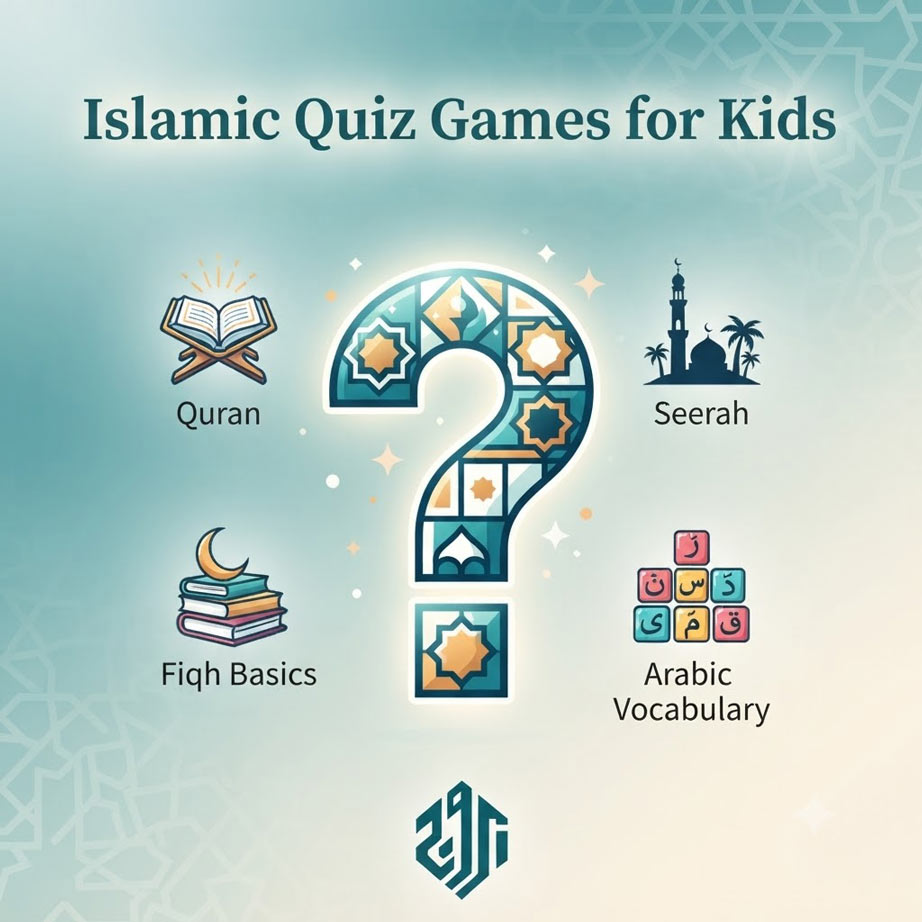
| Islamic quiz games work best when questions rotate across four categories — Quran, Seerah, Fiqh basics, and Arabic vocabulary. |
| Children retain Quranic facts significantly better through active recall games than passive reading or listening alone. |
| Effective family quiz nights use age-tiered question banks so siblings of different ages can compete fairly together. |
| Pairing quiz games with structured Quran instruction reinforces retention rather than replacing the systematic learning children need. |
| Short, frequent quiz sessions of 10–15 minutes build stronger long-term knowledge than occasional lengthy Islamic trivia marathons. |
Many parents in the West watch their children memorize entire fictional universes — sports statistics, cartoon character names, video game lore — while Quranic knowledge slips through the cracks. It’s a familiar frustration, and it’s not a reflection of a child’s ability or interest.
Islamic quiz games for kids work because they use the exact same memory mechanism children already use for the things they love: active recall through repeated, low-pressure question-and-answer play.
A well-structured quiz rotation covering Quran facts, Seerah, and basic Fiqh turns passive Islamic knowledge into knowledge a child can actually retrieve and use.
Table of Contents:
Why Do Quiz Games Help Children Retain Islamic Knowledge Better Than Passive Learning?
Quiz games work because retrieval practice — actively pulling an answer from memory — strengthens recall far more than simply hearing or reading information once. When a child answers “Which surah has no Bismillah at its start?” they’re rebuilding the neural pathway to that fact, not just skimming past it.
We’ve noticed this pattern consistently in classroom sessions at Buruj Academy. Students who reviewed Quran facts through quick oral quiz rounds retained surah names, verse contexts, and basic vocabulary far longer than students who only listened to the same information explained once.
This isn’t unique to Islamic content — it’s how memory works for any subject. The difference is that most families haven’t applied this same game-based structure to Quran and Seerah facts the way they naturally do for school spelling tests or times tables.
Five Ready-to-Use Islamic Questions for Kids Covering Basic Recall
Here are five ready-to-use questions covering basic recall, the exact format that builds this retrieval habit from the very first session.
- Q: How many surahs are in the Quran? A: 114
- Q: What does the word “Quran” mean in Arabic? A: “The Recitation” or “The Reading”
- Q: Which surah is recited in every unit (rakat) of every prayer? A: Surah Al-Fatihah
- Q: What is the first word revealed to Prophet Muhammad ﷺ? A: “Iqra” (Read/Recite)
- Q: How many verses does Surah Al-Fatihah contain? A: Seven verses
That said, quiz games work best as reinforcement alongside — not instead of — structured instruction. Children need a qualified teacher explaining tajweed rules and Quranic meaning first; the quiz format then locks that learning into long-term memory.
Our online Quran course for kids is built specifically around this two-step approach: systematic teaching first, playful reinforcement second.
Help your child start learning the Quran with a FREE trial
What Categories Should a Good Islamic Quiz Game Include?
A well-rounded Islamic quiz game rotates through four core categories: Quran facts, Seerah (Prophetic biography), basic Fiqh and worship practices, and Arabic vocabulary or letters. Covering all four prevents the quiz from becoming repetitive and builds broader religious literacy.
Narrowing a quiz to just one category — Quran trivia alone, for instance — limits what a child actually learns. Real Islamic literacy blends multiple knowledge domains, and children benefit from seeing how they connect.
1. Islamic Quiz for Kids About Quran Facts and Surah Knowledge
This category covers surah names, chapter order, revelation context (Makki or Madani), and famous verses children have already memorized. Sample questions for this round:
- Q: Which surah is called “the heart of the Quran”? A: Surah Yaseen
- Q: How many Juz (parts) does the Quran have? A: 30
- Q: Which surah equals one-third of the Quran in reward when recited, according to the Prophet ﷺ? A: Surah Al-Ikhlas (Sahih al-Bukhari 5013)
- Q: Is Surah Al-Fatihah a Makki or Madani surah? A: Makki
For families actively working through memorization, our guide on easy surahs of the Quran to memorize pairs naturally with this quiz category — quiz on what’s already been memorized to cement it further.
2. Islamic Quiz for Kids About Seerah and Prophetic History
Questions about the Prophet Muhammad ﷺ, his companions, and major events in Islamic history build a child’s connection to the human story behind the religion. Try this round:
- Q: Who was the Prophet’s ﷺ closest companion who became the first caliph? A: Abu Bakr As-Siddiq
- Q: In which cave did the Prophet ﷺ first receive revelation? A: Cave Hira
- Q: What is the migration from Makkah to Madinah called? A: The Hijrah
- Q: Who was the Prophet’s ﷺ wife known for narrating many hadiths? A: Aisha (may Allah be pleased with her)
Our resource on the Prophet Muhammad story for kids offers age-appropriate narrative material that converts naturally into quiz questions once a child has heard the story.
3. Islamic Quiz for Kids About Basic Fiqh and Worship Practice
This category covers the practical side of Islam — how many times Muslims pray daily, what breaks a fast, the order of wudu steps. These questions build functional religious literacy children will use their entire lives.
- Q: How many obligatory prayers does a Muslim perform each day? A: Five
- Q: Name the five pillars of Islam in order. A: Shahada, Salah, Zakat, Sawm, Hajj
- Q: In which month do Muslims fast from dawn to sunset? A: Ramadan
- Q: What must a Muslim do before performing Salah? A: Wudu (ablution)
Our article on the pillars of Islam for kids provides the foundational content this quiz category draws from directly.
Read also: 7 Essential Islamic Studies Lessons for Kids
How Do Parents Structure a Fair Quiz Game for Siblings of Different Ages?
Fair sibling quizzing requires tiered question banks — easier factual questions for younger children, more nuanced context questions for older siblings — scored on a points system rather than speed alone. This prevents an 11-year-old from dominating every round against a 6-year-old.
The most common mistake we see families make when starting family quiz nights is using a single, uniform question difficulty for children spanning several years apart in age.
A 6-year-old and a 12-year-old cannot fairly compete on the same Seerah date-recall question.
Building Three Difficulty Tiers in the Islamic Quiz Games for Kids
Tier one (ages 4–7): Simple recognition questions.
- Q: How many rakats are in Maghrib prayer? A: Three
- Q: What do we say before eating? A: Bismillah
Tier two (ages 8–11): Context and sequence questions.
- Q: Put these events in order: the Hijrah, the first revelation, the conquest of Makkah. A: First revelation, then Hijrah, then conquest of Makkah
- Q: What is the meaning of the Arabic word “Iman”? A: Faith or belief
Tier three (ages 12+): Application and reasoning questions.
- Q: Why do scholars say Surah Al-Ikhlas equals one-third of the Quran? A: Because classical scholars explain the Quran covers three broad themes — rulings, promises and warnings, and Allah’s names and attributes — and Al-Ikhlas concentrates entirely on the third theme
- Q: Why is Al-Fatihah required in every rakat of prayer? A: Because it functions as a direct conversation between the servant and Allah, opening with praise and closing with a request for guidance.
| Age Tier | Question Style | Example Focus |
| 4–7 years | Direct recall, single fact | Prayer counts, basic vocabulary |
| 8–11 years | Sequencing, simple context | Seerah event order, surah themes |
| 12+ years | Reasoning, application | Fiqh rulings with basic evidence |
This tiered approach mirrors how we structure lesson progression at Buruj Academy — content calibrated to a child’s developmental stage rather than a one-size-fits-all script. Explore age-appropriate pacing further in our guide on the best age to memorize Quran.
Families balancing formal learning with home reinforcement often find that enrolling in a structured Online Islamic Studies Classes for Kids give quiz nights actual academic substance to draw from, rather than recycling the same surface-level facts repeatedly.
The first session is free in Buruj’s Islamic Studies Classes for Kids
Scoring Systems That Keep Younger Kids Engaged
Award bonus points for younger children answering tier-one questions correctly under time pressure, and require older children to answer with a brief explanation for full points. This balances the competition without diluting rigor for advanced learners.
We’ve found that removing pure speed as the only scoring factor changes the entire tone of a family quiz night.
Slower, more thoughtful children stop feeling like they’re losing before they even start.
Read also:Islamic Cartoons for Kids
Discover the Buruj Academy Difference
Step into our virtual classrooms and see how our expert instructors make learning Quran and Arabic intuitive and clear. We focus on overcoming the specific hurdles non-native speakers face, building your confidence and connection with the Quran.
Expand Your Islamic Knowledge
Join our structured online courses led by qualified instructors to deepen your understanding of the Deen.
Join a Free Trial ClassRead also:How to Teach a Child to Pray in Islam Step by Step
What Are the Best Islamic Question and Answer Game Formats for Home Use?
The most effective home formats are flashcard-style rapid rounds, “Islamic Jeopardy” category boards, and true-or-false chains — each requiring minimal setup while maximizing active recall repetitions per session. Rotating formats weekly prevents the novelty from wearing off.
1. Flashcard Rapid Round
Write questions on index cards sorted by category, shuffle, and give each child 60 seconds to answer as many as possible. This format is ideal for younger children who need quick wins to stay motivated through a session. A ready 60-second flashcard set:
- Q: How many angels carry the Throne of Allah? A: This is not something children need to answer with certainty — swap for: “What is the name of the angel who brought revelation to the Prophet ﷺ?” A: Jibreel (Gabriel)
- Q: What is the Arabic word for mosque? A: Masjid
- Q: What is the Arabic word for “peace”? A: Salam
- Q: How many times is the word “Allah” typically greeted with after His name? Simplify instead: “What do we say after mentioning Allah’s name?” A: Subhanahu wa ta’ala (Glorified and Exalted is He)
- Q: What is the Arabic word for the Islamic holy book? A: Al-Quran Al-Kareem
Read also:Islamic Quiz for Kids
2. Islamic Jeopardy Category Boards
Create a simple grid — five categories across, five point values down — where children choose a category and difficulty level themselves.
Sample category headers that work well: Surahs, Prophets, Prayer, Arabic Words, Ramadan. This gives children agency over their own challenge level, which research on motivation consistently shows increases engagement.
3. True-or-False Chains
State a series of Islamic facts, some accurate and some subtly altered, and have children identify which is false and correct it. Try this chain:
- “The Quran has 114 surahs.” → True
- “Surah Al-Fatihah has ten verses.” → False, it has seven
- “Muslims pray five times a day.” → True
- “The Hijrah was the Prophet’s ﷺ first revelation.” → False, the Hijrah was the migration to Madinah; the first revelation happened earlier in Cave Hira
This format specifically strengthens critical thinking rather than pure memorization, since children must evaluate rather than simply recall.
For structured activity ideas beyond quizzing alone, our collection of Quranic games for kids and Quran activities for kids offers complementary formats that pair naturally with quiz rotations.
Islamic Quiz Games for Adults
Adult-level Islamic quiz games shift toward deeper Fiqh nuance, Tafsir context, and Arabic root-word analysis, making them suitable for mixed-generation family game nights when questions are layered by difficulty within the same session. Parents modeling engagement matters as much as the content itself.
A sample adult-tier round to run alongside the children’s version:
- Q: What does the phrase “Sab’ al-Mathani” (the seven oft-repeated verses) refer to? A: Surah Al-Fatihah
- Q: According to the hadith on Surah Al-Ikhlas, what did the Prophet ﷺ say it equals? A: One-third of the Quran (Sahih al-Bukhari 5013)
- Q: What is the Arabic root meaning behind “Fatihah”? A: “To open” — from the root f-t-h
When parents participate — visibly trying, occasionally missing an answer, laughing at a wrong guess — children absorb an important unspoken lesson: learning about the deen is a lifelong, shared pursuit, not a childhood-only obligation.
This models the spirit found in the well-known hadith where the Prophet ﷺ said, “The best among you are those who learn the Quran and teach it” (Sahih al-Bukhari 5027). This hadith frames Quran learning and teaching as a continuous, mutual act — exactly what a family quiz night embodies.
Adults benefit from the same active-recall mechanism children do. If a parent is rebuilding or deepening their own Quran knowledge alongside their child’s learning, our Online Quran Classes provide structured content that can directly feed family quiz question banks.
Start Learning Quran With a FREE Trial Lesson
What Mistakes Do Parents Commonly Make When Running Islamic Quiz Nights?
The most common mistakes are treating quiz night as a test with visible scorekeeping pressure, using only difficult questions that discourage beginners, and running sessions too long for a child’s attention span. Each mistake reverses the game’s intended motivational benefit.
In our experience supporting families through Buruj Academy’s parent resources, the single most damaging habit is turning the quiz into an implicit measurement of religious adequacy.
Children who sense they’re being judged on their Islamic knowledge — rather than playing a game about it — disengage quickly and associate Quran-related activities with anxiety instead of enjoyment.
Keeping Sessions Short and Frequent
Ten to fifteen minutes, two or three times weekly, produces stronger retention than a single 45-minute session once a month.
A practical 12-minute session structure: 3 minutes of tier-one warm-up questions, 6 minutes of category rotation across Quran and Seerah, and 3 minutes of a true-or-false closing chain.
Short sessions respect a child’s attention span while building the repetition memory actually requires.
This same principle underlies our approach to how to make reading Quran fun for kids — consistency in small doses outperforms occasional intensity every time.
Avoiding an All-or-Nothing Difficulty Curve
Mix at least 60% easily-answerable questions with 40% genuinely challenging ones in any single session.
For a ten-question round, that means six tier-one recall questions like “What is the Arabic word for prayer?” (Salah) paired with four tier-two or tier-three questions.
A quiz that feels impossible from the first question loses a child’s willingness to keep playing before it has a chance to teach anything.
Read also:Islamic Cartoons for Kids
How Do Quiz Games Fit Into a Broader Quran and Islamic Studies Learning Plan?
Quiz games function as reinforcement tools, not replacements for structured teaching — they work best layered on top of formal Quran reading, Tajweed, and Islamic studies instruction a child receives from a qualified teacher. Treating them as a standalone curriculum leaves gaps in a child’s foundational understanding.
We often meet parents who ask whether quiz apps or trivia nights alone can substitute for formal Quran education.
They cannot — a child needs an instructor to teach correct pronunciation, tajweed application, and contextual meaning before quiz-based recall has anything solid to reinforce.
A quiz question like “How many verses are in Surah Al-Fatihah?” only becomes meaningful once a child has actually learned to recite those seven verses correctly.
Structured instruction and playful review work as a pair, not alternatives. Our guide on how to teach Islam to a child outlines this layered approach in more depth, and our tajweed games and activities for kids resource shows how the same principle applies specifically to recitation practice.
Build Consistent Quran Knowledge with Buruj Academy’s Expert-Led Courses
Quiz games spark enthusiasm, but lasting Quranic literacy comes from structured, expert-guided instruction that quiz nights can then reinforce at home. Buruj Academy pairs both.
Our Online Quran Classes for Kids connect children with Ijazah-certified instructors and Al-Azhar University graduates who bring 12+ years of experience teaching non-Arabic speakers globally.
Using the Buruj Method’s sound-before-rules approach, personalized 1-on-1 sessions, and flexible 24/7 scheduling, we build the foundational knowledge your family’s quiz nights can genuinely test and celebrate.
Book a free trial lesson today and see the difference structured, expert teaching makes.
Join a global community of learners and find the path that best supports your spiritual and intellectual growth:
- Online Studies Islamic Classes (General & Flexible)
- Islamic Studies Course for Beginners (Foundational Knowledge)
- Islamic Studies Classes for Kids (Engaging & Values-Based)
- Islamic Studies Classes for Adults (In-Depth Theological Discussion)
- Islamic Studies Classes for Ladies (Sisterhood & Specialized Learning)
- Islamic Studies Classes for New Muslims (Guided Support & Essentials)
- Tafseer Al Quran Course (Unlocking Divine Meanings)
- Quranic Sciences (Uloom Al Quran) Course (Advanced Linguistic & Historical Context)
Ready to enrich your life with sacred knowledge? Connect with Buruj Academy today and book your free introductory session to begin your journey!
Expand Your Islamic Knowledge
Join our structured online courses led by qualified instructors to deepen your understanding of the Deen.
Join a Free Trial ClassConclusion
Islamic quiz games succeed when they’re treated as a memory-reinforcement layer sitting on top of real instruction, not as a substitute for it. Rotating through Quran, Seerah, Fiqh, and Arabic categories — tiered fairly across sibling ages, using real ready-to-play questions like the ones above — turns family time into lasting religious literacy.
The families who see the strongest results are the ones who keep sessions short, celebrate wrong answers as learning moments, and pair playful recall with a structured course a qualified teacher is actively guiding. Quiz night becomes meaningful once there’s real knowledge behind every question.
Frequently Asked Questions About Islamic Quiz Games for Kids
What Age Is Best to Start Islamic Quiz Games with Children?
Children as young as 4–5 can participate in simple recognition-based Islamic quizzes, particularly around basic vocabulary and short surahs they’ve already memorized. Complexity should scale gradually with age, following the same tiered structure used in formal Quran instruction.
How Long Should a Family Islamic Quiz Session Last?
Ten to fifteen minutes per session, held two to three times weekly, produces better retention than infrequent, lengthy sessions. Short, consistent bursts respect children’s attention spans while reinforcing memory through repetition.
Can Islamic Quiz Games Replace Formal Quran Lessons?
No, quiz games reinforce knowledge already taught but cannot replace structured instruction in tajweed, pronunciation, and Quranic meaning. A qualified teacher remains essential for building the foundational knowledge quiz games then help solidify.
Do Islamic Quiz Games Work for Multiple Children of Different Ages Together?
Yes, when questions are organized into difficulty tiers matched to each child’s developmental stage rather than using uniform difficulty. A points system that rewards effort and accuracy — not just speed — keeps the game fair and enjoyable across age gaps.