 Islamic
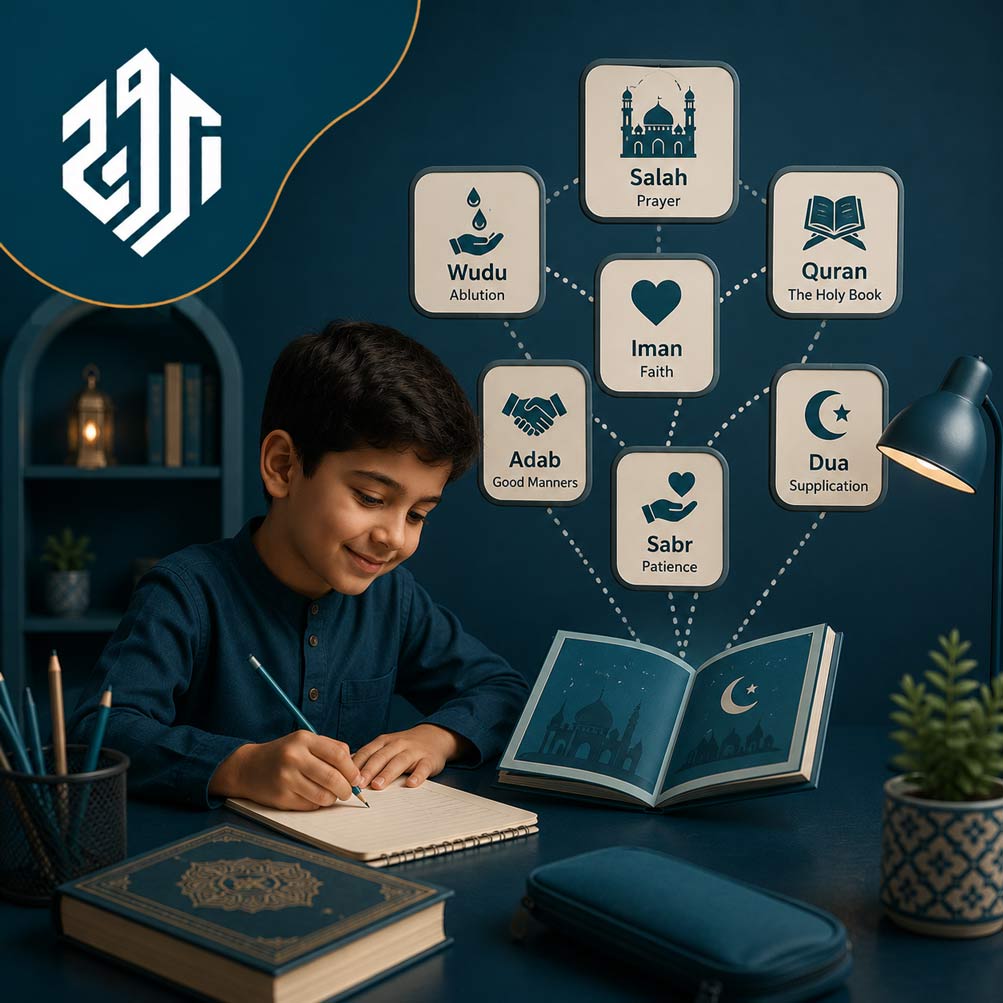
Every Muslim parent raising children outside a Muslim-majority country faces the same quiet worry: will my child grow up fluent in the language of their own faith? Watching a child mix up “Salah” and “Salaam,” or freeze when asked what “Iman” means, is a familiar moment for households building Islamic identity in English-speaking environments.
Islamic vocabulary for kids means teaching foundational Arabic-origin terms — worship words, Quranic terms, character values, and daily phrases — in age-appropriate clusters children can use immediately.
The goal is functional fluency, not memorized definitions, so children absorb words the way they absorb any first language: through repetition, context, and daily use.
Table of Contents:
Why Does Islamic Vocabulary Matter for Children Growing Up in the West?
Islamic vocabulary matters because it is the entry point to everything else a child will learn about their faith. Without core terms like Salah, Wudu, or Iman, later lessons in Tajweed, Fiqh, or Quran memorization become harder to access. Vocabulary is the scaffolding underneath every subject that follows.
In our sessions at Buruj Academy, we consistently notice that children who learn Islamic vocabulary early move through Noorani Qaida and basic Islamic Studies material with far less friction. They already recognize the sounds and meanings; they are not learning a new language and new concepts simultaneously.
This matters more for children raised in English-speaking households than many parents realize. A child in Cairo hears “Insha’Allah” and “Alhamdulillah” from every adult around them daily. A child in Chicago or Manchester may hear these words only from their parents, making deliberate vocabulary teaching essential rather than optional.
Building this foundation early also supports Islamic identity for kids long-term, since language and identity are deeply intertwined for growing children. Our Islamic Studies Classes for Kids at Buruj Academy build vocabulary directly into every lesson, so children absorb terms while learning concepts rather than through separate memorization drills.
What Islamic Vocabulary Categories Should Parents Prioritize First?
Parents should prioritize four vocabulary categories in this order: worship terms, greeting and daily-life phrases, character and value words, and Quranic terms. This sequence follows how children actually use language — starting with what they say and do every day before moving to abstract or textual concepts.
Worship terms come first because they attach to physical actions children already perform, like praying or making wudu. Greetings follow closely, since children use these socially with family and other Muslim children almost immediately.
Character words like Sabr (patience) or Shukr (gratitude) come third, once a child has enough vocabulary scaffolding to understand abstract qualities. Quranic terms – Surah, Ayah, Tilawah- come last, typically alongside a child’s first exposure to reading or listening to Quran.
Read also:Islamic Science for Kids
What Are the Essential Worship Vocabulary Words Every Muslim Child Should Know?
Essential worship vocabulary includes Salah (the five daily prayers), Wudu (ritual washing before prayer), Adhan (the call to prayer), and Sujood (prostration). These four words cover the physical actions a child will perform or witness multiple times daily from an early age.
| Word | Arabic | Simple Meaning for Kids |
| Salah | صلاة | The five daily prayers |
| Wudu | وضوء | Washing before prayer |
| Adhan | أذان | The call to prayer |
| Sujood | سجود | Bowing down to Allah |
We recommend teaching this table’s words in the order shown, since Adhan naturally precedes Wudu, which naturally precedes Salah in a child’s actual routine. Sujood then becomes the culminating action inside the prayer itself.
Everyday Muslim Phrases (Adab and Akhlaq) for Kids
These are the daily Arabic phrases Muslims use to express gratitude, greet others, and remember Allah throughout the day.
- Assalamu Alaikum: “Peace be upon you.” The standard greeting Muslims use when meeting someone.
- Wa Alaikum Assalam: “And unto you peace.” The polite reply to the Islamic greeting.
- Bismillah: “In the name of Allah.” Said before starting any action, like eating, reading, or leaving the house.
- Alhamdulillah: “All praise is due to Allah.” Used to say “thank you” to Allah or when answering “How are you?”
- SubhanAllah: “Glory be to Allah.” Said when you see something amazing in nature or want to praise Allah’s creation.
- Allahu Akbar: “Allah is the greatest.” Said during prayer, and also to express joy or amazement.
- Insha’Allah: “If Allah wills it.” Said whenever you talk about doing something in the future.
- Mashallah: “Allah has willed it.” Said when you see something beautiful or hear good news, to show joy without jealousy.
- JazakAllah Khair: “May Allah reward you with goodness.” The Islamic way to say a deep, meaningful “thank you” to someone.
- Astaghfirullah: “I seek forgiveness from Allah.” Said when you make a mistake or want to ask Allah to forgive you.
- YarhamukAllah: “May Allah have mercy on you.” Said to someone after they sneeze (and after they have said Alhamdulillah).
Read also:Islamic Quiz for Kids
The Five Pillars of Islam Vocabulary for Kids
The Five Pillars are the most important rules and practices that every Muslim follows.
- Shahadah: The declaration of faith. Saying and believing that “There is no god but Allah, and Muhammad is His messenger.”
- Salah: The five daily prayers that Muslims perform facing the Kaaba in Mecca.
- Zakat: Giving a specific portion of your wealth to charity to help those in need.
- Sawm: Fasting (not eating or drinking from dawn to sunset), especially during the holy month of Ramadan.
- Hajj: The pilgrimage (special journey) to Mecca that every Muslim must try to make at least once in their life if they are able.
Core Beliefs and Practices Vocabulary for Kids
These words describe important concepts, holy items, and daily practices in a Muslim’s life.
- Allah: The Arabic word for God. The one and only Creator of everything.
- Prophet Muhammad (ﷺ): The final messenger sent by Allah to teach people about Islam. Muslims say “Sallallahu Alaihi Wasallam” (peace be upon him) after his name.
- Quran: The holy book of Islam. It is the literal word of Allah.
- Dua: A personal prayer or request made directly to Allah. You can make dua in any language, at any time.
- Wudu: The special washing of the hands, mouth, face, arms, and feet performed before praying Salah or touching the Quran.
- Halal: Something that is good, allowed, and permissible in Islam (often used to describe food that is okay to eat).
- Haram: Something that is harmful, forbidden, or not allowed in Islam.
- Jannah: Heaven or Paradise. The beautiful reward Allah promises to those who do good deeds.
- Jahannam: Hell. The place of punishment in the afterlife.
Community and Places Vocabulary for Kids
Words related to the people and places that make up the Islamic world.
- Masjid (Mosque): The place of worship where Muslims go to pray together.
- Ummah: The global family or community of all Muslims around the world.
- Imam: The person who leads the prayers in the Masjid.
- Kaaba: The sacred cube-shaped building in Mecca. It is the first house of worship built for Allah, and Muslims face it during Salah.
- Adhan: The Islamic call to prayer that is announced from the Masjid five times a day.
- Eid: A joyful Islamic holiday. There are two main Eids: Eid al-Fitr (after Ramadan) and Eid al-Adha (after Hajj).
Parents who want structured support pairing vocabulary with correct practice often find our Online Islamic Studies Classes for Kids helpful, since instructors model both the words and the physical actions together in real time.
The first session is free in Buruj’s Islamic Studies Classes for Kids
How Do Parents Introduce Quranic Vocabulary Terms to Young Children?
Parents introduce Quranic vocabulary by starting with structural words — Surah (chapter), Ayah (verse), and Juz (a section of thirty) — before introducing any content-specific terminology. These three words give a child the mental map they need before they can meaningfully discuss any specific verse or chapter.
Children as young as four or five can grasp that the Quran has “Surahs,” the way they understand a book has “chapters.” This concrete comparison removes the intimidation many children feel toward a subject that otherwise feels abstract and distant.
Once a child understands Surah and Ayah, introducing a specific short verse gives the vocabulary real context. Consider the very first revelation:
اقْرَأْ بِٱسْمِ رَبِّكَ ٱلَّذِى خَلَقَ
Iqra’ bismi Rabbika alladhi khalaq
“Read in the name of your Lord who created.” (Al-‘Alaq 96:1)
This is the first Ayah revealed to Prophet Muhammad ﷺ, and its opening word, “Iqra’,” meaning “read,” makes it a natural first vocabulary anchor for children learning both the word Ayah and the concept of revelation.
This single verse also introduces the word “Iqra'” itself, one of the most repeated instructional words in a child’s early Quran education.
Pairing vocabulary with real Quranic text, even one short Ayah, is significantly more memorable than teaching terms in isolation.
For families beginning this stage, our guide on how to teach Islam to a child offers a broader sequencing framework parents can layer vocabulary lessons on top of.
What Common Mistakes Do Parents Make When Teaching Quranic Terms?
The most common mistake parents make is introducing too many Quranic terms at once, before a child has internalized the basic structural vocabulary of Surah and Ayah. This creates confusion rather than comprehension, and children often disengage.
A second frequent mistake is skipping correct pronunciation modeling entirely and moving straight to written Arabic script. Children who hear a word mispronounced repeatedly tend to lock in that error, which becomes harder to correct later during formal Tajweed instruction.
We consistently observe in our classes that students who learn correct sound before letters progress faster once they begin our Noorani Qaida online course for kids, since they are matching familiar sounds to new symbols rather than learning both simultaneously.
Sign up your kid for a free Noorani Qaida lesson
Discover the Buruj Academy Difference
Step into our virtual classrooms and see how our expert instructors make learning Quran and Arabic intuitive and clear. We focus on overcoming the specific hurdles non-native speakers face, building your confidence and connection with the Quran.
Expand Your Islamic Knowledge
Join our structured online courses led by qualified instructors to deepen your understanding of the Deen.
Join a Free Trial ClassWhich Character and Value Words Build a Child’s Islamic Vocabulary Foundation?
Character vocabulary should center on four core words: Sabr (patience), Shukr (gratitude), Amanah (trustworthiness), and Rahmah (mercy). These four terms cover the values most frequently reinforced in daily parenting moments, making them immediately usable rather than purely academic.
Sabr becomes usable the moment a child experiences frustration, whether waiting for a turn or struggling with homework. Parents who name the concept in the moment — “This is a good time to practice Sabr” — give the word a lived meaning rather than a dictionary definition.
Shukr works similarly at mealtimes or after a happy event, becoming a natural response phrase rather than an abstract lesson.
Amanah applies well to responsibilities like caring for a toy or completing a small task reliably.
Rahmah, meaning mercy, connects beautifully to Allah’s own names. Allah is described in the Quran and Sunnah with many beautiful names reflecting His attributes, and children benefit from learning a few of these early.
The Prophet ﷺ said, “Allah has ninety-nine names, one hundred minus one; whoever preserves them will enter Paradise.” (Sahih al-Bukhari 2736)
This hadith gives parents a natural, authentic reason to introduce a handful of Allah’s names alongside character vocabulary, starting with Ar-Rahman (The Most Merciful) and Ar-Raheem (The Most Compassionate), both drawn directly from these ninety-nine.
Read also:Islamic Motivation for Kids
How Many New Vocabulary Words Should Children Learn Per Week?
Children generally retain vocabulary best when introduced to five to seven new words per week, reinforced daily rather than taught once and revisited occasionally. This pace matches natural first-language acquisition patterns, where repetition across varied contexts builds lasting recall.
In our teaching experience, students who receive smaller, consistent weekly clusters outperform those given large monthly vocabulary lists. Overloading a child with fifteen or twenty words at once typically produces recognition without retention, and the words fade within days.
Parents pairing this pacing with structured lessons often see stronger results through our Islamic Studies for Kids program, where instructors track vocabulary progression alongside broader conceptual understanding.
What Techniques Help Non-Native Arabic-Speaking Parents Teach These Words Correctly?
Parents who are not confident in Arabic pronunciation themselves should prioritize audio-first learning tools over text-based flashcards, since mispronounced modeling can pass errors on to children early. Listening alongside a child, rather than reading a transliteration cold, protects pronunciation accuracy from the start.
Recording short daily phrases from a reliable instructor and replaying them together builds a shared reference point parents can return to. This removes the pressure of a parent needing to be the sole pronunciation authority in the household.
Many parents in our programs describe feeling more confident teaching vocabulary once they enroll alongside their children in structured lessons, rather than teaching in isolation. Our online Arabic classes for kids are frequently paired with family enrollment for exactly this reason.
Book a FREE Arabic trial for your Child
Should Parents Learn Alongside Their Children or Teach From Memory?
Parents should learn alongside their children whenever their own Arabic vocabulary or pronunciation feels uncertain, rather than teaching from memory or guesswork.
Modeling genuine, shared learning also reinforces to a child that vocabulary acquisition is a lifelong process, not something completed in childhood alone.
This co-learning approach has an added benefit we observe often: children feel less pressure and more encouragement when a parent is visibly learning too, rather than testing them from a position of assumed mastery.
Families pursuing this together often explore our broader Islamic topics for kids and youth resources as a shared home curriculum, layering vocabulary onto broader themes.
How Does Islamic Vocabulary Connect to Later Quran Memorization and Tajweed?
Islamic vocabulary forms the direct prerequisite for later Quran memorization and Tajweed instruction, since a child who already recognizes words like Ayah, Surah, and Tilawah enters formal lessons without a vocabulary barrier. This connection is often underestimated by parents focused only on immediate religious literacy.
Children who begin Juz Amma memorization with existing Quranic vocabulary typically grasp new concepts faster than peers encountering both the words and the memorization process simultaneously.
This is precisely why vocabulary-building deserves attention as its own foundational stage, not a byproduct of later lessons. Parents exploring the best age to memorize Quran will find that vocabulary readiness matters as much as chronological age when deciding when to begin.
Strong early vocabulary also smooths a child’s transition into our Online Hifz Program for Kids, where instructors build on existing word recognition rather than introducing entirely unfamiliar concepts alongside memorization demands.
Start your child’s Hifz classes with a FREE session
Learn Islamic Vocabulary With Buruj Academy’s Expert Instructors
Building a child’s Islamic vocabulary from scratch is challenging without expert guidance, structured pacing, and correct pronunciation modeling from day one.
Buruj Academy’s Islamic Studies Classes for Kids pair Al-Azhar University graduates with age-appropriate vocabulary instruction rooted in the Buruj Method: sound-before-rules, context-before-abstraction.
Our Ijazah-certified instructors bring 12+ years of experience teaching non-Arabic-speaking children worldwide.
Every lesson uses personalized 1-on-1 sessions, flexible 24/7 scheduling, and real-time correction, so your child builds vocabulary alongside genuine understanding rather than rote memorization.
Ready to give your child a strong Islamic vocabulary foundation? Book a free trial lesson with Buruj Academy today.
Join a global community of learners and find the path that best supports your spiritual and intellectual growth:
- Online Studies Islamic Classes (General & Flexible)
- Islamic Studies Course for Beginners (Foundational Knowledge)
- Islamic Studies Classes for Kids (Engaging & Values-Based)
- Islamic Studies Classes for Adults (In-Depth Theological Discussion)
- Islamic Studies Classes for Ladies (Sisterhood & Specialized Learning)
- Islamic Studies Classes for New Muslims (Guided Support & Essentials)
- Tafseer Al Quran Course (Unlocking Divine Meanings)
- Quranic Sciences (Uloom Al Quran) Course (Advanced Linguistic & Historical Context)
Ready to enrich your life with sacred knowledge? Connect with Buruj Academy today and book your free introductory session to begin your journey!
Expand Your Islamic Knowledge
Join our structured online courses led by qualified instructors to deepen your understanding of the Deen.
Join a Free Trial ClassDiscover the Buruj Academy Difference
Step into our virtual classrooms and see how our expert instructors make learning Quran and Arabic intuitive and clear. We focus on overcoming the specific hurdles non-native speakers face, building your confidence and connection with the Quran.
Conclusion
Teaching Islamic vocabulary is less about memorizing lists and more about weaving Arabic-origin words into a child’s daily rhythm until they become second nature. Small, consistent clusters — tied to prayer, greetings, character, and Quranic structure — build lasting fluency far more reliably than occasional intensive lessons.
Parents who model these words themselves, rather than only testing children on them, give this vocabulary the emotional weight it needs to stick. Over time, this foundation becomes the bridge into Tajweed, Hifz, and deeper Islamic understanding.
Frequently Asked Questions About Islamic Vocabulary for Kids
What Age Should Children Start Learning Islamic Vocabulary?
Children can begin as early as age three or four, starting with simple daily phrases like Assalamu Alaikum and Alhamdulillah. Formal categories like Quranic structural terms typically follow around age five or six, once basic conversational vocabulary is established.
How Long Does It Take a Child to Retain Basic Islamic Vocabulary?
Most children retain a cluster of five to seven words within two to three weeks when reinforced daily through natural conversation. Consistency in daily use matters more than the total number of exposure sessions per week.
Is It Necessary to Teach Arabic Script Alongside Vocabulary?
No, spoken vocabulary should precede script recognition, since children absorb meaning and pronunciation faster through listening and speaking first. Arabic script typically enters through a structured program like Noorani Qaida, once spoken vocabulary is established.
Can Non-Arabic-Speaking Parents Teach This Vocabulary Effectively?
Yes, parents without strong Arabic backgrounds can teach effectively using audio-first resources and by learning alongside their child rather than from memory. Enrolling in structured lessons together often builds parental confidence and pronunciation accuracy simultaneously.
What Is the Difference Between Teaching Vocabulary and Teaching Tajweed?
Vocabulary teaching focuses on meaning and daily usage of Arabic-origin words, while Tajweed focuses on precise articulation and recitation rules for reading the Quran. Vocabulary typically precedes Tajweed instruction, since children need conceptual familiarity before tackling recitation precision.