 Quran
Quran
| Key Takeaways |
| Islamic science for kids refers to structured learning of Quran, Tajweed, Arabic, and Islamic studies as connected subjects, not isolated facts. |
| Children retain religious concepts best between ages 4 and 10, when memory formation and imitation-based learning peak developmentally. |
| A working Islamic science curriculum sequences four pillars: Qaida, Quran reading, Arabic vocabulary, and Islamic studies basics. |
| Short daily sessions of 15 to 20 minutes outperform infrequent long sessions for building lasting Islamic knowledge in young children. |
Many parents in the West watch their children navigate two worlds — a secular classroom by day and a home trying to hold onto faith by evening. The gap between these worlds often feels wider than it should.
Islamic science for kids means teaching Quran reading, Tajweed, Arabic, and Islamic studies as one connected system rather than disconnected facts. Children build lasting religious identity when these subjects reinforce each other daily, not when taught in isolation.
Table of Contents:
What Does Islamic Science for Kids Include?
Islamic science for kids covers four connected subjects: Quran reading fluency, Tajweed application, foundational Arabic, and Islamic studies basics like Fiqh and Seerah. Each subject supports the others rather than standing alone. A child who only memorizes Surahs without understanding meaning misses half the benefit.
We have seen this pattern repeatedly in our sessions at Buruj Academy. Children who learn Arabic vocabulary alongside Quran reading connect faster with the verses they recite. The words stop being sounds and become meaning.
This is precisely why we built our teaching approach around subject integration rather than subject isolation. Parents exploring how to learn the Quran for kids often discover that reading alone, without grammar or vocabulary context, creates a shallow relationship with the text.
Our online Quran classes for kids pair recitation with basic word meaning from the very first lessons, so children build comprehension alongside pronunciation.
Help your child start learning the Quran with a FREE trial
Why Do Parents in the West Struggle to Teach Islamic Science at Home?
Parents outside Muslim-majority countries often lack access to Arabic-speaking mosques, qualified teachers, or peer communities that reinforce learning. The isolation compounds when parents themselves feel uncertain about Tajweed rules or Arabic grammar they never formally studied.
Working professionals frequently tell us they want consistency but cannot commit to fixed weekly class times. Weekend Islamic schools help, but a single ninety-minute session weekly rarely builds retention.
Children need daily touchpoints, even short ones, to keep Arabic sounds and Quranic vocabulary active in memory. This is a documented pattern in second-language acquisition research generally, and it applies directly to Quranic Arabic exposure in children.
How Should Parents Structure an Easy Islamic Science Curriculum for Kids?
An easy Islamic science curriculum for kids sequences learning in four stages: letter recognition through Qaida, guided Quran reading, basic Arabic vocabulary, and simple Islamic studies concepts. Skipping stages creates gaps that surface later as reading struggles or comprehension confusion.
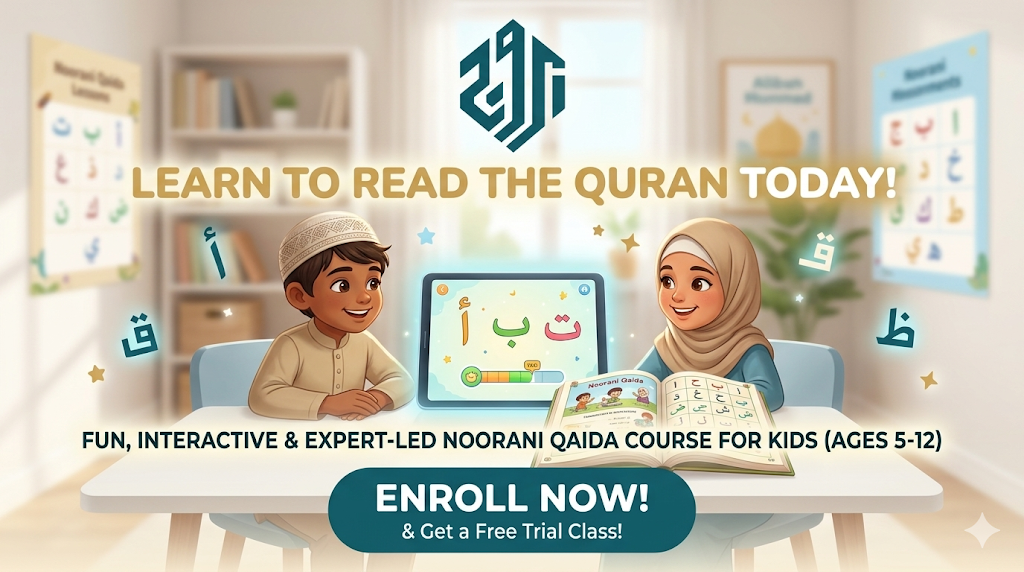
We recommend starting with Noorani Qaida before any Quran reading begins, regardless of the child’s age. Noorani Qaida course builds the phonetic foundation — correct letter sounds, joining rules, and short vowel recognition — that makes every later stage easier.
Once letter recognition is solid, children move into guided Quran reading with a qualified teacher correcting pronunciation in real time. This stage benefits enormously from consistent, patient correction rather than passive listening.
Parents researching how to make reading Quran fun for kids often find that correction delivered warmly, without frustration, keeps children engaged through the inevitable early mistakes.
| Stage | Focus | Typical Starting Age | Core Skill Built |
| Qaida | Letter sounds and joining | 4–6 years | Phonetic accuracy |
| Quran Reading | Guided recitation with correction | 6–8 years | Fluency and confidence |
| Basic Arabic | Vocabulary and simple grammar | 6–9 years | Meaning and comprehension |
| Islamic Studies | Fiqh, Seerah, Pillars | 5–10 years | Applied religious understanding |
This table reflects general developmental patterns we observe across student cohorts, not fixed rules — some children progress faster or slower through each stage.
Sign up your kid for a free Noorani Qaida lesson
What Age Should Islamic Science Lessons Begin?
Islamic science lessons can begin as early as age four with simple letter recognition and Islamic vocabulary, though structured Quran reading typically starts around age six.
Younger children absorb phonetic sounds quickly through repetition and imitation, making early exposure valuable even before formal reading begins.
In our experience at Buruj Academy, four and five-year-olds respond best to short, playful sessions rather than seated instruction. Letter games, and simple Arabic words woven into daily routines work better than worksheets at this age.
Parents wondering about the best age to memorize Quran will find that early exposure to sounds, even without full comprehension, primes children for smoother memorization later.
Which Islamic Science Curriculum Topics Matter Most for Kids?
The most important beginner topics are the Five Pillars of Islam, basic Wudu and Salah steps, simple Seerah stories, and short Surah memorization. These topics give children practical religious competence they can apply daily, not abstract theology disconnected from lived practice.
Children retain religious concepts best when the concept connects to something they do. Teaching Salah steps alongside actual practice — standing, bowing, prostrating — cements the sequence far better than verbal explanation alone.
How Do the Five Pillars Fit Into a Kid’s Curriculum?
The Five Pillars of Islam — Shahada, Salah, Zakah, Sawm, and Hajj — form the practical backbone of any Islamic studies curriculum for children. Each pillar connects to a concrete action a child can eventually perform or observe, making abstract faith tangible.
Buruj Academy’s Islamic studies classes for kids introduce pillars one at a time rather than as a single list to memorize. Shahada comes first since it anchors belief itself. Salah follows immediately after, since it becomes a daily practice children observe and eventually join.
Parents building structured lessons at home can reference our guide on the Pillars of Islam for kids for age-appropriate explanations of each pillar.
Seerah stories work similarly. Rather than presenting the Prophet’s ﷺ biography chronologically like a textbook, we sequence stories by moral lesson — patience, honesty, kindness to animals — so each story lands as a value the child can apply that same day.
Our Prophet Muhammad story for kids resource follows exactly this sequencing.
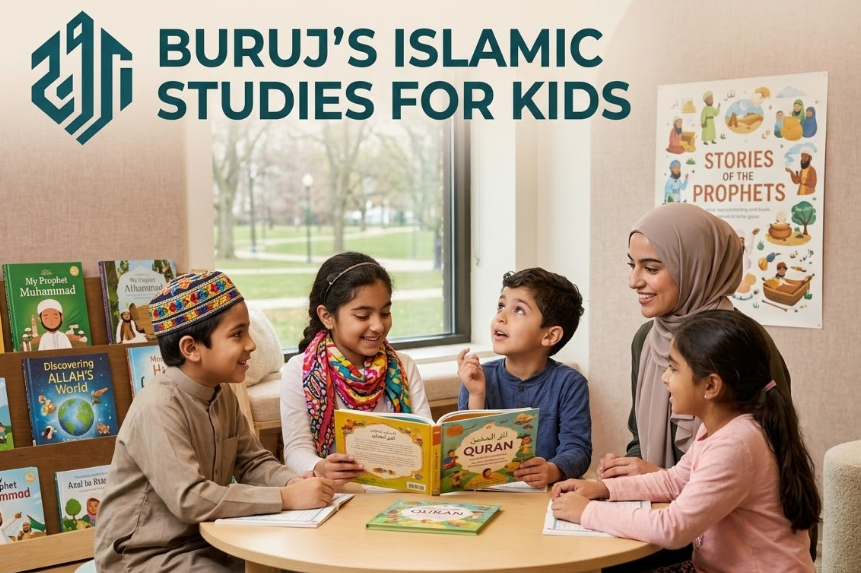
The first session is free in Buruj’s Islamic Studies Classes for Kids
Discover the Buruj Academy Difference
Step into our virtual classrooms and see how our expert instructors make learning Quran and Arabic intuitive and clear. We focus on overcoming the specific hurdles non-native speakers face, building your confidence and connection with the Quran.
Expand Your Islamic Knowledge
Join our structured online courses led by qualified instructors to deepen your understanding of the Deen.
Join a Free Trial ClassWhat Are the Best Practical Methods for Teaching Islamic Science at Home?
The best practical methods combine short daily sessions, consistent timing, and immediate application of new concepts.
Fifteen to twenty minutes daily produces better retention than a single ninety-minute weekly session, because spaced repetition strengthens memory more reliably than concentrated cramming.
Parents often assume longer sessions teach more. In practice, children’s attention spans for structured religious content rarely exceed twenty minutes before quality drops sharply. We have watched this pattern repeat across hundreds of young students.
Read also:Islamic Vocabulary for Kids
Why Does Session Length Matter More Than Session Frequency Alone?
Session length matters because attention quality determines retention, not just total exposure time. A distracted thirty-minute session teaches less than a focused ten-minute one, since children absorb little once fatigue sets in.
Our instructors at Buruj Academy structure kids’ sessions around this reality directly. We break longer topics into micro-lessons — five minutes of Qaida review, five minutes of new Quran verses, five minutes of Arabic vocabulary — rather than sustained single-topic blocks.
This mirrors the Buruj Method’s consistency-before-speed principle, which prioritizes steady daily contact over occasional intensive sessions.
Parents managing this at home without a teacher present often struggle with pacing. This is one of the most common gaps we see in self-taught households — parents either rush past confusion to finish the planned lesson, or over-explain a single point until the child disengages entirely.
Book Your Kid a Free Trial Lesson With One of Buruj’s Quran Tutors for Children
How Can Parents Make Islamic Learning Feel Natural Rather Than Forced?
Islamic learning feels natural when woven into existing daily routines rather than treated as a separate academic subject. Reciting a short Dua before meals, naming Arabic letters during car rides, or discussing a Seerah lesson at bedtime integrates faith into ordinary moments.
We encourage parents to resist treating Islamic education like homework requiring a desk and worksheets. Children associate desk-based learning with school obligation, which can create resistance when the same format applies to faith content.
Games and interactive activities close this gap effectively. Parents exploring Quranic games for kids or Tajweed games and activities will find that competitive, playful formats hold attention far longer than passive listening, especially for children under ten.
How Does Quran Memorization Connect to Broader Islamic Science Learning?
Quran memorization reinforces every other Islamic science subject simultaneously, since memorized verses become reference points for Arabic vocabulary, Tajweed application, and Islamic studies concepts.
A child who memorizes Surah Al-Fatiha, for example, practices Tajweed rules, learns core Arabic words, and encounters foundational theology in one short passage.
Allah describes the elevated status given to those who acquire knowledge: “Allah will raise those who have believed among you and those who were given knowledge, by degrees” (Al-Mujadila 58:11).
(This verse frames knowledge acquisition, including Quran memorization, as a path to elevated standing before Allah, reinforcing why early religious education carries lasting spiritual weight.)
Short Surahs work best as starting points precisely because they compress multiple learning objectives into memorable, repeatable text. Parents can review easy Surahs of the Quran to memorize or shortest Surahs to memorize to identify age-appropriate starting points for young memorizers.
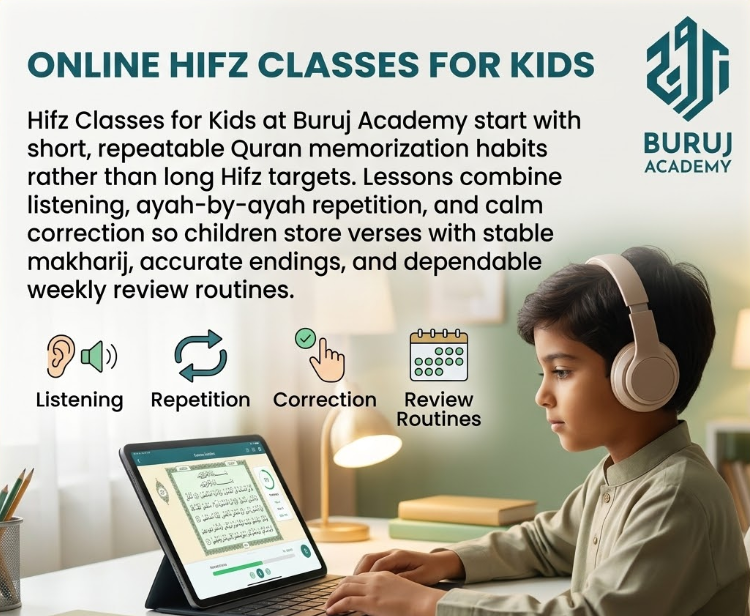
Through Buruj Academy’s Hifz for kids course, we structure memorization pathways using short daily review cycles and gamified repetition rather than pressure-based recitation drills, helping children build retention without the anxiety that often accompanies memorization deadlines.
Start your child’s Hifz classes with a FREE session
Ready to watch your child grow in knowledge and character? Join the Buruj Academy family and book a free trial session for your child today!
Master Islamic Science Foundations with Buruj Academy’s Expert Instructors
Building a complete Islamic science foundation at home is possible, but consistency and correct pronunciation guidance make the difference between shallow exposure and lasting knowledge.
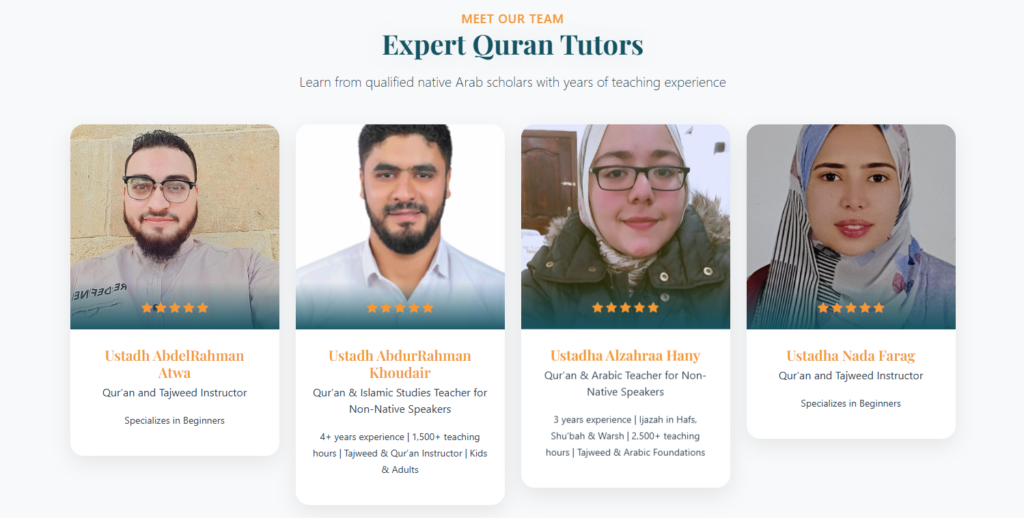
Buruj Academy connects your child with Al-Azhar University graduates and Ijazah-certified instructors who bring 12+ years of experience teaching non-Arabic speakers globally.
Our Online Islamic Studies Classes for Kids, Noorani Qaida for Kids, and Hifz for Kids programs follow the Buruj Method’s sound-before-rules and consistency-before-speed principles, with personalized learning plans, flexible 24/7 scheduling, and real-time correction from patient, child-trained teachers.
Book a free trial lesson today and see the difference structured guidance makes.
Deepen Your Faith with Comprehensive Islamic Scholarship
Nurture your soul and expand your understanding of the Divine message with a structured approach to sacred knowledge. At Buruj Academy, we believe that learning the foundations of our faith is a lifelong journey that brings clarity, purpose, and peace to every believer.
Our curriculum is designed to go beyond the basics, offering profound insights into the interpretation of the Quran, the wisdom of the Prophetic tradition, and the practical application of Islamic principles in the modern world.
Join a global community of learners and find the path that best supports your spiritual and intellectual growth:
- Online Studies Islamic Classes (General & Flexible)
- Islamic Studies Course for Beginners (Foundational Knowledge)
- Islamic Studies Classes for Kids (Engaging & Values-Based)
- Islamic Studies Classes for Adults (In-Depth Theological Discussion)
- Islamic Studies Classes for Ladies (Sisterhood & Specialized Learning)
- Islamic Studies Classes for New Muslims (Guided Support & Essentials)
- Tafseer Al Quran Course (Unlocking Divine Meanings)
- Quranic Sciences (Uloom Al Quran) Course (Advanced Linguistic & Historical Context)
Ready to enrich your life with sacred knowledge? Connect with Buruj Academy today and book your free introductory session to begin your journey!
Expand Your Islamic Knowledge
Join our structured online courses led by qualified instructors to deepen your understanding of the Deen.
Join a Free Trial ClassRead also: Islamic Quiz for Kids
Conclusion
Raising children with strong Islamic grounding in a Western context takes more than good intentions — it takes structure, sequencing, and daily consistency.
The four-pillar approach we have outlined here — Qaida first, then Quran reading, Arabic vocabulary, and Islamic studies concepts – gives parents a reliable framework rather than scattered, disconnected lessons.
Short, focused daily sessions consistently outperform occasional long ones for young learners building lifelong religious identity.
Frequently Asked Questions About Islamic Science for Kids
What Is the Difference Between Islamic Studies and Quran Memorization for Kids?
Islamic studies covers Fiqh, Seerah, and Pillars-based knowledge, while Quran memorization focuses specifically on retaining and reciting Quranic text accurately. Both subjects complement each other, since memorized verses often illustrate concepts taught in Islamic studies lessons.
How Long Does It Take a Child to Complete Noorani Qaida?
Most children complete Noorani Qaida within three to six months with consistent daily practice of fifteen to twenty minutes. Pace varies significantly based on age, prior letter exposure, and session consistency, so this range should be treated as a general guide rather than a fixed timeline.
Can Parents Teach Islamic Science Without Speaking Arabic Themselves?
Parents without Arabic fluency can still support their child’s Islamic science education by maintaining consistent routines, reinforcing lessons from a qualified teacher, and creating a home environment where faith topics come up naturally. A dedicated instructor remains important for pronunciation accuracy and Tajweed correction.
What Islamic Topics Should Come Before Formal Tajweed Rules?
Letter recognition through Qaida, basic Arabic sounds, and simple Quran reading fluency should precede formal Tajweed rule instruction. Introducing rule names before a child can recognize and pronounce letters correctly often creates confusion rather than clarity, so foundational reading always comes first.