 Quran
Quran
| Key Takeaways |
| Islamic scholars permit compelling children to learn and memorize the Quran as part of parental religious duty. |
| Classical scholars all affirm that parents may use appropriate pressure to teach children the Quran. |
| The approach matters: scholars advise starting with encouragement before discipline, and tailoring the method to each child’s temperament and ability. |
| Forcing Quran memorization parallels compelling children to pray — both are established parental obligations in Islamic jurisprudence. |
| Structured, supportive guidance — not harsh coercion — produces the best outcomes in Quran education for children of all ages. |
Many Muslim parents in Western contexts wrestle with a genuine tension: their child resists Quran lessons, and they wonder whether pushing them crosses a line.
The question feels urgent because it sits at the intersection of parental authority, religious obligation, and a child’s emotional wellbeing.
Islamic scholarship is clear on this matter. It is not haram to require your child to learn and read the Quran — in fact, classical scholars across multiple madhabs explicitly affirmed the parent’s right to compel a child toward Quran education, framing it as a parental religious duty rather than an overreach.
Table of Contents:
Is It Haram to Force Your Child to Read the Quran?
No, it is not haram to require your child to learn or read Quran. According to classical Islamic jurisprudence, parents are obligated to raise their children upon beneficial religious knowledge, and compelling them to learn the Quran falls within that duty.
Scholars explicitly permitted — and encouraged — parental enforcement of Quran education for children.
The Quranic command in At-Tahrim 66:6 — يَا أَيُّهَا الَّذِينَ آمَنُوا قُوا أَنْفُسَكُمْ وَأَهْلِيكُمْ نَارًا (“O you who have believed, protect yourselves and your families from a Fire”) — establishes the parent’s guardianship role over their children’s spiritual formation.
This verse is consistently cited by scholars as the foundational basis for parental religious education obligations.
The Prophet ﷺ further specified this responsibility in the hadith recorded by Bukhari and Muslim:
“Every one of you is a shepherd, and every one of you is responsible for his flock… A man is the shepherd of his household and is responsible for his flock.”
Parental responsibility for religious upbringing is therefore not optional — it is an accountability before Allah.
What Classical Scholars Said About Compelling Children to Learn Quran
The classical scholars did not speak vaguely on this matter. The Hanafi scholar al-Hamawi stated in Ghamz ‘Uyun al-Basa’ir that a father may compel his young child to learn the Quran, the adab, and religious knowledge — because doing so is an obligation upon the parents.
Ibn Nujaym in Al-Bahr al-Ra’iq and Ibn ‘Abidin in his Hashiyah record identical positions.
From the Shafi’i school, Ibn Hajar al-Haytami addressed the question of whether children may be physically disciplined for failing to learn — concluding that Quran memorization, being a fard kifayah, provides even stronger grounds for enforcement than certain voluntary acts of worship.
The Hanbali scholar al-Buhuti similarly noted that a father should begin his son with the Quran so that he becomes accustomed to recitation and maintains it.
| Scholar | School | Source | Position |
| Al-Hamawi | Hanafi | Ghamz ‘Uyun al-Basa’ir | Father may compel child to learn Quran and adab |
| Ibn Nujaym | Hanafi | Al-Bahr al-Ra’iq | Same — Quran education is parental obligation |
| Ibn Hajar al-Haytami | Shafi’i | Tuhfat al-Muhtaj | Quran memorization as fard kifayah justifies enforcement |
| Al-Buhuti | Hanbali | Daqa’iq Uli al-Nuha | Father begins son with Quran to build lifelong habit |
This scholarly consensus spans centuries and madhabs — making the permissibility of parental insistence on Quran education one of the more settled questions in Islamic family jurisprudence.
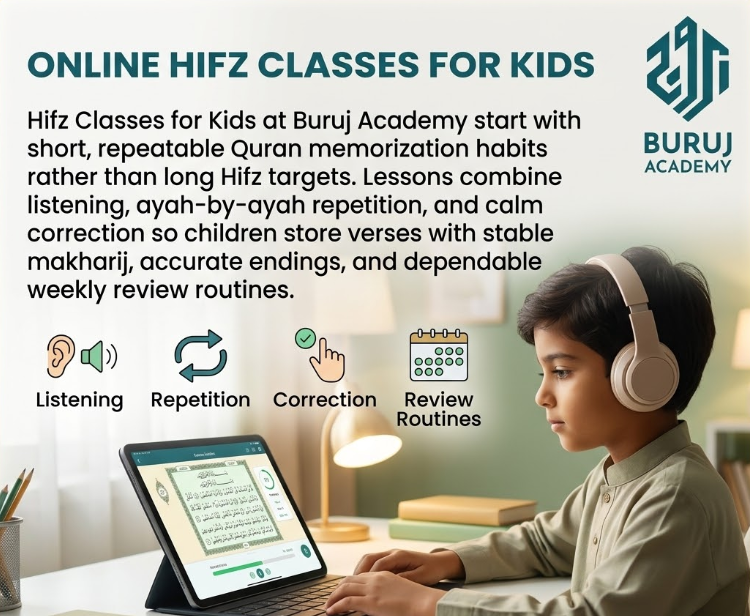
Buruj Academy’s Online Hifz Program for Kids pairs children with instructors trained specifically in child memorization pedagogy.
Start your child’s Hifz classes for free session
How Does This Compare to Compelling Children to Pray?
The parallel with obligatory prayer is the most instructive comparison scholars make. The Prophet ﷺ instructed in the hadith recorded by Abu Dawud:
“Command your children to pray when they are seven years old and beat them for it (prayer) when they are ten.”
If parents are explicitly permitted to enforce prayer — which is fard ‘ayn (an individual obligation) — then enforcing Quran learning is at least equally legitimate.
Ibn Hajar al-Haytami made precisely this point when addressing critics of physical discipline for Quran learning.
His conclusion: Quran memorization is fard kifayah upon the Muslim community, and within the household, the parent bears this collective obligation on behalf of their family. The child’s initial reluctance does not remove the parent’s duty.
What distinguishes legitimate enforcement from harm is the method, not the act of insisting.
Read also: What is the Importance of Reading the Quran with Understanding?
What Is the Right Approach When a Child Resists Quran Learning?
Parents have a clear right to require Quran education — but Islamic scholars are equally clear that wisdom in how they do so is mandatory. Al-Khadimi’s Bariqa Mahmudiyya advises praising children of good character in front of the resistant child, using positive modeling before resorting to stricter measures.
The principle across scholarly literature is: begin with the lightest effective approach and escalate only as needed.
Buruj Academy’s Quran Classes for Kids is built around exactly this principle. Our Al-Azhar-trained instructors use age-appropriate methods — positive reinforcement, manageable daily portions, and clear milestone celebrations — to shift children from resistance to genuine engagement.
Help your child start learning the Quran with a Free trial

In our experience, most resistant children turn a corner within four to six weeks once the learning environment feels safe and the sessions feel achievable.
Excel in Your Quranic Studies
Join Buruj Academy and master the Quran with our structured, professional curriculum.
Book Your Free TrialPractical Methods Scholars Recommend for Parents
| Approach | When to Use | Scholarly Basis |
| Praise and positive reinforcement | First response to resistance | Al-Khadimi, Bariqa Mahmudiyya |
| Setting consistent, small daily requirements | Establishing habit | Al-Buhuti — “accustom them” |
| Gentle firmness — requiring attendance without harshness | Ongoing baseline | General fiqh principle: begin with lighter means |
| Increased accountability for capable children | When ability is confirmed | Ibn Salnun — teach all Quran to the intellectually capable |
| Referral to a qualified external teacher | When parent-child dynamic creates friction | General pedagogical wisdom |
Ibn Salnun’s Adab al-‘Alim wal-Muta’allim offers a particularly useful distinction: a child who is slow in comprehension should be taught at minimum what is required for prayer.
A child who is bright and capable should be taught the full Quran. This graduated expectation prevents parents from demanding the same output from every child regardless of ability — an important nuance in applying scholarly permission appropriately.
Does Forcing Quran on a Child Risk Creating Negative Associations?
This concern is real and worth addressing directly. Some parents worry that pushing Quran will cause their child to resent it in adulthood. Scholars acknowledge this possibility — but they apply the same logic consistently: we do not abandon obligatory prayer because a child might develop resistance to it. The answer is not abandonment but wisdom in execution.
The same concern applies to secular schooling, which parents universally enforce without considering it oppressive. As the scholars note: parents compel children toward worldly education without hesitation. Quran — with its eternal benefit — deserves at least equal prioritization.
In our sessions at Buruj Academy, we consistently observe that children who began with parental insistence become, within months, the most motivated students — particularly when they experience the satisfaction of completing a surah they once thought impossible.
The negative association often comes not from the Quran itself but from an environment of excessive pressure without celebration of progress.
Structured guidance from a qualified, patient teacher — rather than pressure at home without external support — resolves most cases of child resistance. If your child struggles to stay engaged, consider our Quran memorization schedule resources alongside live instruction to create a predictable, low-pressure routine.
Discover the Buruj Academy Difference
Step into our virtual classrooms and see how our expert instructors make learning Quran and Arabic intuitive and clear. We focus on overcoming the specific hurdles non-native speakers face, building your confidence and connection with the Quran.
What Does “Forcing” Actually Mean in an Islamic Context?
Islamic scholars use the term ikrah (compulsion) in a specific sense when applied to children’s education. It means requiring attendance, requiring effort, and applying consequences for consistent avoidance — not psychological cruelty or disproportionate punishment.
The scholarly framework consistently distinguishes between:
- Legitimate enforcement — requiring the child to attend lessons, complete daily portions, and maintain revision
- Appropriate consequence — graduated accountability proportional to the child’s age and the severity of avoidance
- Prohibited excess — punishment that causes physical or psychological harm disproportionate to the educational goal
The Hanbali principle from al-Buhuti — begin with the Quran so that they become accustomed to recitation and maintain it — reflects an educational philosophy, not a punitive one. The goal is habit formation through consistent structure, not forced compliance through fear.
For families navigating this balance, our article on reading the Quran for the first time offers practical grounding for children beginning their Quran education, and our benefits of memorizing Quran piece can help parents frame the conversation with their children in motivating, concrete terms.
Read also: How to Read the Quran Without Knowing Arabic?
How to Support Your Child’s Quran Education Effectively?
Parents who approach Quran education strategically — rather than reactively — achieve far better outcomes. Based on both scholarly guidance and our instructors’ direct experience, the following framework produces consistent results:
1. Start early and make it normal
Children who grow up with daily Quran time treat it as a natural part of life rather than an imposition. Even five minutes of daily recitation practice from age four builds a habit that requires no enforcement by age seven.
2. Separate learning from punishment
Quran time should never be associated with anger, frustration, or family conflict. If a session is becoming tense, pause — and resume later with a calmer approach. This is not weakness; it is pedagogical wisdom.
3. Involve a qualified teacher early
The parent-child dynamic is not always optimal for academic instruction. A qualified, patient teacher removes the emotional weight from the parent’s shoulders and gives the child a neutral learning relationship.
4. Celebrate milestones visibly
Completing a surah, finishing a juz’, or achieving consistent recitation accuracy all deserve genuine recognition. Children are motivated by accomplishment — build that feeling deliberately.
For memorization-specific strategies, our guide on how to memorize Quran faster covers practical retention techniques applicable even for young learners.
Start Your Child’s Quran Journey with Buruj Academy’s Expert Instructors
Parental insistence on Quran education is not only permitted — it is part of fulfilling your trust before Allah regarding your children’s upbringing. The question is not whether to prioritize Quran for your child, but how to do it in a way that builds love alongside knowledge.
Buruj Academy’s Hifz for Kids course is designed for exactly this purpose — combining parental intention with expert, child-appropriate instruction:
- Al-Azhar University graduates and Ijazah-certified instructors with 12+ years teaching non-Arabic-speaking children
- Personalized 1-on-1 sessions tailored to your child’s age, level, and learning pace
- The Buruj Method: Consistency-before-speed — building sustainable memorization habits from day one
- Flexible scheduling to fit family routines globally
- Real-time feedback and positive reinforcement that keeps children engaged
Book your child’s free trial lesson and experience the difference qualified, structured instruction makes.
Enroll your child in one of our specialized, kid-friendly tracks today:
- Online Quran Classes for Kids
- Tajweed Classes for Kids
- Hifz Classes for Kids
- Online Arabic Classes for Kids
- Quranic Arabic Course for Kids
- Noorani Qaida Course for Kids
- Islamic Studies Classes for Kids
Ready to watch your child grow in knowledge and character? Join the Buruj Academy family and book a free trial session for your child today!
Excel in Your Quranic Studies
Join Buruj Academy and master the Quran with our structured, professional curriculum.
Book Your Free TrialConclusion
Requiring your child to learn and read the Quran is not haram — it is, according to scholars across multiple madhabs, a parental religious duty rooted in clear Quranic command and prophetic guidance.
The classical scholars were explicit: a parent may compel a child toward Quran education just as they compel them toward prayer and schooling.
What matters alongside that right is wisdom in application. Enforcement without empathy, or pressure without structure, undermines the very habit you are trying to build.
The most effective parents combine firm consistency with patient, qualified instruction — giving their children every condition needed to develop a genuine, lasting relationship with the Quran.
Frequently Asked Questions About Forcing Children to Read Quran
Is it haram to make your child memorize Quran if they don’t want to?
No, it is not haram. Classical scholars permitted parents to require children to learn and memorize the Quran. Scholars categorize this as a parental religious duty — comparable to enforcing prayer — and frame it as fulfilling the Quranic obligation to protect one’s family spiritually.
At what age should parents start requiring Quran education?
Most scholars and educators recommend introducing Quran recitation between ages four and six, and establishing consistent structured learning by age seven — the same age the Prophet ﷺ specified for beginning prayer instruction. Early exposure normalizes Quran time before resistance patterns develop, making later formal memorization significantly easier.
What if my child develops a negative attitude toward the Quran because of being forced?
The risk of negative association comes primarily from how Quran is taught, not from requiring it. Harsh punishment, excessive pressure, and emotionally charged sessions create aversion — not the learning itself. Scholars advise starting with encouragement, using a qualified external teacher to remove parent-child tension, and celebrating progress visibly to build positive associations alongside consistent expectations.
Can a parent discipline a child for refusing Quran lessons?
Classical scholars permitted appropriate, graduated consequences for consistent avoidance of Quran learning — similar to the prophetic guidance on disciplining children who abandon prayer at age ten. The key qualifier across all scholarly literature is proportionality: consequences must be measured, age-appropriate, and aimed at habit formation rather than punishment for its own sake.
Is hiring an online Quran teacher sufficient to fulfill parental duty?
Enrolling your child with a qualified teacher fulfills the educational dimension of parental duty and is often more effective than home instruction alone. The parent’s ongoing role remains: ensuring the child attends, completing assigned revision between sessions, and maintaining an environment where Quran learning is valued. Teacher and parent roles are complementary, not interchangeable.