 Islamic
Many parents in Western countries watch their children absorb secular trivia effortlessly while Islamic knowledge feels harder to absorb. A well-built Islamic quiz for kids fixes this gap directly.
The right quiz format turns passive listening into active recall, the single most effective memory tool available.
Below, we share the exact categories, sample questions, and hosting methods that make Islamic learning stick for children raised outside Muslim-majority countries.
Table of Contents:
What Makes an Effective Islamic Quiz for Kids?
An effective Islamic quiz for kids blends five core categories — pillars of faith, prophets, Quran structure, daily worship, and Islamic manners — pitched at the child’s exact age level. The best quizzes prioritize active recall over passive reading, since recalling an answer strengthens memory far more than simply hearing it repeated.
In our sessions at Buruj Academy, we’ve noticed something consistent across hundreds of young students. Children who are quizzed weekly on Islamic basics retain the material months longer than children who only hear it explained once in a lecture format.
This isn’t unique to religious content – it mirrors how children learn multiplication tables or spelling words.
The difference is that Islamic knowledge carries eternal weight, which is exactly why getting the method right matters so much for parents raising Muslim children in non-Muslim environments.
Why Active Recall Beats Passive Listening for Young Muslims
Active recall works because retrieving information from memory reinforces the neural pathway more than simply re-reading or re-hearing it. When a child answers “What are the Five Pillars of Islam?” from memory, that retrieval act cements the fact far deeper than a tenth retelling by a parent.
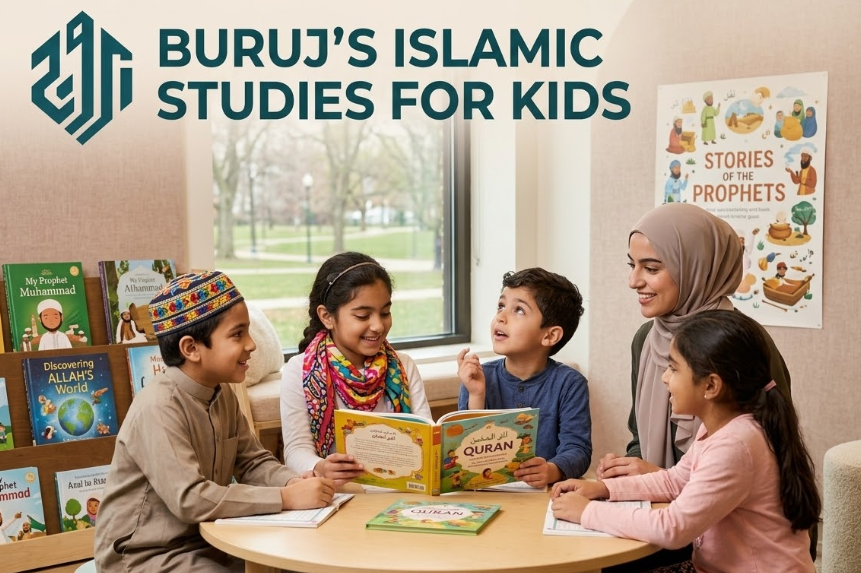
We’ve watched this play out repeatedly with students enrolled in our Online Islamic Studies Classes for Kids. Students who answer quiz-style questions weekly consistently outperform those who only listen to explanations, even when total study time is identical between the two groups.
This is why we build interactive recall directly into our Islamic Studies course structure rather than relying purely on lecture-based teaching.
The first session is free in Buruj’s Islamic Studies Classes for Kids
Five Pillars of Islam Quiz Questions for Kids
The Five Pillars quiz category tests a child’s grasp of Shahada, Salah, Zakat, Sawm, and Hajj — the five foundational acts every Muslim performs. These pillars form the practical skeleton of Islamic worship, and children as young as five can begin learning them through simple true-or-false or fill-in-the-blank formats.
Younger children (ages 5-7) do best with single-fact questions. Older children (ages 8-12) can handle “why” questions that require explaining the purpose behind a pillar, not just naming it.
| Age Group | Question Style | Example |
| 5-7 years | Simple recall | “How many pillars of Islam are there?” |
| 8-10 years | Fill-in-the-blank | “Muslims fast during the month of ___.” |
| 11-12 years | Explain-why | “Why do Muslims give Zakat?” |
This table shows how question complexity should scale with a child’s developmental stage rather than staying static across all ages.
Sample Shahada and Salah Questions
The Shahada declares that there is no god but Allah and that Muhammad is His messenger, forming the entry statement into the Muslim faith. Salah, the second pillar, requires five daily prayers performed at Fajr, Dhuhr, Asr, Maghrib, and Isha.
What are the two parts of the Shahada?
Answer: Belief in the oneness of Allah, and belief that Muhammad (peace be upon him) is His final messenger.
Name the five daily prayers in order
Answer: Fajr, Dhuhr, Asr, Maghrib, Isha.
We’ve found that children memorize prayer names faster when the quiz question asks them to recite the order rather than just naming one prayer at random. Sequencing questions build stronger structural memory than isolated fact recall.
Parents wanting deeper guidance on this topic can review our full breakdown of the pillars of Islam for kids, which expands on each pillar’s meaning for young learners.
Prophet-Focused Quiz Questions Children Enjoy Most
Prophet-focused questions test a child’s knowledge of the 25 prophets named in the Quran, with special focus on Adam, Nuh, Ibrahim, Musa, Isa, and Muhammad.
Children consistently rate prophet stories as their favorite quiz category, since these questions blend narrative excitement with factual recall.
We consistently see this in our own classrooms. Prophet story questions generate more enthusiasm from young students than any other quiz category, likely because each prophet’s story carries dramatic tension children naturally connect with.
Read also:The Best Islamic Games for Kids
Which prophet built a large ship to save his followers from a flood?
Answer: Prophet Nuh (Noah), peace be upon him.
Which prophet is known as Khalilullah, the friend of Allah?
Answer: Prophet Ibrahim (Abraham), peace be upon him.
Rotating through different prophets each week, rather than covering all 25 at once, prevents information overload. We recommend introducing no more than two or three new prophets per quiz session for children under age ten.
For a comprehensive resource covering all major prophets in age-appropriate language, parents can explore our guide on prophets in Islam for kids.
Turning the Prophet Muhammad’s Life Into Quiz Content
Prophet Muhammad’s biography (seerah) offers rich quiz material spanning his childhood in Mecca, his marriage to Khadijah, the first revelation, and the migration to Medina. Children benefit from learning this story chronologically rather than as scattered, disconnected facts.
In which city was Prophet Muhammad (peace be upon him) born?
Answer: Mecca.
What is the name of the migration from Mecca to Medina?
Answer: The Hijrah.
We introduce the seerah as a sequential storyline in our Online Quran Classes for Kids, since children retain biographical facts better when they understand the order events occurred in. A full narrative-based resource is available in our Prophet Muhammad story for kids guide.
Help your child start learning the Quran with a FREE trial
Discover the Buruj Academy Difference
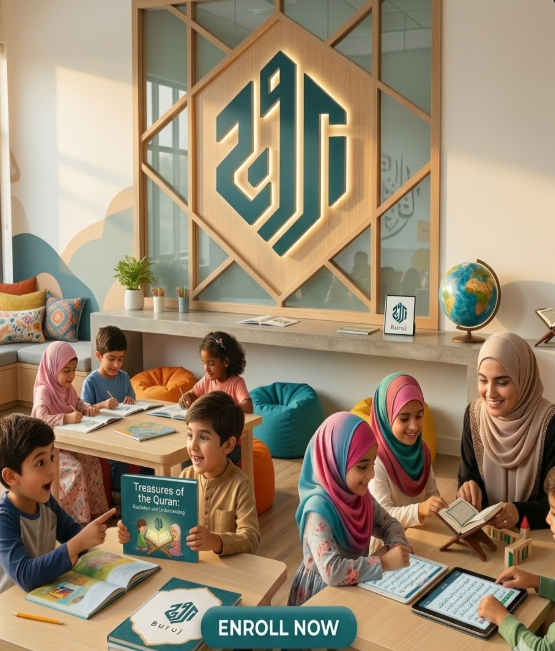
Step into our virtual classrooms and see how our expert instructors make learning Quran and Arabic intuitive and clear. We focus on overcoming the specific hurdles non-native speakers face, building your confidence and connection with the Quran.
Expand Your Islamic Knowledge
Join our structured online courses led by qualified instructors to deepen your understanding of the Deen.
Join a Free Trial ClassQuran Structure and Fact-Based Quiz Questions
Quran structure questions test whether children know basic facts: 114 total surahs, Al-Fatiha as the opening chapter, and which surah is considered the shortest. These structural facts give children a mental map of the Quran long before they’ve read it cover to cover.
How many surahs (chapters) are in the Quran?
Answer: 114 surahs.
How many verses does Surah Al-Fatiha contain?
Answer: Seven verses.
Children benefit enormously from combining quiz questions with actual short surah recitation practice.
We’ve seen students at Buruj Academy answer structural quiz questions correctly for months, yet struggle to connect that knowledge to actual recitation until we paired quizzing with hands-on Quran reading.
This is precisely why our Online Quran Classes for Kids integrate short surah practice alongside knowledge-based learning, rather than treating fact recall and recitation as separate skills.
Explore more structural facts in our dedicated Quran facts for kids article.
Short Surah Memorization Quiz Questions
Short surah quiz questions test recognition of commonly memorized chapters like Al-Ikhlas, Al-Falaq, An-Nas, and Al-Kawthar — surahs typically taught first due to their brevity and daily prayer use.
قُلْ هُوَ اللَّهُ أَحَدٌ
Qul huwa Allahu ahad
“Say, ‘He is Allah, [who is] One.'” (Al-Ikhlas 112:1)
This four-verse surah is one of the first children memorize, and the Prophet described it as equal to one-third of the Quran in reward.
How many verses does Surah Al-Ikhlas contain?
Answer: Four verses.
Which surah is often recited for protection against evil?
Answer: Surah Al-Falaq or Surah An-Nas.
Our Juz Amma memorization for kids guide pairs directly with this quiz category, since most short surahs children memorize first come from Juz 30. Parents can also review our list of the easiest surahs of Quran to memorize for a structured starting sequence.
Daily Worship and Islamic Manners Quiz Questions
Daily worship and manners questions test practical, everyday Islamic behaviors: saying Bismillah before eating, responding to a sneeze with Alhamdulillah, and greeting others with Salaam.
These questions matter because they connect quiz knowledge directly to daily lived practice, not abstract theology.
What do Muslims say before starting a meal?
Answer: Bismillah (In the name of Allah).
What should you say when someone sneezes and says Alhamdulillah?
Answer: Yarhamuk Allah (May Allah have mercy on you).
We weave manners-based questions throughout our Online Islamic Studies Classes curriculum specifically because these small daily habits build a child’s Islamic identity more consistently than abstract theological concepts alone.
Parents seeking a broader manners curriculum can also review our guide on how to teach Islam to a child.
How to Turn Quiz Time Into a Weekly Family Habit
Weekly quiz consistency matters more than quiz length for building long-term retention in children. A five-to-ten-minute session held every week outperforms an occasional hour-long quiz marathon held once a month.
We recommend parents treat quiz time like a recurring family ritual — perhaps right after Friday Maghrib prayer or during a weekend breakfast.
Consistency builds the expectation that Islamic learning is a normal, enjoyable part of family life rather than an occasional chore.
Digital tools like flashcard apps or simple printed question cards work well for this. For structured guidance on building sustainable home routines, see our article on how to make reading Quran fun for kids, which applies the same consistency principles to daily Quran reading habits.
Expand Your Islamic Knowledge
Join our structured online courses led by qualified instructors to deepen your understanding of the Deen.
Join a Free Trial ClassLearn Quran and Islamic Studies with Buruj Academy’s Expert Instructors
A strong islamic quiz for kids habit works best alongside structured, teacher-guided learning that builds real comprehension, not just memorized trivia answers. Buruj Academy offers exactly this combination for families worldwide.
Our Al-Azhar University graduate instructors bring 12+ years of experience teaching non-Arabic speaking children across the Online Quran Classes for Kids, Islamic Studies for Kids, and Noorani Qaida for Kids programs.
Every lesson uses personalized, 1-on-1 sessions with flexible scheduling built around your family’s timezone.
Book a free trial lesson today and watch your child’s Islamic knowledge grow with expert, patient guidance.
Join a global community of learners and find the path that best supports your spiritual and intellectual growth:
- Online Studies Islamic Classes (General & Flexible)
- Islamic Studies Course for Beginners (Foundational Knowledge)
- Islamic Studies Classes for Kids (Engaging & Values-Based)
- Islamic Studies Classes for Adults (In-Depth Theological Discussion)
- Islamic Studies Classes for Ladies (Sisterhood & Specialized Learning)
- Islamic Studies Classes for New Muslims (Guided Support & Essentials)
- Tafseer Al Quran Course (Unlocking Divine Meanings)
- Quranic Sciences (Uloom Al Quran) Course (Advanced Linguistic & Historical Context)
Ready to enrich your life with sacred knowledge? Connect with Buruj Academy today and book your free introductory session to begin your journey!
Read also:Islamic Science for Kids
Conclusion
Building Islamic knowledge in children raised outside Muslim-majority countries doesn’t require elaborate curricula — it requires consistent, well-structured recall practice woven into ordinary family routines. A thoughtfully designed quiz spanning pillars, prophets, Quran structure, and daily manners gives children a complete foundation piece by piece.
The families who see the strongest results treat quiz time as a joyful weekly ritual rather than a test to dread. Paired with expert-guided Quran and Islamic Studies instruction, that small weekly habit compounds into genuine, lasting religious confidence for the next generation.
Frequently Asked Questions About Islamic Quiz for Kids
What Age Should Kids Start Islamic Quizzes?
Children as young as five can begin with simple true-or-false or single-fact recall questions about basic Islamic concepts. By age eight, kids can typically handle fill-in-the-blank formats, and by ten to twelve, explain-why questions that test deeper comprehension become appropriate.
How Often Should Parents Quiz Their Kids on Islamic Knowledge?
Weekly five-to-ten-minute sessions build stronger long-term retention than occasional lengthy quiz marathons. Consistency matters far more than session length, since spaced repetition strengthens memory pathways more effectively than cramming large amounts of content infrequently.
What Topics Should an Islamic Quiz for Kids Cover?
A well-rounded quiz covers five core areas: the Five Pillars of Islam, major prophets, basic Quran structure and facts, daily worship practices, and everyday Islamic manners. Rotating through all five categories weekly prevents any single topic from feeling repetitive or overwhelming.
Can Islamic Quizzes Replace Formal Quran or Islamic Studies Classes?
Quizzes reinforce and test existing knowledge but cannot replace structured instruction from a qualified teacher. Formal classes build comprehension, correct pronunciation, and deeper understanding, while quizzes serve best as a supplementary retention tool alongside real teacher-guided learning.