 Quran
Quran
| Key Takeaways |
| Arabic writing for kids should start with letter shapes in isolation before joining letters into words. |
| Arabic is written right to left, and most letters change shape based on position within a word. |
| Tracing worksheets before free-hand writing build the muscle memory children need for correct letter formation. |
| Short daily practice sessions of 10 to 15 minutes produce stronger retention than long, infrequent sessions. |
| Combining writing practice with vocabulary meaning helps children retain both the shape and the purpose of each letter. |
Watching a child hold a pencil the wrong way while attempting their first Arabic letter is a familiar moment for any parent starting this journey. Arabic writing for kids succeeds when instruction moves in a specific order: letter recognition, then isolated shapes, then connected forms, then full words.
This sequence, followed consistently, prevents the reversed strokes and confused letter shapes that derail so many beginners.
Table of Contents:
Step 1: Start By Teaching Kids the Direction of Arabic Writing
Arabic is written and read from right to left, which is the single most important concept to establish before a child picks up a pencil. Every letter, word, and line moves in this direction, opposite to English.
In our sessions at Buruj Academy, we’ve noticed that children who skip this step often mirror their English habits. They start writing from the left margin, then wonder why their Arabic words look backward compared to a book.
We recommend physically pointing to the right side of the page first. Say “we start here” before every early writing exercise, until the motion becomes automatic. A simple exercise: place a colored dot or sticker in the top-right corner of the practice page for the first two weeks. This visual anchor removes the guesswork about where each line begins, and children stop hesitating before they write.
Structured guidance accelerates this adjustment significantly. Buruj Academy’s Online Arabic Classes for Kids use direction-first drills before any letter is introduced, so children build the right-to-left habit before it competes with anything else they’re learning.
Book a FREE Arabic trial for your child

Step2: Introduce the Arabic Alphabet in Isolated Letter Form First
Children should learn each Arabic letter in its standalone, unconnected shape before attempting any connected word. The Arabic alphabet contains 28 letters, and each one has a distinct isolated form that serves as the child’s first reference point.
This isolated form is the “home base” shape. Every other version of the letter (beginning, middle, end) is a variation of this core shape, so mastering it first makes every later stage easier.
Table 1 shows a small sample of isolated letters and simple English-sound anchors that help children recall each shape.
| Arabic Letter | Isolated Shape Description | English Sound Anchor |
| ب | Curved boat shape with one dot below | “B” as in “boat” |
| ت | Curved boat shape with two dots above | “T” as in “top” |
| ج | Hook shape with one dot below the curve | “J” as in “jump” |
| د | Small curved hook, no dots | “D” as in “door” |
| س | Three small teeth in a row | “S” as in “sun” |
We introduce no more than 3 to 4 new letters per session with young children. Overloading a single session with the full alphabet causes confusion between visually similar shapes like ب, ت, and ث.
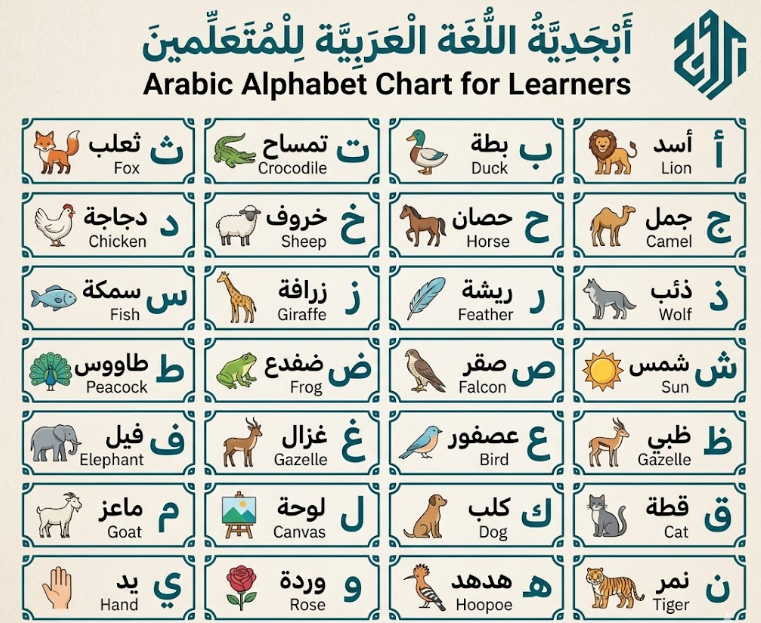
For a complete visual reference organized by letter groups, our guide on the Arabic alphabet with pictures for kids pairs each letter with an illustrated object to strengthen memory.
Step 3: Ensure Kids Practice Tracing Before Attempting Free-Hand Writing
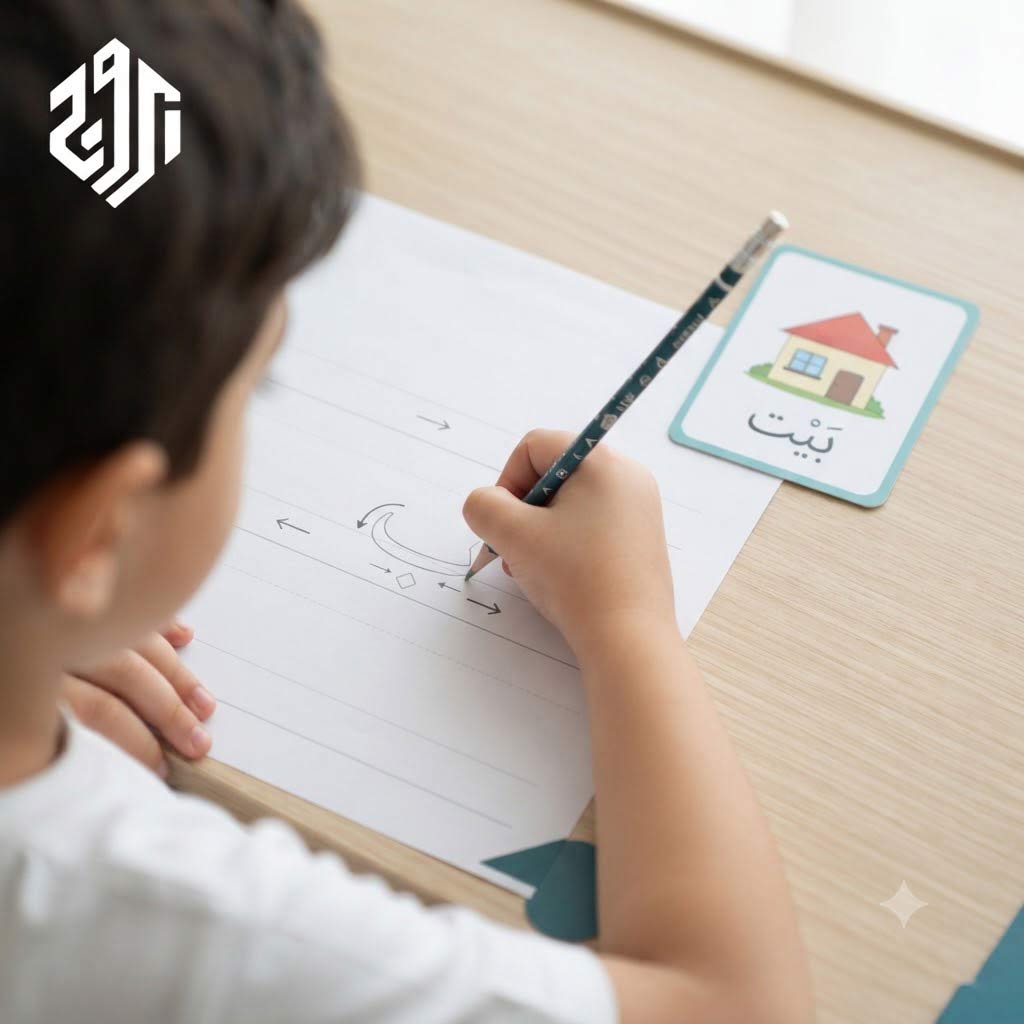
Tracing pre-printed letter outlines builds the fine motor memory a child’s hand needs before free-hand writing becomes accurate. Skipping this step is the most common reason children develop shaky, inconsistent letter shapes later.
A tracing sheet should show the letter in a dotted or light-gray outline, with directional arrows indicating stroke order. The child traces over the outline repeatedly, gradually building confidence in the shape.
What Stroke Order Teaches a Child’s Hand
Most Arabic letters follow a consistent stroke pattern: start from the top-right point of the letter and move toward the bottom-left. Learning this pattern early prevents the reversed or fragmented strokes we often see in self-taught beginners.
We ask children to trace each letter 5 to 7 times per session before attempting it without guides. This repetition count reflects what our instructors have found produces steady, confident strokes without causing fatigue in a single sitting.
A helpful practical exercise: fold a piece of paper into four sections. In section one, the child traces a heavily dotted letter.
In section two, the dots are lighter. In section three, only a faint outline remains. In section four, the child writes it completely free-hand. This fading technique moves a child gradually from guided to independent writing within a single practice sheet.
Read also:Colours in Arabic for Kids
Step 4: Teach How Arabic Letters Change Shape by Position
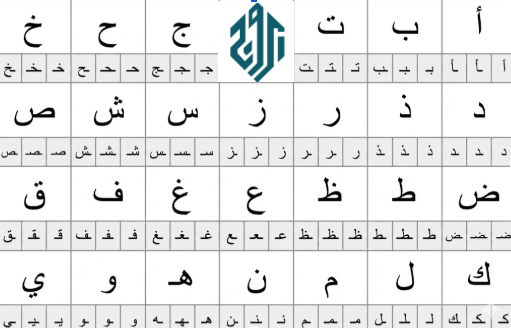
Most Arabic letters take on different shapes depending on whether they appear at the beginning, middle, or end of a word, and this positional change is what makes Arabic writing challenging for beginners. Children need explicit instruction on this concept rather than discovering it through trial and error.
Unlike English letters, which stay visually identical no matter where they sit in a word, an Arabic letter can look quite different in each of its four positions.
Table 2 demonstrates this shift using the letter ع (Ain) across its four possible forms.
| Position | Shape | Example Word Context |
| Isolated | ع | Standing alone |
| Beginning | عـ | عَلَمَ (flag) |
| Middle | ـعـ | مَعْنَى (meaning) |
| End | ـع | شَمْع (candle) |
We explain this to children using a simple analogy: think of the letter as an actor wearing different costumes depending on which scene it’s in, but it’s still the same actor underneath. This framing reduces the anxiety children feel when a familiar letter suddenly looks unfamiliar.
Practical exercise: give the child a list of 5 simple words and ask them to circle every appearance of one target letter, regardless of its shape. This trains visual recognition across all four positions simultaneously.
Our detailed breakdown of learning the Arabic alphabet for kids expands further on positional forms with additional practice sets.
Read also:Days of the Week in Arabic for Kids
Discover the Buruj Academy Difference
Step into our virtual classrooms and see how our expert instructors make learning Quran and Arabic intuitive and clear. We focus on overcoming the specific hurdles non-native speakers face, building your confidence and connection with the Quran.
Master the Arabic Language
Join our expert-led courses and build a strong foundation in Classical and Modern Arabic.
Get Your Free TrialStep 5: Kids Practice Writing Connector and Non-Connector Letters Separately
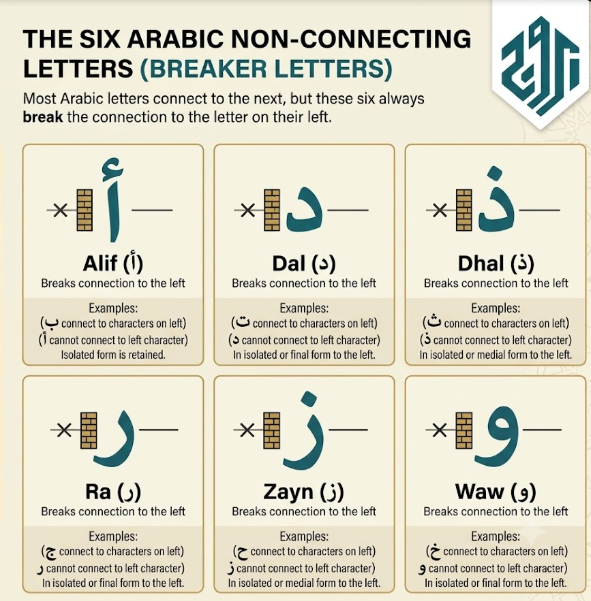
Six Arabic letters never connect to the letter that follows them, even in the middle of a word, and this distinction must be taught explicitly to prevent joining errors. These letters are ا (Alif), د (Dal), ذ (Thal), ر (Ra), ز (Zay), and و (Waw).
When a child understands which letters break the connection, word segments start making visual sense instead of looking like random letter clusters.
We teach this using a simple rule: “these six letters always finish their job and let go.” After one of these letters, a small gap or fresh letter shape signals a new segment has begun, even within a single word.
A hands-on activity that works well: write a short word containing one of these six letters, such as دَار (house). Ask the child to mark where the “break” happens with a small vertical line. Repeating this with 8 to 10 words builds automatic recognition of these breaking points.
Step 6: Guide Children Through Connecting Letters Into Simple Words
Once isolated shapes and positional forms are familiar, children are ready to connect 2 to 3 letters into their first simple words. This stage bridges everything learned so far into functional, meaningful writing.
We start with short, high-frequency words rather than abstract letter combinations, since children retain shapes better when they’re attached to a recognizable meaning.
Choosing the Right First Words for Practice
The best starter words use letters the child has already mastered and avoid letters with only subtle visual differences from one another. A word like بَيْت (house) works well because ب, ي, and ت each have clearly distinct shapes.
We recommend beginning with three-letter words before progressing to four or five letters. This keeps the visual load manageable while still producing a complete, real word the child recognizes.
A useful exercise: provide the child with isolated letter cards and ask them to physically arrange the cards to spell a word, before writing it by hand. This separates the “which letters” decision from the “how do I write it” motor task.
For structured vocabulary building alongside writing, our guide on learning Arabic words for kids offers age-appropriate word lists that pair naturally with this stage.
Consistent guided practice through Buruj Academy’s Learn Arabic Writing Course gives children structured feedback at each of these stages, correcting small errors before they solidify into long-term habits.
Book your free trial to start writing Arabic
Step 7: Pair Every Written Word With Its Meaning and Pronunciation
Writing practice sticks longer when children know what a word means and how it sounds, rather than copying unfamiliar shapes with no context. This connection between shape, sound, and meaning is what separates memorization from genuine literacy.
In our experience, children who write words they understand retain the correct spelling far longer than those who copy words mechanically without context.
We pair each new writing word with a simple picture or gesture representing its meaning. Writing قَلَم (pen) while holding an actual pen, for example, cements the connection between the written symbol and the real object.
A structured exercise: create flashcards with the Arabic word on one side and a picture on the other. The child writes the word from memory, then flips the card to self-check both spelling and meaning together.
Our collection of Arabic sentences for kids provides additional context-rich examples that naturally extend this word-and-meaning pairing into full sentences.
Step 8: Correct Common Letter Reversal and Shape Confusion Errors Early
Children learning Arabic writing frequently confuse letters that share a similar base shape but differ only in dot placement, and catching these errors early prevents them from becoming permanent habits. This is one of the most predictable challenge points in early instruction.
Letters like ب، ت، ث share an identical curved base, differing only in the number and position of dots. Similarly, ج، ح، خ share one hook shape with varying dot placement.
Table 3 organizes these commonly confused letter families for focused practice.
| Letter Family | Shared Base Shape | Distinguishing Dots |
| ب ت ث | Curved boat | 1 dot below, 2 above, 3 above |
| ج ح خ | Hook curve | 1 dot below, none, 1 dot above |
| د ذ | Small hook | None, 1 dot above |
| ر ز | Downward curve | None, 1 dot above |
We ask children to write each letter family together on one line, saying the dot count aloud as they write. This verbal-visual pairing reinforces the distinguishing feature rather than the shared shape.
A quick daily check: write five words containing letters from the same family and ask the child to read them aloud before writing. Reading first exposes reversal errors before they get written down.
Step 9: Use Short Daily Sessions Instead of Long Infrequent Practice
Sessions of 10 to 15 minutes practiced daily produce stronger letter retention than 45-minute sessions practiced only once or twice a week. Handwriting is a motor skill, and motor skills develop through consistent, spaced repetition rather than concentrated bursts.
In our instructors’ experience, children who practice briefly every day show noticeably steadier letter formation within 3 to 4 weeks compared to children on a once-weekly schedule.
A simple daily structure that works well: two minutes reviewing yesterday’s letters, five minutes tracing new shapes, five minutes writing a short word combining old and new letters. This keeps sessions short enough to hold a child’s attention fully.
Parents can support this rhythm even without a scheduled class, by keeping a small practice notebook visible near a regular daily routine, such as right after breakfast.
Read also:Arabic Kids Shows
Step 10: Add Dictation Exercises to Test Retention Without Copying
Dictation, where a child writes a word or letter after hearing it spoken rather than seeing it, reveals whether shapes have genuinely been retained rather than just copied. This step exposes gaps that visual copying can hide.
Copying only tests whether a child can reproduce what’s in front of them. Dictation tests whether the sound-to-shape connection has actually formed in memory.
We introduce dictation only after a child can confidently trace and copy a set of letters or words. Testing retention too early creates frustration rather than useful feedback.
A simple weekly dictation exercise: say five previously practiced letters aloud, one at a time, and ask the child to write each one before moving to the next. Review together immediately afterward while the sounds are still fresh.
Our detailed resource on improving Arabic writing with dictation expands this technique into a full weekly practice structure suitable for various age groups.
Step 11: Introduce Simple Sentence Writing Once Word Formation Is Solid
Once a child writes individual words correctly and consistently, short 2 to 4 word sentences become the natural next step in building functional Arabic literacy. This stage connects isolated vocabulary into meaningful, communicative writing.
We start with simple subject-verb or subject-adjective sentences using vocabulary the child already writes confidently, such as البَيْتُ كَبِيرٌ (the house is big).
A practical progression exercise: give the child three word cards and ask them to arrange and copy them into a grammatically simple sentence, then attempt writing the same sentence from memory the following day.
For a deeper look at building this next stage, our guide on the Arabic sentence structure for beginners explains how word order functions once children reach this level.
Master Arabic Writing for Kids with Buruj Academy’s Structured Program
Teaching Arabic writing at home takes patience, but a structured system prevents the reversed letters and shape confusion that self-taught practice often produces. Buruj Academy’s Online Arabic Classes for Kids apply this exact step-by-step sequence with real-time correction.
Our Al-Azhar-trained instructors bring 12+ years of experience teaching non-Arabic speakers, using the Buruj Method’s context-before-abstraction approach so every letter connects to real meaning.
Each child receives a personalized learning plan adjusted for age and pace, with flexible 24/7 scheduling for families anywhere in the world. Real-time pronunciation and writing correction happens during every session, not after.
Book a free trial lesson today and see how a guided, structured approach transforms a child’s confidence with Arabic writing from the very first session.
Begin your transformation today by choosing the path that fits your goals:
- Online Arabic Classes (General & Comprehensive)
- Arabic Course for Beginners
- Arabic Alphabet Learning Course
- Online Arabic Classes for Kids
- Arabic Classes for Adults
- Arabic Grammar Course (Nahw & Sarf)
- Intermediate Arabic Course (B1/B2)
- Arabic Speaking Course (Conversational Fluency)
- Arabic Reading Course (Literary Excellence)
- Learn Arabic Writing Course (Calligraphy & Composition)
Ready to speak with confidence? Join the global community at Buruj Academy and book your free placement interview today!
Discover the Buruj Academy Difference
Step into our virtual classrooms and see how our expert instructors make learning Quran and Arabic intuitive and clear. We focus on overcoming the specific hurdles non-native speakers face, building your confidence and connection with the Quran.
Excel in Your Quranic Studies
Join Buruj Academy and master the Quran with our structured, professional curriculum.
Book Your Free TrialConclusion
Arabic writing for kids develops most reliably through a fixed sequence: direction, isolated letters, positional forms, connected words, then full sentences. Skipping ahead in this order is where most confusion and reversed strokes originate.
What separates lasting literacy from surface-level copying is meaning. A child who understands what they’re writing retains it; a child who only traces shapes forgets them.
Short, consistent daily sessions paired with dictation checks reveal true progress far more accurately than occasional long practice blocks ever could.
Frequently Asked Questions About Arabic Writing for Kids
What Age Should Children Start Practicing Arabic Writing?
Most children can begin isolated letter tracing around age 4 to 5, once basic pencil grip and fine motor control are developing. Connected word writing typically follows naturally between ages 6 and 7, depending on individual readiness and prior letter recognition practice.
Why Does My Child Keep Reversing Arabic Letters?
Letter reversal usually stems from insufficient tracing practice or unclear direction instruction before free-hand writing begins. Reinforcing right-to-left movement and using fading tracing sheets, as outlined earlier, typically resolves reversal within a few consistent weeks.
Is It Necessary to Learn Arabic Speaking Before Arabic Writing?
Basic sound recognition should precede writing, since children write more accurately when they can already say the letter or word aloud. Full speaking fluency, however, isn’t required before writing begins; the two skills develop well together through paired practice.