 Tajweed
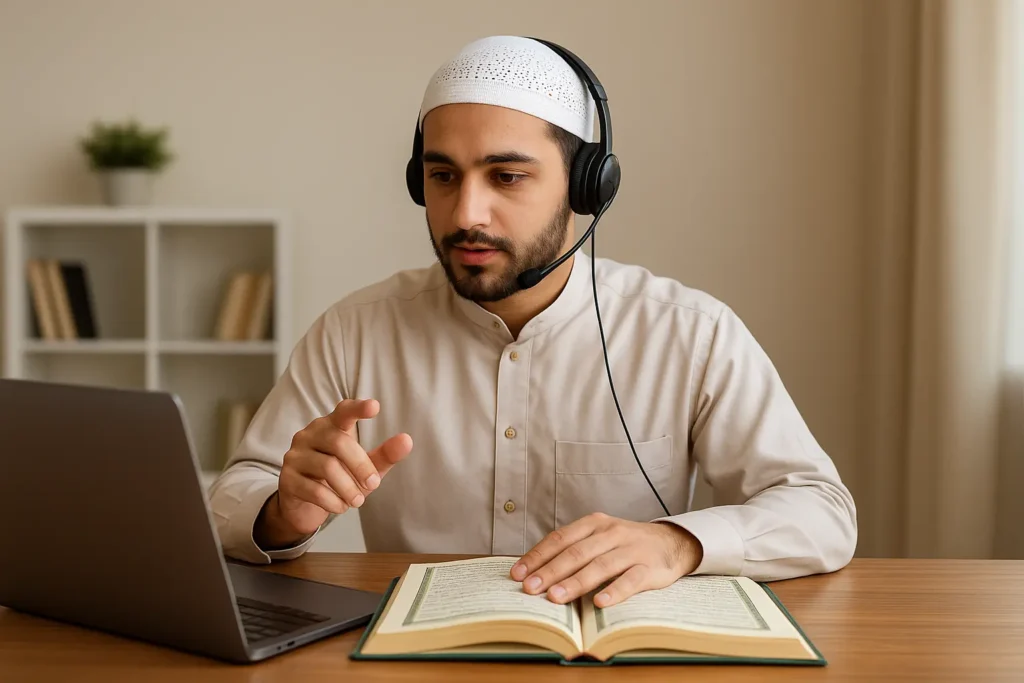
Choosing the right reciter to learn Tajweed from is one of the most consequential decisions a student makes — because you will unconsciously imitate whatever you listen to most. The wrong choice can entrench mispronunciations that take months to correct.
The best reciters to learn Tajweed from are those who combine phonetic precision, consistent rule application, and clarity of makhraj.
In our experience at Buruj Academy, the ten reciters below have proven most effective as learning references for non-Arabic speakers at every level.
Table of Contents:
1. Mahmoud Khalil Al-Husary — The Teacher’s Reciter
Mahmoud Khalil Al-Husary is the single most educationally valuable reciter for Tajweed students. He recorded a dedicated Mu’allim (teaching) recitation specifically designed for learners, pausing after each verse for repetition. His standard Murattal recitation applies every Tajweed rule with textbook precision and intentional clarity.
Al-Husary served as the first Qari of Egypt’s Dar Al-Ulum and received official recognition from Al-Azhar. His articulation of the makharij — particularly the differentiation between ض and ظ, and the precise application of Qalqalah — is among the cleanest on record.
Listen to his Murattal recitation and his Mujawwad recitation on QuranicAudio.
In our Tajweed for Beginners course, we regularly use his recitations as demonstration audio before students attempt their own application.
Book Your FREE Trial Lesson to Begin Your Tajweed Journey

2. Abdul Basit Abdul Samad
Abdul Basit Abdul Samad is widely regarded as the most technically refined reciter of the 20th century. His Mujawwad style — the beautified, deliberate recitation mode — applies every rule of Tajweed at a measured pace that makes individual rule instances audible and imitable.
For students learning Madd lengths, Ghunnah duration, and precise Tafkhim and Tarqiq (heavy and light letters), listening to Abdul Basit’s Mujawwad is like having each rule demonstrated in real time.
Listen to his Murattal recitation and Mujawwad recitation on QuranicAudio.
3. Mishari Rashid Al-Afasy — Best for Beginners
Mishari Rashid Al-Afasy offers the most accessible entry point for beginners. His Tajweed is correct, his pace is moderate, and his voice is naturally clear — making individual letters and rules easy to distinguish without straining to hear. Students who are still building their ear for Arabic phonetics find his recitation the most imitable.
Al-Afasy holds an Ijazah in the Ten Qira’at from Sheikh Ahmad Amer, placing his credentials among the highest. His clear Ghunnah application and consistent Ikhfa nasalization make him particularly useful for students working through foundational Tajweed rules.
Listen to his full recitation of Mishari Rashid Al-Afasy on QuranicAudio.

4. Muhammad Siddiq Al-Minshawi — Deep Emotional Precision
Muhammad Siddiq Al-Minshawi combines emotional depth with technical Tajweed accuracy in a way few reciters have matched. His Mujawwad recitation is particularly valuable for students who have moved beyond beginner level and want to hear how advanced Tajweed rules — including subtle Ikhfa gradations and complex Idgham applications — sound within emotionally engaged recitation.
Al-Minshawi was appointed Qari of Egypt and held the highest Egyptian state recognition for Quranic recitation. His slower, ornamented style makes every Tajweed event distinguishable without sacrificing the recitation’s spiritual character.
Listen to his Murattal and Mujawwad recitations on QuranicAudio.

5. Sa’ud Ash-Shuraym — Precise, Unornamented Tajweed
Sa’ud Ash-Shuraym, former Imam of Masjid Al-Haram in Makkah, delivers a style that is technically precise without heavy vocal ornamentation. This makes him ideal for students who want to study Tajweed application in a clean, modern style — particularly how Hafs ‘an ‘Asim rules apply in natural, unembellished recitation.
His clear application of Izhar, Qalqalah, and Waqf (stopping) rules is especially instructive. For students preparing to recite in salah, Shuraym’s style offers a realistic model for how correct Tajweed sounds in everyday prayer recitation.
Listen to his full recitation of Sa’ud Ash-Shuraym on QuranicAudio. This is also an excellent companion to studying Qalqalah letters in detail.

Read also: Free Tajweed Resources
Discover the Buruj Academy Difference
Step into our virtual classrooms and see how our expert instructors make learning Quran and Arabic intuitive and clear. We focus on overcoming the specific hurdles non-native speakers face, building your confidence and connection with the Quran.
Excel in Your Quranic Studies
Join Buruj Academy and master the Quran with our structured, professional curriculum.
Book Your Free Trial6. Abdur-Rahman As-Sudais — Clarity of Makhraj in Modern Recitation
Abdur-Rahman As-Sudais, Grand Imam of Masjid Al-Haram, is one of the most recognized voices in the Muslim world. His recitation is valuable for Tajweed learners because of the exceptional clarity of his makharij — particularly his precise differentiation of the heavy letters (حروف مستعلية) and his consistent Madd application.
Students learning Makharij Al-Huruf find that listening to Sudais alongside anatomical Makhraj study reinforces the connection between theoretical articulation points and their actual sound. His widely distributed recordings make him one of the most accessible reciters globally.
Listen to his full recitation of Abdur-Rahman As-Sudais.

7. Hani Ar-Rifai — Clear Articulation for Rule Study
Hani Ar-Rifai delivers recitation at a moderate pace with crisp, well-defined letter articulation. He is particularly useful for students studying Noon Sakinah and Tanween rules — his Ikhfa, Idgham, Iqlab, and Izhar applications are each distinctly audible and consistent throughout the entire Quran.
Non-Arabic speaking students at Buruj Academy working through Idgham rules frequently find that listening to Hani Ar-Rifai’s recitation alongside rule charts creates fast pattern recognition. His moderate tempo allows students to pause, replay, and identify the rule applied before moving to the next word.
Listen to his full recitation of Hani Ar-Rifai.

8. Saad Al-Ghamdi — Measured Pace for Independent Study
Saad Al-Ghamdi recites at a deliberate, unhurried pace that makes him one of the most effective reciters for independent Tajweed self-study. His consistent application of Ghunnah — the nasal resonance held for two counts — is particularly clean and audible, making him ideal for students working through Ghunnah rules.
His recitation style avoids vocal gymnastics, which helps students focus on rule application rather than vocal imitation. This deliberate simplicity is, paradoxically, what makes him one of the most educationally useful voices in the Tajweed learner’s library.
Listen to his full recitation of Saad Al-Ghamdi.
9. Maher Al-Muaiqly — Consistent Tajweed for Daily Listening
Maher Al-Muaiqly, Imam of Masjid Al-Haram, offers a flowing, consistent recitation that is well-suited for extended daily listening. His Tajweed is correct and uninterrupted, making him ideal for students building the habit of continuous Quran listening — which is one of the most effective long-term Tajweed acquisition strategies.
For students working through a Quran recitation course and wanting background immersion audio alongside formal study, Al-Muaiqly’s recordings are among the most reliable. His Madd Asli and Madd Far’i applications are particularly consistent throughout his full Quran recording.
Listen to his full recitation of Maher Al-Muaiqly.

10. Ahmed Ibn Ali Al-Ajmy — Measured Beauty for Intermediate Students
Ahmed Ibn Ali Al-Ajmy offers a balanced combination of beauty and Tajweed precision that makes him valuable for intermediate students who have grasped foundational rules and want a model for integrating them into expressive, natural-sounding recitation. His application of Tafkhim (heavy pronunciation) rules for letters like خ, غ, and ص is among the most instructive available.
Al-Ajmy’s recitation style demonstrates how correct Tajweed and natural recitation beauty are not in tension — a realization that significantly motivates students who worry that following rules will make their recitation sound mechanical.
Listen to his full recitation of Ahmed Ibn Ali Al-Ajmy.

Read also: What is Tajweed?
How Do These Reciters Compare for Tajweed Learning?
Different reciters serve different learning stages and objectives. The table below maps each reciter to the Tajweed skills they best demonstrate.
| Reciter | Best For | Level | Recitation Style |
| Mahmoud Khalil Al-Husary | Rule-by-rule study | Beginner–Advanced | Murattal + Mu’allim |
| Abdul Basit Abdul Samad | Madd, Ghunnah, ornamented rules | Intermediate–Advanced | Mujawwad |
| Mishari Rashid Al-Afasy | First-stage listening, imitation | Beginner | Murattal |
| Muhammad Siddiq Al-Minshawi | Advanced rule nuance | Intermediate–Advanced | Mujawwad |
| Sa’ud Ash-Shuraym | Prayer-ready recitation model | All levels | Murattal |
| Abdur-Rahman As-Sudais | Makhraj clarity | Beginner–Intermediate | Murattal |
| Hani Ar-Rifai | Noon Sakinah and Tanween rules | Beginner–Intermediate | Murattal |
| Saad Al-Ghamdi | Independent self-study | Beginner | Murattal |
| Maher Al-Muaiqly | Daily listening immersion | Intermediate | Murattal |
| Ahmed Ibn Ali Al-Ajmy | Tafkhim and expressive integration | Intermediate | Murattal |
Use Al-Husary and Abdul Basit for structured study sessions. Use Al-Afasy, Ghamdi, and Maher for continuous listening. The two approaches together — focused study and passive immersion — produce the fastest Tajweed progress.
Read also:What Is Harakat in Tajweed?
What Is the Difference Between Murattal and Mujawwad for Tajweed Students?
Murattal is a moderate-speed recitation style that applies Tajweed rules cleanly without extended vocal ornamentation. Mujawwad is the beautified style — deliberate, slow, and ornamented — where every rule is maximally extended and demonstrated. Both styles are recited with correct Tajweed, but Mujawwad makes individual rule events significantly more audible and slower to imitate.
For beginners, Murattal is the correct starting point — it models correct Tajweed at a speed resembling natural recitation.
Mujawwad becomes more useful once a student can identify rules in real time and wants to study how ornamentation and Tajweed precision integrate at the highest level of recitation.
Read also: The Best Tajweed Tutors
Can Listening Alone Teach You Tajweed Without a Teacher?
Listening to skilled reciters is a necessary component of Tajweed learning, but it cannot replace structured teacher feedback. The core challenge is that a student can listen extensively and still internalize incorrect habits — particularly in makharij — without realizing it, because they lack the trained ear to identify their own errors.
In our Online Tajweed Classes, our Ijazah-certified instructors use these same reciters as reference audio — but the instructor’s role is to catch the gap between what the student hears and what they produce.
If you are serious about learning Tajweed from the Quran with lasting accuracy, combine daily listening with at least two live correction sessions per week.
For a structured foundation, our Tajweed for Beginners course is designed precisely for this combined approach.
Book Your FREE Trial Lesson to Begin Your Tajweed Journey

Start Learning Tajweed with Buruj Academy’s Certified Instructors
Listening to great reciters builds your ear. A qualified teacher builds your recitation. At Buruj Academy, our Online Tajweed Classes pair you with Ijazah-certified, Al-Azhar-trained instructors in 1-on-1 sessions that correct your specific errors in real time.
What sets our program apart:
- Al-Azhar University graduates with 12+ years teaching non-Arabic speakers
- The Buruj Method: Sound-before-rules — you hear correct Tajweed before memorizing its name
- Personalized learning plans matched to your level and pace
- Flexible scheduling for students globally
- Real-time makhraj correction every session
Book your free trial lesson and experience the difference between listening and truly learning.
Join a supportive learning environment tailored to your pace and lifestyle. Start your journey toward excellence by enrolling in one of our specialized tracks:
- Online Tajweed Classes
- Tajweed Classes for Beginners
- Tajweed Classes for Adults
- Tajweed Classes for Sisters
- Tajweed Classes for Kids
- Advanced Tajweed Course
- Amli Tajweed Course (Practical Application)
Ready to transform your recitation? book your free assessment and start your path to Tajweed mastery today!
Excel in Your Quranic Studies
Join Buruj Academy and master the Quran with our structured, professional curriculum.
Book Your Free TrialConclusion
The best reciters for Tajweed learning are not simply those with the most beautiful voices — they are those whose precision, clarity, and pace make individual rules audible and imitable. Al-Husary and Abdul Basit anchor your rule study. Al-Afasy, Ghamdi, and Maher build your listening immersion. Together, they give your ear a complete Tajweed education.
But your ear alone cannot correct your tongue. Pair daily listening with live instruction, and progress that might otherwise take years accelerates into months.
Frequently Asked Questions About the Best Reciters to Learn Tajweed
Which Reciter Is Best for a Complete Beginner Learning Tajweed?
For a complete beginner, Mishari Rashid Al-Afasy and Saad Al-Ghamdi are the most accessible starting points. Both recite at a moderate pace with clear letter articulation and consistent Tajweed application. Al-Husary’s Mu’allim (teaching) recitation is also uniquely valuable because it includes intentional pauses after each verse for learner repetition.
Can I Learn Tajweed Just by Imitating Reciters Without a Teacher?
Imitating skilled reciters builds your auditory model, but it cannot replace teacher feedback. Without a qualified instructor, makhraj errors accumulate undetected. Most students who learn by listening alone develop confident but inaccurate recitation habits. A qualified teacher identifies and corrects the gap between what you hear and what you actually produce.
How Many Times Should I Listen to a Reciter Before Trying to Imitate?
In our instructors’ experience, students benefit most from listening to a short passage — one to three verses — at least three times before attempting imitation. The first listening is for orientation, the second for rule identification, and the third for focused phonetic mapping. Attempting imitation too early creates guesswork rather than genuine mimicry.